The Exasperated Historian
Menu
  • Home
  • The Women’s List (New)
  • The Men’s List
  • The Animal List
  • Collections
  • The Blog
  • Contact Us
  • FAQ
Menu

Category: Uncategorized

New York City, New York, USA (2025)

Posted on July 15, 2025July 15, 2025 by nickssquire12

Ah yes, my second trip to New York City.

I have nothing against the people who live there, but I will be very upfront and honest, I do not like New York City. I didn't like it the first time and I liked it even less this time around. There are too many people everywhere and, honestly, in Manhattan specifically there's not much history I'm interested in--I've definitely seen all I need to and don't plan on ever going back.

St. Patrick's Cathedral

With that said, let's start the tour!

One of our stops was St. Patrick's Cathedral, right in the middle of Manhattan. While the inside of the building is equally impressive, it still feels wrong to me to wander around and take photos and videos inside a place of worship, so you can survive with this photo of the outside instead.

According to the church's website, the cathedral was built between 1858 and 1879, funded in part by poor immigrants, as well as the wealthier citizens of the city. In 1866, the first church known as St. Patrick's in the city was destroyed by a fire, so many describe the cathedral that exists today as the second St. Patrick's church in New York City. Restoration work was undertaken on the inside and out of the building in the 1970s, to celebrate the church's 100th birthday.

If you tour the inside of the church, you will see dozens of statues, beautiful pieces of stained glass, and many other ornate decorations. One thing my group commented on (since none of us are Catholic), is we wish the stained glass had inscriptions on them to let the public know which Biblical scene is taking place in them. They do all say on them who donated the pieces though, so that's cool!

The Cathedral is also still a practicing church, with active mass times and other services taking place inside. When we visited, they had big banners inside advertising the Christian prayer app "Hallow," which my fiancé had never heard of. At first he was dismayed by the thought of a cathedral having an app of all things, but once I explained it was advertising he was...slightly less dismayed.

Brooklyn Bridge
Manhattan's skyline

The Staten Island Ferry is a free ferry service that takes tourists and locals alike from Manhattan to Staten Island and back, and while it does so it gives some pretty incredible views of Manhattan's famous skyline, the Statue of Liberty, and the Brooklyn Bridge. According to the Ferry's website, they transport around 22 million people every year, which is crazy!

I was most excited to see the Brooklyn Bridge because it meant I could take a photo to fan girl about the early 2000s film "Kate and Leopold." Sadly no one else in my group had any idea what I was talking about!

One World Trade
The Firefighters Lost on 9/11

Ground Zero at the World Trade Center is one of the saddest places you can visit, not just in New York, but anywhere in the US.

I don't know how anyone reading this doesn't know about the 9/11 Tragedy, but in case you don't, here is a brief summary.

On September 11th, 2001, four planes were hijacked and used, or were attempted to use, as a way to commit terror attacks on US Soil. Two of the planes struck One World Trade Center Tower One and Tower Two. A third plane struck the Pentagon, and a fourth was crashed in a small field in Pennsylvania by the heroic passengers on board, who made the choice to sacrifice themselves and prevent further lives being lost rather than let the plane strike whatever its intended target was. To this day, no one knows what the fourth target was.

When the planes struck in New York, first responders responded, well, immediately. Unfortunately for those at work in the towers, if you were on a floor above where the planes struck you had two options: die in the tower, or die by jumping to death outside of the building, as all the stairs and elevators were blocked by flames. For those lucky enough to be beneath where the planes struck, some were able to escape thanks to the help of brave volunteers and first responders.

Over two thousand people died that day. What most people don't know, is that another, much smaller tower in the World Trade Center complex also fell that day, after being struck and damaged by debris from the attack.

Today, the ground where Tower One and Tower Two stood are large, recessed, reflecting pools. Around the edges of the pool are the names of everyone who died, be it civilians or first responders, that day--and also those that died in the bombing that took place at the World Trade Center several years before. The day I visited in June 2025, one of the reflecting pools was undergoing maintenance and was dry, but the other pool was still fully operational.

Today, the 9/11 memorial fund also ensures that, on the birthday of anyone who died, a white rose is placed by their name on the memorial plaque, helping to keep their memory alive for generations to come.

Right across the street from the One World plaza is a fire station for FDNY. On the side of the fire house is a poster, (in the photo I took shown above), with the name and photo of every fire fighter that perished that day. While we were there, we were able to point out Pete Davidson's father amongst the dozens of other first responders who gave the ultimate sacrifice that day. Sadly, all six firefighters who served from the Brooklyn 118 died that day, but are credited with saving over 200 lives.

What most people don't realize, is that the work to identify victims of 9/11 still isn't complete. The New York City Medical Examiner's Office is still working every day to identify more than 1,000 missing people, presumed dead because of where they were last known to be alive that day.

After the attacks, family members of the victims provided over 17,000 DNA samples in an effort to help locate their missing relatives. Those samples are still being used today. In the aftermath of the tragedy, almost two million tons of debris were searched by hand to find any trace of human remains. In 2006, over 700 small bone fragments were discovered on the roof of a building across the street from Ground Zero--later identified to be from victims of one of the planes. After this discovery, 18,000 tons of excavated material was also searched, leading to over a thousand more human remains, down to the microscopic level.

All of those tiny fragments, discovered from the day of the attacks all the way up to five years later, have been catalogued and kept safe. To date, over 21,000 individual pieces of human remains have been located--there were 2,573 victims in total that day. Of those, sixty percent of the victims were identified, with forty percent (or 1,103 people) still unaccounted for as of November 2024.

The problem lies in the DNA technology as it stands today. What happened at Ground Zero is a perfect storm for destroying DNA--everything from jet fuel to diesel fuel, bacteria, mold, various chemicals, insects, heat. Think of anything that might destroy DNA cells--whatever it was, the odds are it was present during the attacks or in the aftermath.

The remains present and still unidentified have been tested over and over again as technology advances, up to fifteen times in some cases, and the work will not end until every piece has been identified and returned home to that victim's family.

Around half of those families, however? They have informed the medical office that, if their loved one is found, they don't want to know. Those families have tried to put the past to rest, and knowing a piece of their loved one has been sitting in a lab for twenty-four years now is too much to bear. The other half of the families however, are waiting for news, hoping that every day will be that day. When remains are identified and the family is notified, they have the option of having the remains transferred to the funeral home of their choice, or they can stay at the medical examiner's office, which is located within the museum complex.

I obviously didn't get to visit the medical examiner's office, but I learned about the recovery efforts a few years ago and have always wanted to find time to highlight the work the medical examiner is still doing to help the families affected by this horrific tragedy.

Carpathia's Unloading Pier

The business name Cunard Line doesn't mean as much to most people today as it did one hundred years ago.

Before the invention of airplanes, and later planes big enough to carry passengers across the world, people would have to travel by oceanliner.

The very word oceanliner has lost meaning in the modern landscape. Today, if you asked a random selection of people on the street what the difference is between an oceanliner and a cruise ship is, the response you would receive is probably first, "What's an oceanliner?" and second, "Isn't that just a cruise ship?"

(For those curious, an oceanliner is a ship built specifically for the purpose of ferrying passengers back and forth across oceans--ships like Titanic, Olympic, Queen Mary, and so on), while a cruise ship is a vessel meant specifically to take people on vacations and for pleasure. It doesn't seem like that big of a difference today but I promise it is.

Anyways! I digress--unfortunately I was not able to physically stop at Cunard's Pier 54 while in New York City (part of the famed Chelsea Piers), but we did pass it on a bus tour and our guide casually mentioned, "By the way, that's the pier that Carpathia unloaded Titanic's passengers on, and three years later that Lusitania took off from on her fatal voyage."

Other than my fiancé and I, nobody else in our group seemed phased by the casualness of our guide's comments. Meanwhile I'm sitting in the back of the bus, openly gaping and scrambling to get this photo!

Returning visitors to this site, and those who know me in person, know how much I am personally invested in the story of Titanic. I am also sure everyone knows the Titanic story by now as well, but once again, for those who don't, I'll give a quick summary.

In April of 1912, The White Star Line, one of the largest oceanliner companies in the world, launched their latest, most fabulous, and technically largest ship in the world, RMS Titanic. RMS stands for Royal Mail Ship--and one of Titanic's primary duties was to carry bags and bags of mail from the UK to the US and back.

Also happening at the time was a massive coal strike. Oceanliners of the day relied on coal in order to power their steam engines. With not enough coal to go around, and Titanic underbooked for her maiden voyage, White Star Line made the decision to move what coal they did have from other ships, onto the Titanic in order to power her first trip across the sea. At the same time, White Star Line "upgraded" numerous passengers set to sail on those other vessels that had just been stripped of their coal supplies.

On the night of April 14th, 1912, Titanic was steaming across an ice cold Atlantic ocean. Her captain, J Edward Smith, had been warned numerous times of ice flows in the area, but elected to ignore the warnings and continued to speed on--at least one other ship in the area, the Californian, had elected to shut down her engines and wait for daylight out of an abundance of caution.

At around 11 PM, disaster struck. In the blackness of night, Titanic's two lookouts spotted an iceberg "Dead Ahead." They immediately rang down to the bridge to warn of the danger. The crew (which did not include Captain Smith, as he had already gone to bed for the night), made the decision to try to steer the ship out of the way of the iceberg.

(Ironically, studies have now proven that had the Titanic hit the iceberg head on, she would have sustained severe structural damage, but she would not have sunk. To watch a video on that analysis and to support one of my favorite YouTube channels click here.)

Within minutes of the lookout spotting the iceberg, Titanic would graze the berg on her starboard side, ripping open five of her watertight compartments. Had only four been breached, she also might not have sunk. Another quick fact! Most people think the iceberg ripped open one giant gash that allowed water to enter the ship--when in actuality it was a series of punctures ranging from small to large. Can you tell I'm a Titanic nerd?

On the night of the 14th, Titanic had around 2,200 souls on board (the approximate number can never be known for certain). Three hours after the iceberg struck the ship, Titanic would snap in half from the sheer weight of the water rushing into the bow section, and within minutes would sink under the waves, just after 2 AM on the 15th. The Californian, and one other mystery ship, were nearby--but neither had wireless operators awake and able to receive Titanic's distress signals. The closest ship who did hear the distress signals was Cunard Line's Carpathia, captained by Arthur Rostron. 

Captain Rostron had made full steam ahead, or as close to it as he could manage while keeping his own crew and passengers safe through the dangerous ice flows, and arrived at the scene on the morning of the 15th. He had believed that when he arrived, Titanic would still be afloat but heavily damaged, and that he would be assisting passengers move to his ship to continue the trip to New York.

Instead, what he found was very different. As I mentioned, Titanic was long gone. Not only that, but over 1,500 of her passengers and crew had also perished. Captain Rostron's Carpathia arrived in the midst of Titanic's lifeboats, with 705 survivors freezing inside them.

Carpathia had been heading in the opposite direction, taking her passengers and cargo to Italy, but after rescuing the Titanic survivors, they changed course and headed to New York as quickly as possible. Carpathia was not equipped to hold so many people, but the passengers and crew did everything possible to help the survivors--including sharing food, clothes, and in some cases even giving up their own cabins.

On April 18th, Carpathia steamed into New York, arriving at the very pier I photographed above, delivering all of the Titanic survivors to the place they had headed out for only a few days before, but their lives had changed forever. 40,000 people waited at the pier to meet them, everyone from EMS workers to journalists, to anxious family members praying that their loved ones would walk down the gangplank.

Just over three years later, in May 1915, the Cunard liner Lusitania--noted for its considerable speed and luxury, was leaving from the same pier in New York that Carpathia had delivered Titanic's survivors in April 1912.

By May 1915, World War I was in full swing in Europe, and the German government was operating U-Boats in the water around the United Kingdom. The Lusitania was leaving New York to head for Ireland, knowing full well that they were heading into dangerous waters. The passengers, some of whom were some of society's most wealthy, and some of whom were immigrants returning to Europe because of the war, traveled knowing full well of the danger. There were 1,959 souls on board.

Unfortunately for those on board Lusitania, their captain, William Thomas Turner, elected to ignore the British Admiralty's warnings of the danger. He was told to be especially careful in the water around Ireland and also to travel across the ocean in a zigzag pattern--which would slow them down but also make it harder for the U-Boats to torpedo them. Apparently Captain Turner decided he knew better than the Admiralty and did neither of the recommendations.

Everything was going fine until May 7th. On that morning, the Lusitania was within sight of the Irish coast when disaster struck. A torpedo hit the Lusitania, and twenty minutes later she sunk beneath the waves, taking 1,198 souls with her.

Two disasters, separated by three years and costing the lives of around 3,400 people, connected by a simple pier in New York City. All of that hit me hard as I looked at the rusty metal sign--and then a few seconds later, it was out of sight as we continued to drive on to our next stop.

While doing research for this section of the blog, I found an article all about the "Curse of Pier 54" and how, while Lusitania and Titanic were the most well known disasters linked to the pier, they were not the only ones. Evidently Lusitania's sister ship Mauretania stuck the pier on two separate occasions, in 1907 and 1925. Then in 1932, a fire broke out causing devastating results:

"More than 700 firemen became involved in fighting the flames, battling for hours until it became clear that the US$2-million structure was doomed. More than US$100,000 worth of cargo turned to ash, but there was a higher cost to bear. Not all attending firemen survived, dozens were injured and nearby buildings were destroyed. As the sun set that day, Pier 54’s flaring wreckage collapsed into the Hudson River, having claimed further souls."

(From "Pier 54, Cunard's Cursed New York Base" article linked below)

The pier's building was reconstructed following the fire, opening in July 1933. In 1991, with the collapse of the oceanliner industry, the building was leveled--leaving a blank concrete slate behind. Then in 2015, what was left of the pier was obliterated to make way for an art installation. Today, all that remains is the rusty steel sign I was able to photograph from my tour bus.

My Book of Mormon playbook

Okay let's switch to a lighter topic, shall we?

I don't consider myself a "Theatre Kid" by any means, but there are definitely a few musicals that I have always wanted to see. Earlier this year, I got to see "Jersey Boys" at the Phoenix Theatre in Arizona, which was AMAZING, and while in New York I got to see "Book of Mormon" at the Eugene O'Neill Theatre.

For those who don't know, "Book of Mormon" is a satirical take on the Church of Jesus Christ of Latter-Day-Saints (better known as "Mormons" by non-church members). I am not LDS myself, but growing up a majority of my friends and parts of my extended family were/are, and now a lot of my future family-in-law are also practicing members of the church. I knew going into it that the play "Book of Mormon" is largely seen as offensive to members of the church, but many of my non-member friends who had seen it told me its amazing and that I had to see it one day.

Then I looked up the opening number for the musical, which was performed at the Tony awards after "Book of Mormon" debuted on Broadway (and can be viewed by clicking here). It is SO SPOT ON and hilarious, so I was immediately hooked.

Now that I have seen the entire musical, I am even more stoked. I genuinely loved the entire show from start to finish. I went with my fiancé, his brothers, and his grandma, and they were--let's say less enthused by parts of the show, but I think they still liked it for the most part. They didn't outright say they hated it anyway.

To summarize the basic plot, for those who haven't seen anything about the show is pretty simple. Two missionaries for the church, Elder Price and Elder Cunningham, are called to serve in a war torn village in Uganda. Elder Price feels betrayed by this because he had prayed time and again and thought he would be sent to his favorite place in the world--Orlando, Florida. His companion, Elder Cunningham, is a bit of an idiot and social outcast, who has never actually read the Book of Mormon himself and therefore doesn't know how to proselytize properly.

I don't want to give away too much, but let's just say the musical number "Spooky Mormon Hell Dream" is absolutely hilarious and my fiancé and his brothers all agreed the song "Turn it Off" is spot on to how they were raised in the church.

If you're a Pagan heathen like me, or are just interested in seeing a musical that pokes fun while still staying (mostly) accurate to the LDS doctrine, I highly recommend watching "Book of Mormon"!

PS, when I looked up the musical online to get a bit more information, I found out the theatre I watched it in was actually where "Book of Mormon" first debuted in 2011! The musical received nine Tony awards and has made more than $1 Billion since its debut.

According to Encyclopedia Britannica, the Church of Jesus Christ of Latter-Day-Saints themselves had an interesting response to the popularity of the show. Rather than protesting or denouncing the musical, instead the church bought ad space in the official playbook and had tag lines printed on advertisements that said things like "The book is always better" or "You've seen the play, now read the book."

I mean, that's one way to do it I guess, haha!

Spotted in New York

So yeah, that about sums up my trip to New York City. I took this Fight Club sewer grate photo after having dinner in Little Italy because I thought it was funny!

As I said, I've never been the biggest fan of New York, and I'll probably never go back, but I'm glad I got to experience "Book of Mormon" on Broadway and that I was able to do a deep dive into Pier 54. It wasn't all bad!

I hope you enjoyed my random ramblings on random New York topics. There's still more to come from my trip around the world, so keep checking back. I've still got to tell you all about my experiences in Denmark and Japan!

Thank you New York, and Goodnight!

Sources:

St. Patrick's Cathedral

https://saintpatrickscathedral.org/history-heritage

https://saintpatrickscathedral.org/historical-timeline

Staten Island Ferry

https://siferry.com/about/

9/11 Memorial and Museum

https://www.911memorial.org

https://allthatsinteresting.com/scott-davidson

https://www.cbsnews.com/news/nyc-medical-examiner-still-identifying-september-11-victims-remains-60-minutes-transcript/

Cunard Pier Sources

https://americanhistory.si.edu/

https://www.britannica.com/topic/Titanic

https://www.britannica.com/topic/Lusitania-British-ship

https://www.worldofcruising.co.uk/editors-corner/pier-54-cunard-new-york-history

"Book of Mormon" Source

https://bookofmormonbroadway.com

https://www.britannica.com/topic/The-Book-of-Mormon

Seoul, South Korea

Posted on July 14, 2025July 14, 2025 by nickssquire12

(My fiancé doesn't like having his photo posted anywhere online, so you get to enjoy various photos from my trip around the world with his face covered, haha!) Here is a photo of my family-in-law that I traveled around the world with standing in the courtyard of Gyeongbokgung Palace in Seoul. Our tour guide suggested we post with our hands and fingers twisted in the Korean way they make a heart. Clearly us Americans were not very well versed in this particular pose!

Outside of the Palace

For our tour of Seoul, we found ourselves on a big tour bus with probably twenty other people--and our group by itself was ten, so it was a pretty big group! Our tour guide was a very excited woman named Chloe, who was originally from a smaller village in South Korea but she told us she had moved to Seoul a few years before. Her English was pretty good, and so our tour of Seoul was much more insightful than the tour we would have the next day around Jeju, which you can read about by clicking here.

The Changing of the Guard
https://theexasperatedhistorian.com/wp-content/uploads/2025/07/20250603_101224.mp4

One of our stops in Seoul was visiting the Royal Palace, just in time to see the Changing of the Guard ceremony.

Today, South Korea has no royal family and so Gyeongbokgung Palace is a historical and tourism site, not a still-functioning home for heads of state. I noticed while we were watching the ceremony that the announcer (who repeated the same message in Korean, English, Japanese, and I believe a form of Chinese as well), noted that the "Guards" in the ceremony were actually actors, and not members of the military or actual trained guards. It makes sense that they are actors and not guards because there is no royal family to protect these days, but I thought it was an interesting thing to note all the same.

Different Types of Guards

I was lucky because I was able to snag the last tourism pamphlet in English that they had available that day! Inside I found these absolutely adorable drawings of the different types of guards, along with their functions. Please don't ask me to try to pronounce any of them!

The ceremony itself was really interesting to witness, but I have to admit, the effect was sort-of ruined by the fact that the palace is now smack in the middle of the hustle and bustle of modern Seoul, so there are skyscrapers all around that can be seen outside the palace walls, as well as electronic billboards and other signs of modern life.

Besides the changing of the guard ceremony, visitors can also walk around the other buildings on the site, most of which are modern recreations of what was once on the site (at least according to our guide). There are not many signs in English, or other non-Asian languages, so if you plan on visiting and don't speak or read Korean, I highly recommend having someone there who can interpret for you.

This is information about the palace I found after doing some online research:

Originally built in 1395 to house the Joseon Dynasty, the palace was destroyed in a Japanese invasion in 1592. The palace was left in ruins for 270 years, only being rebuilt in 1867. During the renovation and rebuilding, several new buildings were added around the complex. In 1895, the royal Empress Myeongseong was assassinated on the palace grounds. After the assassination, the royal family ceased to use the palace grounds as a place to live (presumably for safety reasons), but there are four other palaces in Korea the family was able to use throughout history.

Gyeongbokgung Palace is remembered today as being the place where the emperor created the Korean written alphabet and began distributing it to the people.

In 1910, a peace treaty between Korea and Japan was settled--giving Japan quite a bit more power over Korea than the Korean people would like. As a consequence, the royal palace began to be destroyed to make room for the new government buildings.

Beginning in the 1990s, the South Korean government began to once again restore the palace, allowing visitors to tour the grounds and see the guard changing ceremony like I was able to do.


Jogyesa Temple

Another place we visited while in Seoul was the Jogyesa Temple. Jogyesa is a Buddhist Temple that has existed in Korea for many decades. According to the pamphlet I snagged while there, the temple was originally built in 1910 and then moved to its current location in 1937--although the temple did not receive its current name until 1954. The temple's previous names were influenced by the Japanese language and culture, and so the Korean people changed the name to Jogyesa as a way of removing as much evidence of the Japanese occupation as possible.

With a baby Buddha

When we visited the temple in June of 2025, the temple was decorated with all different colored paper lanterns. According to our guide, the different colored lanterns had been purchased by Buddhist people living in the area, who had done so as a way of celebrating the Buddha's birthday, at the end of May. Here I am standing next to a statue of the Buddha as a child which was on the temple grounds.

I did some more research online to be able to tell you more, and this is what I discovered.

The originally temple actually dates as far back as the late 14th century, but the temple was destroyed in a fire. The version of the temple that stands today was rebuilt in 1910 and then moved in 1937, as the pamphlet I got while there explained.

Jogyesa Temple is one of the main sites of Korean Buddhism. Today, it is the head temple for the Jogye order of Buddhist monks--Jogye Buddhism is also the largest denomination of Korean Buddhism. On the temple grounds are two trees that are around five hundred years old, and a ten-story Pagoda that was constructed in 2009. There is even a museum and various conference halls on the grounds as well. The Jogyesa Temple is a strangely spiritual example of how something so important can span the centuries of time as well as represent a religion so deeply ingrained in the people's mindset.

Namsangol Hanok Village

Our last stop of the day on our tour of Seoul was a place called Namsangol Hanok Village. According to the pamphlet I grabbed while there, Hanok Village was traditionally a summer vacation area for people living in Korea during the Joseon Dynasty. As the city of Seoul grew up, Hanok was swallowed by the surrounding city. In 1998, however, officials from the Seoul government chose five houses from Hanok to move and rebuild in a new area, creating Namsangol Hanok Village as an area for tourists and native Koreans alike to learn about their history.

Besides being able to tour the houses, we also learned that people can have traditional Korean weddings on the grounds at Hanok. Our guide told us this was an option that people could do, and sure enough when we rounded a corner we saw a couple in traditional attire in the midst of their big day. (I felt bad that we walked in on them but hopefully they knew ahead of time that the park would not be closed to the public during their wedding!).

Traditional Korean Wedding Clothes

(Photo Courtesy of Brides.com--no I did not take photos of the couple during their wedding!)

Namsangol Hanok

Walking around the village was interesting to get to see the traditional Korean way of life, but I will add that there were no signs explaining what any of the houses were in English, and our tour guide essentially dropped us off and said, "wander around and meet back at the bus in 20 minutes!" so our group had a hard time figuring out what the different houses represented or who had once lived there. Looking through the pamphlet I picked up, it says the houses are as follows:

House 1 belonged to a carpenter, House 2 belonged to a general, House 3 was the Min Family Home, House 4 belonged to the father of an empress, and House 5 belonged to the empress's uncle. While that information is really cool--none of the houses were labeled either that I can recall so I have no way of telling you which was which.

I did some more research online in order to fill in the gaps a bit more. Apparently in 1994, before the village was even re-built, a time capsule was buried on what are now the village grounds. The capsule is supposed to be buried for four hundred years and should be opened in 2394! The reason for this is because it was buried for the 600th anniversary of Seoul being (South) Korea's capital, and will be opened on the 1000th anniversary!

The five houses chosen to stand in the village today all once belonged to high ranking officials or aristocrats, and all were originally built in different neighborhoods. Four of the five houses were rebuilt by completely recycling the original materials, but one of the houses was too old and decayed so newer materials had to be used (although the website doesn't say which house is newer!).

Apparently there is a lot more to do in Namsangol Hanok other than just walk around, but because it was the last stop on our tour and we didn't have much time, we didn't get to experience anything else. According to the website Visit Korea:

Some of the unique programs and activities to participate in include wearing hanbok, folding hanji (traditional Korean paper), writing in Korean, traditional tea ceremony, traditional etiquette school, and herbal medicine experience. There are also taekwondo demonstrations and other various performances held around the village. Visitors can also try traditional games such as yunnori (traditional board game), or understand more about the area through a guided tour.

The original Hanok Village was known as Cheonghak-dong, or "The Place Where the Gods Live" because of how beautiful the surrounding scenery was. In an effort to try to recreate this beauty, there is a garden with traditional plants in it in the new village today.

Tour Bus

We also visited a traditional Ginseng museum and store, as well as a museum about traditional Korean culture, but we had so little time at either I didn't get any photos (nor do I remember the name of the museum!). Here are some other photos we took while traveling around Seoul though.

(Above is a photo of our tour bus advertising that it takes people to the DMZ--luckily our tour didn't go there!)

Some of Seoul's Overhead Wiring
A Light Pole in Seoul

I've never been to Mexico, but my brother has told me some "horror" stories about the way wiring and other infrastructure is done in Ensenada and Tijuana. As an American, I was just as stunned to see some of the things that are normal and part of every day life in other parts of the world--like the piles of different wires all tied together in knots up above your head or the fact that the massive bolts that are supposed to be holding up light poles were just hammered off to the side of the grounding plate in Seoul.

Ck4KTFNuYXBjaGF0LzEzLjQzLjAuNDMgKFNNLUc5OTZVOyBBbmRyb2lkIDE0I0c5OTZVU1FTREdYSjIjMzQ7IGd6aXApIFYvTVVTSFJPT00=

Another thing I noticed while we drove around Seoul was that there are certain companies that either do not exist at all, or are in much smaller quantities in the US, all over South Korea and other parts of the world. In Seoul, we saw a Kinko's (pictured above) and a Kodak Express. In Australia, South Korea, and Japan, 7/11 stores are EVERYWHERE. And they're really nice too!

So, what did I learn in Seoul? Well, I learned that trying to visit a foreign country with a language barrier is really tough, but we still had fun and got to see some interesting stuff. I hope you enjoyed this virtual tour of Seoul made by an American who will quickly admit I do not know nearly enough about Korean history!

Sources:

Royal Palace Information:

https://royal.cha.go.kr/ENG/contents/E101010000.do

https://english.visitkorea.or.kr/svc/contents/contentsView.do?vcontsId=87740

Jogyesa Temple Information:

https://english.visitkorea.or.kr/svc/whereToGo/locIntrdn/rgnContentsView.do?vcontsId=111552

https://eng.templestay.com

Namsangol Hanok Village Information:

https://english.visitkorea.or.kr/svc/whereToGo/locIntrdn/rgnContentsView.do?vcontsId=112249

https://www.koreatodo.com/namsangol-hanok-village

Jeju Island, South Korea

Posted on July 10, 2025July 11, 2025 by nickssquire12
Jeju Stone Park

In June of 2025, I was given the opportunity to visit two cities in South Korea, Seoul and Jeju Island. This post will be about Jeju with another about Seoul coming soon!


Stone Statue

On the day we visited Jeju, our tour guide unfortunately spoke pretty much ZERO English, and no one in our group spoke any Korean, so it was a bit of a rough day.

(For those wondering, my fiancé's grandmother had very specifically booked a private tour with an English speaking guide, so she was very upset to say the least).

Our guide spoke such little English, that my future Uncle-in-Law decided to dub the man "Mystery," and after a little while, I think the man realized he was supposed to answer anytime someone looked in his direction and said the word "Mystery"!

Anyways, with that cleared up let me tell you about our day on Jeju--and a little about Jeju itself.

My future grandmother-in-law and cousin-in-law

According to Encyclopedia Britannica, Jeju Island is classed as a special autonomous province within South Korea itself. I had no idea because again, we had no way of figuring out any information about the island's history while we were there. None of us had any real cell phone service and had done little research beforehand!

(In my defense, Jeju was a port on a cruise we were taking at the time and I didn't realize that was where we were stopping until it was too late to do any studying for the day).

As for the island's ancient history, it was once its own independent kingdom--with that period of its history ending in 938 AD. For the next thousand years, the island was used as a place to send political exiles and for grazing horses, odd combination I know. Between 1946 and the early 1950s, various political factions used the island as a meeting point to plan ways to oppose the idea of splitting the Korean Peninsula in two--a plan that was eventually put into place, forming North and South Korea like the world knows today.

Though official death counts are hard to come by, it is estimated the South Korean government may have killed as many as 25,000 people on the island during the political unrest.

Today, the island's main sources of income are tourism, fishing, and oranges or tangerines. While we were there, we saw oranges and tangerines everywhere! Apparently the island is actually known for the fruits, so much so that tourists can buy all sorts of products featuring them. My future grandmother-in-law and future cousin-in-law got matching tangerine hats, while I got a capybara plushie that I named Jeju as a reminder of where he came from (the stuffie is featured in the above image!).

The other reason the island is semi-famous to the western world is because of their special female divers, called haenyeo (“sea women”). I had actually heard of the divers before we visited the island, and so it was a special treat to be able to see them while on the island.

Female Divers on Jeju

The female divers on Jeju only dive around ninety days a year, but during those days they can be in the water for up to seven hours at a time, slowly gathering abalone and other precious shellfish that are native to the area. Some of the divers are well over eighty years old, and they all dive without the use of supplemental oxygen. The practice is not only useful to the island's economy, but also allows the women to practice their cultural traditions and keep them alive for future generations. Not only do they continue to dive into old age, but they also dive all throughout their pregnancies as well! Genetic testing in recent years have even shown that the population of Jeju has been so shaped by diving that it is even showing up in their genetic code. That particularly fascinating article can be read here.

Its a little hard to see in the photo, but the divers are the ladies in orange!

Village in the Stone Park
https://theexasperatedhistorian.com/wp-content/uploads/2025/07/20250605_112055.mp4
Jeju Stone Park Pamphlet

Our other stop while on the island was a place called Jeju Stone Park. We could tell that the place had some sort of cultural significance to the Korean people, but again, had no way of figuring out what ourselves while we were there.

The park itself was actually pretty sizeable, and included several walking paths as well as a village, a museum, and a reflecting pool that tourists can take photos in.

I found the park's website and apparently the park itself was created as a way to showcase to visitors the art and architecture of the island that Jeju is known for, namely their various stone statues. I also snagged a pamphlet about the park while we were there, and while the English translation is grammatically correct, it still did not provide much more information about the park than I already made note of.

One of the Beaches

If you ever decide to visit Jeju yourself, I highly recommend either going with someone who speaks fluent Korean, or finding a tour guide who speaks whatever your language may be. Of course, sometimes that is what you think you have done and things don't turn out that way, but definitely at least try to plan it that way.

Jeju was a very beautiful place to visit, but it was hot and humid the day we visited as well, so dress appropriately, research the weather beforehand, and pack plenty of water!


Sources:

Jeju Stone Park Website

Jeju Island Britannica Page

Jeju Island's Female Divers

Stop Attacking Female Secret Service Agents

Posted on July 16, 2024July 16, 2024 by nickssquire12
Okay people there is one thing about the Trump story PISSING ME OFF. Here is a quick little rant that I originally posted on my Facebook page but figured I would also record my thoughts here, for posterity, in regards to the attempted assassination of former President Trump over the past weekend.
(And if you somehow are living under a rock and haven't heard the news, here is a news article about the attempted assassination: https://www.foxnews.com/live-news/trump-rally-assassination-attempt-july-14 Unfortunately I haven't been able to locate a source that does not name or identify the shooter, but as per my own policy I will continue to NOT name or glorify/martyr the shooter on this site.)
But back to my rant and what exactly about this story pisses me off.
It's probably not what you're thinking it is. Many of you have probably seen Conservative pundits like Matt Walsh and Awaken With JP saying that there should be no female Secret Service agents, and that women in general do not belong as agents or in other government/military roles. These pundits have been saying this because of one, albeit cowardly*, agent who was seen hiding while bullets rang out around her. What they have conveniently left out is the fact that another female agent actually did her job and protected the former president by throwing her body over his.
But that's not the only reason I am upset. For those unaware of history, sure, they might think there is some credence to the fact that women do not belong as agents protecting the president, president-elect, or former president--or the rest of his family or that of the Vice President. However, if one examines the basic facts and history of the Secret Service, they would realize this is false.
The Secret Service was not formally established until after the assassination of President Lincoln in 1865. Before that time, Presidents had bodyguards and protective details, but they were not categorized as their own functioning body like the Secret Service we know today. In the late 1850s and early 1860s, violent threats against the President were becoming more common, especially after Lincoln managed to win the presidency despite his name not appearing on the ballots of several states (thanks to a little thing called the Electoral College but that's a tangent for another day).
When it came time for President-elect Lincoln to travel from his home state of Illinois to Washington DC for his inauguration in March of 1861, the Pinkerton Detective Agency (a private detective bureau that later inspired and possibly led to the creation of the FBI--however Pinkerton as a company still survives to present-day as well) was tasked with protecting the president-elect. Two agents were given the task-- Allan Pinkerton himself, and a woman named Kate Warne.
However, what's important to note is this: Kate Warne, and the female agent who did shield President Trump this past week, are heroes. They saved the life of the man they were assigned to protect, and they did their jobs.
You know who didn't do their jobs? Who did NOT protect their president?
Example #1: The bodyguard assigned to protect President Lincoln at Ford's Theatre on April 14, 1865. He got bored because he couldn't see the play from his post, so he went to the bar next door and was drinking heavily while his charge was shot in the back of the head.
Example #2: The three MALE secret service agents, alongside several other bodyguards, assigned to protect President McKinley when he was shot in 1901.
Example #3: The MALE Secret Service agents who abundantly bungled what happened in Dealey Plaza in November 1963, when President John F Kennedy was struck in the head by a bullet and declared deceased soon after.
(The JFK assassination was bungled so horribly almost no on believes the "official story" that Oswald acted alone. Most point to the CIA as the culprit--including the president's own nephew Robert F Kennedy Jr, but in my own humble opinion, it was the incompetent Secret Service agents, who had spent the night before partying [according to some sources], that accidentally killed the president themselves in the panic following Oswald's shots).
You know who else WASN'T protected by their male secret service agents?
Example #4: President Reagan in 1981, who was nearly killed by a man obsessed with actress Jodie Foster, and decided to get her attention by shooting the president. Luckily Reagan survived his wound, but what can't be denied is that he was wounded in the attack.
And if we go back even further, in 1912, we find Example #5: President Theodore Roosevelt was shot in the chest by a would-be assassin...and lived. Once again, his MALE bodyguards failed to protect him. President Roosevelt would survive...and in fact go on to give a speech while actively bleeding because TR was a bada** like that, but the point still stands.
Female Secret Service Agents Two...Male Agents...ah...yeah hmm 🤔
And to the male Conservative pundits who continue to make the idiotic statement that all women should be barred from a job in which they have a better track record than men, I say this:
STOP MAKING ME SOUND LIKE A STARK RAVING FEMINIST. It's honestly embarrassing and literally takes only a few minutes to do some basic research and look all of this up. So once again, STOP IT and give Agent Warne and the other Agent from this past weekend the respect they deserve.
Signed,
The EXTREMELY Exasperated Historian
*After writing this, I saw a news article come out saying the reason why the female agent in question was seemingly hiding behind the podium was because she was checking President Trump for other injuries after he was shot. If this is true, then she not only is NOT bad at her job, but was actually fulfilling the duties of her role--and that makes the ridicule and scorn directed at her even worse. The internet sucks you guys.
Sources:
https://www.foxnews.com/live-news/trump-rally-assassination-attempt-july-14

https://fords.org/lincolns-assassination/

https://www.britannica.com/event/United-States-presidential-election-of-1860

https://www.pearcemuseum.com/education/seventh-grade-curriculum/facts-from-lincolns-assassination-and-death/#:~:text=Lincoln%27s%20bodyguard%20was%20in%20the%20saloon&text=President%20Lincoln%27s%20bodyguard%2C%20Officer%20John,the%20time%20of%20the%20assassination.

https://www.ohiohistory.org/the-assassination-of-william-mckinley-and-the-development-of-presidential-security/

https://www.jfklibrary.org/learn/about-jfk/jfk-in-history/november-22-1963-death-of-the-president

https://www.goodreads.com/book/show/276333.Mortal_Error

https://thehill.com/blogs/blog-briefing-room/3993563-robert-kennedy-jr-sees-overwhelming-evidence-cia-involved-in-jfk-assassination/

https://www.irishcentral.com/roots/history/jfk-secret-service-agents-too-hungover-to-react

https://www.reaganlibrary.gov/permanent-exhibits/assassination-attempt

https://www.theguardian.com/us-news/2024/mar/13/john-hinckley-ronald-reagan-assassination-attempt

https://www.history.com/news/shot-in-the-chest-100-years-ago-teddy-roosevelt-kept-on-talking

All My History Travels (So Far!)

Posted on January 25, 2024January 27, 2024 by nickssquire12

Since I was seven or eight years old, I have been fascinated by all things history. Luckily in my (now almost twenty-four) years of living, I have managed to visit some pretty interesting places and learn lots of local history. Here are some of my adventures I've had along the way.

2007-Visiting Sentimental Journey at the Commemorative Air Force Museum, Mesa, Arizona, United States of America
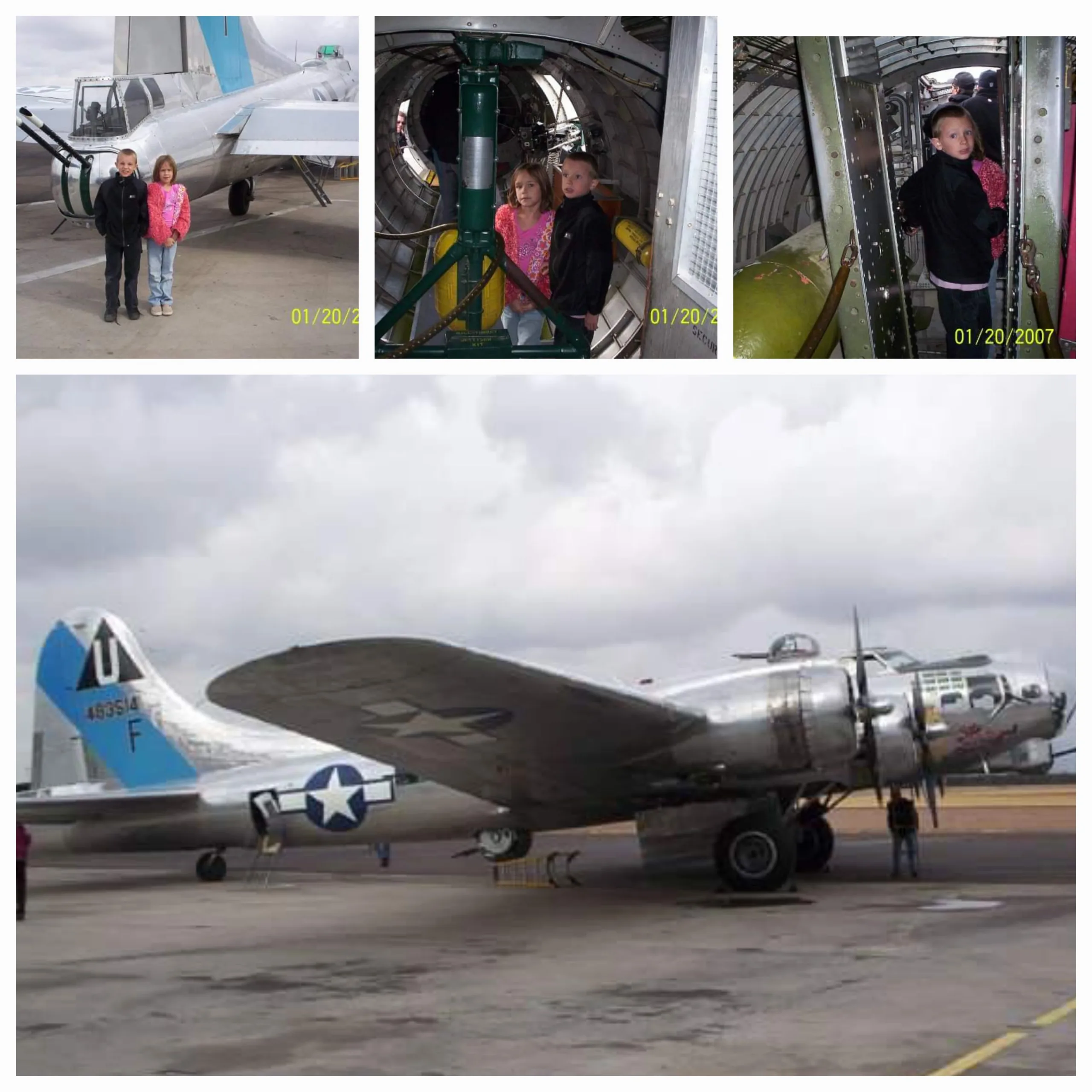
Sentimental Journey Collage

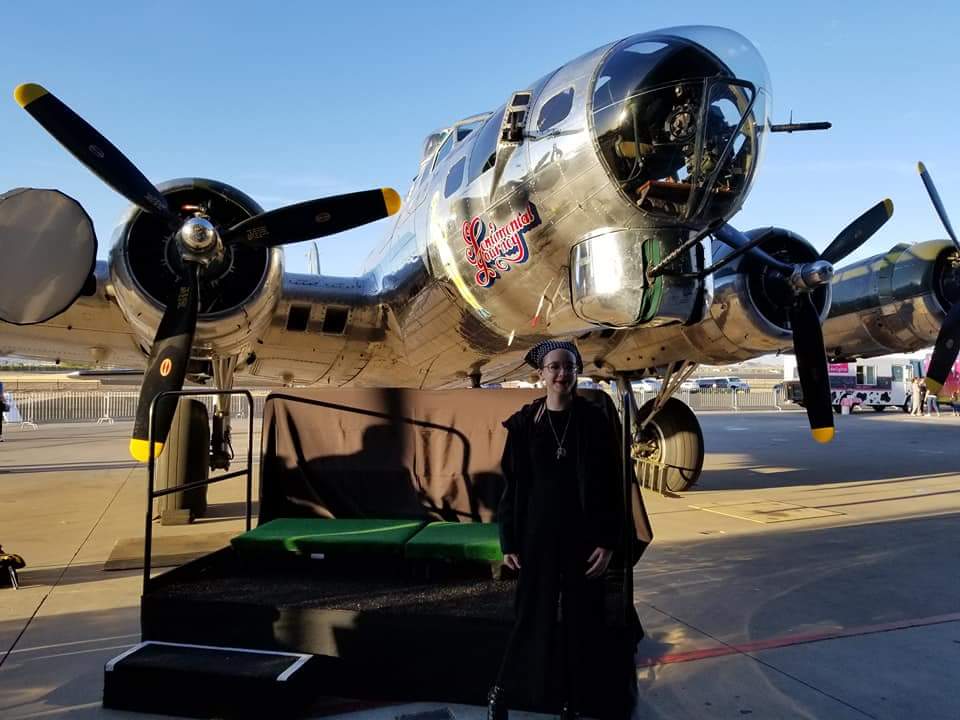
Sentimental Journey is a B17-G Flying Fortress who served the United States military doing active bombing raids during World War II.

According to the Commemorative Air Force Museum's website, (linked here), Sentimental Journey is one of only five B17 bombers still flying today.
Sentimental Journey holds a special place in my family's heart. My maternal grandfather Dale raised my brother, cousins, and I to love and appreciate this particular aircraft from the time we were tiny. These pictures are from just before my seventh birthday, when my brother and I were lucky enough to step inside of the airplane.

Sentimental Journey spends the majority of her time at the Commemorative Air Force Museum, located near Falcon Field airport in my hometown of Mesa, Arizona.

When we were tiny, my grandpa would always take my cousins and I to Falcon Field to watch the planes take off and land. He would always buy us a cup of hot chocolate and some Cheetos from the vending machine. The ladies who worked in the office at the air field always knew us on sight because, while my grandpa intended for us to sit still and watch the planes, in reality us kids were too busy running around and banging ourselves up on the rocks. We frequently used up all of the bandages in the office first aid kit. Falcon Field will always hold memories for my family, and Sentimental Journey was one of the first pieces of history I was given the opportunity to learn about and see and feel with my own eyes and hands.

2011, 2012, and 2021--The Copper Queen Mine Tour, Bisbee, Arizona, United States of America

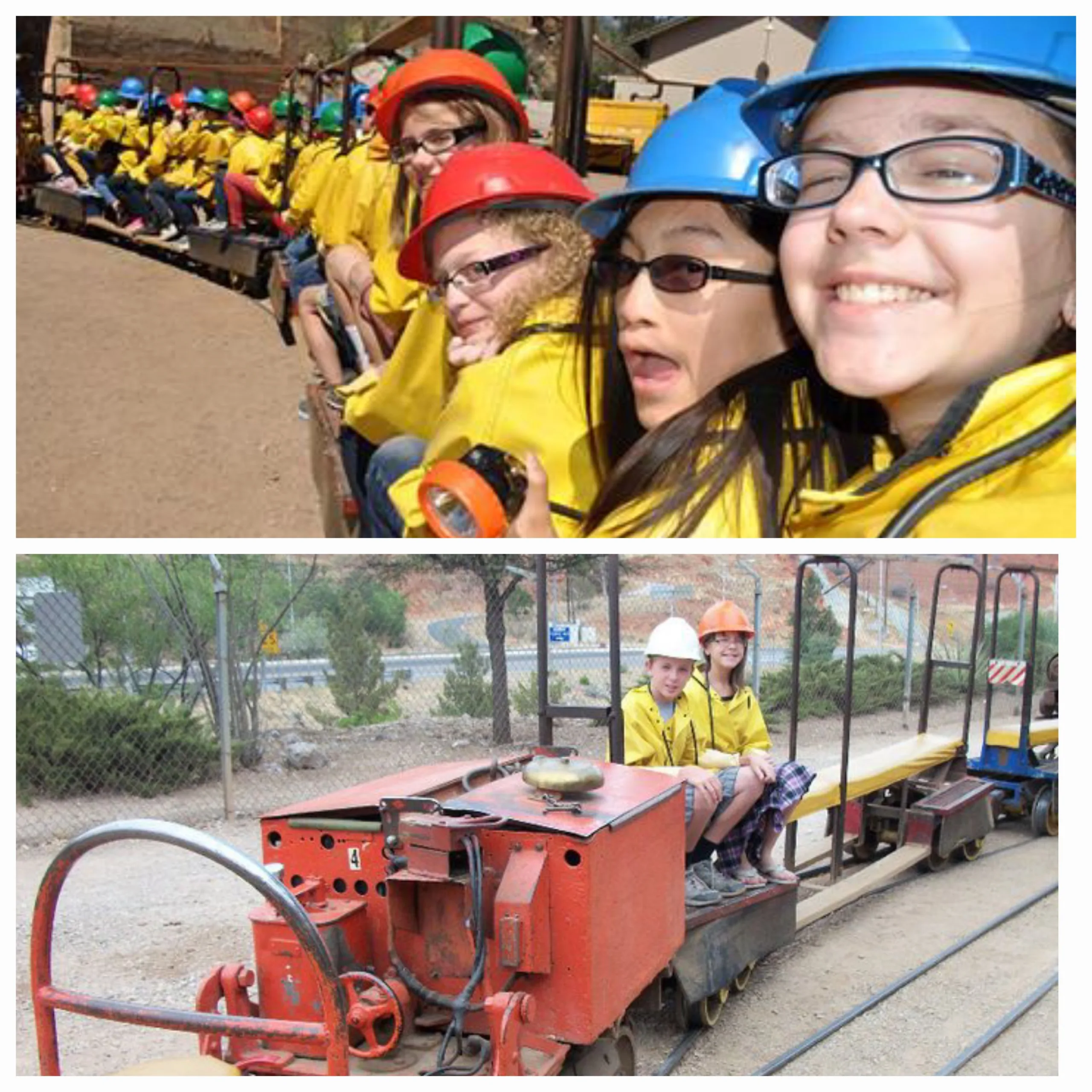
Queen Mine Tour, Bisbee Arizona

I have had the opportunity to visit the Copper Queen three times in my life, and if you ever visit Bisbee, Arizona I HIGHLY recommend taking the tour yourself (unless you are claustrophobic and hate being underground in which case you won't have nearly as much fun...like my poor friend Sierra on our Seventh Grade History trip which is the top photo in this section).

Copper was mined in Bisbee from the 1880s until 1975. Bisbee was one of the leading exporters of copper for the state of Arizona, to the point that schoolchildren in Arizona are taught about the "Five C's of Arizona" -- Copper, Climate, Citrus, Cattle, and Cotton.

The Queen Mine Tour officially opened in February of 1976, less than a year after the mine had officially closed. The tour has continued ever since, with participants getting to take a ride deep into the mines on the same train that used to carry miners to work and back every day.

To learn more about the Copper Queen, or to schedule a tour yourself, visit their website here.

2012- Pima Air and Space Museum, Tucson, Arizona, United States of America

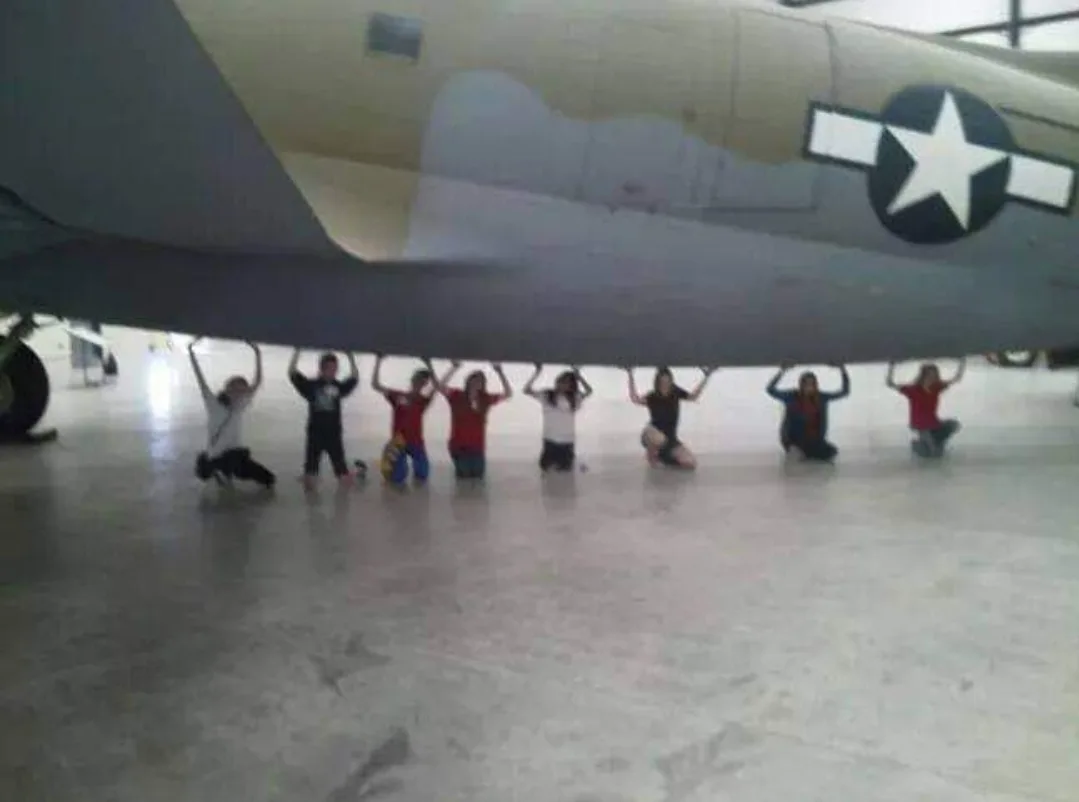
Pima Air and Space

On that same seventh grade history trip I mentioned above, my class also stopped at the Pima Air and Space Museum, in Tucson, Arizona.

The museum's initial idea dates back to 1966, and remains open to this day. Of all the aerospace museums I've visited over the years, the Pima Air and Space Museum is definitely one of, if not the coolest museums I have ever stepped foot in, and if you have not had the chance to visit yourself, I cannot recommend it enough. To learn more about the museum or get tickets, visit the museum's website here.

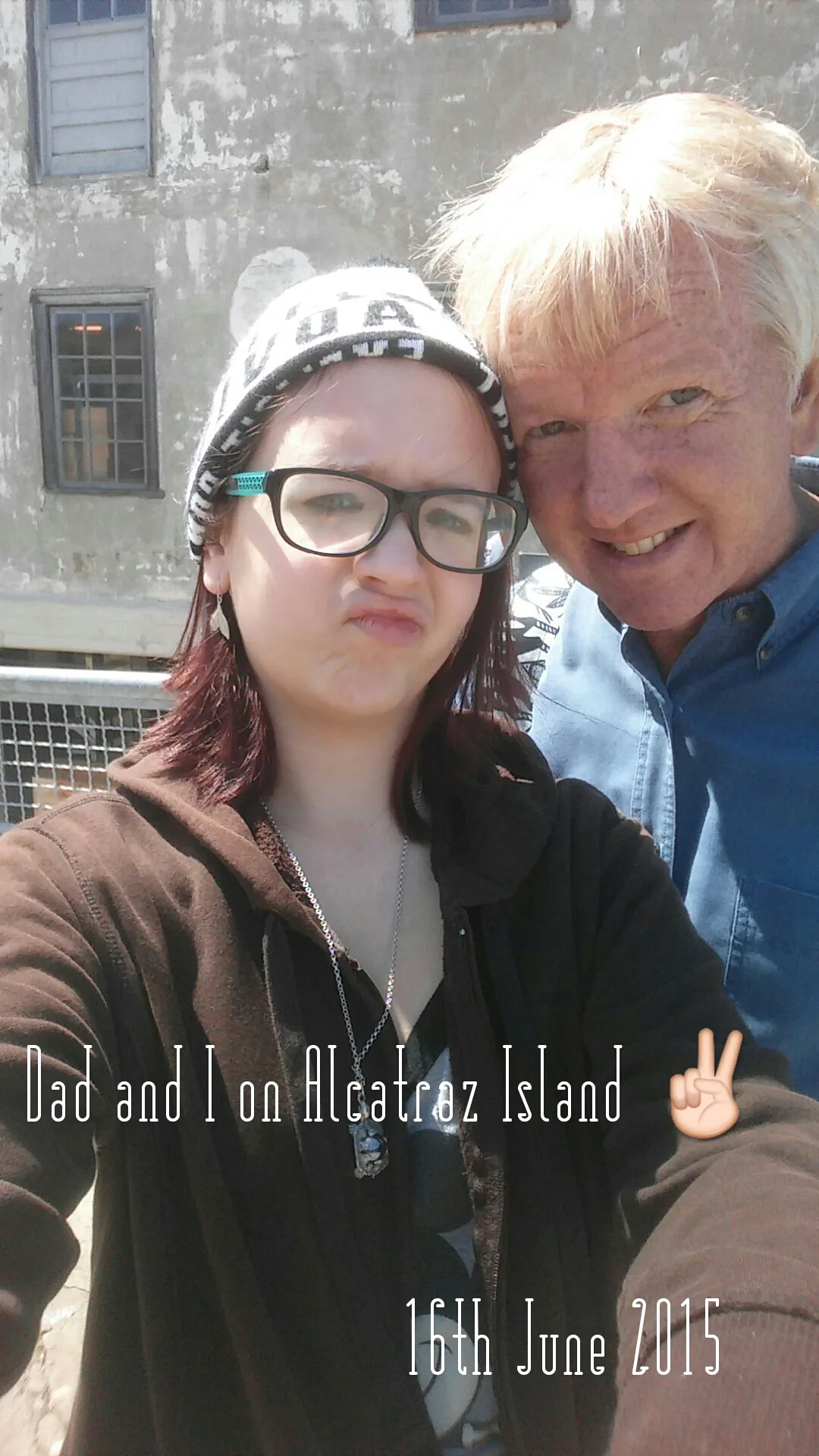
2015--Alcatraz Island, San Francisco, California, United States of America

Alcatraz Island

Before I say anything else, first let me apologize for my face in this photo. I was a stupid fifteen year old who thought it was a good look. I know now that it most definitely was NOT a good look for any photograph, especially one with my dad at a historic site.

But I can't change the past and this is the only photo I have remaining so with that said...

Alcatraz Island, also known as "The Rock."

I visited Alcatraz with my parents and brother in June of 2015, which is the warmest month of the year to visit San Francisco. I know this because a few years later, one of my oldest friends competed in a swimming competition from Alcatraz back to San Francisco and every year that competition is held in June because again, its the only month out of the year that the water is warm enough for the swimmers to compete safely. Yikes!

As for Alcatraz itself, for those unaware, the island is best remembered for being a federal prison for many years, but is so much more than that. As described by the National Park Service, Alcatraz has been a "Civil War fortress, military prison, federal prison, bird sanctuary, first lighthouse on the West Coast, and the birthplace of the American Indian Red Power movement."

Alcatraz served as a military installation from 1850 to 1934, a federal prison from 1934 to 1963, and was occupied by several different Native American activist groups in 1964, as well as again from 1969 to 1971. In 1973, Alcatraz Island officially opened as a tourist destination for the general public and is now considered a National Park.

In order to get to Alcatraz, tourists take a ferry ride from San Francisco across the bay to the island. The standout part of the journey for me was the fact that all of the TV screens on the ferry, which displayed safety information for guests once they reached the island, also had interpreters giving those same instructions in American Sign Language. This is much more common now in 2024, but eight years ago in 2015 this was something I hardly ever saw and so it stood out in my memory.

To learn more about Alcatraz and its history, click here.

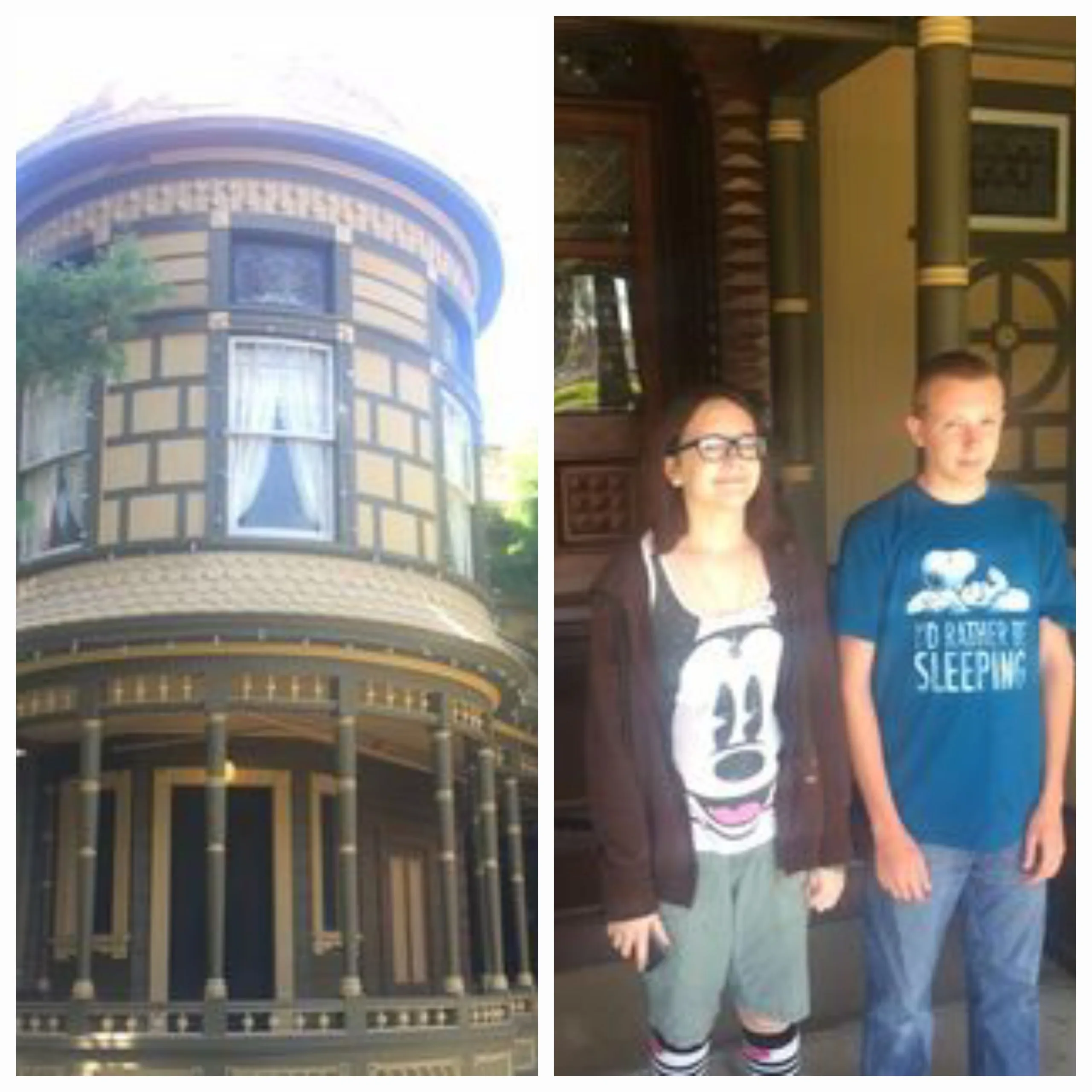
2015--The Winchester Mystery House, San Jose, California, United States of America

Winchester House

After leaving Alcatraz, and San Francisco, behind, my parents, brother, and I traveled to San Jose, in order to visit the famous Winchester Mystery House.

To learn more about the house and its famous owner, check out my article on Mrs. Winchester herself, here.

Between 1886 and 1922, Sarah Winchester converted an eight bedroom farmhouse into a confusing mansion with the following features (according to the official Winchester House website, which you can access here).

-24,000 square feet
-10,000 windows
-2,000 doors
-160 rooms
-52 skylights
-47 stairways and fireplaces
-17 chimneys
-13 bathrooms
-6 kitchens
-Built at a price tag of the $5 million dollars in 1923 or $71 million today

My family sprang for the fancy tour, so we were allowed to see the inside of the mansion as well as some of the outer buildings. Unfortunately the tour did not allow for guests to take photos inside of the mansion, so enjoy our crusty, low-quality photos of us outside the house instead!

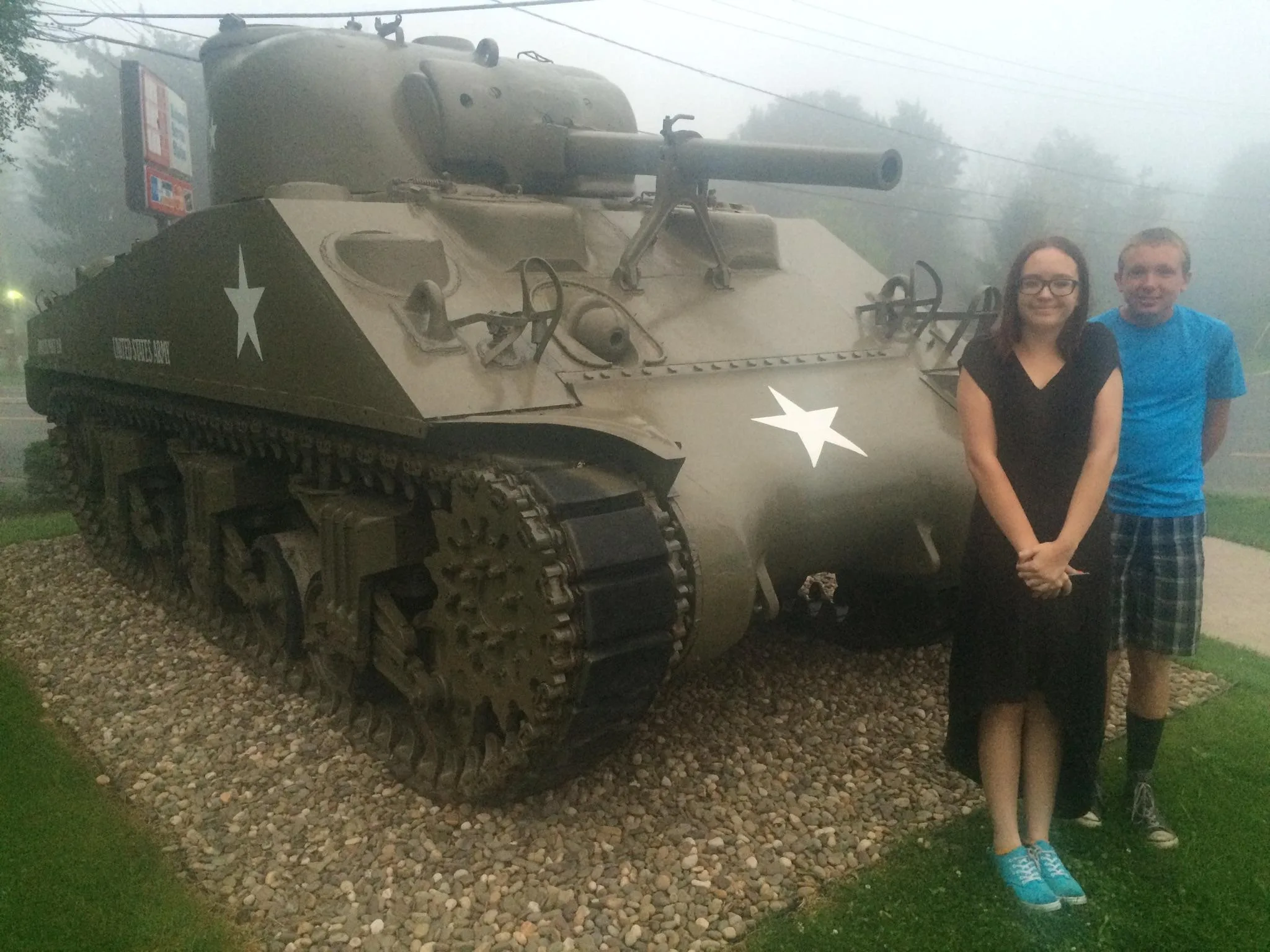
2015--Visiting a Random World War II Tank in Pennsylvania, United States of America

Logan and Zoe in PA

For my brother's eighteenth birthday, our dad took us on a trip back east to visit his family's farm in Pennsylvania. While we were out driving around, we stumbled across an M4 Sherman Tank just parked on the side of the road. I don't know why an actual World War II tank is sitting in Philipsburg, Pennsylvania, but I got a photo of it! So, enjoy!

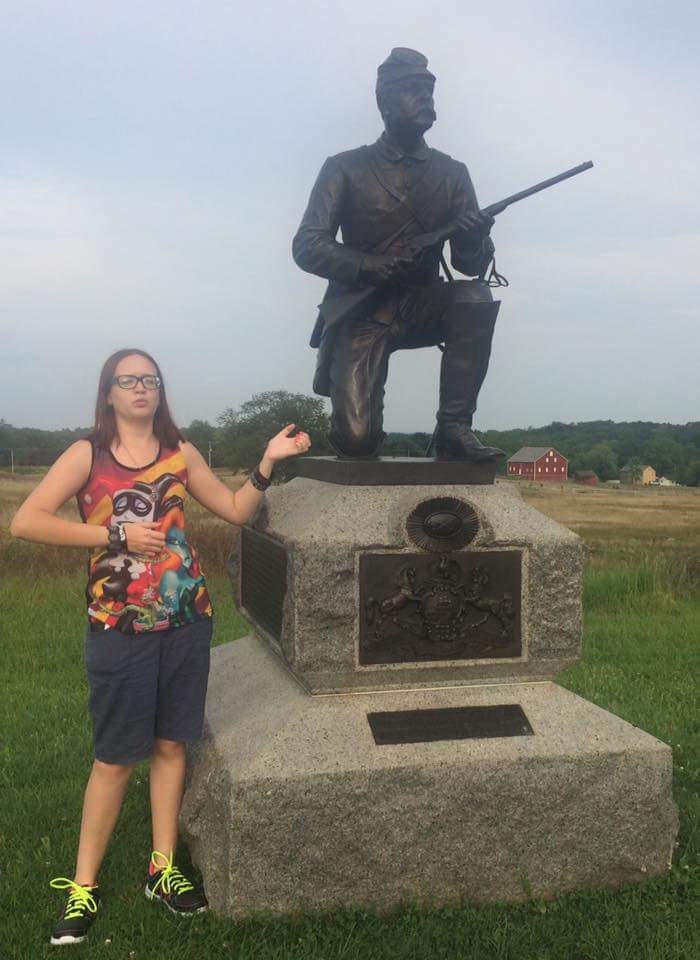
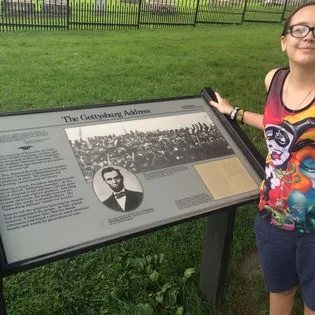
2015--Gettysburg Battlefield, Gettysburg, Pennsylvania, United States of America

zoe goofing off, gettysburg
Gettysburg 2

Once again I find myself apologizing for being a goofy fifteen year old. I know now this is not the most appropriate pose for a person to be taking while standing on a literal scarred battlefield, but what can I say I was fifteen and thought it was a good idea.

Anyway! On that same trip for my brother's birthday I mentioned earlier, my dad also took us to Gettysburg, which is both a town people live in and also a National Park, which was really cool to experience firsthand.

For those unaware, Gettysburg was the site of one of the most horrific battles during the War Between the States (and according to the Gettysburg website, linked here, it was actually the largest battle of the entire conflict). The battle occurred over three days in July of 1863, during which time over 51,000 soldiers either died, were wounded, or declared missing--in THREE DAYS.

Immediately after the battle, residents of Gettysburg and preservationists began efforts to ensure Gettysburg would remain as a testament and memorial to those who died. In 1895, the land where the battle had taken place was declared a National Military Park, and in 1933 the area was re-designated to become a part of the National Park Service.

Today, visitors to the park can take a driving tour from their own vehicles, to scout around the area and see just how massive the battle was. There is also a museum and walking areas as well.

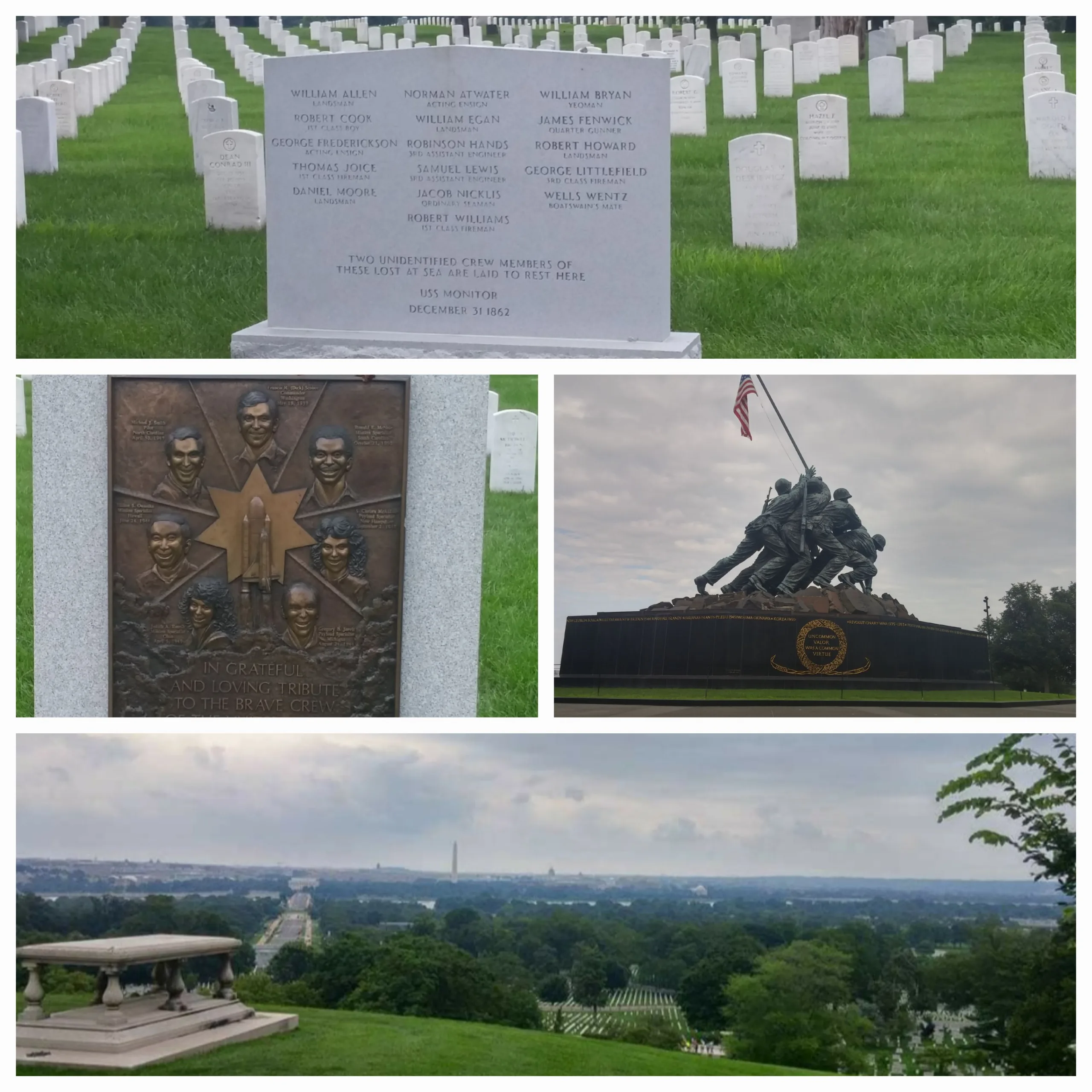
2015-Arlington National Cemetery, Arlington, Virginia, United States of America

Arlington

While on that same trip when I was fifteen, we also visited Arlington National Cemetery, the most hallowed burial ground in the United States--but it did not start out that way.

For a more complete history of Arlington, check out my article on its most famous owner, Mary Custis Lee. The short version is this: Mary owned the property and happened to be married to General Robert E Lee, the most famous Confederate General during the War Between the States.

After General Lee went off to fight in the war, his wife and family fled further down into the Confederacy (because Arlington is within sight of Washington DC, which was the capitol of the United States still).

Soon after, it became time for the Custis Lee family to pay their property taxes. Because the United States federal government was upset with General Lee for choosing to fight with the Confederate army, the federal government seized the property after the Lee family failed to pay their taxes.

Soon after seizing the property, the Union army began burying their dead at Arlington. The military did not begin the burials because of Arlington's beautiful and scenic views however. Unfortunately, the burials began to spite the Custis Lee family.

After the conclusion of the war, the Custis Lee family then spent several years fighting with the federal government over the property. Eventually, the federal government purchased the land from the Custis Lee family and continued to bury military veterans there.

As I said, this is an extremely shortened version of events, so please read Mary Custis Lee's biography here on my website or check out the Arlington National Cemetery website here to learn more.

When I visited the cemetery in 2015, I was stunned to not only learn the history behind the property, but also to take in the breathtaking views as well. There are thousands and thousands of graves as far as the eye can see, as well as countless memorials, statues, and other tributes to those who gave their lives for their country. Arlington has graves dating from the Revolutionary War (graves that were re-interred at the cemetery after the creation of the graveyard) all the way to today. According to Arlington's website, they conduct between twenty-seven and thirty funerals every week day and several on Saturdays as well.

If you happen to be in the Washington DC area and have spare time, I highly recommend visiting Arlington National Cemetery to see, honor, and remember.

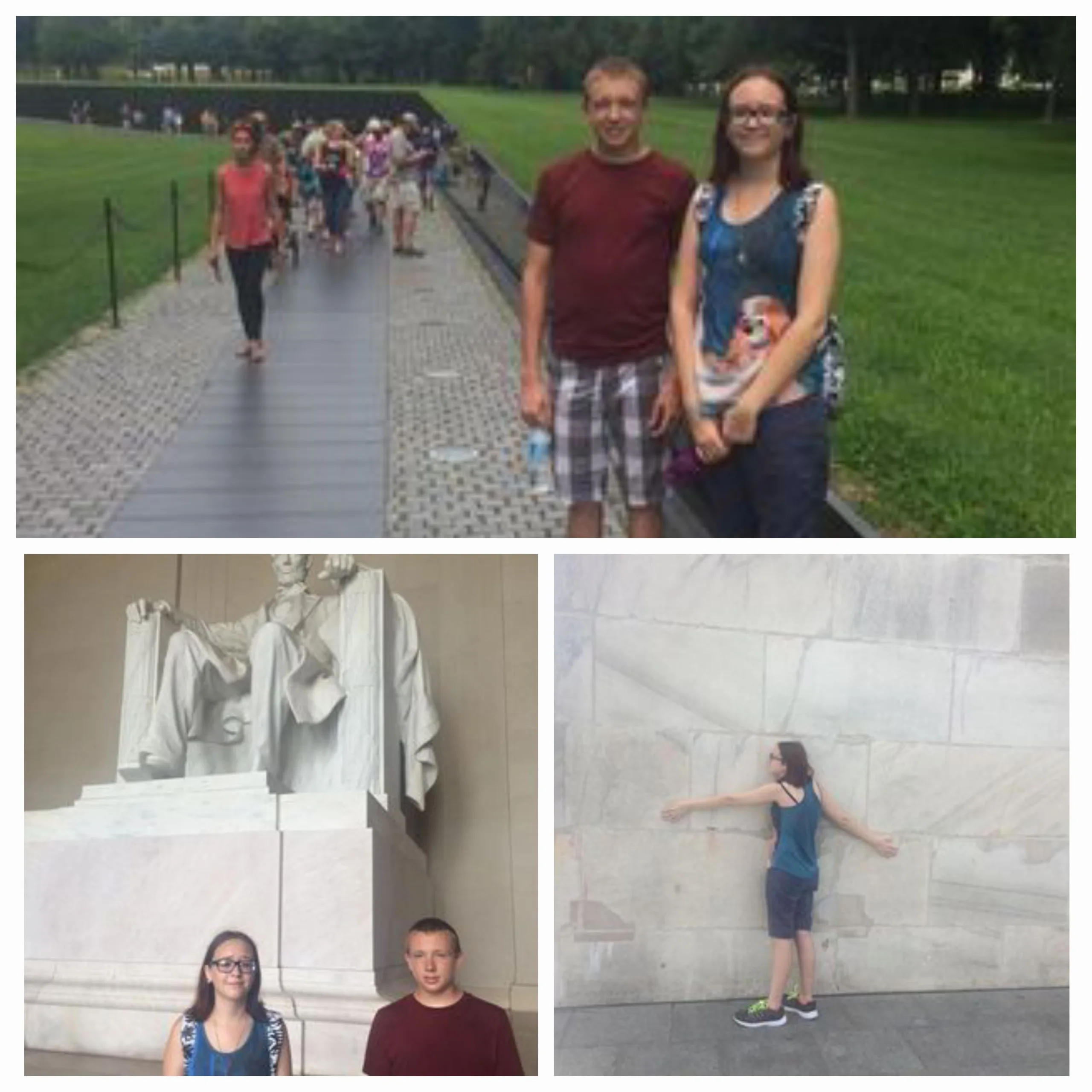
2015--Washington DC, United States of America

Washington DC
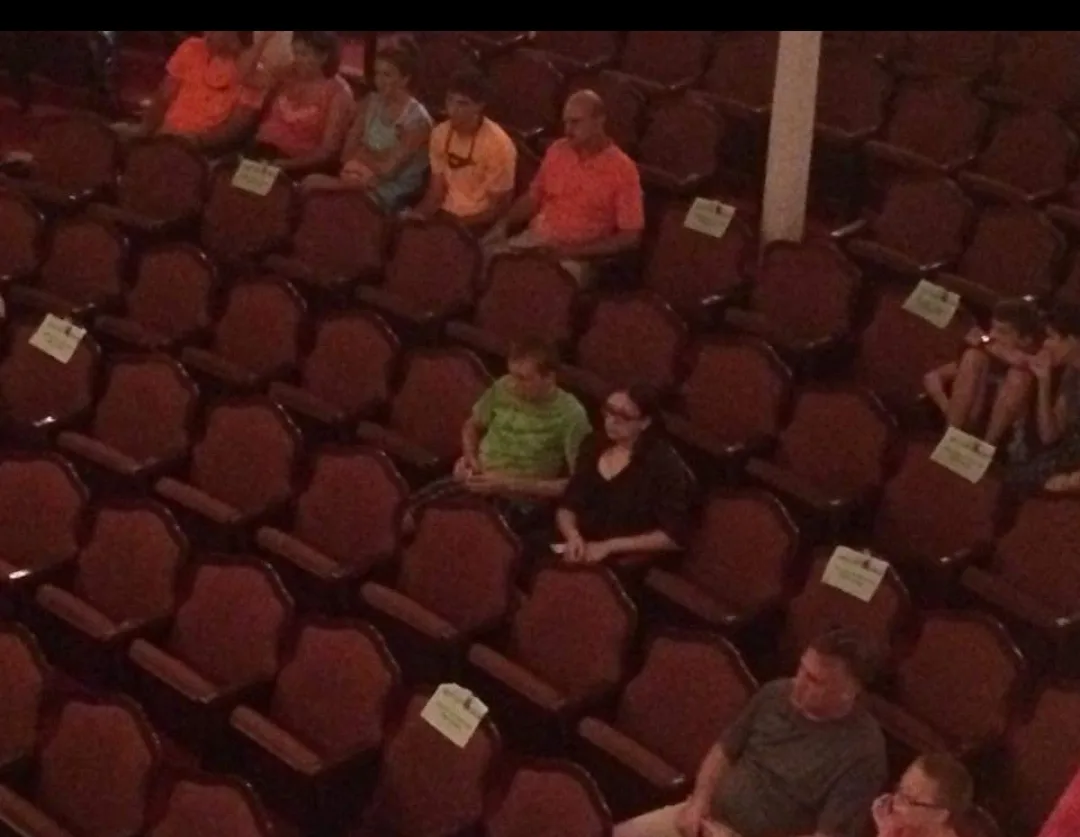
Zoe and her brother in Ford's Theatre
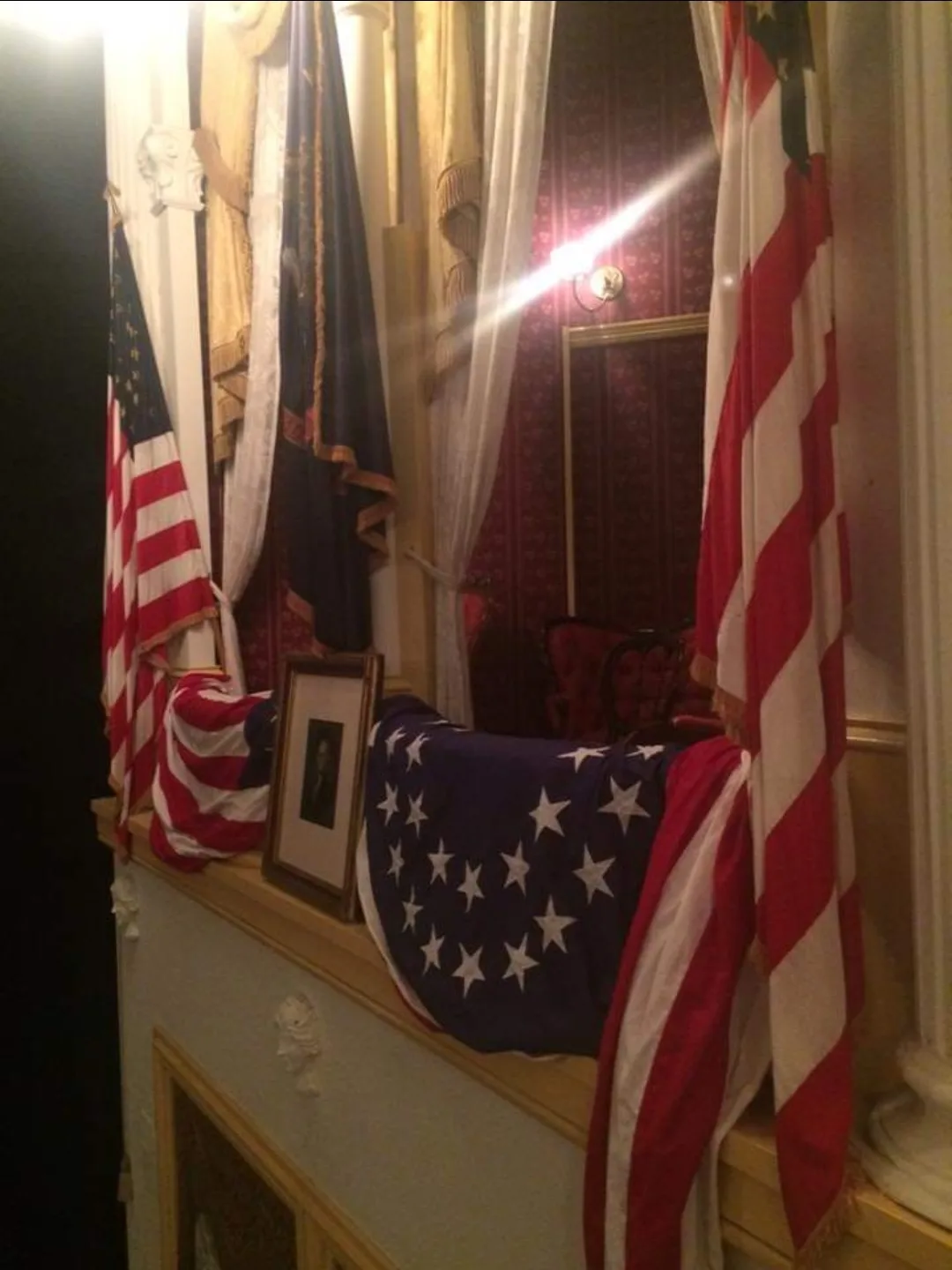
The Presidential Box at Ford's Theater

Why we thought visiting Washington DC in July was a good idea, I don't know, but we did! While in DC, we saw all the major sites--the Vietnam War Memorial, the Abraham Lincoln Memorial, and the Washington Memorial are pictured here, alongside our stop at Ford's Theater. We also stopped the White House and the US Capitol Rotunda. And we did it all while drenched in sweat from the humidity!

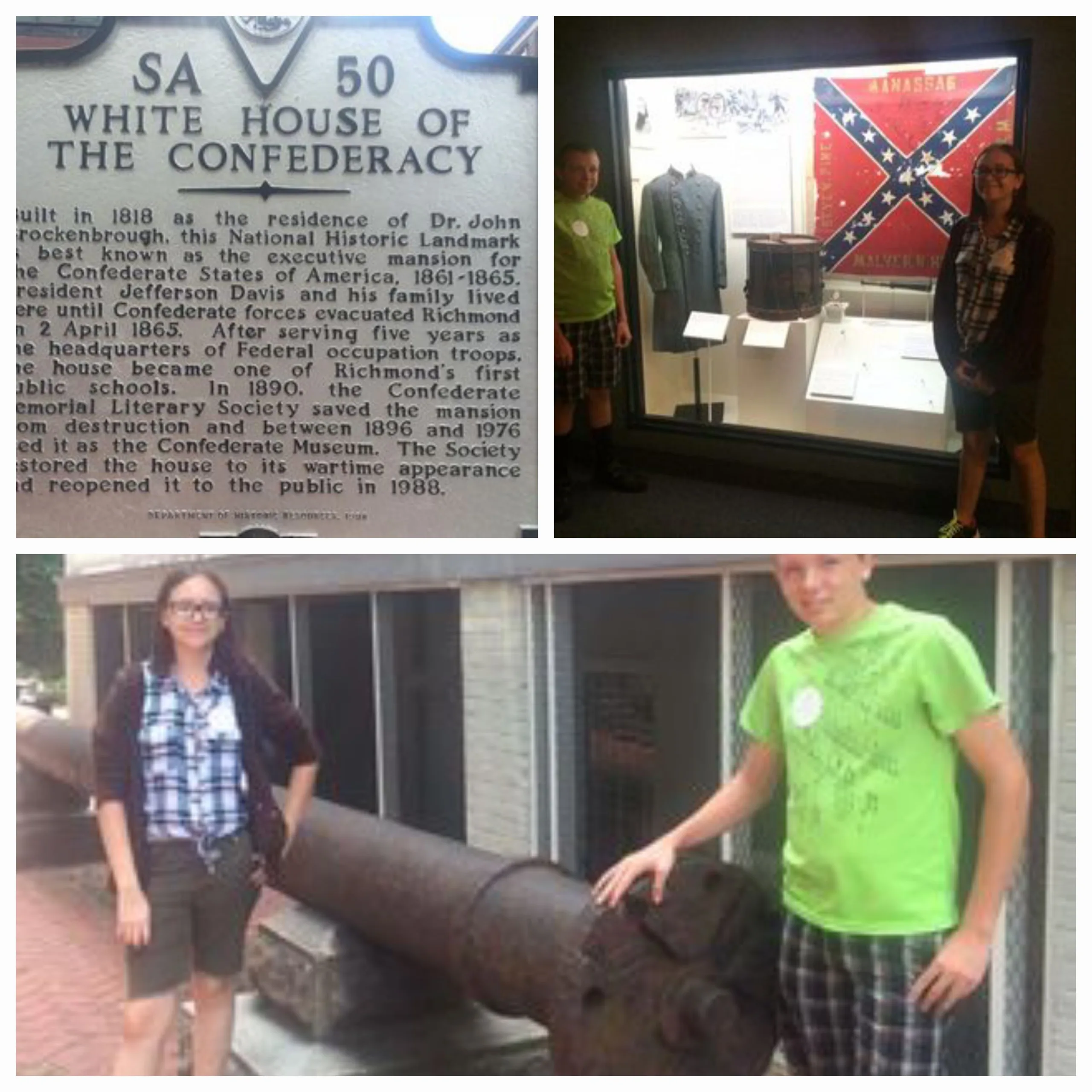
2015- The American Civil War Museum/White House of the Confederacy, Richmond, Virginia, United States of America

White House of the Confederacy

A little known historical place to visit is located in Richmond, Virginia. "The White House of the Confederacy" is exactly what it sounds like, the executive mansion and home of President Jefferson Davis and his family during the War Between the States.

Today, the home is open for tours, which my dad, brother, and I went on. Attached to the house is a museum dedicated to taking a more nuanced take on the War Between the States, which was also very interesting. To learn more about both the house and the museum, visit their website here.

2015-The Mariner's Museum, Norfolk, Virginia, United States of America

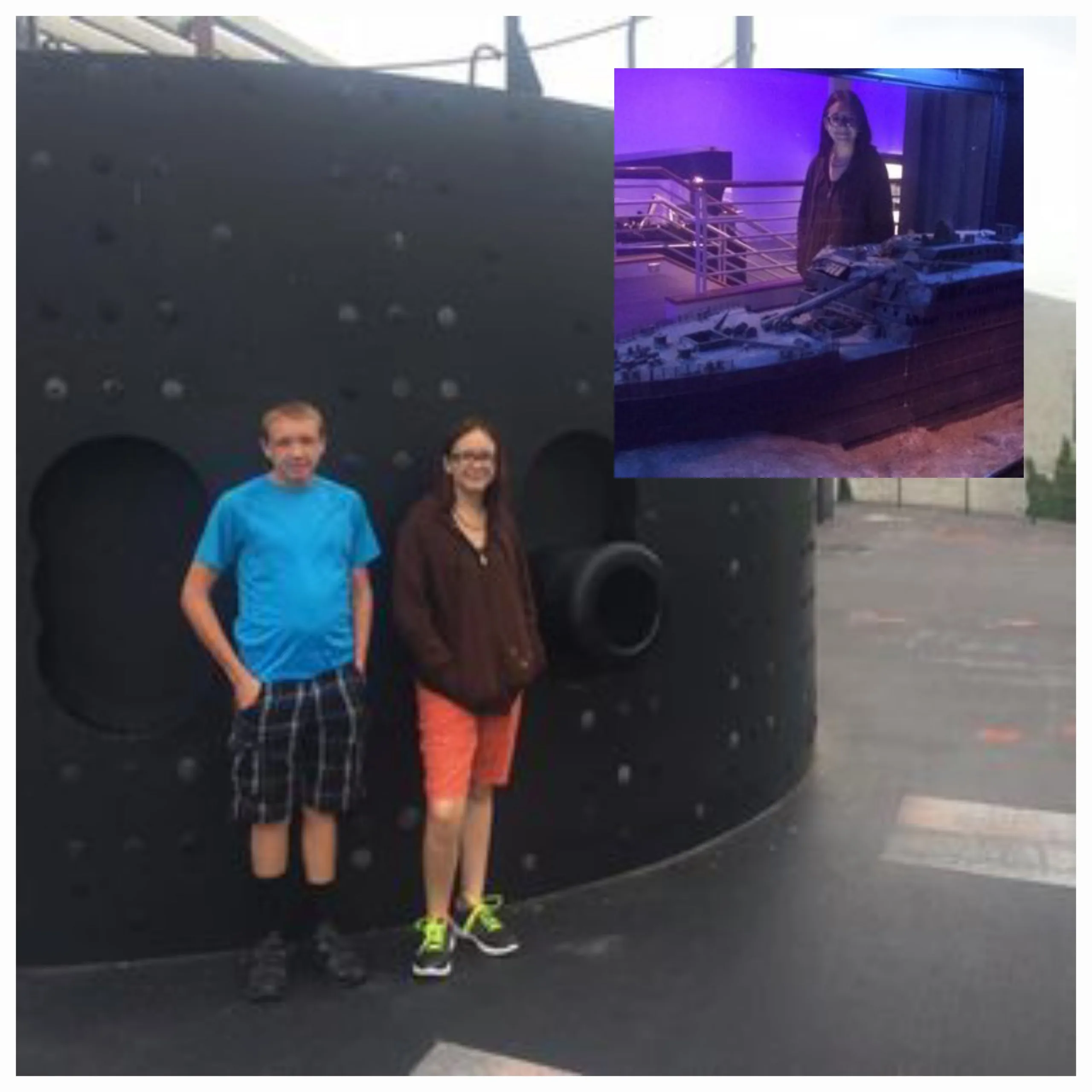
Mariner's Museum
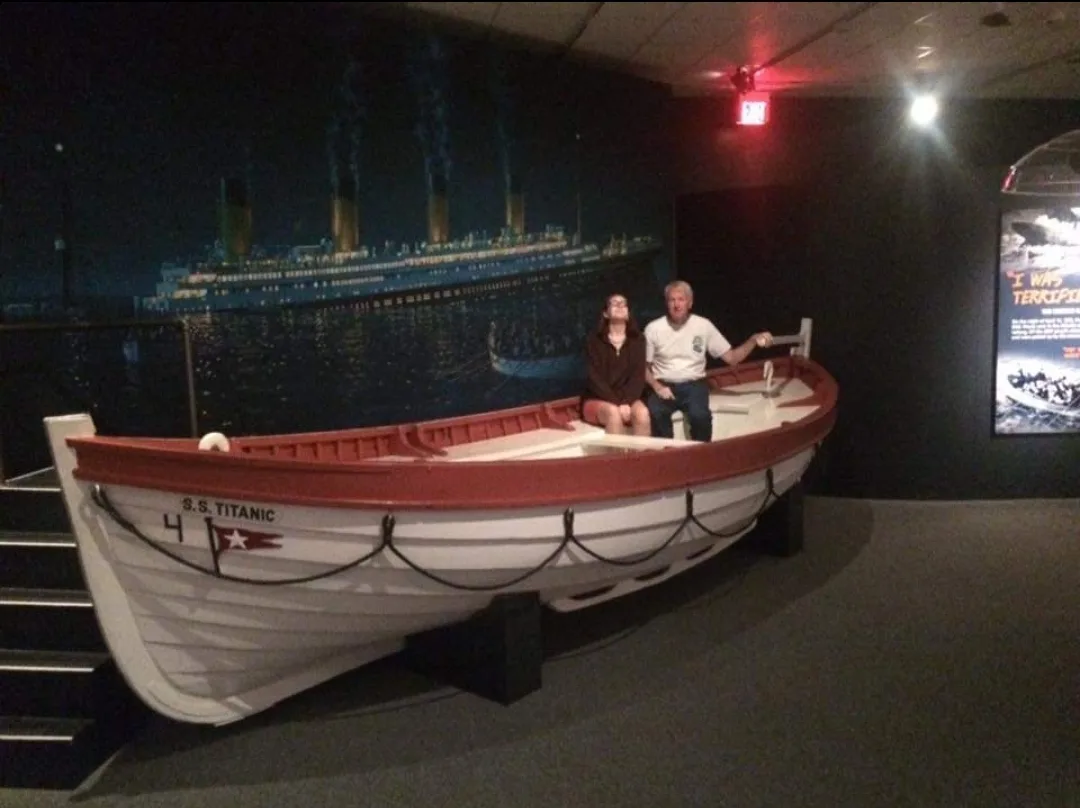
Zoe and Jerome in a replica Titanic lifeboat

While we may have traveled to the east coast to celebrate my brother's birthday, my dad told me I could pick a few museums I wanted to see myself. Number one on my list was the Mariner's Museum in Norfolk, Virginia. The reason? My favorite battle to research from the War Between the States happened extremely close by, the Monitor vs the Merrimack, the world's first ironclad battleship battle.

Not only is the museum extremely close by to the battle location, but, the museum also holds the recovered pieces of the Monitor itself, which was lifted from the sea floor in 2002 and brought to the museum for preservation.

The museum dates all the way back to 1930 and remains open to this day. Also included in the museum are other artifacts and exhibits, including those from the RMS Titanic.

To learn more about the museum, visit their website here. 

2016--Visiting Old Ironsides, also known as The USS Constitution, Boston, Massachusetts, United States of America

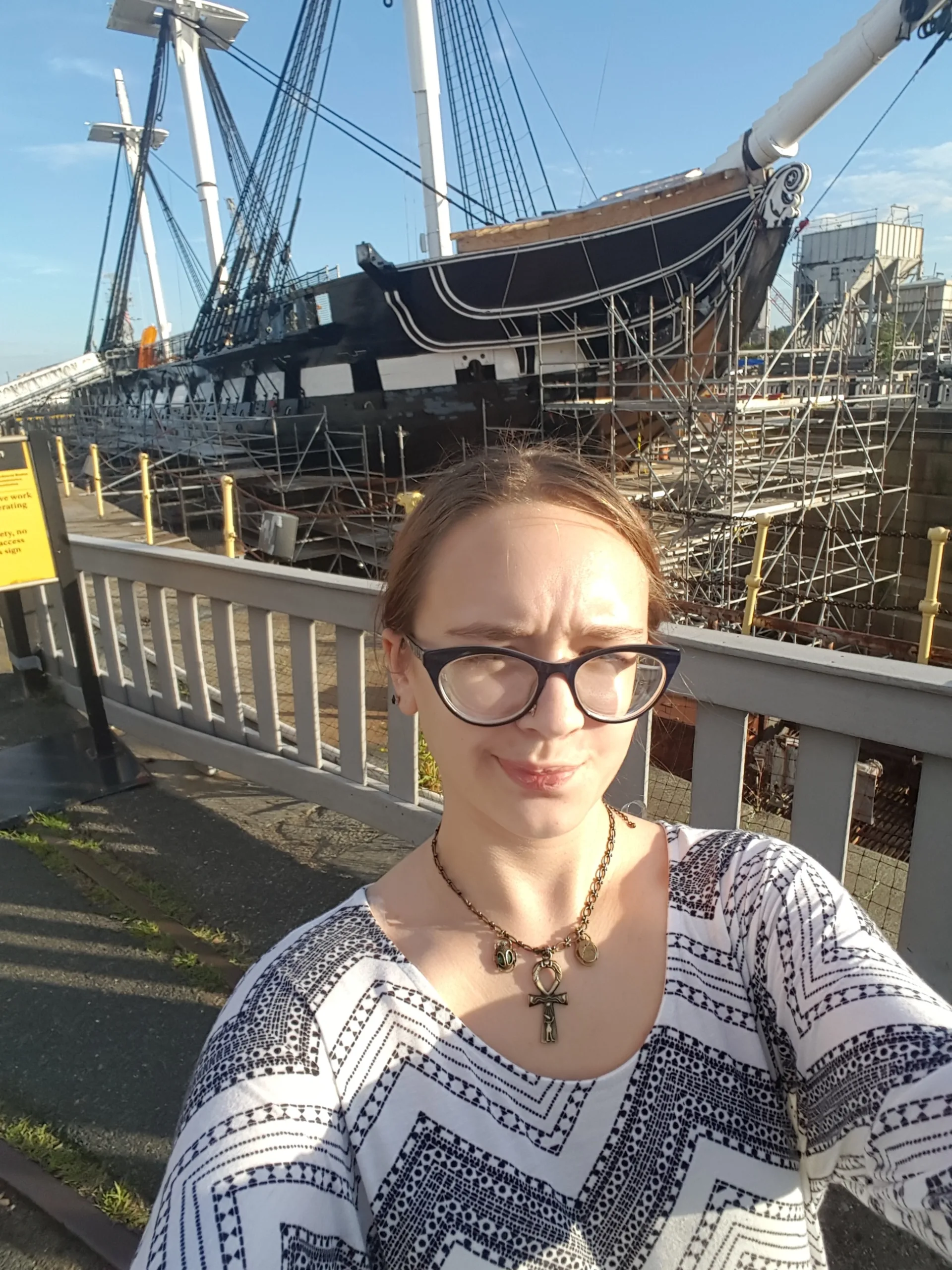
Zoe with the USS Constitution, Old Ironsides

When I was sixteen, my dad and I took a trip to Massachusetts, New York, New Jersey, Vermont, New Hampshire, Connecticut, and Rhode Island. We landed in Boston, and unfortunately the museum for the USS Constitution had just closed for the day! So while I did not get a chance to go into the museum, I did get this quick selfie with the ship herself.

For those who do not know her history, the USS Constitution was designed and built between 1794 and 1797. Yes, you read that right, 1797.

The Constitution was one of six frigates created under the order of President George Washington, in order to create the fledgling United States' first true navy. It took three launches before she finally became truly seaworthy, and in 1798, the Constitution completed her first long-distance journey, sailing all the way to the Caribbean islands. Over the next thirty-two years, the ship would see battle in several conflicts along the Eastern Seaboard and garnering fame as she did so.

In 1830, rumors began to swirl that the Constitution would be scrapped. As a rallying cry to save the aging ship, Oliver Wendell Holmes Sr wrote a now-famous poem defending the ship, by-then nicknamed "Old Ironsides." This poem and public interest helped ensure the Constitution would survive being decommissioned and scrapped.

Between 1844 and 1846, the Constitution completed a sailing journey around the world. In all, she sailed 52,370 miles during that one journey.

By August of 1860, the Constitution was removed from active military duty and transformed into a naval school ship instead. To be fair though, by then the ship had been rebuilt several times and was sixty-three years old!

For the next several decades, the ship would serve as a training vessel for naval academy students as well as a transport vessel. In 1925, schoolchildren across the country would raise $154,000 in order to facilitate the latest round of restoration work for the ship.

In 1976, the USS Constitution Museum officially opened in the Charlestown Navy Shipyard. That same year, a group of white oak trees in Indiana are specifically set aside and designated for future repairs the ship might need.

In 1995, a copper spike from the ship went to space on a mission on the space shuttle Atlantis! Two years later, the Constitution would set sail under her own power for the first time in 116 years. She celebrated her 200th birthday in 1997.

All of these dates were provided by the official USS Constitution timeline posted on the museum's website, located here.

As you can see from my photo, when I visited the ship she happened to be undergoing her latest round of renovations, hence the scaffolding all over her. But even though I didn't get to spend as much time with the ship as I would have liked, it was still really cool to see a piece of history almost as old as the United States itself.

2016--Springfield Armory National Historic Site, Springfield, Massachusetts, United States of America

Springfield Armory

I think everyone knows the best adventures are the ones that happen on accident.

During my dad and I's trip back east, during which time we saw the USS Constitution, we also visited Springfield Armory, by accident.

We were driving along the freeway through Massachusetts when my dad pointed to a brown road sign on the side of the freeway.

"Springfield Armory!" he shouted excitedly before quickly changing lanes and exiting the freeway.

"What's Springfield Armory?" I remember asking him confused.

Little did I know, Springfield Armory is a hidden National Park that not enough Americans know about. I knew I had found a special place to hold in my heart when the first park ranger we met quickly introduced himself and then said:

"If you have any questions I will be right back! I left my car windows down and its about to rain. Be right back!"

Then he ran out the door we had just walked through, jingling his car keys as he went!

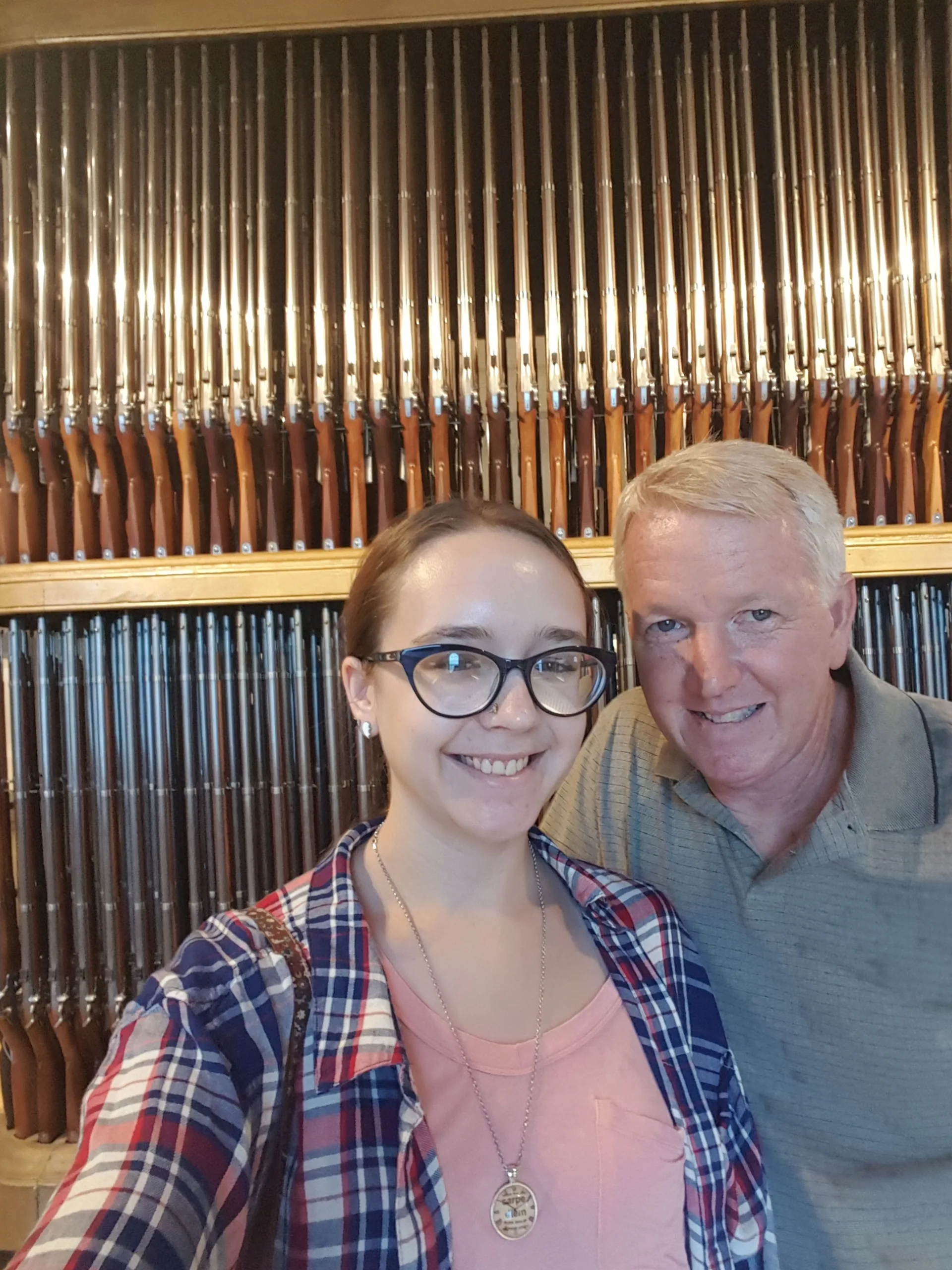
Springfield Armory began manufacturing muskets in 1794, but dated back a few years earlier, to when General George Washington declared it as a holding arsenal for the Revolutionary War Soldiers. The last weapons manufactured at Springfield Armory were produced in 1968, after two hundred and four years of continual manufacturing. Let me restate in case you missed it the first time--204 YEARS.

In 1978, Springfield Armory reopened as a National Historic Site, continuing to provide educational materials to guests to this day. The Armory holds the world's largest collection of American military firearms. To learn more about the armory, visit their website here.

2016-- 9/11 Memorial in Jersey City, New Jersey, United States of America

9-11 memorial

While on the same trip to New England with my dad, we stopped at multiple places in Manhattan, but also stayed at a hotel in Jersey City.

No offense New Jersey, but that was the most disgusting hotel room I have ever stayed in.

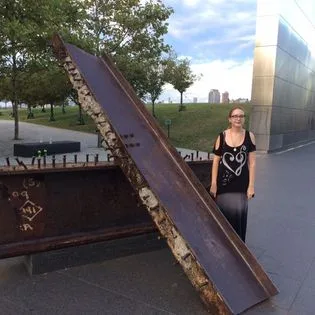
Anyway! While on that side of the river, we also stopped at the 9/11 Memorial, which was one of the most haunting and moving spots I have ever visited. Here I am standing alongside some of the rubble taken from the site of the Twin Towers.

2016--Ellis Island and the Statue of Liberty

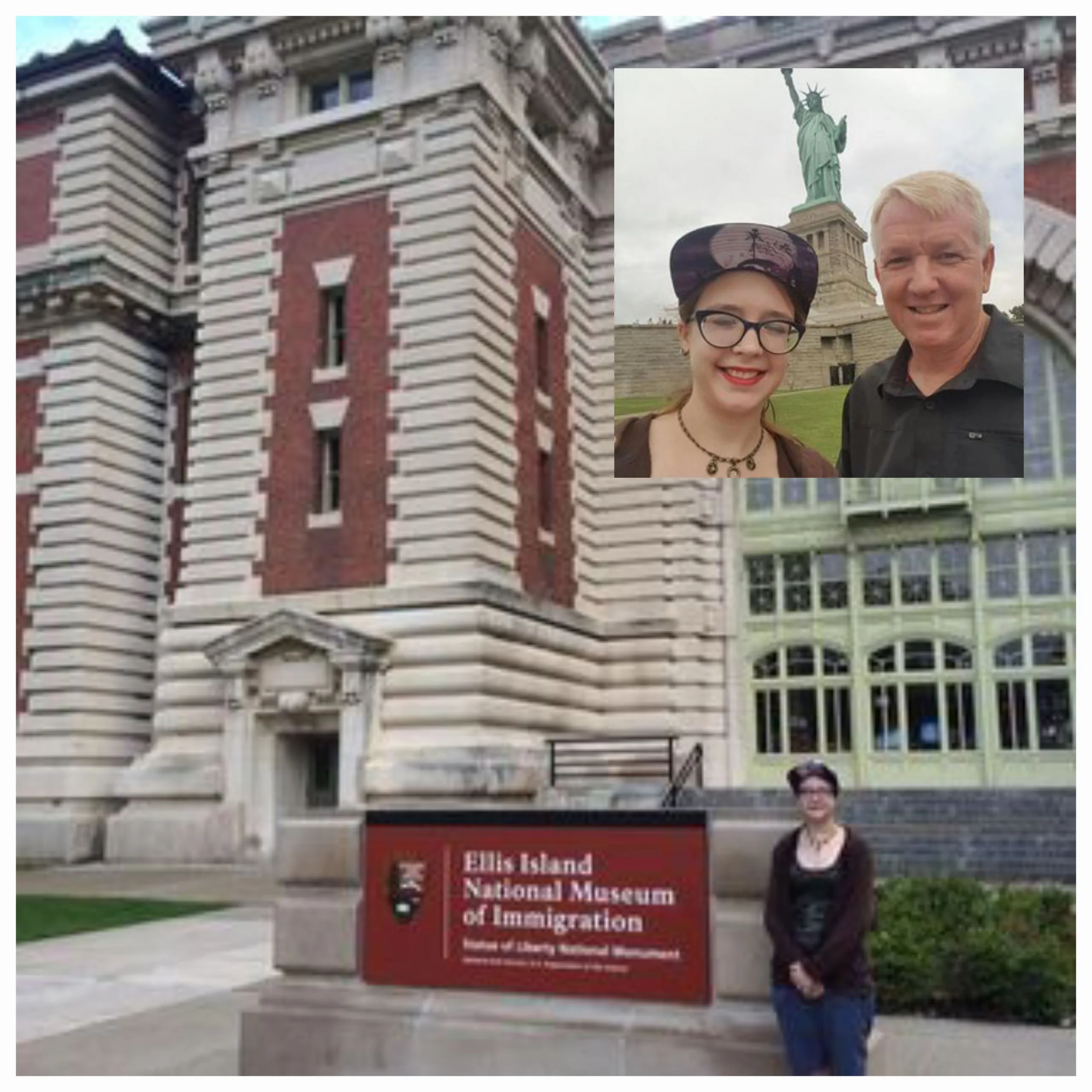
Ellis Island and Statue of Liberty

Once again I must apologize for my awful sense of fashion. I was sixteen and...well there's really no excuse for why I thought that was a good look. I also chose to wear extremely uncomfortable shoes and so I was miserable most of the day we were hiking around Manhattan, Ellis Island, and the Statue of Liberty.

With all that said, I did really enjoy the day, which started at Ellis Island.

For those who do not know, Ellis Island and the Statue of Liberty are both operated as part of the same national monument, which has been dubbed the "Statue of Liberty National Monument, NJ, NY" according to the park's website, which can be accessed here.

Ellis Island was operated as an immigration checkpoint for the Eastern United States between 1892 to 1954. During those years, over twelve million immigrants traveled the halls of Ellis Island to be inspected, both physically and on paper, before they were told whether or not they would be allowed to travel within the United States.

In 1965, Ellis Island became a part of the Statue of Liberty National Monument, as I mentioned above. Between 1976 and 1984, the island was opened to tourists wanting to visit, however, it was badly in need of repairs. $156 Million later, the island reopened for tourists in 1990, and has remained open ever since.

As for the Statue of Liberty, she has a history of her own.

The statue was first gifted to the United States by the people of France in 1886, and was designated a national monument in 1924. The National Park Service began caring for the statue in 1934, and today hundreds of tourists flood the island each and every day to get photos like my dad and I posed for.

You can make reservations to travel up inside the statue itself, all the way up to her crown, but my dad and I didn't have the time nor did we want to battle our way through the crowd either. To learn more about the statue or to plan a trip, you can visit the National Park Service website for the statue here. 

You can reach both Ellis Island and the Statue of Liberty by a ferry. My dad and I embarked on our journey from New Jersey, and ended up in Manhattan where we continued on as tourists for the day.

2016- The Metropolitan Museum of Art, Manhattan, New York, United States of America

The Met

Ah, the Met. One of the most well-known art museums in the world, thanks to celebrity functions like The Met Gala that happens every year.

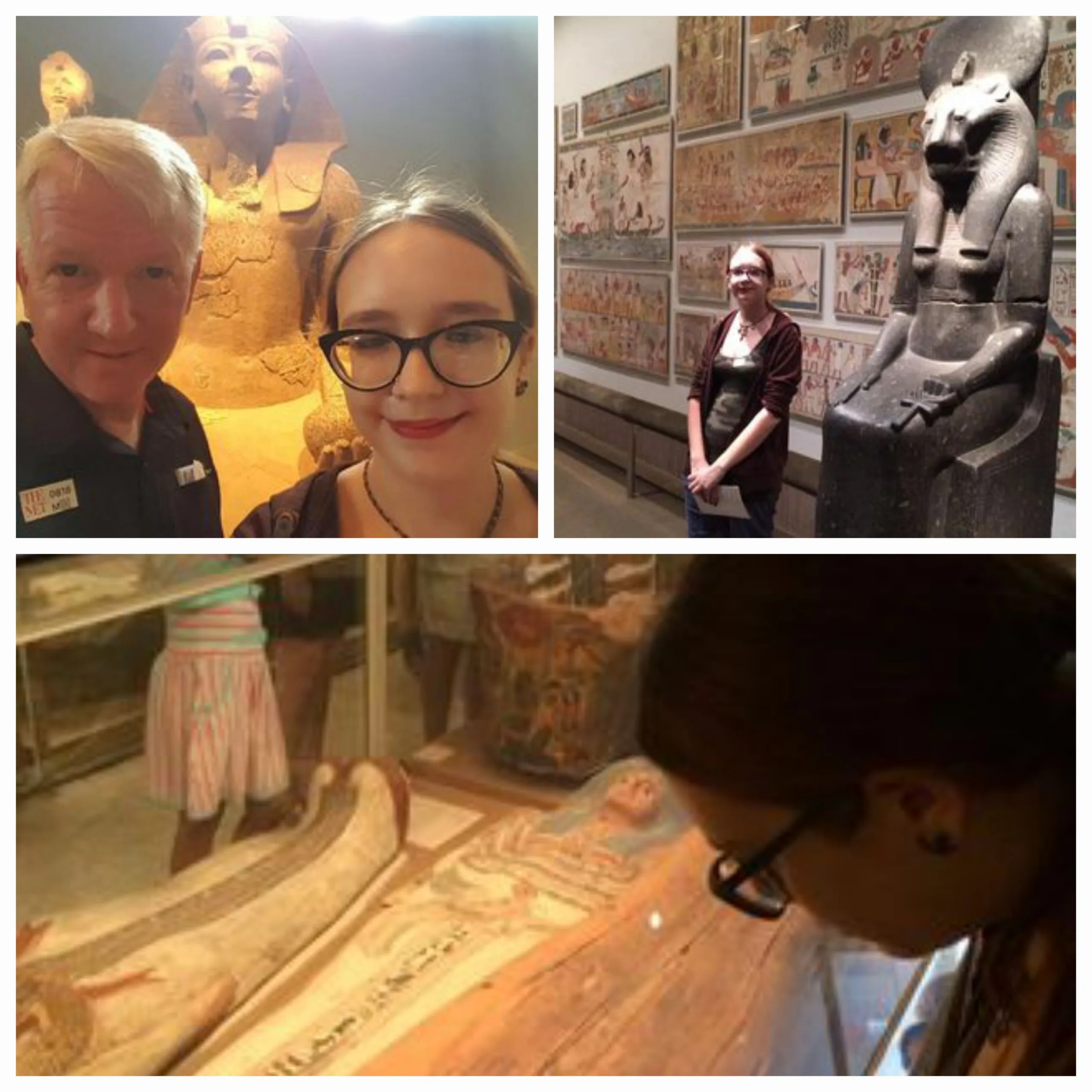
When I visited the Met, my dad and I were in a bit of a hurry, so we didn't get to see the entire museum. We did, however, spend a large amount of time in the Ancient Egypt wing. I don't have a photo of it here, but my favorite artifact in the entire Met was the actual floral wreath that was placed over Pharaoh Tutankhamun's mummified remains.

The history of the Met begins in 1866, when a group of Americans in France decided to bring art and art history to the United States in order to better educate the American public. In 1870, the Met officially opened its doors on Fifth Avenue, however it was a different Fifth Avenue location from where it is today. The museum would not open at its current site until 1880.

To learn more about the Met and its various collections that are on display, visit their website here.

2017- Tortilla Flat and Hayden, Arizona, United States of America

Tortilla Flat

When I was seventeen, my dad and I both decided I should probably learn to drive. A right of passage for most American youth, I already owned a car (I had bought a 1999 Mercury Grand Marquis from a friend of the family when I was fourteen for $2,000), and so all I needed to know was how to drive it.

You would think learning to drive would be fairly straightforward, and for a lot of teenagers it is. For me though? Not so much. For those who do not know their late 90s vehicles, my car was basically a boat. Picture a 90s police car--that's basically what I was driving just without the red and blue flashing lights.

And if you also don't know, I wear glasses and have extremely poor depth perception. So when it came time for me to learn to drive, my dad and I were in for a bit of adventure.

Most Arizonans living in the eastern half of the Valley of the Sun know exactly what Tortilla Flat is, but if you're an out-of-towner, I'll let you in on a little secret. Tortilla Flat is a tourist spot but is also the oldest still-operating stagecoach town in the state of Arizona, originally built in 1904. They even have a website, which you can access here.

Today, Tortilla Flat has a restaurant, a museum, and a gift shop. If you've driven into town, you've seen it all, but its still worth it to park and wander around for a bit. In order to get to Tortilla Flat, you have to drive along a long and winding road...with several cliffsides along side it.

If you ask my dad, he will heartily inform you that I nearly drove off several of those cliffs while learning to drive. In my defense! I had no idea where we were going at the time. My dad had me sit behind the wheel, and drive. He was giving me directions as we went. Luckily we didn't die! Or drive off a cliff! And now its a funny memory to look back on.

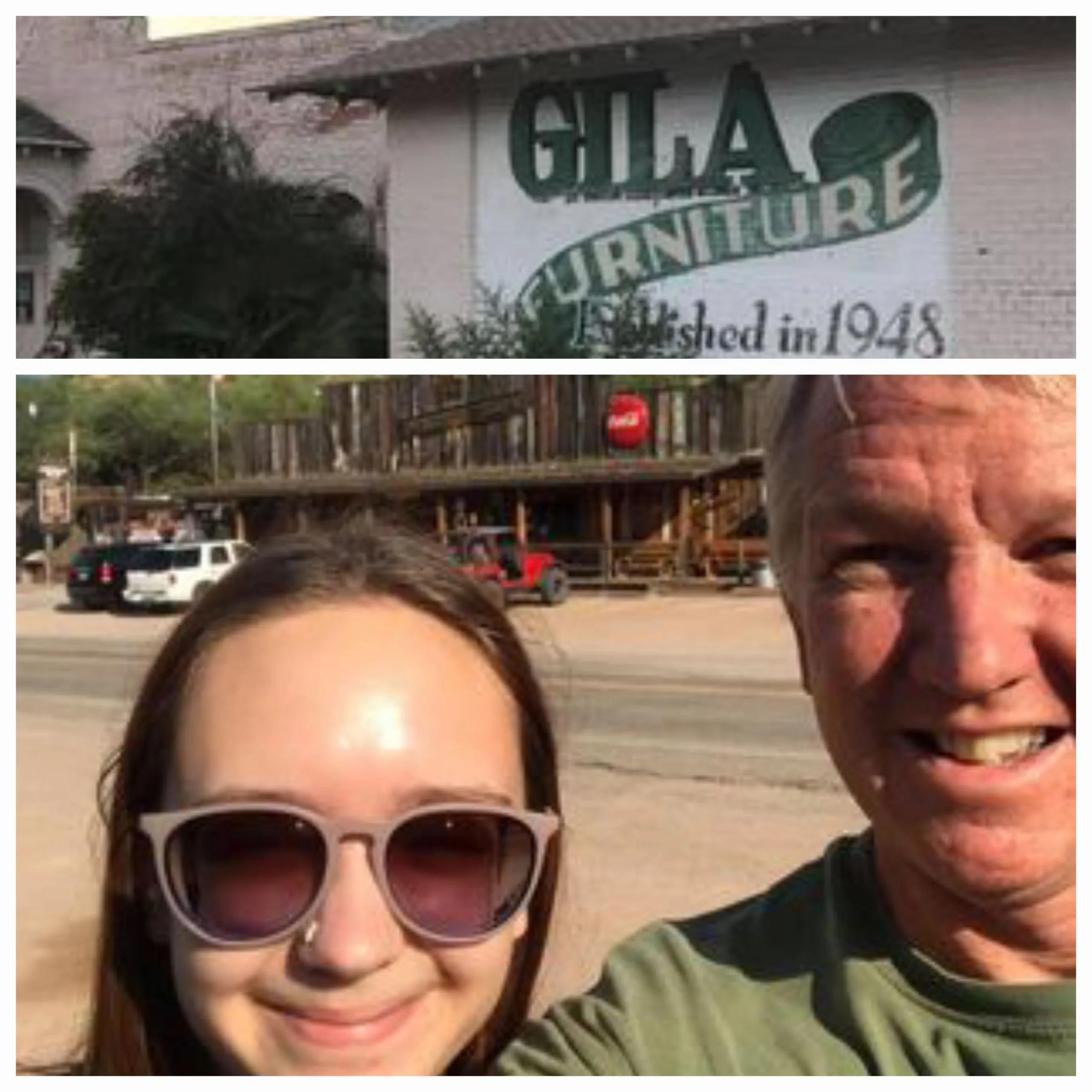
That same day, after leaving Tortilla Flat, we continued on our little road trip and headed out to Hayden, Arizona. If you've never heard of Hayden don't worry--I hadn't either. The town still has a few residents, but most of the buildings are abandoned. We drove out there because my dad used to sell furniture to a store out there called Gila, shown here, which opened in 1948. Hayden may be tiny, but they do still have an active website, which you can reach here.

2017-- Lincoln, New Mexico, United States of America

Lincoln NM

I can't believe this is the only surviving photo I took of my trip to Lincoln! While not much survives in Lincoln today, the tiny town was once the sight of one of the nastiest wars in the Old West, The Lincoln County War. And you know who the most-famous character to walk away from that war was?

Billy the Kid.

The Lincoln County War is a story that deserves a fully fleshed out retelling, which I don't have space for here, but the war took place because of local politics and street-vengeance. Some of the battles took place on the very streets tourists can now walk every day.

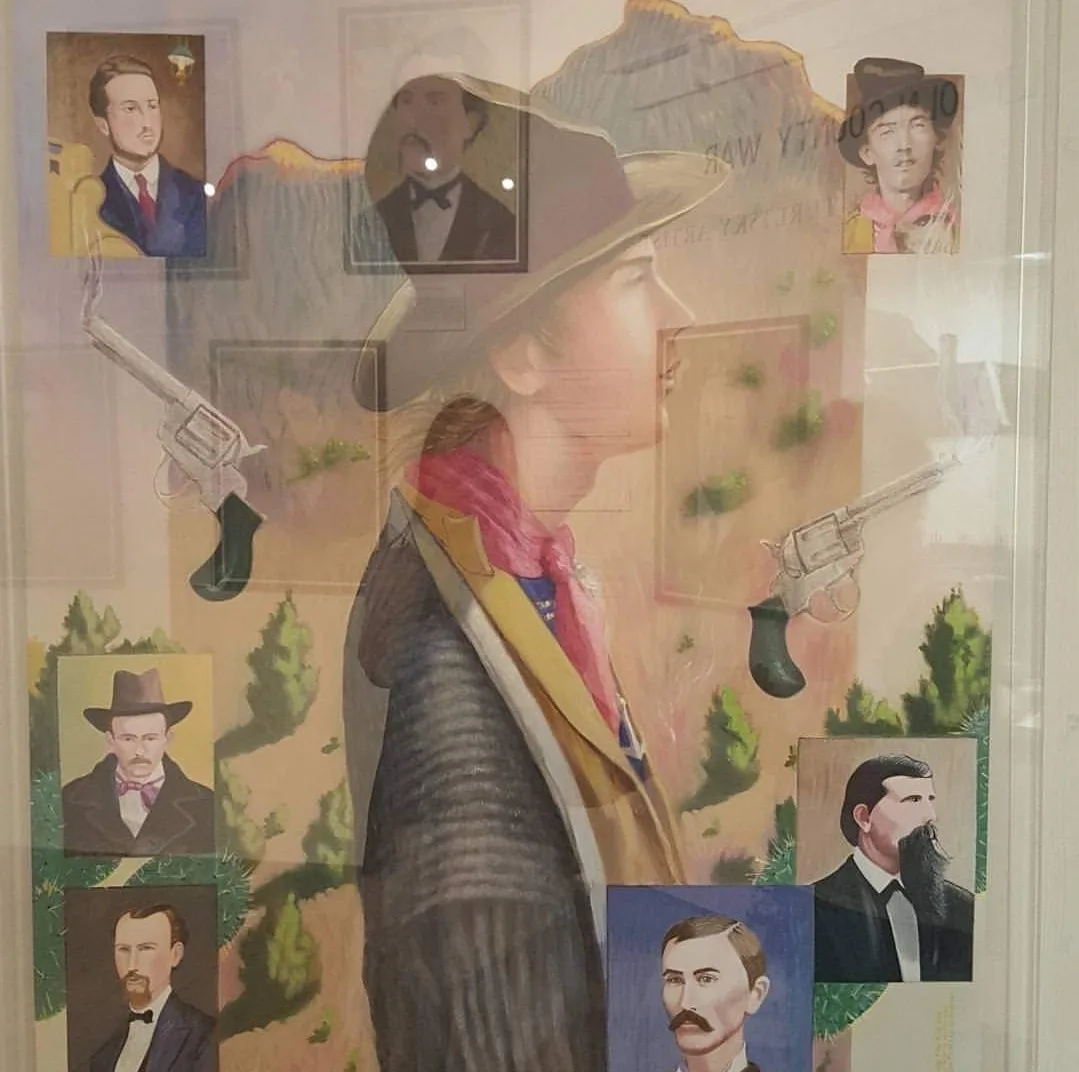
According to the Lincoln Historic Site website (which you can reach here), the little town is now the most-visited historic site in New Mexico. There are multiple buildings that have survived from the 1870s and 1880s, as well as gift shops and museums tourists can visit. This photo is of a painting of Billy the Kid and some other notable western figures involved in the local history at the time.

If you're ever passing through Southern New Mexico, I highly recommend stopping by Lincoln. Ruidoso, New Mexico is a short drive away and has beautiful sights and hotels to stay in. Another random fact--if you're in a rental car that does not have Bluetooth or an Aux Cord, you can tune into the local classic rock station, KIDX 101.5 "The Kid" named in honor of the area's most famous outlaw.

2017- Montezuma's Castle, Toozigut, Fort Misery, and Jerome, Arizona, United States of America

Montezuma castle
Fort Misery

At one point in 2017, my mom and I took a road trip around the area of Prescott, Arizona--unfortunately not many pictures of this trip survive. While we were driving around, we visited Prescott and Jerome, Arizona, as well as national monuments like Toozigut and Fort Misery.

I have actually visited Jerome three or four times throughout my life, but I don't have any photos somehow! So that's disappointing, but yes, Jerome holds a special place in my family's heart. Jerome has been dubbed the "Wickedest Town in the West" according to the town's website (which can be accessed here). Originally founded in 1876, Jerome eventually became the fourth largest city in Arizona, with a population of around 15,000 people in the 1920s. This number is incredible given the fact that the town is literally built into the side of a hill, and constantly looks like its about to collapse and fall.

No I am not kidding.

The population today has shrunk to around 400 people, but its a thriving tourist spot and has a major scene in the art world, alongside its close-by neighbor Sedona.

To learn more about Jerome here on my website, you can read articles on its most famous Madam, Jennie Bauters, as well as the town's strange connection to Winston Churchill through his mother, Lady Randolph Churchill.

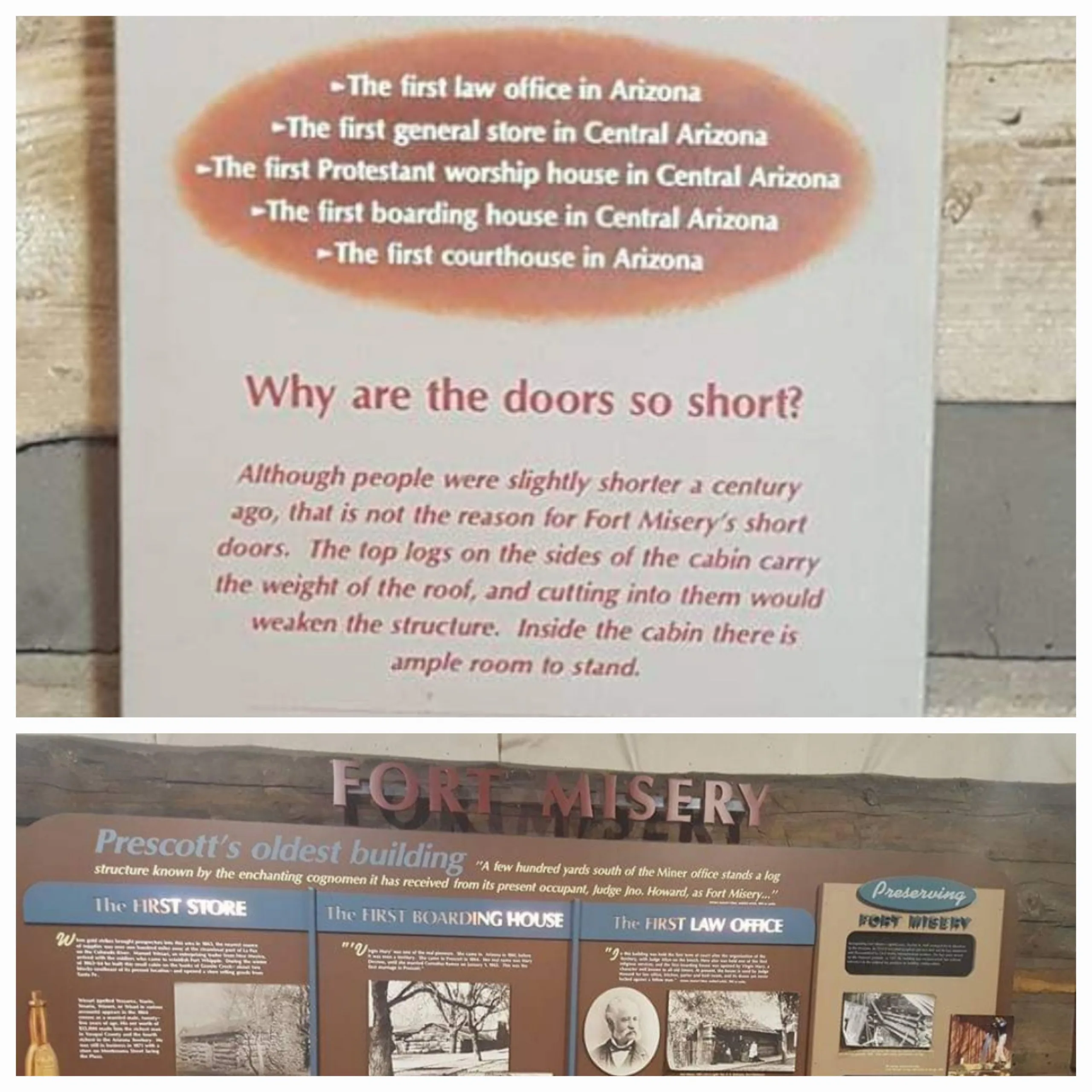
Fort Misery, on the other hand, has been deemed the oldest still-surviving log building in the state of Arizona. Originally built in either 1863 or 1864, today the log cabin has been moved from its original site to now being a part of the Sharlot Hall Museum (which you can read more about here). My takeaway? The doors were really, really, short.

Because no trip around Arizona would be complete without visiting Native American sites as well, my mom and I also stopped at Montezuma's Castle, pictured above, and Tuzigoot National Monument.

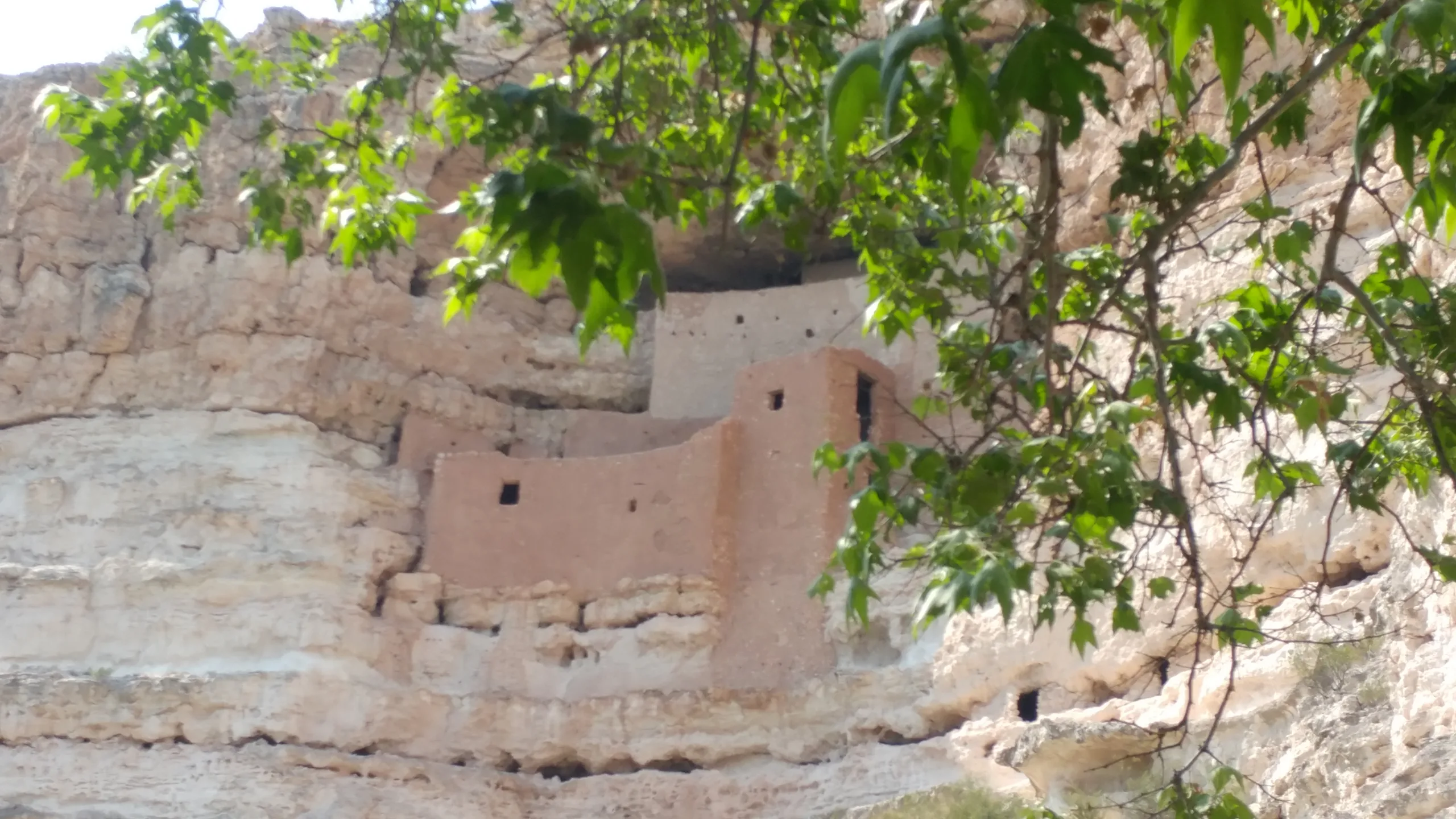
Best estimates from archaeologists date Montezuma's Castle to around 600 years ago, when the Sinagua people called it home. Built into the side of a cliff, Montezuma's Castle is a pueblo ruin comprising of over forty ruins. Archaeologists theorize that the Sinagua people lived in and around Montezuma's Castle for four hundred years.

The site was one of four national monuments created in 1906 by President Theodore Roosevelt, making it one of the oldest historic landmarks to be declared a national monument in the United States.

Early visitors could actually step foot inside the ruins thanks to scaffolding ladders that had been erected on the cliffside, but extensive damage to the ruins by tourists eventually made it so that the public was no longer allowed access after 1951.

The closest visitors can get today is from where I took the photo you can see above. The reason why it is so fuzzy is because I had to zoom in quite a bit on my phone's camera. While its disappointing that we as the general public can no longer get closer, at least the site will be preserved for generations to come.

To learn more about Montezuma's Castle, you can read about it on the park's website here.

As for Tuzigoot National Monument, this pueblo structure holds over 100 rooms inside and was occupied by several hundred people for several hundred years.

The site was abandoned by the Sinagua people sometime in the 1300s and was left abandoned until the 1930s. At that point, archaeologists excavated the site and in 1939 it was turned into a national monument. To learn more about Tuzigoot, you can read about it here.

I don't have any photos that survive from my time at Tuzigoot, but I did purchase one of the most interesting books in my entire collection while there, which is really saying something given the fact that I own almost 1300 books at this point.

The book in question is called Finder's Keepers: A Tale of Archaeological Plunder and Obsession by Craig Childs. Mr. Childs dives deep into the question of archaeological ethics, and whether or not archaeologists should remove artifacts from their ancestral homelands to display in museums and other places. The book made me question what I thought I knew about anthropology and the field of archaeology, and I highly recommend it to anyone with an interest in those fields, along with Southwestern Native American studies as well.

2018-- Sentimental Journey, again! Mesa, Arizona, United States of America

Zoe in front of Senitmental Journey

For my grandmother's 76th birthday, my mom, brother, and I took her to a big band swing dance that was a fundraiser for the Commemorative Air Force Museum. The main showstopper attraction was Sentimental Journey, so I posed for a photo with my old friend.

2019--Joining the Daughters of the American Revolution, Chandler, Arizona, United States of America

Zoe with her DAR Regalia

While this technically wasn't "visiting" a historic site, this is definitely a historic achievement.

The Daughters of the American Revolution are a genealogy based organization that hope to promote historic preservation, patriotism, and education. In order to join the society, you must be a woman who can prove direct lineage from a patriot who fought in the American Revolution.

Since DAR's founding in 1890, over one million women have become members, and I happen to be one of them.

To learn more about DAR, and see if you might be able to join and become a member yourself, visit the national website at dar.org.

2019--Visiting The Madonna of the Trail Statues in Albuquerque, New Mexico, and Springerville, Arizona, United States of America

Madonna Statues

2019 was a big year for me and my DAR journey. A few months after joining the organization, I got the chance to visit two of the statues DAR erected across the United States, from Maryland to California.

The project began in 1911, when the national society decided to erect twelve identical statues across the "Old Trails Road" that stretched across the country. The first statue was dedicated in 1928, when then-judge (and future president) Harry S Truman spoke at the unveiling.

The twelve statues are located in the following locations:

-Bethesda, Maryland

-Beallsville, Pennsylvania

-Wheeling, West Virginia

-Springfield, Ohio

-Richmond, Indiana

-Vandalia, Illinois

-Lexington, Missouri

-Council Grove, Kansas

-Lamar, Colorado

-Albuquerque, New Mexico

-Springerville, Arizona

-Upland, California

I have personally visited the statues in Springerville, Arizona, and Albuquerque, New Mexico, and hope to one day visit some of the others as well. The statues were erected to honor the pioneering spirit of mothers along the old wagon roads across the country. Unfortunately today, some see the statues as problematic and take issue with them as a result, but so far, all twelve have remained standing.

To read more about the statues, and the controversy surrounding them, click here.

2020--Visiting Butte View/Adamsville Cemeteries, Florence, Arizona, United States of America

Adamsville

I won't spend much time on this section because I already wrote a blog post about these old cemeteries, which you can read here.

This is simply an acknowledgement that in late 2020, I visited these two adjoining cemeteries outside of Florence, Arizona.

2020--Visiting Historic Pinal Cemetery, outside Superior, Arizona, United States of America

Historic Pinal

Once again, I already wrote a more extensive blog post about Pinal Cemetery, which can be read here.

I visited the abandoned cemetery in late December 2020, but my dad, brother, and cousin first visited in 2006 or 2007. Its way off the beaten path and hard to locate for those who have never visited before, but its still worth a stop if you happen to be in the area.'

2021--Boothill Graveyard, Tombstone, Arizona, United States of America

Flat Brandon and Zoe outside Boothill

Once again, I already have a blog post written about my stop at Boothill, which can be read here. I've been to Tombstone twice now, and it is a lot of fun if you like old west tourist things! (Ignore the Flat Brandon, its a long story!)

2021--The Titan Missile Museum, Green Valley, Arizona, United States of America

Titan Missile Museum

Do you like large and intimidating nuclear warheads? Do you enjoy smacking your head on metal scaffolding if you happen to be above five and a half feet tall? Do you like going up and down lots of metal stairs?

If you said yes to any of the above questions, do I have the museum for you!

Once again, no I'm not kidding!

The Titan Missile Museum is a de-activated nuclear missile silo that allows visitors to step inside a window into the past. There isn't a lot of information about the history of the site itself--I'm guessing because part of it might still be under lock and key from the federal government.

The Titan Missile Museum teaches visitors about The Cold War and the nuclear missiles developed during it, specifically the Titan II Missiles. Visitors get to see artifacts on the surface as well as traveling down into the silo itself. And don't worry, the photos of the missile shown here are real, BUT the missile has been deactivated and is not harmful to the general public.

To learn more about the museum and the Titan II missiles, visit their website here.

2021--Grand Canyon Pioneer Cemetery, Grand Canyon Village, Arizona, United States of America

Grand Canyon Pioneer Cemetery 2021, zoe

I also have a blog post about the cemetery at the Grand Canyon, which can be read here.

If you are ever visiting Arizona's most famous landmark, make sure to stop at the cemetery to see some of the most unique headstones I have ever seen.

2021--Philo Farnsworth Grave (Provo City Cemetery, Provo, Utah, United States of America) and Reva Beck Bosone Grave (American Fork Cemetery, American Fork, Utah, United States of America)

Utah graves

Once again, I wrote more extensively about both cemeteries in a blog post that you can read here.

If you would like to learn more about why I visited the two individuals I did, you can read about them both here:

Philo Farnsworth, inventor of the all-electric television

Reva Beck Bosone, first female politician elected to national office from Utah

2021--Sacagawea Cemetery, Fort Washakie, Wyoming, United States of America

Sacagawea Cemetery

Once again, I have a more conclusive writeup on the cemetery that can be read here.

2021--The Buffalo Bill Center of the West, Cody, Wyoming, United States of America

Cody
Cody pt 2

If you ever find yourself in Cody, Wyoming, you simply have to stop at one of the largest and most fascinating museums I have ever stepped foot in, The Buffalo Bill Center of the West.

For one thing, its more than just a regular old museum. In fact, its five museums in one, all located under a single roof!

According to their website, the five museums are as follows: "Draper Natural History Museum, Buffalo Bill Museum, Plains Indian Museum, Whitney Western Art Museum, and Cody Firearms Museum."

I didn't have a chance to step into the art museum, but my mom and I did go through the other four. My favorites were the Plains Indians Museum and the Cody Firearms Museum, both of which I included photos of above.

One of the most fascinating artifacts in the entire building was the actual Native American teepee which has survived to present day. Its hard to get the full experience from a photograph, but picture this. I am five feet six inches tall, and it towered above me!

The Buffalo Bill Center of the West gets its roots from the Buffalo Bill Museum, founded in 1927 by William Cody's niece, Mary Jester Allen. The current location of the center was donated in 1935 by Whitney Vanderbilt. The art museum was added in 1959, and ten years later the Plains Indians museum was added as well. The firearms museum was opened to the public in 1991, with the fifth and final section, the Draper Natural History Museum, added in 2002.

To read a full timeline history of the museum, click here.

To view the museum's website to plan a visit of your own, click here!

If the center sounds vaguely familiar to you, maybe its because one of my favorite history Youtubers uploaded two videos on the center only a few months ago. Below are links to both of The History Underground's videos on the center, which give you a much better look inside at the exhibits.

2021--Fort Caspar and Lou Taubert's Ranch Outfitters, Casper, Wyoming, United States of America

Casper, Wyoming

For some of my younger and more internet-attuned audience members, you might read "Casper, Wyoming" and think--JEFFREE STAR!

But unfortunately, while I was in Casper I did not see Jeffree Star or any of his now-famous yaks. This was also before Jeffree opened his "Makeup and Meat" store in Casper as well, but I really want to go back and visit it someday!

(If you have no idea what I'm talking about, the internet personality, makeup mogul, and ranch owner Jeffree Star happens to own a ranch outside of Casper, Wyoming, and he opened a storefront there to sell both his makeup and products from his ranch).

Anyways! Like I said, Jeffree had yet to open his store while I was in Casper, so instead we stopped at the Fort Caspar Museum and the world-famous western wear store Lou Taubert.

Fort Caspar dates to 1847, when Brigham Young led his wagon train of LDS Pioneers across the midwestern states. In June of that year, the pioneers constructed a ferry boat to cross the North Platte river. The remains of that same ferry exist today in the museum, along with other structures built in 1859 that still exist today as well.

If you visit in the summer months, you can walk around those older structures outside and look within. There is also a small indoor museum to walk around as well, and the staff is very enthusiastic about answering your questions.

(They also had a very wide ranging selection of books to buy in the gift shop!)

To learn more about Fort Caspar, visit their website here.

Lou Taubert's, on the other hand, is both a store and a piece of history.

According to their website, Lou Taubert's has been supplying the west with their products since 1919! (Technically the western wear store opened in 1947, but the original owner opened his first store in 1919). I had no idea what to expect when we arrived, but my mom knew she wanted to visit.

In fact, she'd been wanting to visit since she was a member of FFA (Future Farmer's of America) in high school. Visiting Lou Taubert's was checking an item off a bucket list she hadn't actually ever written down, and boy was it worth the stop!

The ranch outfitting store is unlike any other. For one thing, the store is in a building that covers NINE different floors, or approximately 55,000 square feet of floor space. Lou Taubert's is also family owned and has been operating over three generations.

(Which is kind of impressive that they've managed to stretch three generations across one hundred years. My own family has been running our own small local business for just over sixty years and we're on our fourth generation already!)

From 1980 to 2018, the family expanded to having a second store in Billings, Montana, but today they only operate the original store out of Casper.

My favorite part about visiting Lou Taubert's was the extraordinary number of old photographs located around the store. We spent most of our time on the floor with the cowboy hats and other women's clothing. While my mom shopped, I looked around the photos of all the different rodeo queens who had competed across the country for various titles, all of whom seemed to have shopped at Lou Taubert's.

To learn more about this famous store, visit their website here.

2021--The Big Boots of Cheyenne and Lakeview Cemetery, Cheyenne, Wyoming, United States of America

zoe w the big governor boot, cheyenne WY 2021
nellie ross grave

Cheyenne, the capitol of Wyoming. Our last stop in my favorite state in the United States allowed me to visit one of the strangest man-made landmarks in the country, the so-called "Big Boots."

According to an online brochure, which you can read here, there are thirty eight-foot-fall hand painted boots located all over the city. Each was painted by a local artist and shows an aspect of history for Cheyenne or Wyoming. Here I am pictured with the Governor's Boot, which lists--you guessed it--every governor of the state of Wyoming, at least at the time of the boot's creation. I am underlining Nellie Tayloe Ross's name--the first female governor of Wyoming, whom we also stopped to visit at Lakeview cemetery that same day (also pictured).

2021--Visiting the Tabor Ladies, and the Inventor of Tampax, Denver, Colorado, United States of America

Denver graves
Augusta Tabor grave

While my mom and I didn't spend a ton of time in Denver on our road trip through, I did make sure to have us stop off at two cemeteries: Mount Olivet Catholic Cemetery (technically in Wheat Ridge, Colorado) and Riverside Cemetery.

At Mount Olivet, we visited both Gertrude Tenderich-Sears, the inventor of the first modern tampon, and Elizabeth "Baby Doe" Tabor, the second wife of silver baron Horace Tabor. Mount Olivet is a beautiful cemetery, with perfectly manicured lawns and interesting headstones in a picturesque environment for those who like to wander.

Riverside Cemetery, on the other hand, was extremely depressing to witness. First of all, it is located directly across the street from a water treatment sewage plant, which made the entire cemetery smell like...well...rotting corpses. If that isn't bad enough, the cemetery is very old and very overgrown. I managed to find Augusta Tabor's grave (the first wife of the aforementioned Horace Tabor) simply because it is tall and easy to spot from a distance, but other graves that were smaller and closer to the ground were almost impossible to identify. My mom and I still took some time to wander, but the cemetery does not have clear roads to drive down or any other markers to help visitors find who they are looking for either, so we didn't stay as long as I would have wanted to otherwise.

2021--The National Museum of World War II Aviation, Colorado Springs, Colorado, United States of America


Zoe with a plane

My mother and I found this museum by complete accident, but what a find it was!

I have always loved aerospace museums, and this one was one of the best I've visited so far. Not only is the hangar full of all sorts of old planes, engines, and other machinery from World War II, but the museum also had short biographies on some of the most famous pilots from the period, and before.

The only downside to this museum was the gift shop, which was pretty lackluster, at least when we visited. We spent several hours wandering around, taking in the sights as well as calling and texting various family members, to tell them to stop by the next time they visited that part of Colorado.

To learn more about the National Museum of World War II Aviation, visit their website, here.

2021--The Loretto Chapel, Santa Fe, New Mexico, United States of America

the staircase at the loretto chapel, santa fe nm, 2021

The story of one of the most famous staircases in the world starts in 1850, when the local Catholic order in New Mexico decided a school for girls was needed.

The sisters of Loretto took up the call, and built the Loretto Academy in 1853, after a journey which cost the Mother Superior her life, and during which time the sisters had to quickly learn Spanish in order to communicate with the locals.

Twenty years later, the sisters were able to begin construction of a chapel to go alongside the school. While the architect in charge was able to complete most of the building, he died before he could build a staircase that would reach the chapel's loft.

Because of the shape of the chapel itself, a standard staircase would have taken up too much floorspace and would have shrunk the available seating on the floor of the chapel to make not sustainable. Not knowing what else to do, the sisters of Loretto prayed for nine days to St. Joseph, the Patron Saint of Carpenters.

This is what happened next, according to the Loretto Chapel's Website:

"A carpenter appeared with only a hammer and carpenter’s square. He built what is now known as the Miraculous Staircase with simple tools and wooden pegs. The rare wood is not native to the American Southwest. When the Staircase was complete, it is said that the carpenter disappeared without receiving thanks or payment. The Sisters tried all local lumber stores but could not find accounts open for supplies for their stairs. Some believe the carpenter was St. Joseph himself while others believe that is was someone sent by St. Joseph. What is known is that the Sisters of Loretto prayed, and their prayers were answered."

The stairs are not just beautiful, but practical as well. Designed with two 360 degree complete turns, the stairs provided a way to the chapel's loft while also taking up as minimal floor space as possible. Because of the way they are designed, the entire weight of the staircase lays on the bottom step. They did not originally have railings, but about ten years after the miracle took place, the railings were added to help those climbing up and down.

Today, the Loretto Chapel is as much a tourist attraction as it is a Catholic place of worship. For a couple of dollars per person, visitors can sit in the pews and listen to an audio recording recount the story of the miracle. I very much enjoyed the entire experience, and the gift shop was equally amazing!

To learn more about the Loretto Chapel, visit their website here.

2021--I Debuted as Debutante for Daughters of the American Revolution, Fountain Hills, Arizona, United States of America

zoe with the other debutantes, 2021

From the time I joined DAR at the age of nineteen, I had it in my mind that I wanted to participate in their version of a Debutante Ball. Girls are allowed to debut as "Debs" between the ages of eighteen and twenty-two in DAR, and so I was originally supposed to be a part of the ball in 2020 (the first year I was eligible because the ball only happens once a year, and had already taken place by the time my paperwork came through in 2019).

Well, then covid happened.

I feel like no further explanation is needed than that!

So, 2020 was out for that particular endeavor, but luckily the ball was rescheduled for 2021 and I was ready to go.

I'm not wearing them in this particular photo, but I did have white gloves that I wore for part of the ceremony. There were five of us debutantes in all that year, but one of the girls missed this photo. I wore a long ivory gown with a bow on the back, and my grandmother Helen's pearls. My stepsister did my hair, I managed to do my own makeup, and my father served as my chaperone for the presentation itself.

Part of the reason why I agreed to take part in the ball was because I knew it would be the only time my family would see me in a white/ivory formal gown. Ever since I was a child I have been determined to marry in a black gown (the color of life in Ancient Egyptian culture) and not white. White wedding dresses only became the fashion after Queen Victoria married Albert in a white gown (before their fairy tale wedding, women usually married in the nicest gown they already owned, regardless of color). Not only that, but white is also the color associated with death in Ancient Egyptian culture--and neither of those traditions particularly excite me when I think about my future wedding.

With that tangent aside, however, I definitely think being a debutante counts as a historical venture I took part in. As for what a debutante ball actually is... well, that largely depends on who you ask and whether or not you identify as a feminist.

Historically, debutante balls were a way for young women in high society to debut themselves. What this meant was, when a girl reached the age in which she was eligible for marriage, she would "come out" to society to introduce herself, her family, and what all she could bring to her marriage.

Today, many feminists view debutante balls as something to look down upon, because they view these ceremonies as though women are being presented for the sole purpose of getting married and being a man's property. Whether or not you agree with that is up to you and has nothing to do with this blog post, however.

While the first confirmed date for a debutante ball has been lost to history, the first notable ball that has made it into the history books dates all the way back to 1780 in England. The last presentation of ladies in England in this manner ended in 1958.

I enjoyed my night as a debutante--except for the fact that my dress was fairly tight and I had to keep standing up and sitting down, over and over, for standing ovations and various other reasons. Other than that though, the night was quite fabulous!

Because the ball I debuted at was a part of DAR, I was sponsored by my chapter, Cactus Wren. The three other girls in the photo with me were all from the same chapter, and the fifth girl was from a third beside that. The DAR Debutante Ball is a good way for younger DAR members to get to know one another, and show our community that DAR is not just for little old ladies. While some of the other girls wore their mother's wedding dresses, or a dress they bought online, I chose to buy my dress from a local store that only sells modest dresses, "Modest Wedding and Prom." I was happy to support a local business and loved my dress! I bought it even though they offered rentals, even though I doubted even then that I would ever wear it again.

To learn more about the history of Debutante Balls, here is an article from Encyclopedia Britannica.

2022--Visiting Pearl Hart's Grave, Central Heights, Arizona, United States of America

Pearl Hart's Grave

As you can tell, I like visiting historic cemeteries and well, dead people. I can't believe it took me nineteen years of living in Arizona to realize Pearl Hart is buried in my home state, but in July of 2022 I got the chance to visit her in person.

To learn more about the cemetery Pearl is buried in, read my blog post about it here.

2023--Hearing Zahi Hawass Speak at a Lecture, Phoenix, Arizona, United States of America

Zoe at the zahi hawass lecture in phx, may 2023

I won't say much about it here because again, I already wrote a blog post (that you can read here), but ever since I was a little girl, Zahi Hawass has been my hero, and so when I found out he was coming to Phoenix I had a proper fan-girl freakout.

Yes he is an old man who is an archaeologist, and I was a twenty-three-year-old-girl at the time, but still! Dr. Zahi Hawass! Chances are if you have watched a documentary on Ancient Egypt at any point in the last twenty years he was probably in it. Thanks again to my mom for getting us the tickets! This was a dream come true.

2023--My First Rodeo, Taylor, Arizona, United States of America

zoe at the taylor rodeo, jul 23
https://theexasperatedhistorian.com/wp-content/uploads/2024/01/20230701_200554.mp4

How I managed to make it to twenty-three years old without seeing a real rodeo, I'm not sure, but wow was Taylor a great place to start!

Before I met my boyfriend in March of 2022, I had heard of the town of Taylor, had driven through a time or two, but it never registered as anything more than that, a town up north.

After meeting my boyfriend, that all changed. Taylor is a little slice of heaven to his family, and a big part of the reason why is the fact that his ancestors literally helped found the town. According to the town of Taylor's website, the founder of Taylor, AZ was James Pearce, my boyfriend's great-great-great-grandfather through his paternal grandmother's side.

My boyfriend's family still owns a house in Taylor, which has been in the family for generations, and every year they go up for the annual rodeo. 2023 was Taylor's 69th Annual Rodeo, and it was AWESOME. I can't wait to go back again.

The only downside? The rodeo takes place over 4th of July weekend and it was a bit toasty to say the least. The weather was in the low nineties and it was bright and sunny. My cowboy hat and sunglasses were a lifesaver until the sun went down. If you ever want to visit the rodeo, plan on arriving early! Almost as soon as the gates open, the bleacher seats will be packed full, even though the main event doesn't start until hours later.

The rodeo featured all of the typical rodeo competitions you might expect: bronc riding, bull riding, barrel racing, trick riding, calf roping, and more. They also kicked off the night with an anvil launching!


And in the future...

I know I will have more historical adventures in the years to come, but I thought a fun way to kick off 2024 would be to look back on my life and everything I've done so far.

In the future I will continue to update my website with blog posts every time I do anything fun and historical in any way, but again, I thought this would be a good way to start the year and to remember all the places I've been and the things I have seen. I have a passport, but I've never left the United States. I'm about to turn twenty-four, and I think I've seen and done quite a bit in my time already.

To the future!

And beyond 🙂

Testing a Fannie Farmer Recipe…

Posted on August 19, 2023 by nickssquire12

Hello All!

Today I present you with a (possibly) new series of posts, testing vintage recipes. I use the word possibly because I have no idea if I will continue this trend or not, seeing as I stumbled across this one by accident.

With that being said...

Image Courtesy of Amazon

A few weeks ago, I (like many other fans) purchased Dylan Hollis's first cookbook: Baking Yesteryear, in which Dylan explores various desserts and treats from the 1900s through the 1980s.

I have always considered myself more of a baker than a cook, and so I decided that while I had some free time I would test out a recipe from the book. Usually when I buy a cookbook, I look at it once or twice, then add it to my library and forget it exists. I'm fairly certain this is the first time I've actually tried to bake a recipe out of a cookbook I've purchased and not a random recipe I've found online.

But I digress, back to Dylan.

As I was flipping through the various recipes, I came across one for "Pioneer Brownies" in the 1900's chapter. As I read the short description Dylan provided, my eyes landed on a familiar name--Fannie Farmer. Yes, Dylan had copied this recipe from Mrs. Farmer herself (and you can read more about her by clicking her name above). Mrs. Farmer is renowned in the history of cooking and American culinary arts because she was a pioneer in using exact measurements, as opposed to a sprinkle of this and a dash of that.


Fannie-Farmer-circa-1900, courtesy of Wikipedia-BPL

As a fan of brownies and intrigued by the opportunity to try a vintage recipe, I quickly jotted down the ingredients in my own typical fashion (that is to say, I went off memory of what ingredients I already had in my cabinets and then wrote down exactly zero amounts of how much I needed to buy of anything else) and then headed off to Target.

After coming home with my supplies, I set to work. First I had to dig around and find a measuring tape to see if the rectangular pan I owned was in fact a 9 by 13" pan (luckily for me it was!).

Preparing my kitchen

Once I was sure my pan was a sufficient size, I got to work.

And immediately encountered my first problem. The recipe called for "Unsweetened" chocolate and I had purchased a mix of both milk and dark chocolate chips. Oops.

Second problem, the recipe called for melted chocolate, but didn't specify what form it was supposed to come from. After attempting to melt some chocolate chips in my microwave (and almost starting a fire while melting the plastic bowl the chips were in instead of the chips themselves), I resorted to melting the chocolate chips in a saucepan on my stove, which worked much faster!

(Although I still don't quite know if I had the correct amount of chocolate by the time I was done. I'm not very good with converting grams and ounces and so on--Mrs. Farmer probably would not approve of my cooking methods!).

Eventually though, I got my batter all mixed together and into the baking pan.

Raw Batter Waiting to be Baked

My first observation? The dough wasn't very dark. I'm pretty sure I put more chocolate into the recipe than I was supposed to, and yet the dough still looked much lighter than a traditional (Boxed) brownie batter. But I stuck it in the oven anyway and hoped for the best.

The recipe also stated it needed to bake 25-30 minutes. Luckily I knew from previous experience that brownies need to bake much longer than cookies or even cakes.

However, what I was not prepared for was the fact that at 26 minutes in the oven, the brownies were still completely raw in the center! Usually my oven runs hot so this made me only a little nervous.

Fresh Out of the Oven

As you can see, it took me four total tries of poking the brownies with a fork before I finally got the indication they were done.

(For those unaware of the fork technique, you can tell when brownies are fully cooked by sticking a fork or other sharp object into the batter. If the fork comes out clean, they're done! If the fork comes out and the batter sticks or is still runny, then it needs to keep cooking).

It ended up taking my brownies just over forty minutes to bake fully in the oven. The recipe then said to let them cool completely before removing them from the pan, so I waited another forty minutes.

Fresh out of the Pan

At this point I found myself frowning at my creation. They definitely do not look like the traditional brownie we expect today. And unfortunately for me, this was one of the recipes that Dylan neglected to include a photo of in the cookbook. I also tried to do a quick Google Image search of "Fannie Farmer Pioneer Brownies." Half of the results looked similar to mine (a good sign!) but the other half looked like the darker brownies I'm used to.

Cutting the Brownies into Bars

As for the taste, well, they definitely taste more like vanilla than chocolate--to the point I'm left with a bit of a vanilla aftertaste after taking a bite. They're still good! I think they're very tasty, and they have the typical brownie consistency and texture as well. These brownies have a crinkly and flaky top, as well as a chewy/fudgy texture underneath. They just don't taste like brownies!

Maybe I messed the recipe up, or maybe Mrs. Farmer didn't think brownies needed to taste like chocolate. My mom asked me if this treat is actually supposed to be a "Blondie" since they are so much lighter and taste more like vanilla, but you would think Dylan would have mentioned that in his cookbook...

I honestly have no idea if I made this one right or not. But it was fun to try something new! I'll include the recipe below in case you want to try it yourself--and if you do, let me know your results!


(Editor's Note--uh, this is kind of embarrassing but when I got the book back out to type out the recipe I realized what I did wrong. This is the first time I've ever made brownies from scratch, and also the first time I've ever made a recipe that uses ounces and grams as part of the method. I definitely...definitely got the ounces to grams part on the chocolate confused. I just realized I only used half of the amount of chocolate I was supposed to...uh...my bad! Things are definitely making more sense now...So, definitely make sure you use the full amount of chocolate required. OR use half and enjoy a brownie texture with a vanilla flavor like I managed to do. Whoops! You live and you learn, right?)

Pioneer Brownies, a Fannie Farmer Recipe, from Dylan Hollis's Baking Yesteryear.

Prep Time: 15 Minutes (It probably took me closer to 20)

Cook Time: 30 Minutes (or 40, depending on the oven apparently!)

Ingredients:

2 Cups (400g) granulated sugar

1/2 Cup (115g) butter, melted

2 large eggs

4oz (113g), unsweetened chocolate, melted

2 tsp vanilla

1 cup (140g) all-purpose flour

1 cup (115g) chopped walnuts

Method:

1: Preheat the oven to 325 degrees F (or 165 degrees C)

2: Line a 9x13 inch (23x33cm) pan with parchment paper, if your paper doesn't cover the entire pan, grease the sides not covered

3: Beat together the sugar and butter

4: Whisk in the eggs one at a time, beating smooth after each addition

5: Whisk in the chocolate, and then the vanilla

6: Fold in the flour, and then fold in the walnuts

7: Turn the batter into the parchment-lined pan and bake for 25 to 30 minutes

8: All the brownies to cool completely in the pan, then remove the brownies by grasping the sides of the parchment. Cut into bars and serve


I Did a Thing (My ASU Graduation)

Posted on June 2, 2023 by nickssquire12

In May of 2023, I graduated from Arizona State University's College of Interdisciplinary Sciences and Arts (better known as CISA by those associated with ASU). I majored in History and minored in English.

2023 Grad

Graduation itself went fairly smoothly, unlike my actual college experience. Unfortunately for me and my family, it took place at 9 AM on the Thursday morning leading up to Mother's Day week here in the United States. Also, the ceremony took place at Desert Financial Arena on the ASU Tempe campus. Graduation was the first, and hopefully last, time I ever set foot on ASU's Tempe campus.

With Flat Russell

I managed to sneak across the stage my friend, Flat Russell. Flat Russell is a representation of my prison-pen-pal (its a long story!) Russell. Since Russell can't get out and travel himself, I take him along with me on various adventures. Since Russell might not ever have a graduation ceremony of his own, I decided to take him with me.

With Dr. Nystrom

As I mentioned, my ASU journey was...interesting to say the least. During my five semesters at the university, I had many headaches, horrible teachers, incredibly dimwitted fellow classmates, and many assignments that made me grab my temples and attempt to not scream at the top of my lungs.

My saving grace was my professor for my capstone class, HST495, Methods of Historical Inquiry. Dr. Eric Nystrom is one of the few reasons I actually managed to graduate with my sanity intact. His reviews on Rate My Professor are mixed, but that's because he also teaches History of Engineering, and let's be honest, not many engineers are probably in any way interested in the history aspect of their field. So I don't blame him for the less than favorable reviews.

If you are an ASU student and are a history major/minor, or are wanting to become a social studies teacher, I highly recommend taking a class from Dr. Nystrom. I spent five years in college overall (starting at Mesa Community College, part of the Maricopa Community College network in December of 2017), and through all of those long semesters and classes, Dr. Nystrom was the only history professor I had who actually seemed interested in the field and willing to help his students succeed both in the classroom and beyond.

The Historian with her Father

Because of the bad-timing of the graduation ceremony itself, a lot of my family was unable to attend the ceremony because they had to work (understandably so! Seriously, 9 AM on a Thursday?!). Anyway, my dad, his girlfriend, my boyfriend, his mom, and my maternal grandmother all came to support me at the stadium itself, while other members of my family watched on the ASU livestream video. Here I am with my dad--buying the hat was my mom's idea but my dad was nice enough to pose for me with it on!

The Historian with her Mother

After the ceremony was over, and I got a few photos with my professor and family, I raced to get to work to help out my mom at our family's flower shop. Later that evening, once the craziness from Mother's Day had calmed down, I posed with my mom for a few photos by our newly rebuilt fountain in front of the flower shop. I am holding my ASU diploma envelope behind my mom's head to display her "Grad Mom" head-boppers!

The historian and her boyfriend

After the Mother's Day madness had ended, my family took me out to celebrate at our favorite restaurant, The Old Spaghetti Factory. That was when my boyfriend and I finally got a chance to pose for some photos as well since we had forgotten to on the graduation day itself.

My boyfriend prefers his internet anonymity, and so I have decided to cover his face and refrain from naming him in case you are wondering.

Also, my knee has been swollen for six weeks now and the green KT tape helps support it--in case you are wondering about that!

Posing with My Headgear

My mom bought me a set of "2023 Grad" head-boppers, and my boyfriend's mom also gave me a smaller head-bopper that says "Grad" on a more-standard looking graduation cap. Both are able to be layered and you can bet I wore them at work for a few days after graduation to continue the celebration!

Jamie in Grad Gear

(I apologize for misspelling Jamie Fraser's name...I blame autocorrect.)

In case some of you are unaware, before I met my boyfriend I purchased a life-size cardboard cutout of the Outlander character Jamie Fraser and claimed he was my "boyfriend."

I was very upfront about Jamie's presence when my actual boyfriend and I started dating, and Jamie has continued to stand guard in my room ever since. After the graduation festivities came to an end, I didn't really know what to do with my cap, gown, and other graduation-related items I had been gifted, including a balloon from my friend Ronda!

Anyway, since I didn't want the balloon to escape my room and scare my brother down the hall, I decided to be-deck Jamie with all my stuff and make him an ASU grad. I think its a good look for him.


So friends, seeing as I got an email from ASU yesterday letting me know my diploma is officially in the mail and on its way, I figured it was time to announce my graduation and make it clear that I am technically now an *actual* historian, whatever that means anyway. I have no idea what the future holds, but my college career is officially over...until I recoup my savings and go back for my masters in any case.

I will never return to ASU, I have heard nothing but bad things about their history masters program, and also my actual experience at ASU (sans Dr. Nystrom) was ATROCIOUS to say the least. Even though I had a high enough GPA to technically graduate with honors, I was told that I was ineligible because I was two-credits short of the minimum to wear honor cords to graduation. And yet, when I received my email confirmation that my diploma was in the mail, I was informed I graduated summa cum laude--so really I have no idea what is going on, and I graduated already! It really was that bad...

One day I will be selecting another school to go for my masters, but that will be far in the future. I would love to eventually earn a PhD, in part because I would love to have that distinction and also in part to honor my paternal grandmother, who graduated from ASU with her PhD in 1989. She passed away just over ten years later, a day before I was born.

Framed fuzzy photo of Helen in cap and gown

In the meantime, I will continue to work at my family's flower shop, and am also in the process of becoming a licensed substitute teacher in my home state of Arizona. Hopefully I will also be able to one day publish my final project for ASU, a short-history of the floral industry in Arizona, that incorporated standard print sources as well as interviews with some of the men and women who have been involved in the industry for decades.

As I proudly displayed on my graduation announcements, The Best is Yet to Come. Who knows what the future holds? All I know is, I have many many many more stories to share with the world, and I am happy that I will finally have more time to share those stories again.

Thank you to my readers and supporters who have followed my website since the beginning, or have joined along the way. Continue reading and learning! And if you have any stories you think should be shared on this site, send me an email and I'll add them to the list!

Thanks again everyone,

-Zoë, the Slightly-Less Exasperated Historian

I Spent an Evening with Dr. Zahi Hawass (Kind of Anyway!)

Posted on June 2, 2023 by nickssquire12

On 2 May 2023, my mother and I attended the first stop of Dr. Zahi Hawass's North American lecture series, "An Evening with Dr. Zahi Hawass."

The Man Himself

During Dr. Hawass's lecture, he spoke on many upcoming digs and excavations happening in Egypt this coming fall. He was most excited about new research into the Great Pyramids at Giza, as well as trying to discover the lost tomb of Nefertiti.

Elon Musk and Aliens Made the Pyramids

Dr. Hawass also made sure to include plenty of jokes along the way to break up the serious nature of the talk. In the beginning of his program, Dr. Hawass made light of the History Channel's attempts to claim aliens built the pyramids. According to Dr. Hawass, neither aliens or Elon Musk were responsible for the creation of the Giza Pyramids, despite what some would have you believe!

The Books Dr. Hawass was selling

Dr. Hawass and his team were also selling books as part of the lecture tour. He was selling the two books shown above, Secret Egypt and Tutankhamun: Treasures of the Golden Pharaoh, the Centennial Celebration. Were they overpriced? Of course, but are they also both really cool? Most definitely.

Secret Egypt is a travel guide to all of the best archaeological sites, restaurants, hotels, and so-on across Egypt that Dr. Hawass recommends. This book is part of the push to get more people to visit Egypt as part of the traveling tours Dr. Hawass is now a part of via the company Archaeological Paths.

The book on Tutankhamun is very large and has many glossy photos, which makes the high price worth it to book collectors like myself.

The Historian Posing for a Photo

I really enjoyed this lecture by Dr. Hawass. To most people, who are not as well-versed in Egyptian Dynastic history like I am, they probably got lost a time or two as Dr. Hawass raced through several different topics and subjects during his hour and a half talk. At the end of the lecture, Dr. Hawass had time for questions and also did a book signing (which I did not hang around for because it was getting late and was an over-half-an-hour drive home for me on a Tuesday).

Did I get to shake hands with my childhood hero? No. But being in the same room with him, surrounded by people who were also interested in learning more about Ancient Egypt was very exciting and made for a fun evening.

Thank you to my mom who bought us both the tickets to attend the event as part of my graduation presents from Arizona State University for my bachelors degree.

Giving Thanks and Credit Where It’s Due

Posted on October 15, 2022 by nickssquire12

Hey everyone!

If any of you are regular visitors to the site, you may have noticed some appearance changes in the past few months.

Some of you may also know that I am not an artist, by any means. The written word is my strong suit, and any time I am asked to do anything creative for an assignment for school or work or anything, my brain immediately freezes up and I go into panic mode. I thought I was going to be an artist, like my aunt Lynne in first grade. You know what happened? I had an assignment on the fennec fox and I ended up drawing a hideous looking creature--the artist dream went up in smoke.

Anyway! Back to the purpose of this post. As you may have noticed, the site has gone through some upgrades in the past few months, and this is all thanks to two local artists that I owe a million and one thanks to.

The first facelift we received a few months back was the integration of an actual logo for the first time since I launched the site in July of 2019. And by logo, I mean the simplistic but quite ingenious outline of my glasses you now see at the top of every page, as well as the thumbnail icon for individual tabs, save icons, and so on. I had been struggling with the idea for that particular thumbnail since I launched the site. The first few years (and yes, I cringe when I typed the word years), I was using an old photo of me as a baby. Not very professional by any means, and luckily now we have something much better! The logo was created by my wonderful boyfriend (who prefers his internet anonymity) and so he'll remain unnamed here, but still I wanted to say a massive thank you to him! <3

Now, the newest update we just launched last night. For the first few years, the home page of the site here had another family photo. I always wanted to replace it, but once again I struggled for years with what I wanted and, once I decided, how I would acquire whatever it was.

Again, I am not an artists by any means, so once I had the idea, I was lucky enough to be put in contact with another amazing, local artist named Duncan Robertson. You can find Duncan on his Instagram page here: duncan.art. Duncan has been a friend of my family for many years and after giving him the idea, he came back with this wonderful cartoon version of me!

Original Sketch by Duncan Robertson

And yes, in case you're wondering I do assume this very pose whenever I become particularly exasperated by something or other, which happens quite often.

After Duncan supplied the sketch, my boyfriend and I put our heads together to figure out how best to implement her on the front page of the website. After a few sets of trial and error, we eventually landed on the image you see now.

And in case you don't want to click back over there, you can view it below.

DailyThoughtsTRANS

Yes, its wordy. Yes, its a little over the top. And yes, a few of the facts will probably piss off certain people who get offended by every little thing. But here's the thing--I am EXASPERATED for many reasons, and these are just six of those reasons. If one person reads these little fact bubbles and retains that knowledge, I'll be happy.

Hopefully more than one person will walk away remembering these women's names and will be able to implement that knowledge somehow. Or maybe they'll see the numbers of the women and realize just how many thousands of people have lived throughout human history, and how varied and complicated those lives can be.

Big things are coming in the future, and this was just the first step. Thank you for being readers or users, and hanging in there with me this far. I can't wait to see where the future takes us from here.

Thanks again to Mr. Anonymity (my boyfriend!) and Duncan Robertson. Please please please follow Duncan on Instagram and follow his artistic journey there--I'm sure he'll appreciate it!

Thanks again everyone.

Stay informed, stay interested, and keep reading.

-Zoë, The Exasperated Historian

Celebrating 1,000 Women (And Counting!)

Posted on December 24, 2020January 16, 2022 by nickssquire12

Just a quick note to celebrate this historic milestone. After gathering data and stories for five years, I am now proud to say the first 1,000 women have been posted to this website, where their stories will live on forever. We have seen criminals, victims, scientists, mathematicians, lawyers, advocates, survivors, artists, musicians, actresses, innkeepers, warriors, royalty, and so much more.

I now know I have over six hundred more women to go, but I wanted to mark the date as the first 1,000 appeared. Today, Christmas Eve, 24 December 2020, officially marks that day. Entry number one, Hypatia of Alexandria, and entry number one thousand, Claressa Shields, have led completely different lives than just about anyone, but that's even more perfect in a way. These two women represent how varied and wonderful the human story is, and how each story impacts the world in such a different way.

Thank you, to anyone reading this, to anyone who has supported me over the years, and to everyone who will continue or begin to support me in the future. None of this would have been possible without you, and I will always be grateful.

To 1,000 more eventually! (And a special note of appreciation for the 200 men who have active profiles on this site as well. We won't forget you either, and I'm proud to say I have about twenty more on the way...)

-The Exasperated Historian Herself, Zoë

  • 1
  • 2
  • Next

Categories

Archives

  • July 2025 (10)
  • July 2024 (1)
  • January 2024 (1)
  • August 2023 (1)
  • June 2023 (2)
  • October 2022 (1)
  • July 2022 (1)
  • June 2021 (3)
  • December 2020 (3)
  • August 2019 (1)
  • July 2019 (2)

Search

© 2026 The Exasperated Historian | Powered by Minimalist Blog WordPress Theme