The Exasperated Historian
Menu
  • Home
  • The Women’s List (New)
  • The Men’s List
  • The Animal List
  • Collections
  • The Blog
  • Contact Us
  • FAQ
Menu

Category: Birth Locations

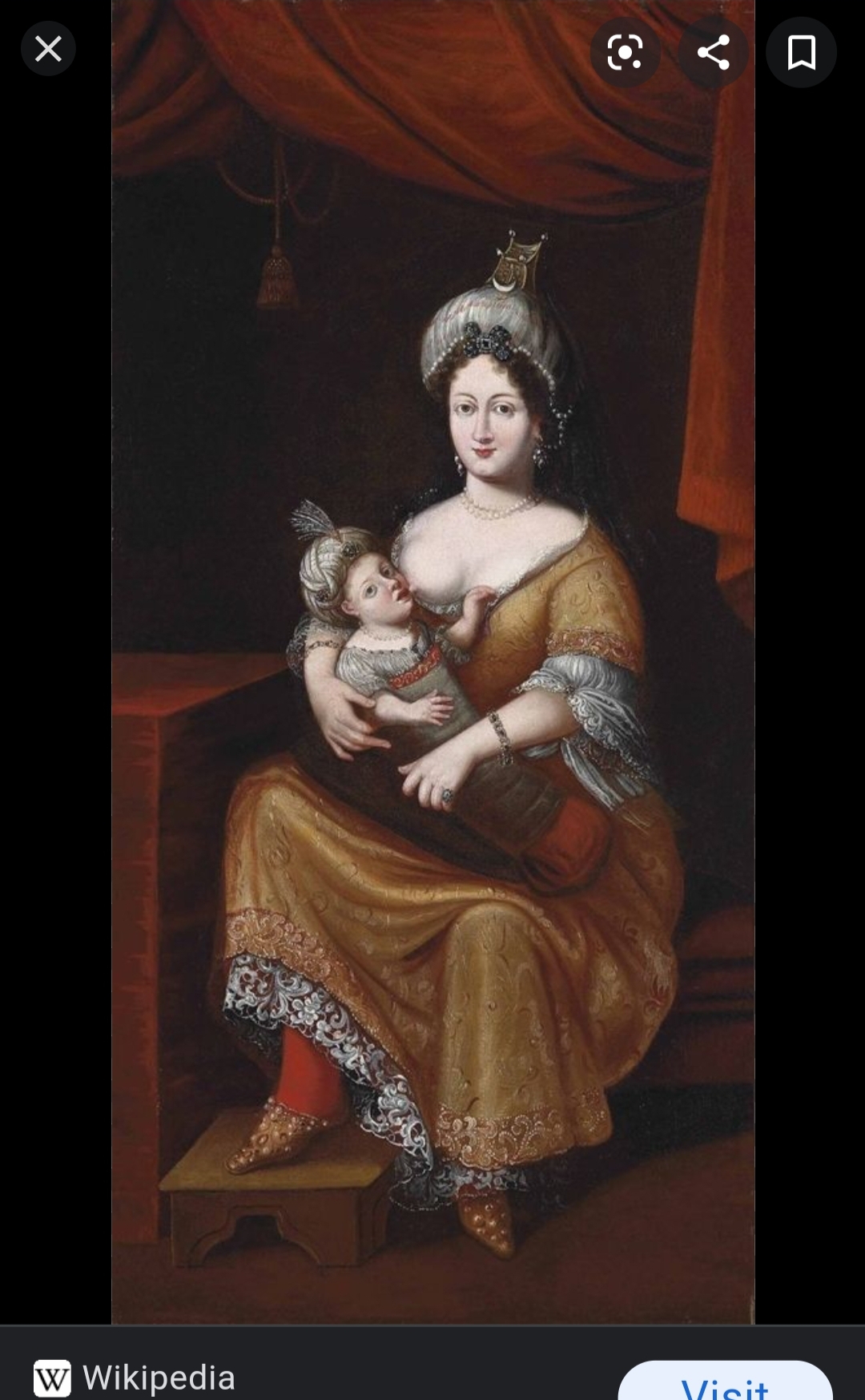
1079) Kosem Sultan

Courtesy of Wikipedia

1079: Kösem Sultan

One of the Most Powerful Women in the History of the Ottoman Empire

Born: c.1589, Present-day Bosnia & Herzegovina or Greece

Died: 3 September 1651, Constantinople, Ottoman Empire (Present-day Istanbul, Turkey)

Also Known As: Mahpeykar Sultan

Possible Original Name: Anastasia

Kösem entered the Ottoman court after being captured and brought to Constantinople from her native lands, and was given to the sultan as a member of his harem; initially as a slave, she quickly rose through the ranks to become the leader of the harem.

While historians are not certain as to what her name was at birth, some have suggested it was Anastasia. After she was brought to the Muslim world and converted to Islam, her name was changed to the Persian Mahpeykar, meaning “Moon Shaped,” while her less formal name, Kösem, was given to her reportedly on account of her hairless and smooth skin (the name could also mean a shepherd leading his herd).

Kösem eventually became the wife of the Sultan Ahmed I and was the mother of seven or eight of his children. She had risen to become head of the harem before the wedding, had given birth to four or five sons (sources differ) and three daughters.

While Kösem had given birth to many of the sultan’s sons, she had not birthed his eldest; another of Ahmed’s concubines had that distinction. In the Ottoman culture, the eldest son did not necessarily inherit the throne. Instead, the sons would battle one another for supremacy and the winner would become the next sultan. As such, Kösem began fighting for her sons from the moment they were born, which meant going head-to-head with whoever stood in her way.

In 1617, Ahmed died following a fourteen-year relationship with Kösem. Kösem herself was still only around twenty-eight herself at the time, but with her husband gone, the protections her family had lived under were now gone as well. Now, Kösem needed to be strong.

Ahmed’s mentally incompetent brother was placed on the throne with the backing of Kösem. Kösem knew that if the brother, Mustafa I, became Sultan, she would be able to wield power through him. Unfortunately, Mustafa was deposed after three months, and eventually Kösem’s stepson became the sultan. In 1622, a revolt led to the death of Ahmed’s other son, and Mustafa I was able to retake the sultanate. The following year, Kösem’s son Murad IV became Sultan, and Kösem was elevated to the position of valide sultan, or “mother of the sultan.”

For the first several years of his reign (sources differ, stating the time was between five and ten years), Murad IV was actually still a minor, meaning Kösem was able to rule as his regent and wield considerable power. Though Kösem had to step down once her son became of age, he was known to occasionally consider his mother’s input in the following years he ruled. However, Murad died in 1640, possibly from excessive alcohol consumption.

After Murad’s death, the throne went to his younger brother İbrahim; Kösem’s only still living son. İbrahim was marked by mismanagement of the empire and outright neglect. Kösem left the palace and lost her influence entirely during this time. In 1648, tired of İbrahim’s failures as a sultan, Kösem and other influential members of the court ousted him from power (with his eventually execution reportedly being signed off on by Kösem herself). İbrahim’s successor was his six or seven-year-old son (again, sources differ), Mehmed IV. Because the child was obviously still a minor, Kösem was once again able to rise up and act as his regent.

Mehmed’s mother, Turhan Hatice, gained the title of valide sultan, but unlike Kösem had a generation before, Turhan did not gain the influence and power her mother-in-law had carried. Instead, Kösem retained the power of regent over her grandson, and was granted a new title as a result: büyük valide or grandmother sultan instead.

Turhan was understandably incensed as she realized her mother-in-law was not about to release her stranglehold on the empire’s power. As a result, Turhan began to build up a rival political base within the palace. Kösem decided she wasn’t about to take that lying down, and started to make moves to depose her grandson in favor of his half-brother. Unlike Mehmed, this half-brother’s mother did not want any political clout, and would pose no threat to Kösem’s authority should her son take the throne.

When Turhan learned Kösem’s plans, she moved first. One night while she was lying in her bed, a group of men from Turhan’s camp entered Kösem’s rooms, strangling her to death. The story goes that the men used either Kösem’s own braids, or maybe even the strings of her bed curtains. Whichever was the case, Kösem’s end was a brutal one. In all, she had lived through the reigns of six sultans and had acted as regent to two of her sons and one of her grandsons. Kösem was also popular throughout the empire, and her death was marked by three deaths of mourning throughout Istanbul. While Turhan was able to gain immense power with Kösem’s death, she also angered the public in so doing. According to History of Royal Women (article linked below): “Kosem was also known for her charity. She built a mosque, financed irrigation works in Egypt, and helped the poor in Mecca.” While Kösem’s legacy is split today, with some historians critiquing her for sticking her nose in where it didn’t belong, others celebrate her as a mother, grandmother, wife, and leader, who genuinely seemed to care for the well-being of her people and took control of her country as a way to keep things running as smoothly and efficiently as possible. Whichever side you choose to see her from, what cannot be denied is that Kösem made her mark on history, and will not be forgotten any time soon.

Badges Earned:

Find a Grave Marked

Sources:

https://www.britannica.com/biography/Kosem-Sultan

https://www.historyofroyalwomen.com/kosem-sultan/kosem-sultan-dynamic-regent-ottoman-empire/

https://www.dailysabah.com/feature/2015/09/18/the-woman-who-oversaw-3-generations-of-the-ottoman-empire

https://www.findagrave.com/memorial/31441786/mahpeyher-k%C3%B6sem_valide-sultan
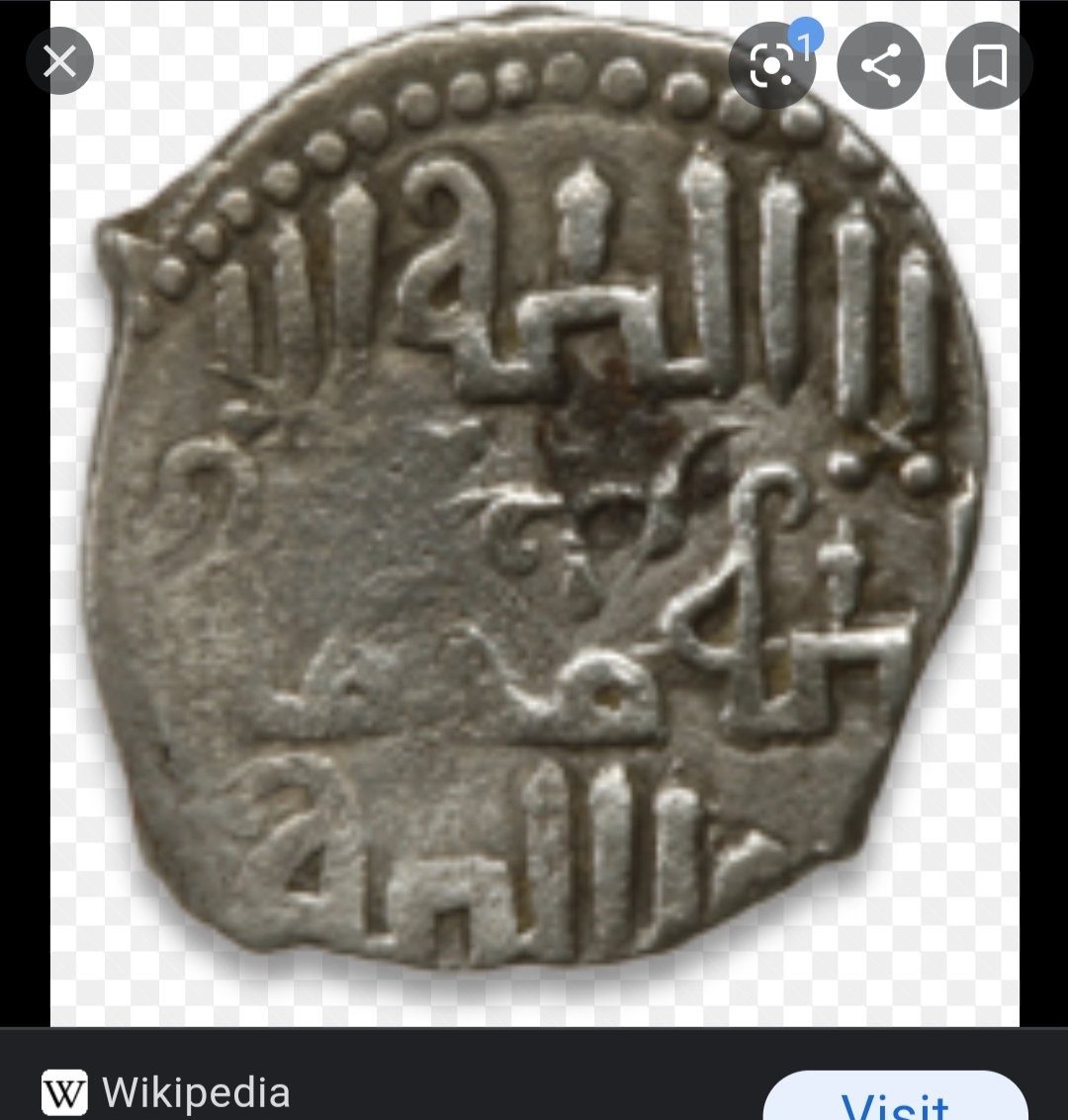
1078) Toregene Khatun

Coin dating from the time of Toregene's reign

1078: Töregene Khatun
Ruled the Mongol Empire from 1241 to 1246 AD

Born: c.1185 AD, Merkit Region of the Mongol Empire (Present-day parts of Mongolia and Russia)

Died: c.1265 AD, Mongol Empire

Töregene was the daughter-in-law of Genghis Khan (through a forced marriage). Her new Mongol husband was actually her second. Her first husband was a member of the Merkit tribe, which just so happened to have pissed off the Mongols. With Töregene now conveniently a widow, she was forcibly married off to Ögedei, becoming his second wife.

Ögedei was Genghis’s third son, and therefore never truly expected to ever be put in charge of the empire. Instead, Ögedei spent most of his time wenching and attempting to become the most lecherous alcoholic in his family.

Eventually, Ögedei was appointed leader of the Mongol Empire anyway (his two older brothers had disputed paternity—they may not have been Genghis’s biological sons, so power was given to Ögedei instead). He was completely disinterested in ruling, and since no other man around was willing to step up either, Töregene saw her opportunity and took it. While Ögedei was wasting money, drinking, organizing the raping of four thousand girls in a mass demonstration of power, and planning disastrous military campaigns, his wife decided enough was enough and made moves to save the empire before it was too late.

Töregene redid the empire’s tax code and began education and building plans across the empire. She even took the title of Empress (yeke khatun) while her husband was still alive; something unprecedented for her time period. Less than a year later, Ögedei died from complications of his alcoholism as well as a broken heart stemming from the death of his favorite son.

With Ögedei dead, Töregene managed to delay the coronation of his (male) replacement for five years, always coming up with another excuse for why the transition of power couldn’t take place. During that time (c.1241-1246 AD), Töregene herself managed to consolidate her own power and might over the empire. One-way Töregene ensured she stayed at the top was by replacing the staff that had been close to her husband with those loyal only to her. Of all of these new advisors, Töregene was closest to a woman named Fatima, who served as her confidant and advisor, and may have also been her lover. Fatima even received the title of “Khatun” or queen.

Töregene had five sons. But did she place any of them in prominent positions or power? No. Instead, Töregene and Fatima kept all the power for themselves (despite the fact that Fatima, a Shiite Muslim woman, was extremely unpopular). They ruled this way for several years, however Töregene knew better than anyone she couldn’t live forever. With that in mind, she began grooming her son Güyük to be her successor. Töregene had political opponents executed while more loyal subjects were granted the recently vacated positions all in an effort to smooth over the transition for Güyük to eventually take the throne. And one day, he did. Fatima and Töregene retired with the hopes of living out their days in peace.

Unfortunately, their peace was not to last. Güyük turned on his mother almost immediately. He undid the laws she had passed (most of which were unpopular anyway), executed the officials Töregene had placed in power, and then he did the unthinkable. Güyük accused his mother’s partner Fatima of witchcraft, and he demanded she be handed over for punishment and execution.

Töregene refused. Time and again she came up with new excuses for why Fatima could not be handed over. Eventually Güyük gave up on diplomacy and took Fatima by force, executing her soon after*. Töregene died around this time as well, though no one is certain of the circumstances surrounding her death, or even if it occurred before or after Fatima’s execution.

*According to Rejected Princess author Jason Porath, “Fatima’s death is grisly. She was first tortured into confession of witchcraft against…Toregene ... After that, because of a prohibition on the spilling of noble blood in the court, she had all her orifices sewn shut, got rolled up in a sheet of felt, and was tossed into a river to drown.”

Badges Earned:

Rejected Princess

Sources:

https://www.rejectedprincesses.com/princesses/toregene-khatun

https://www.mintageworld.com/media/detail/13149-the-great-mongolian-ruler-toregene-khatun/

http://unusualhistoricals.blogspot.com/2012/03/women-who-ruled-toregene-khatun-of.html

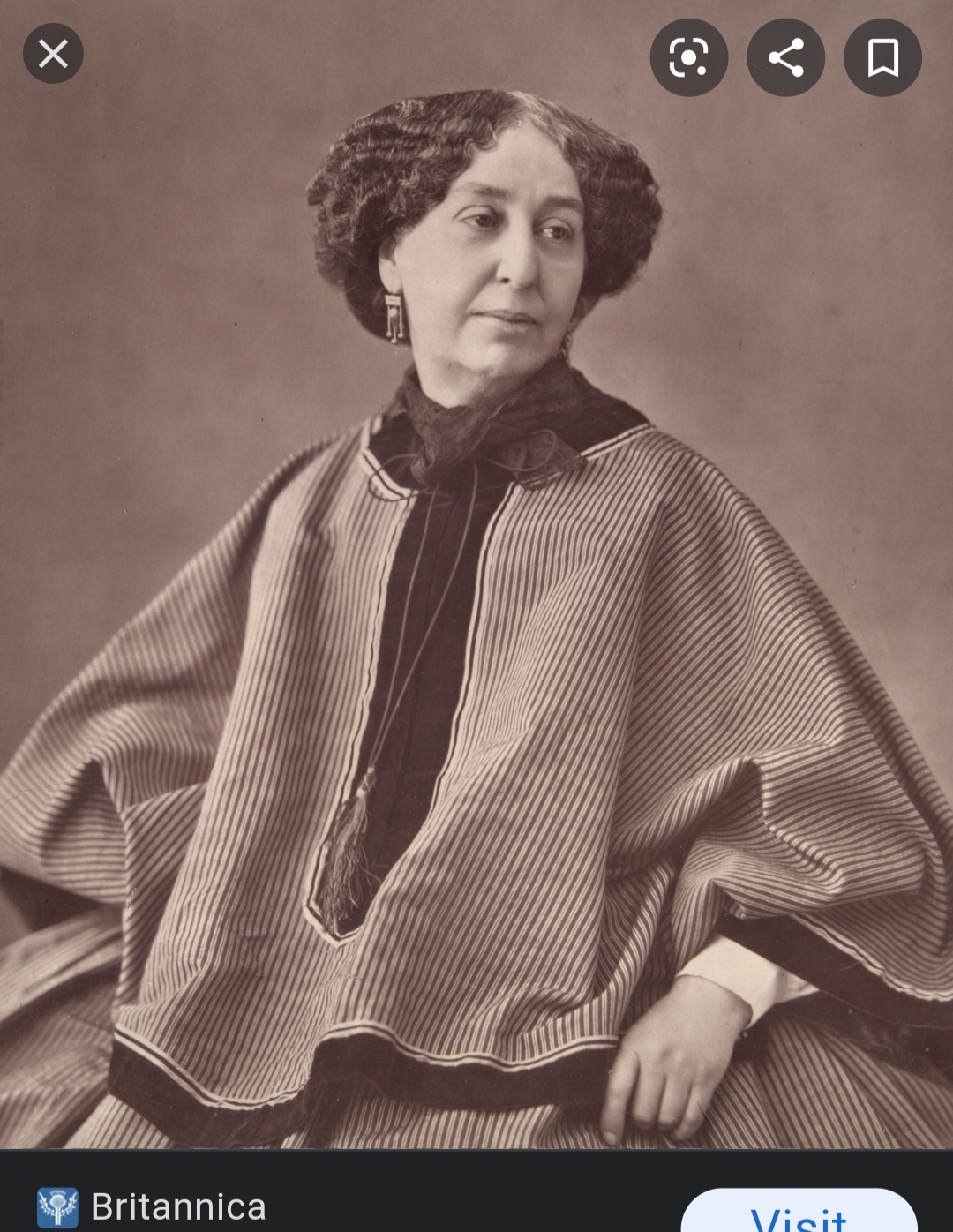
1077) George Sand

Courtesy of Britannica

“There is only one happiness in life, to love and be loved.”

“The world will know and understand me someday. But if that day does not arrive, it does not greatly matter. I shall have opened the way for other women.”

1077: George Sand

Novelist and Memoirist

Born: 1 July 1804, Paris, France

Died: 8 June 1876, Nohant-Vic, Centre, France

Original Name: Baroness Amantine Aurore Lucile Dupin (Dudevant)

George was known for her confidence, feminist writing, androgyny, and sexuality.

She wrote about women being trapped in unhappy marriages per the social climate of the time, as well as other topics about conventional womanhood that made her stand out from the crowd.

George was initially raised in the countryside at her grandmother’s estate after her father died when she was four, but she was eventually sent to a Paris convent school.

According to Notable Biographies, (article linked below): To save [George] from mysticism (the belief that communication with God can be achieved through spiritual insight), her grandmother called her to her home. Here [George] studied nature, practiced medicine on the peasants (poor, working class), read from the philosophers of all ages, and developed a passion for the works of French writer François René Chateaubriand (1768–1848). Her colorful tutor encouraged her to wear men's clothing while horseback riding, and she galloped through the countryside in trousers and a loose shirt, free, wild, and in love with nature.

In 1822, George married a man named Casmir, and though the marriage was happy enough in the beginning, George soon became bored with her conventional life and began having an affair with one of her neighbors. By then, George had become mistress of her grandmother’s estate after her grandmother had died, and so George was already set apart from the standard woman of her day.

In January 1831, George left home and moved to Paris to begin her literary degree. The following year, she officially took up the pseudonym George in time for her first novel’s publication: Indiana. After a few years, George and her husband received a legal separation and disillusion of their marriage. George retained custody of their daughter Solange, while Casimir took custody of their second child, a son named Maurice.

Over the years she had several affairs with various men (including the composer Chopin [and according to some sources, an unconfirmed affair with the female actress Marie Dorval as well]) and continued to publish a multitude of novels as well. George even managed to write several plays, pen various political works, and worked as a literary critic as well. She eventually became one of the most successful female authors of the nineteenth century. Elizabeth Barrett Browning wrote a poem entitled “George Sand: A Desire” in a clear nod and homage to George.

George was also known, as previously stated, for her androgyny. George was known to nearly always dress in male attire; men’s pants were more comfortable than a crinoline when traveling, and George just preferred men’s clothing in general. She was also known to smoke cigars in public, and loved to take her hookah pipe on the road with her as well.

In the last years of her life, she switched to writing her “rustic novels”, which her inspired by her love of her early childhood on her grandmother’s estate. She also wrote an autobiography as well as a book of stories for her grandchildren. Though she died at her home estate of Nohant, rumors first began to circulate in 2004 that George’s remains might one day be moved to the Pantheon in Paris. However, as of July 2021, those plans have never moved beyond anything other than a rumor.

Badges Earned:

Find a Grave Marked

Located In My Personal Library:

Historical Heartthrobs: 50 Timeless Crushes From Cleopatra to Camus by Kelly Murphy

Sources:

https://www.britannica.com/biography/George-Sand

https://www.notablebiographies.com/Ro-Sc/Sand-George.html

https://www.literaryladiesguide.com/author-biography/sand-george/

https://www.newworldencyclopedia.org/entry/George_Sand

https://www.findagrave.com/memorial/7752823/george-sand

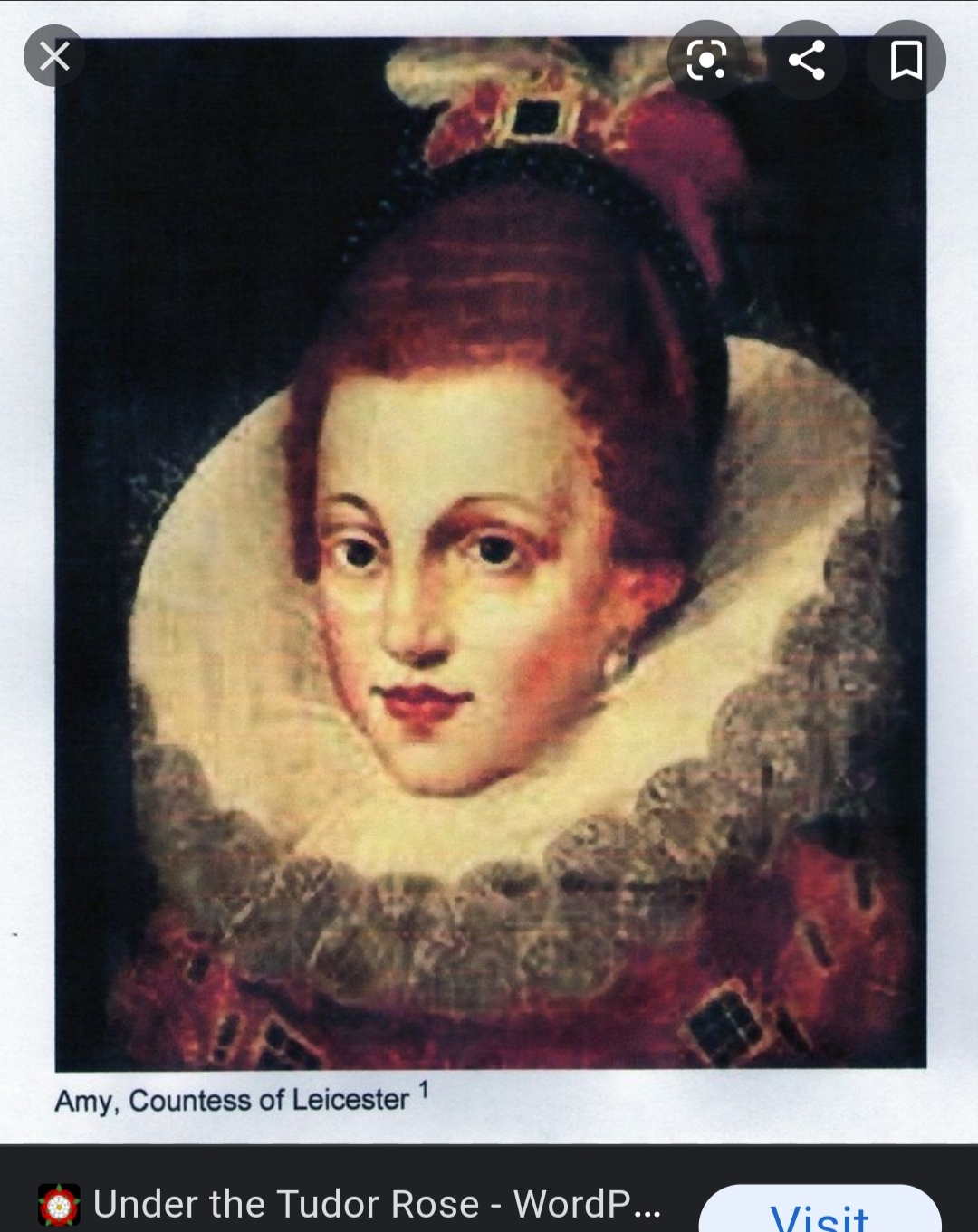
1076) Amy Robsart Dudley

Courtesy of Under the Tudor Rose

1076: Lady Amy Robsart Dudley

Accident or Murder Most Foul?

Born: 7 June 1532, Stanfield, Norfolk, England (Present-day Norfolk, England, United Kingdom)

Died: 8 September 1560, Cumnor, Oxfordshire, England (Present-day Cumnor, Oxfordshire, England, United Kingdom)

Amy was raised in a protestant family that was fairly well off, but very little else of her upbringing is known today. She was her father’s only legitimate child and seemed to have had a comfortable upbringing.

Amy was the first wife of Sir Robert Dudley, a high-ranking courtier in Queen Elizabeth I’s court. In fact, Robert Dudley was actually the only man Queen Elizabeth was said to have ever loved. As you can assume, his marriage led to a bit of friction between him and the queen.

Especially considering Amy and Robert’s marriage might have been one of love and not just a contract like so many others in their day were. At the time, they were both only around eighteen years old. Their marriage lasted ten years, but they were unfortunately separated several times over the years. Robert was arrested and kept imprisoned in the Tower of London for a year after the fiasco surrounding his sister-in-law, Lady Jane Grey’s, nine-day tenure as queen of England. A few years later, Robert was absent from his marriage once again as he was sent abroad to fight for Philip II of Spain in France (by then, Philip was married to Mary I, the queen regnant of England).

According to Tudor Society (article linked below): In November 1558, Mary I died and Elizabeth I, Dudley’s childhood friend, became Queen of England. Elizabeth soon rewarded Dudley for his friendship and support by making him Master of the Horse. This role required him to be away from Amy at court, and to spend most of his time with the Queen. Just five months later, ambassadors and diplomats were repeating the gossip that the Queen was in love with her favourite, Dudley, and that the couple were planning to marry after Amy's death – Amy had some malady in one of her breasts, probably breast cancer.

Evidence suggests Amy’s health had improved enough for her to visit her husband in May of 1859, but she would never see him again. When she died sixteen months later, her manner of death was extremely suspicious to say the least.

When Amy was only twenty-eight years old, she was found lifeless at the foot of the staircase in her home.

A jury of fifteen male neighbors decided her death was from an accidental fall resulting in two separate head wounds and a broken neck; and that she’d died instantly.

Copies of letters from the time indicate Amy may have had some form of mental instability or depression, leading others to conclude it may have been a suicide. However, others still think the queen had Amy done away with in order to bring Robert closer to her. If that was the case, the ploy didn’t work, because Robert ended up remarrying someone else.

On the day in question, Amy reportedly sent away all of the house staff to go to a local fair. She also attempted to get the other women also staying with her to leave as well, but three of the ladies said they did not want to go to the fair because it was a Sunday. One of the women had a meal with Amy but the other two simply remained in the house. For reasons unknown, Amy was very upset and angry throughout the day, and only hours after eating the meal with the two other ladies, Amy was discovered dead.

Over four hundred and fifty years later, the true nature of Amy's death remains a mystery. Unfortunately for her, it seems to at least some that Amy has not been able to spend the ensuing centuries resting in peace either. According to an article I found, Amy's specter has been seen at three separate locations from throughout her life. She also reportedly appeared to Robert and warned him of his impending death; a week before he passed away.

Badges Earned:

Find a Grave Marked

Located In My Personal Library:

Amy Robsart: A Life And It’s End by Christine Hartweg

Sources:

https://www.tudorsociety.com/4-june-1550-the-marriage-of-robert-dudley-and-amy-robsart/

http://www.berkshirehistory.com/bios/arobsart.html

https://www.tudorsociety.com/amy-robsart-really-know-christine-hartweg/

http://hauntedisles.blogspot.com/2014/09/the-ghost-of-amy-robsart-wife-of-sir.html

https://www.findagrave.com/memorial/209315914/lady_amy-dudley

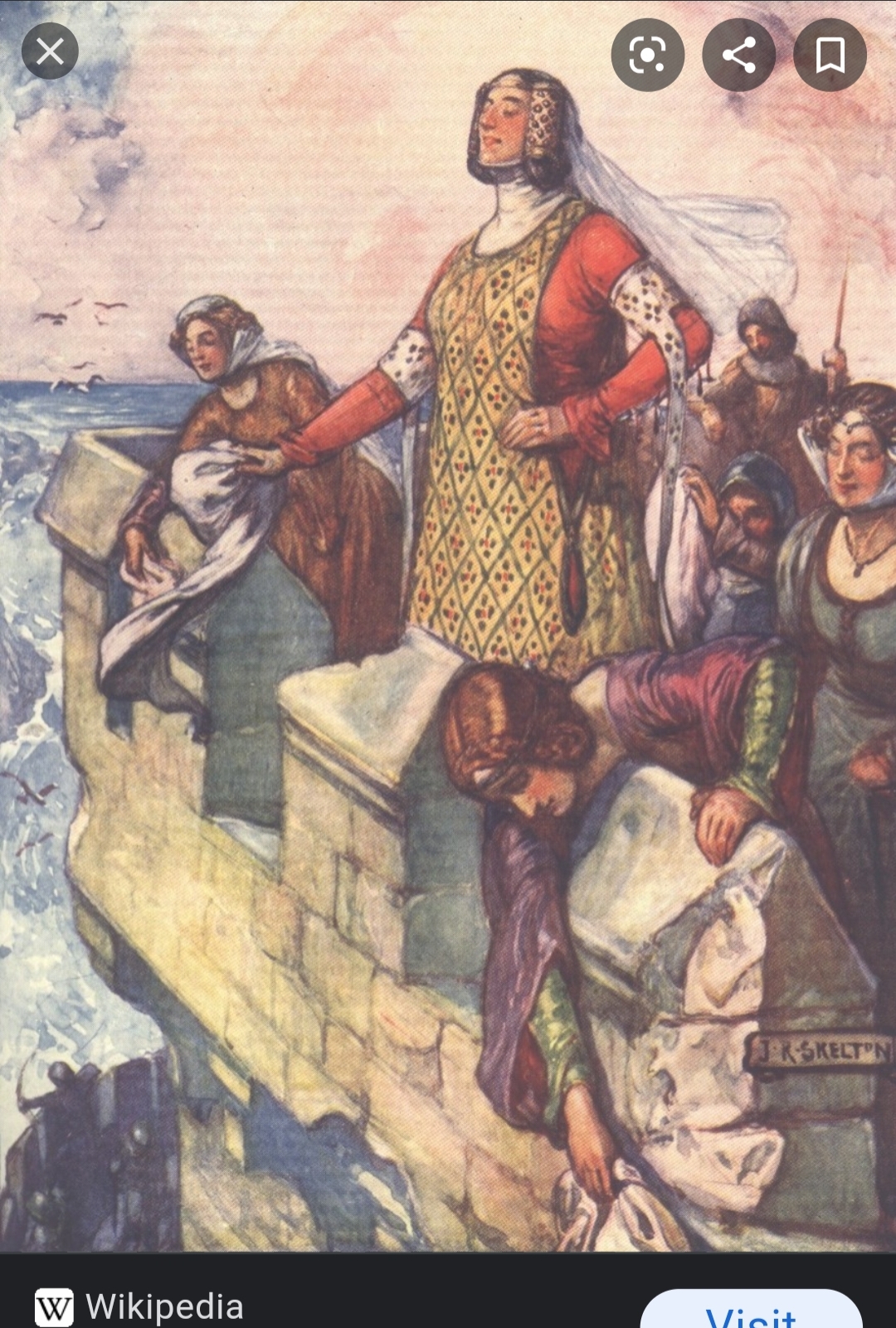
1075) Agnes Randolph

Courtesy of Wikipedia

1075: Agnes Randolph

Heroine of Scotland

Born: c.1312, Kingdom of Scotland (Present-day Scotland, United Kingdom)

Died: c.1369, Kingdom of Scotland (Present-day Scotland, United Kingdom)

Also Known As: Black Agnes

Agnes was the Countess of Dunbar and March. She also held the following (according to her WikiTree profile): From her brothers she obtained by inheritance the Isle of Man, the Lordship of Annandale, the baronies of Morton and Tibbers in Nithsdale, Mordington, Longformacus, and Duns, in Berwickshire; Mochrum in Galloway, Cumnock in Ayrshire, and Blantyre in Clydesdale.

The year was 1338, and twenty-four years earlier the formidable Robert the Bruce had driven the English from Scotland’s lands. However, the English had never taken that slight lightly and returned to Scotland intent on taking the kingdom once and for all.

Unfortunately for them, Agnes got in their way (and was evidently one of Robert the Bruce’s great-nieces through her father, according to one source).

The English assumed Dunbar Castle would be relatively easy to take. After all, its lord, Patrick, the Earl of Dunbar and March, wasn’t home at the time. Instead, he was fighting for the Scottish Army in the North, leaving the castle in his twenty-six-year-old second wife’s hands.

Known as Black Agnes because of her darker complexion and hair, Agnes wasn’t the diminutive wife the English were expecting her to be. When asked to surrender her home, Agnes’s response was (supposedly):

‘Of Scotland’s King I haud my house,

He pays me meat and fee,

And I will keep my gude auld house,

While my house will keep me.’

According to Historic UK (article linked below): The Earl of Salisbury, the English commander, opened the siege by hurling huge rocks at the walls of the castle using great catapults. Between these attacks, and in clear view of the English, Agnes sent her maids dressed in their Sunday finest onto the ramparts to dust and clean the marks of the shot from the walls with their dainty white handkerchiefs.

When his initial plan failed, the Earl of Salisbury next unveiled a large battering ram with which he hoped to break open the walls to the castle. Agnes, upon seeing the battering ram, responded by having large boulders dropped on it. The battering ram was destroyed and the Englishmen who had survived the onslaught ran for it.

The siege dragged on for five long months, all through the winter and into spring. Just when the English hoped for a surrender, the castle was resupplied by two boats that entered through a half-submerged concealed doorway. As the story goes, Agnes had a bottle of wine and a loaf of freshly baked bread delivered to the Earl of Salisbury come the next morning.

Soon after, Agnes’s brother (who had previously been captured and was held by the English) was delivered to the frontlines of the siege. The Earl of Salisbury announced that if Agnes did not surrender the castle, they would kill her brother. Agnes reportedly told the English to go right ahead. Her brother, The Earl of Moray, had no children of his own. Therefore, should he die, Agnes would inherit the title.

Sounds cold, but the ploy worked. The English did not execute Agnes’s brother after all.

Finally, in early June, the English gave up and marched away, realizing they would never get the better of Agnes.

After the siege she fades from history. Today, historians don’t know if Agnes or Patrick had any children, and if they did, if they outlived their parents. One source states that their shared titles passed down to Agnes’s sister and Patrick’s brother, the two of whom had married themselves.

Not much of Dunbar Castle survives to present day, but there are a few ruins—mostly bricks on a small patch of green earth. The source I found that goes into further details about the Castle also noted that an apparition has been seen on the castle grounds; a ghostly figure of a woman reportedly claimed to be that of Black Agnes herself. It seems that, even seven hundred and fifty-odd years after her death Agnes continues to defend her home.

Badges Earned:

Find a Grave Marked

Rejected Princess

Located In My Personal Library:

The Warrior Queens by Antoina Fraser

Sources:

https://www.historic-uk.com/HistoryUK/HistoryofScotland/Black-Agnes/

https://www.undiscoveredscotland.co.uk/usbiography/r/agnesrandolphdunbar.html

https://www.wikitree.com/wiki/Randolph-348

https://www.rejectedprincesses.com/princesses/black-agnes

https://www.findagrave.com/memorial/194275168/agnes-randolph

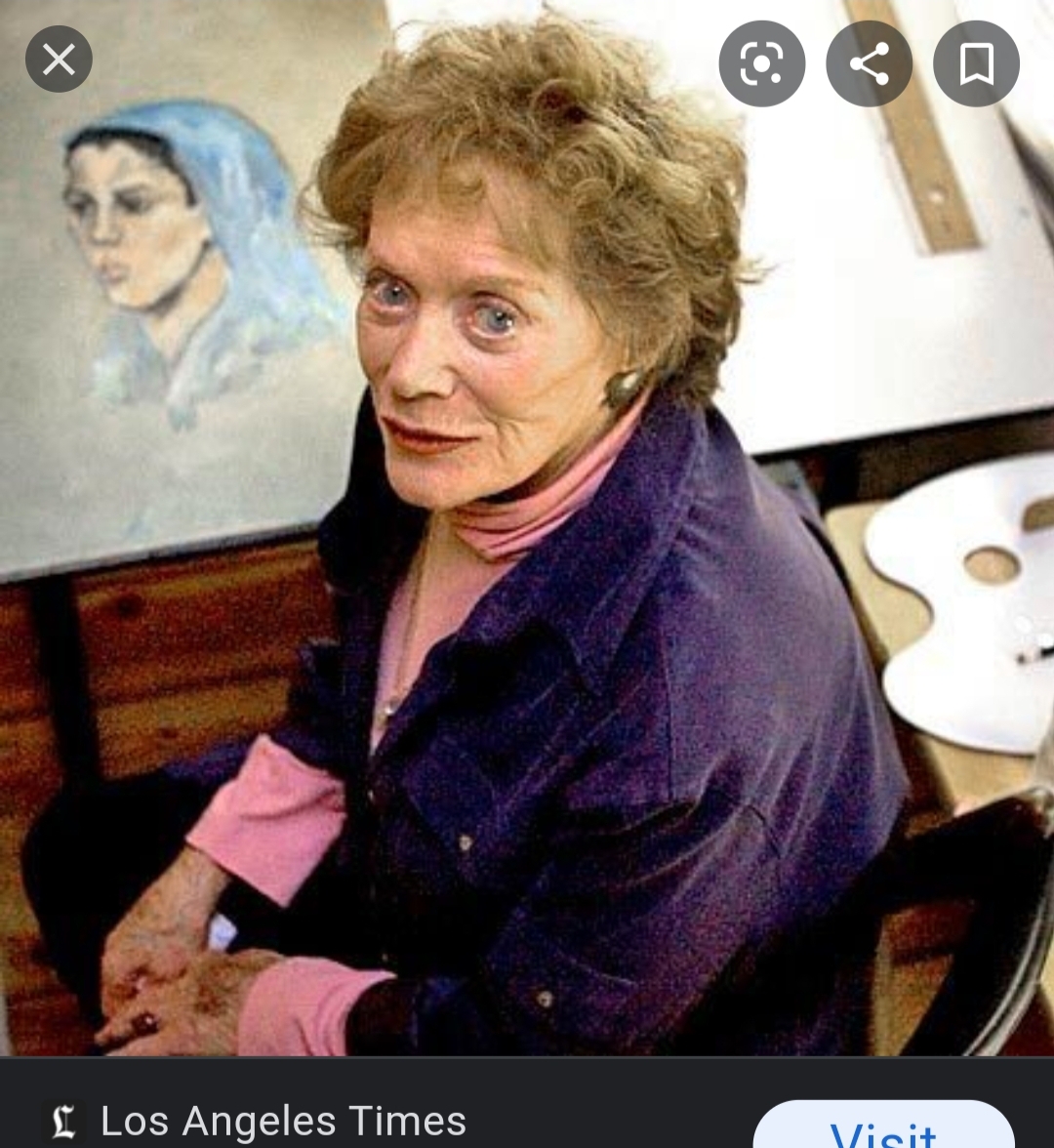
1074) Dina Babbitt

Courtesy of the Los Angeles Times

“I wouldn’t be alive if it hadn’t been for those paintings, and my kids wouldn’t be here."

1074: Dina Gottliebova Babbitt

Shoah Survivor Whose Ordeal Didn’t End with the Liberation of the Camps

Born: 21 January 1923, Brno, Czechoslovakia (Present-day Brno, South Moravia, Czech Republic)

Died: 29 July 2009, Felton, California, United States of America

Original Name: Annemarie Dinah Gottliebova

She had been an art student in her native country when she was deported to the concentration camp. Dina reportedly painted a scene from Snow White on the walls of the children’s barrack to help the kids find some semblance of cheer in the dark times. After word got around, Dr. Mengele forced Dina to paint portraits of fellow inmates in order to prove their racial inferiority (in his eyes). Though Dina’s father and fiancé died during the Shoah, she was able to save her mother’s life by telling Mengele she would not paint for him unless her mother lived. In response, Mengele reportedly asked Dina, “What’s her number?”

Dina was an assistant-animator in Hollywood after the war. She married and had two children, but later divorced her husband. She had her tattoo removed during an unrelated surgery at some point, but a scar in the spot remained. Dina quipped she sometimes used her tattoo (61016) as a lottery number.

In 1963, six of her portraits of Romani “gypsies” were discovered (a seventh was found in 1977) and Dina was notified by the museum of their existence after it was confirmed she was the original painter in 1973. Ever since, Dina and her family have been fighting to get those paintings back; which are currently held by the Auschwitz-Birkenau Memorial and Museum (who bought the paintings from survivors and therefore claim ownership of them). Dina wanted the paintings back, not to keep in a private collection in her own home, but because she saw them as her own. Dina wanted to be able to hold the paintings one more time, then donate them to a museum of her own choice. Sadly, she died before that dream could ever come true.

The US State Department and the Institute for Holocaust studies in Washington DC all tried to help the family but were unsuccessful. At one point, there was even a petition signed by over 400 comic book legends (including Stan Lee) to try and get the paintings restored to Dina.

In 2017, the paintings were part of an exhibit at the museum without the family’s permission. The museum was also planning on copying the paintings into books to sell—again without the family’s permission, and in violation of the permitted public use agreement the museum signed with the family, which states the museum is not allowed to profit off of Dina’s artworks.

According to Dina’s daughter Karin, “My mom was tortured, forced to draw for Dr. Mengele. Her work is being exploited. This is not an exhibit to say the Holocaust should never happen again. They are extorting the work of her hands. This is a public, intimate raping of Jews. If she was still alive, she would go and handcuff herself to the exhibit to be with her paintings and to make a statement… Ultimately, my mother got a letter saying if [the paintings] belong to anyone, they belong to Dr. Mengele and his heirs since they were painted under his employment. How do I feel about that? That they were ‘commissioned’? She told them every day, ‘I will hold onto the wire of the electric fence because life is meaningless.’ This is commissioned?... The one dream my mother had was that she wanted her paintings to be displayed in America because she was an American and proud to be one. If my mother knew I was crying, she’d be furious. ‘If you cry,’ she would say, ‘they win.’” (Courtesy of the JWeekly article linked below).

The Holocaust Museum continues to state the paintings’ historical significance supersedes the family’s right to them.

Dina was eighty-six when she passed away from cancer. Just before she died, the museum sent Dina and her family “reproductions” of her original paintings, but still refused to give up the originals. Dina never opened the copies.

Badges Earned:

Find a Grave Marked

Located In My Personal Library:

Ink & Paint: The Women of Walt Disney's Animation by Mindy Johnson

Sources:

https://www.latimes.com/nation/la-me-dina-babbitt1-2009aug01-story.html

https://www.jweekly.com/2017/08/15/auschwitz-forced-paint-now-family-wants-art-returned/

https://www.nytimes.com/2009/08/02/arts/02babbitt.html

https://www.findagrave.com/memorial/40129244/dina-gottliebova-babbitt

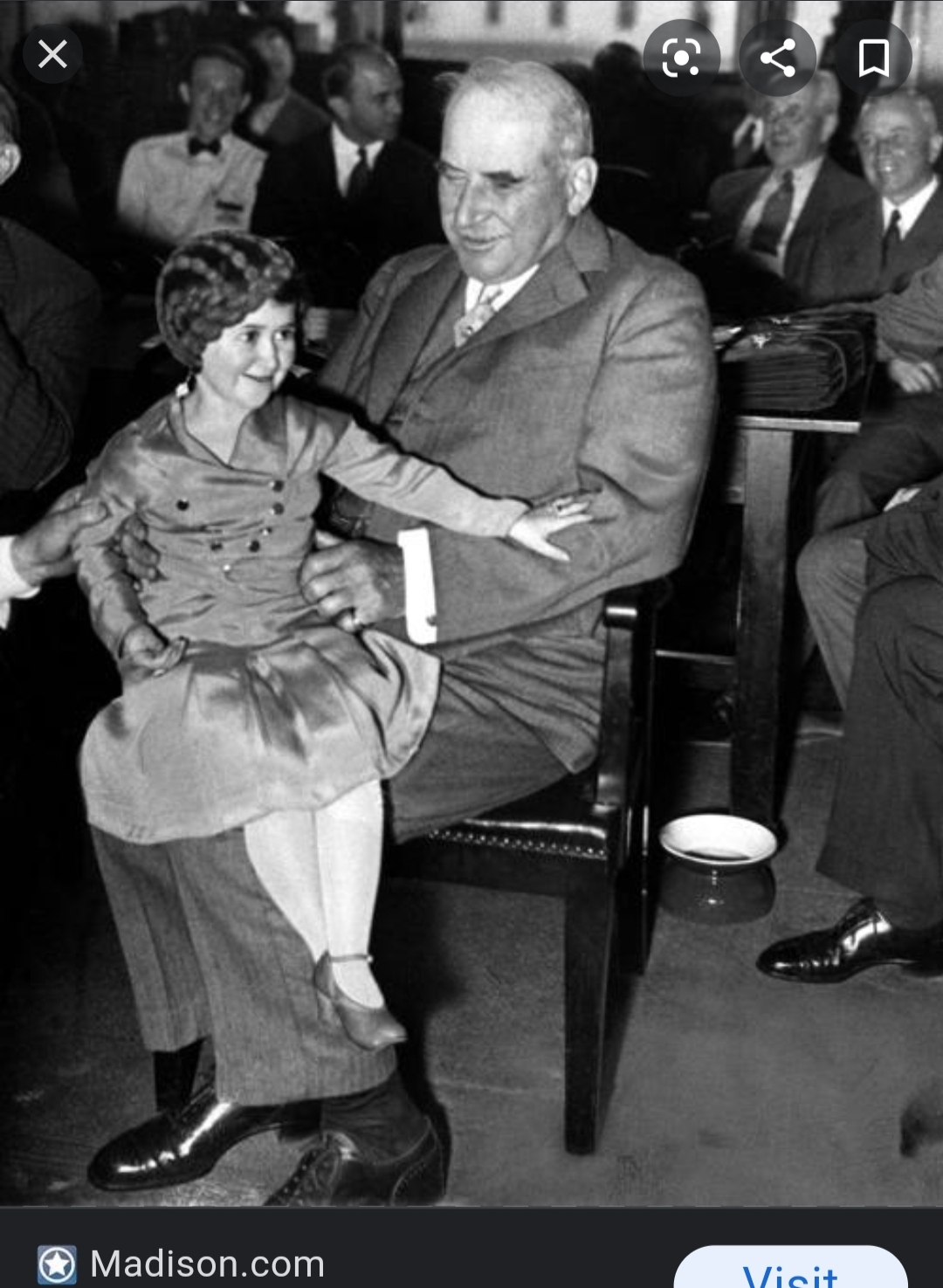
1073) Lya Graf

Courtesy of Madison

1073: Lya Graf

Immortalized in a Photo in Which She is Sitting on JP Morgan’s Lap

Born: c.1901-1913, Germany

Died: 1941, Auschwitz Concentration Camp (Present-day Oswiecim, Poland)

Original Name: Lia Schwartz

Lya was born with a form of dwarfism. She was twenty-seven inches tall and wanted no part of being in the photos (which took place moments before a United States Senate committee meeting in 1933).

Lya was apparently planted there by a Barnum and Bailey employee (she worked for the circus at the time). According to American Heritage, JP Morgan and Lya had the following conversation while the photos were being taken:

“I have a grandson bigger than you,” he said.

“But I’m older,” Miss Graf replied.

“How old are you?”

The press agent said she was thirty-two, but Miss Graf corrected him:

“I am not—only twenty.”

“Well, you certainly don’t look it,” Morgan said.

In 1935, Lya returned to Germany after being hounded by the press in the United States, wanting a simpler life once again.

In 1937, Lya was arrested by the Nazis for being half-Jewish and a dwarf. She was undesirable to the Nazi regime, and died four years later in the most notorious of all their concentration camps.

Very little else about Lya’s life is known, and even the included facts here are not entirely certain. Lya’s story is so obscure she doesn’t even have a Wikipedia page! However, the fact that only a little is known about her does not mean she should not be remembered here.

Sources:

https://www.americanheritage.com/millionaire-midget

http://www.divergingfates.eu/index.php/2017/03/31/lya-graf-lia-schwartz-1913-1941-the-smallest-woman-in-the-world/

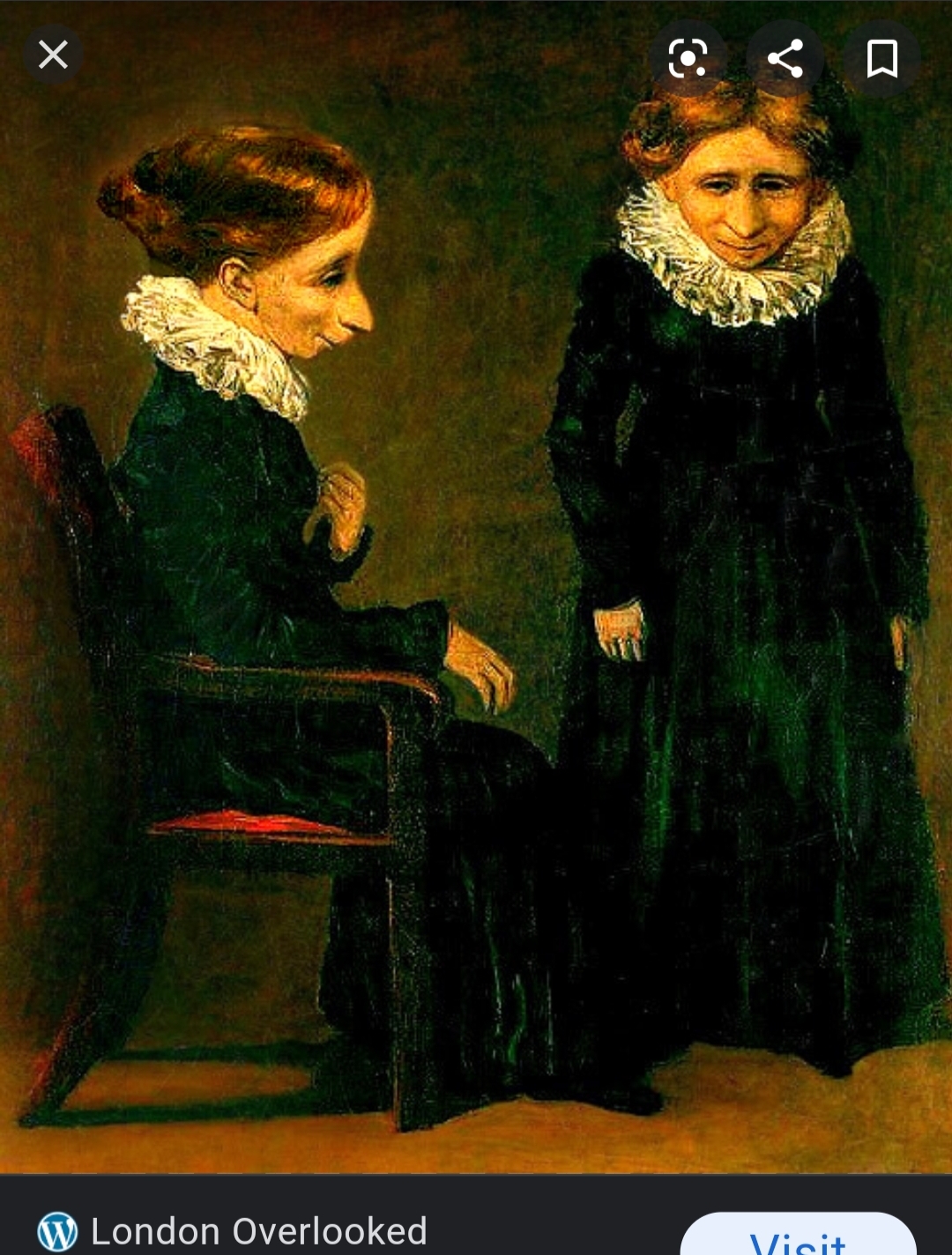
1072) Caroline Crachami

Courtesy of London Overlooked

1072: Caroline Crachami

One of the First Well-Known Cases of Dwarfism

Born: 1815, Either Italy or Ireland*

Died: 3 June 1824, West London, England, United Kingdom

Also Known As: The Sicilian Fairy or The Sicilian Dwarf

Possible Real Name: Caroline Foghell

In 1824, Caroline arrived in London to be put on display as a human curiosity by a man claiming to be her father. However, the true details of her life story are in extreme doubt today, and very little is known for certain.

What is known is that when Caroline died, she was twenty-two inches tall, between five and six pounds, and the man she was with claimed she was nine years old. One source claims she had been in fragile health her entire life, and after catching a cough died of tuberculosis.

However, later analysis of her teeth left scientists wondering if her story was actually true. The analysis of the teeth showed that Caroline was actually closer to that of a three-year-old and not a nine-year-old as claimed.

The story gets even sadder, however. Soon after Caroline died, a man arrived in London claiming to be Caroline’s real father. He attempted to put a stop to her already planned autopsy, but he arrived too late. Within four days of Caroline’s death, her body was received by the Royal College of Surgeons in London for examination. Her skeleton remains on public display in the Hunterian Museum there today, alongside the “Irish Giant” Charles Byrne, who stood at over eight feet tall in life and asked for his skeleton to not be put on public display after his death.

According to the London Dead (linked below): Caroline is still on show at the Hunterian Museum along with a death mask, a ‘very unlike’ portrait, her shoes, the clothes she was wearing when she died and a tiny ring. She is now considered to have suffered from Seckel syndrome, a form of microcephalic primordial dwarfism.

*Depending on which source you believe, Caroline’s family was either from Dublin or Sicily. Some sources claim both are true—that her father was ethnically Italian but was living in Ireland by the time Caroline was born. We may never know for certain where Caroline was born, or the other exact details of her life, but we can remember her, and hope for the day when her body is given a proper and dignified burial as she deserves.

Badges Earned:

Find a Grave Marked

Sources:

https://pubmed.ncbi.nlm.nih.gov/9545099/

https://pubmed.ncbi.nlm.nih.gov/1456294/

https://london-overlooked.com/sicilian-dwarf/

http://thelondondead.blogspot.com/2013/12/caroline-crachami-sicilian-fairy.html

https://www.thehumanmarvels.com/caroline-crachami-the-sicilian-fairy/

https://www.findagrave.com/memorial/15057751/caroline-crachami

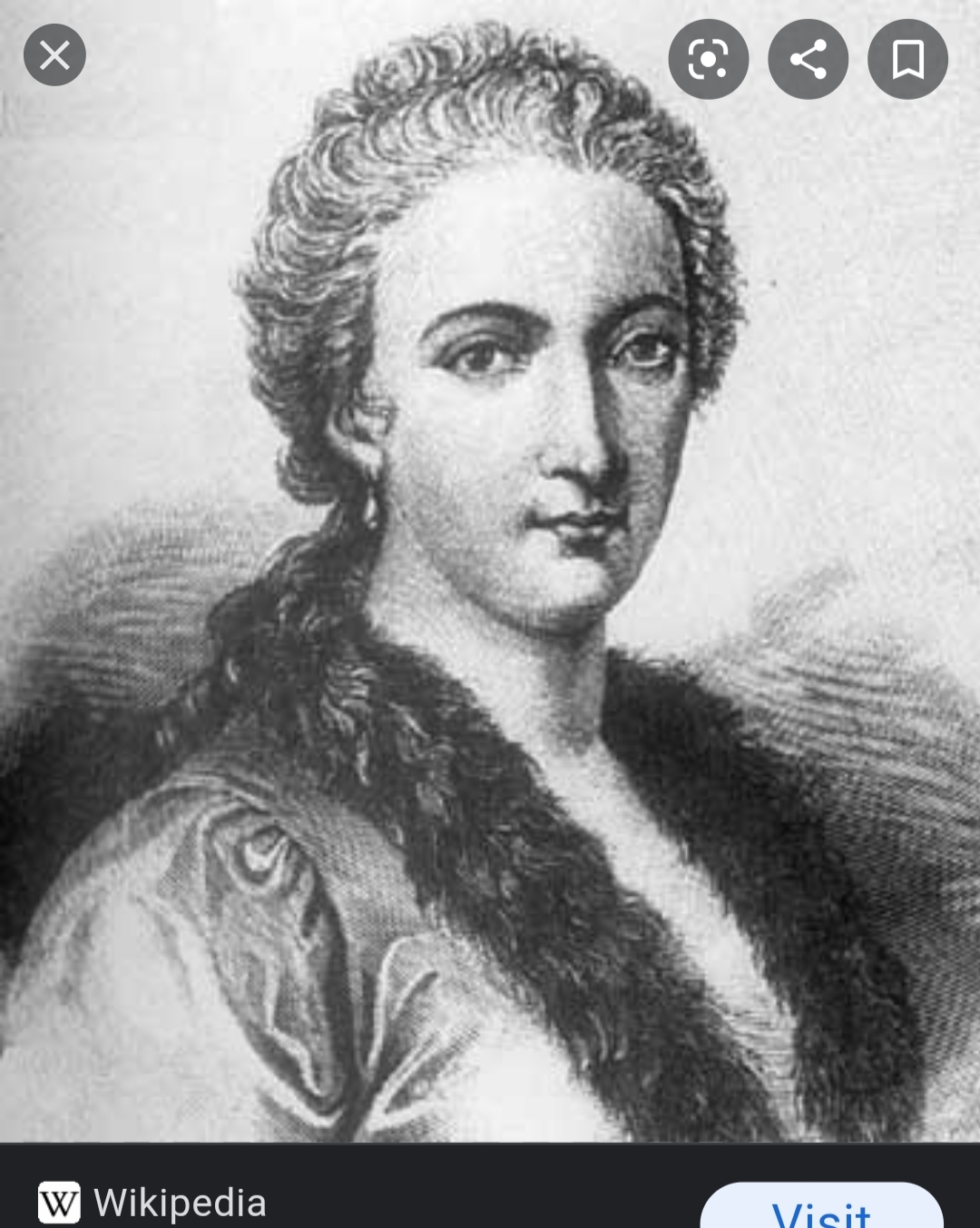
1071) Maria Gaetana Agnesi

Courtesy of Wikipedia

“The human mind contemplates [the virtues of Christ] with marvel. The heart imitates them with love.”

1071: Maria Gaetana Agnesi

The First Woman to Write a Well-Known Calculus Textbook

Born: 16 May 1718, Milan, Habsburg Crown Lands (Present-day Milan, Italy)

Died: 9 January 1799, Milan, Habsburg Crown Lands (Present-day Milan, Italy)

Maria was a linguist, mathematician, and philosopher. She is most known among mathematicians these days for her formula, the Witch of Agnesi, which is still taught in Calculus classes today. Though some articles will claim Maria was also the first female mathematics professor, this isn’t exactly true. She was granted an honorary position on the faculty of the University of Bologna by Pope Benedict XIV, but she never actually taught there. Nor do any records indicate she even visited the city of Bologna during her lifetime.

According to Smithsonian Magazine, (article linked below): That a devout Catholic woman who dedicated decades of her life to serving the poor should be perpetually associated with a witch via a curve she didn’t even invent is ironic to say the least. But in some ways it feels fitting. “It really is like a Freudian slip of the mathematical imagination to make the Italian word ‘curve’ into the Italian word for a diabolically possessed woman,” says Stanford University science historian Paula Findlen. “It’s a great mathematical joke.” Whether he was being deliberately punny or not, Colson’s mistranslation has cemented Agnesi’s place in calculus classes.

According to several sources, Maria was the oldest of her father’s between twenty-one and twenty-three children (he had three wives, but even still—dang!). She was extremely well educated in mathematics as well as languages. Maria was fluent in Greek, French, Latin, Hebrew, Spanish, and German, most of which she had mastered by the age of eleven. Alongside her younger sister, Maria Teresa—a musical prodigy in her own right, Maria Gaetana would give lectures on various scientific fields with her father’s urging. The two sisters would draw attention to the family and elevate their social standing.

Maria never married and instead wrote and published a collection of essays expressing her wish for women to be educated. After her mother died, Maria had to take over as head of the household for her father, and some scholars believe this is why she never married. However, another source points out that around this same time, Maria told her father she intended to become a nun. While that wish never came true, Maria did devote the rest of her life to charity and other devotional works within her church.

When Maria was thirty, she published her math textbook entitled Instituzioni analitiche ad uso della gioventù italiana (Analytical Institutions for the Use of the Italian Youth). The book was groundbreaking, not least because it was written by a woman, but also because it was one of the most in-depth calculus books ever written (the first calculus textbook to be written about both differential and integral calculus) and the book was published in Italian. At the time, the vast majority of scholarly pursuits were written in Latin, but Maria decided to write the book in Italian so that it would be more accessible to a wider variety of students.

Maria spent the last forty-seven years of her life using her considerable wealth opening homes and caring for the less fortunate. She gave up her work with mathematics entirely after the death of her father, and some scholars also believe she only ever worked in the field to begin with because of her father’s urgings. Maria’s true passion was seemingly in charitable works and helping the less fortunate.

She eventually became the director of the women’s section of the Pio Albergo Trivulgio; which was a shelter for the poor and sick at the time. She eventually passed away in one of the very poorhouses she herself had once worked.

Though Maria isn’t a saint in the Catholic church, her devotion to God and religion were profound. Today, modern scholars have a hard time separating the religiously attuned woman from the mathematician who was so talented but also so uninterested in further pursuing her field. Its hard to rectify a woman whose two sides were so completely different from one another, but Maria exemplified that very virtue.

Badges Earned:

Find a Grave Marked

Located In My Personal Library:

Hypatia’s Heritage: A History of Women in Science from Antiquity to the Late Nineteenth Century by Margaret Alic

Sources:

https://www.agnesscott.edu/lriddle/women/agnesi.htm

https://www.smithsonianmag.com/science-nature/18th-century-lady-mathematician-who-changed-how-calculus-was-taught-180969078/

https://www.famousscientists.org/maria-gaetana-agnesi/

https://www.britannica.com/biography/Maria-Gaetana-Agnesi

https://www.findagrave.com/memorial/67937077/maria-gaetana-agnesi

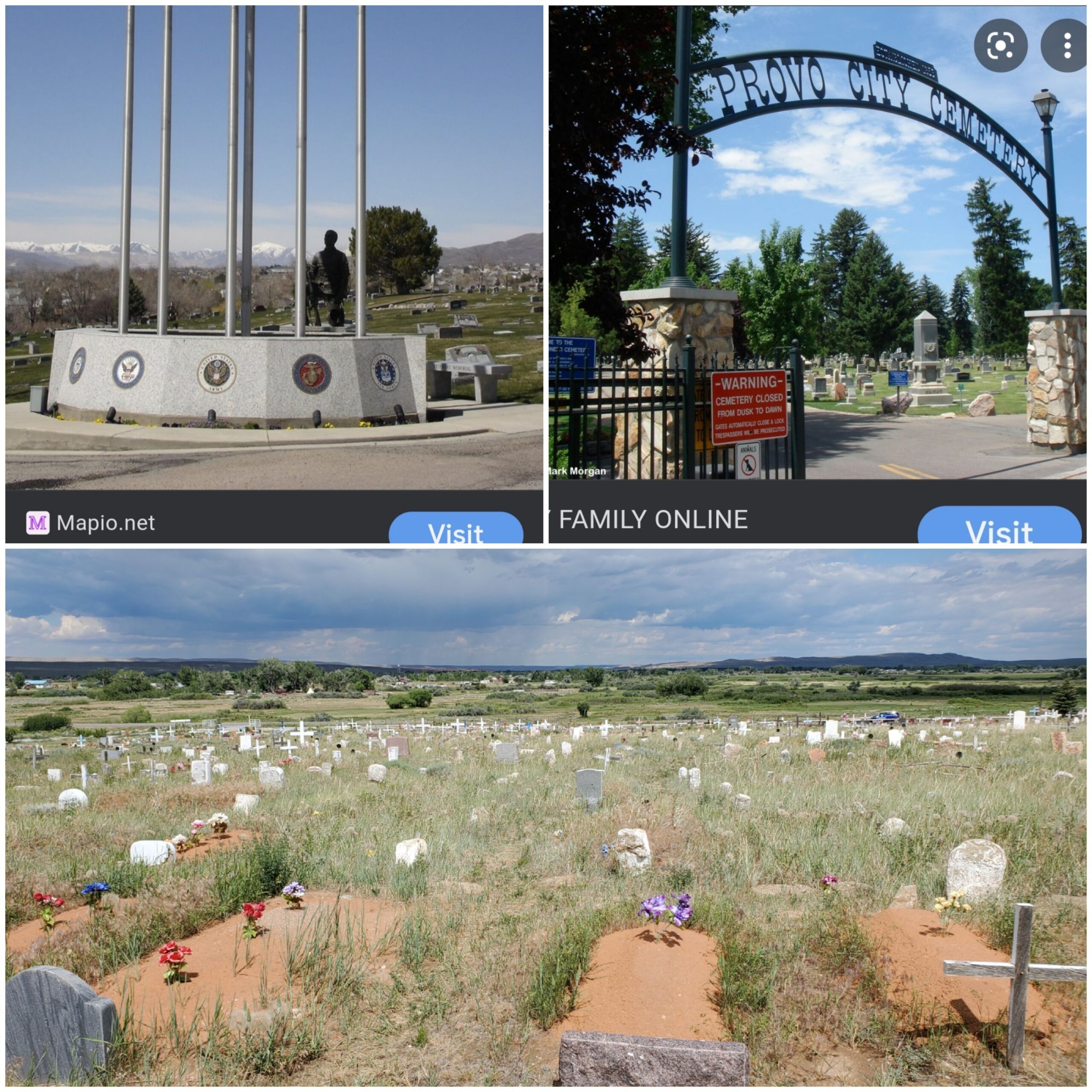
Provo City, American Fork, and Sacajawea Cemeteries

Posted on June 27, 2021January 16, 2022 by nickssquire12

Over the past two days, my mother and I have visited three more cemeteries: Provo City (Provo, Utah), American Fork (American Fork, Utah), and Sacajawea (Fort Washakie, Wyoming--Located on the Wind River Reservation).

I wanted to visit each cemetery for a specific purpose; someone from my lists are buried in each one.

Provo City was first. This sleepy little cemetery is tucked away in the university town of Provo. When my mother and I visited, around five PM on a Saturday afternoon, only two other cars with other visitors were there with us. Provo is most well known today for being the home of Brigham Young University (BYU), and so of course the majority of folks who live, and have died, in the city are members of the Church of Jesus Christ of Latter Day Saints. Though not LDS (or more commonly known as Mormon) myself, my hometown is also largely populated by the LDS community and so their customs and iconography are familiar to me. My mother and I almost felt home when we saw the multitude of headstones engraved with an image of a temple; only in this case the majority of these grave markers showed the local LDS temple in Provo and not the one we are more familiar with--though there was one headstone in the Provo City Cemetery that showed the temple located in my hometown, so that was pretty cool.

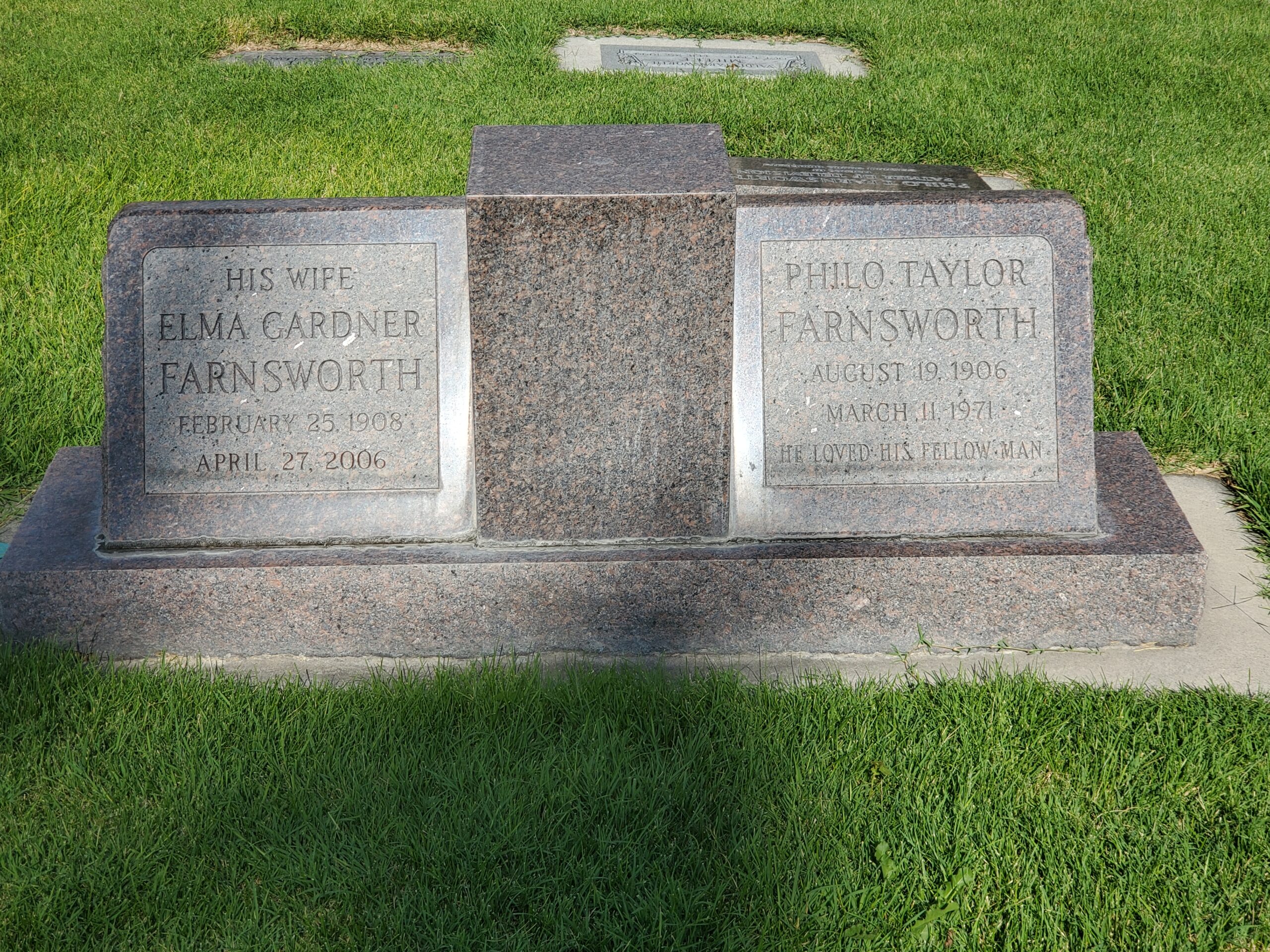
With all that said, the person I most wanted to visit in Provo City Cemetery was Philo Farnsworth, the inventor of the all-electronic television and so much more. For a man who gave the world so much, his final resting place is fairly simple. Philo died in Salt Lake City, but is buried in Provo. The GPS coordinates listed on Find a Grave can be linked through Google Maps, and if you use that link you will get fairly close to his gravesite, but its not exact. In any case, my mother and I found Philo and his wife within a few minutes of arriving within the cemetery.

Philo Farnsworth Grave

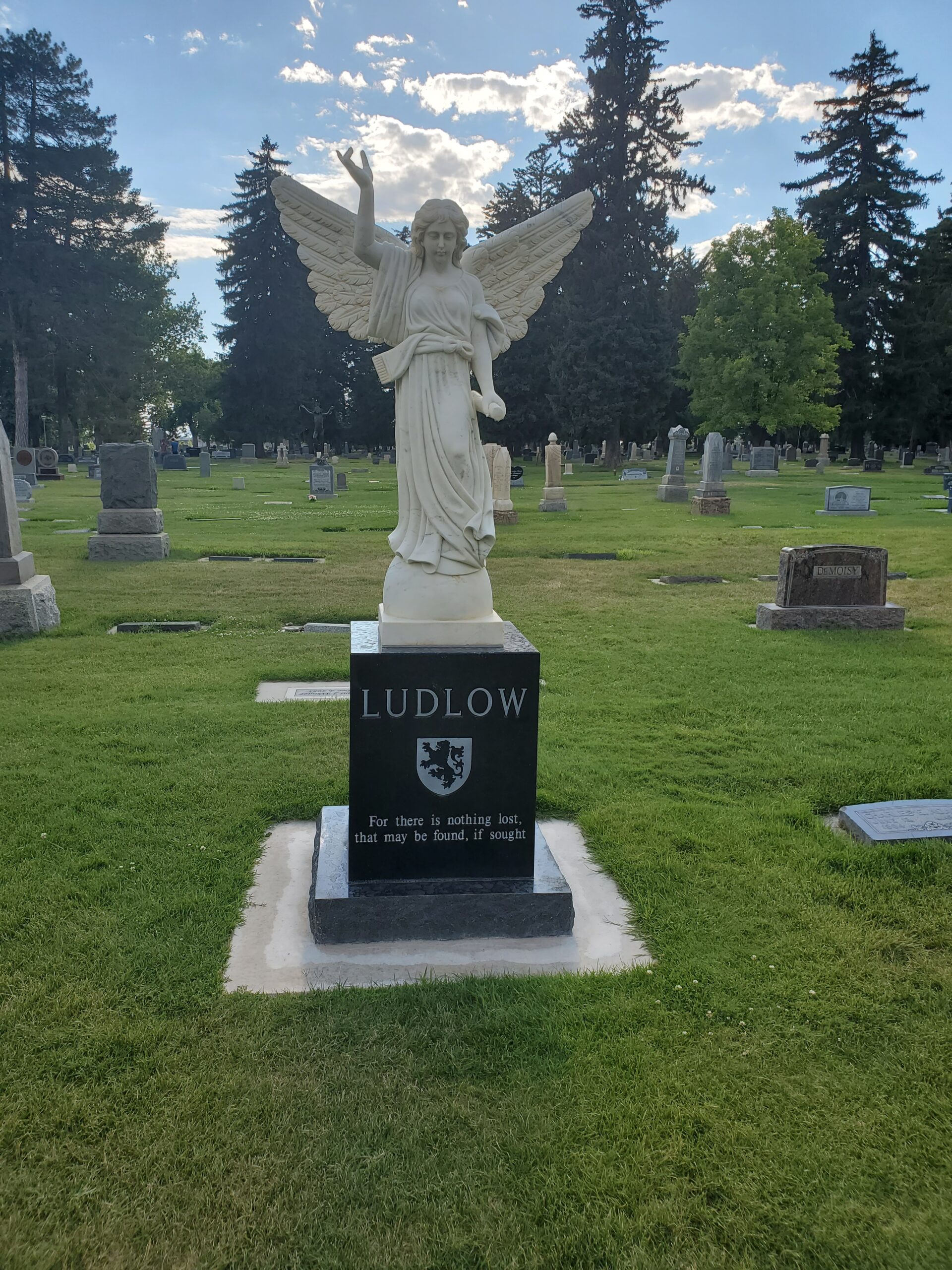
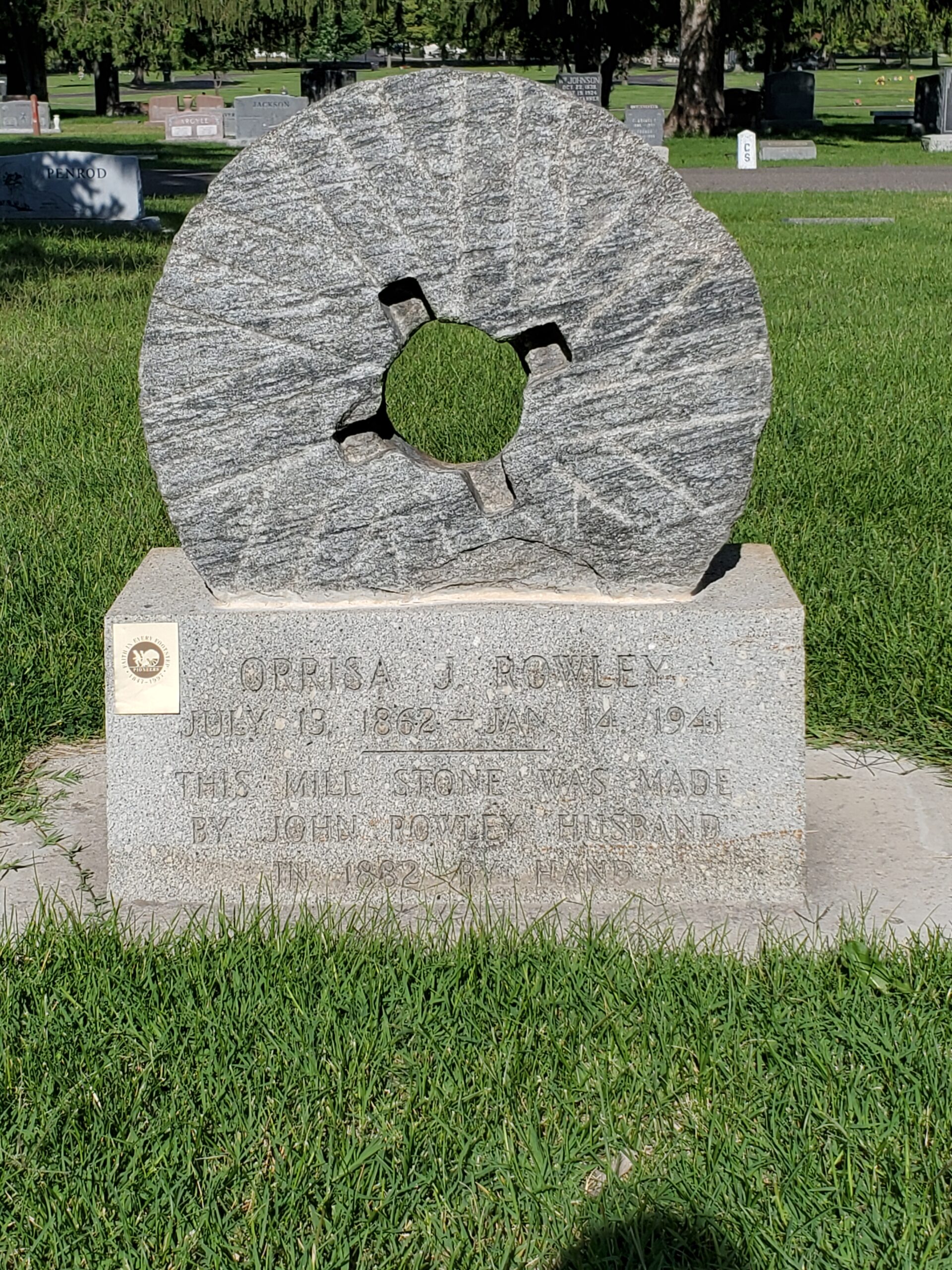
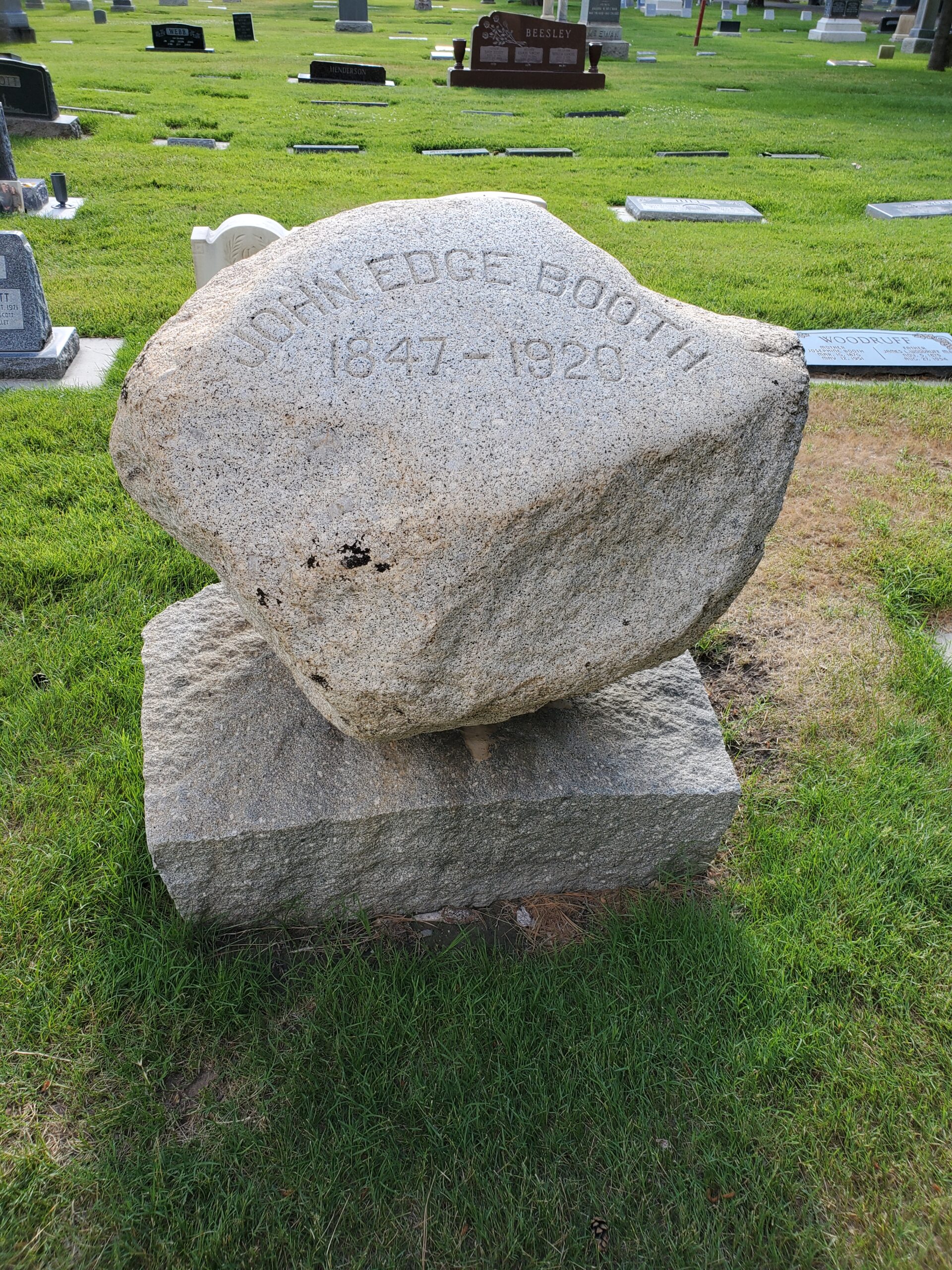
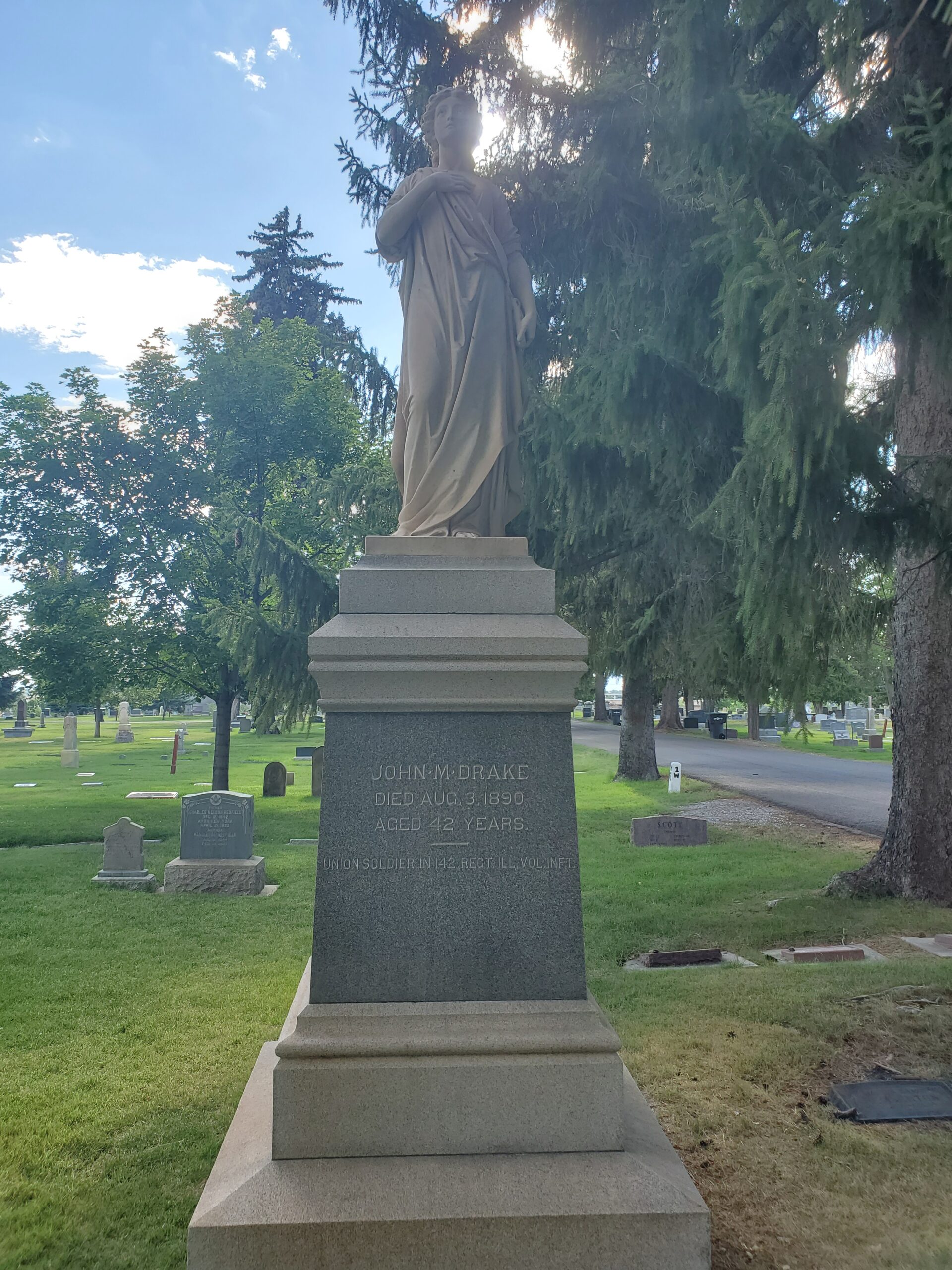
Provo City Cemetery is a good mix of different types of headstones and grave markers. Most traditional city cemeteries that are still allowing burials today have mostly flat along the ground or upright rectangular markers. Provo City does have a mix of these more traditional markers, but there was a variety of other sculptures and other works of art to designate a final resting spot within the cemetery as well. Here are a few of the more unique markers we spotted.

This grave was marked with a tall angel statue
This grave is marked with a millstone made by the deceased's husband in the 1800's
This grave marker is a simple boulder engraved with a name
This grave is adorned with a white statue to top it
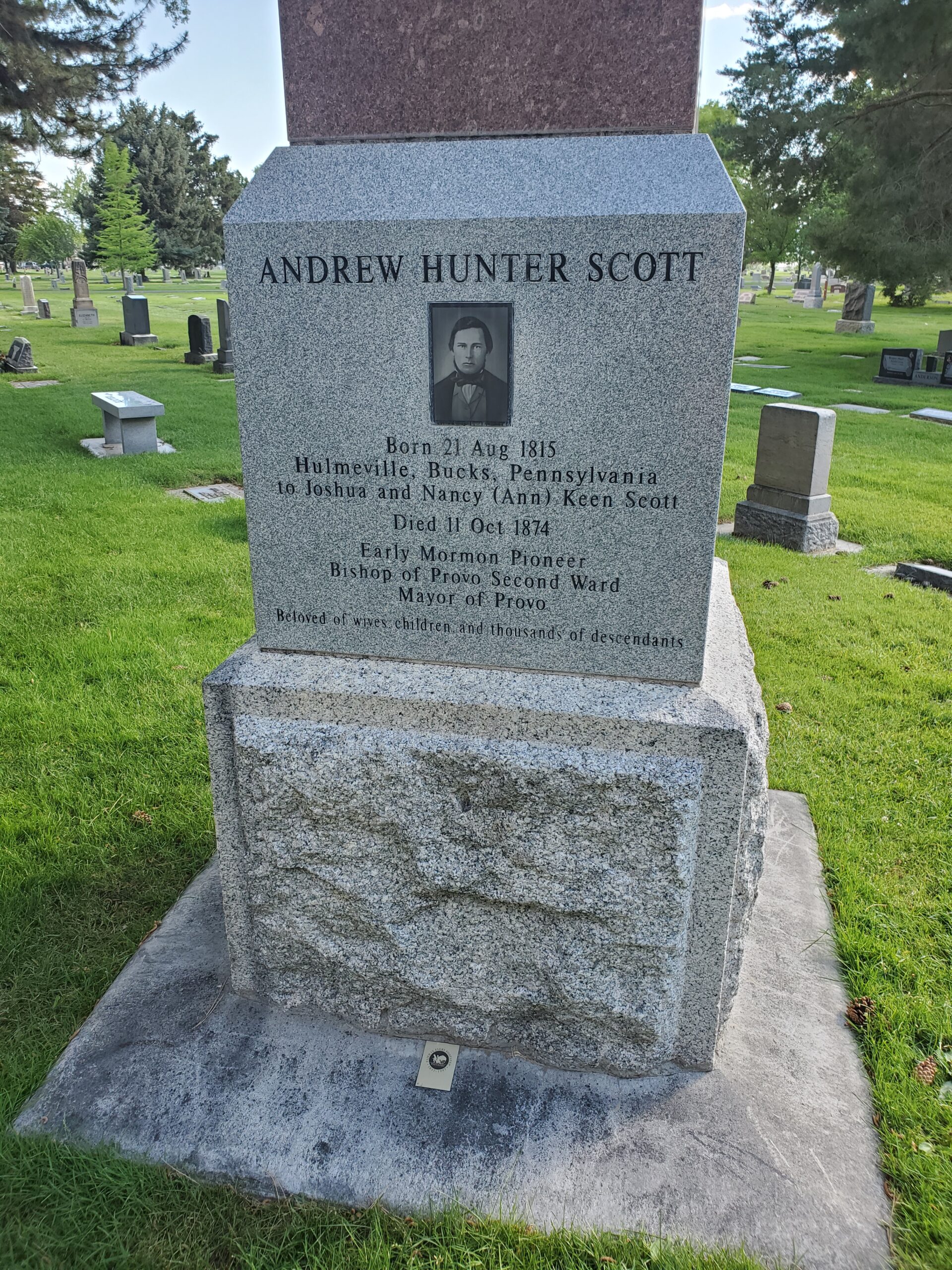
This is the grave of one of Provo's early pioneers

If you're passing through Provo during daylight hours, I highly recommend stopping by the cemetery for a quick walk around. The graves each tell a story and the artwork is unique, as you can see. Sadly, there are quite a few graves for children and young adults--many of whom are from recent years.


Twenty to thirty minutes down the road is the American Fork Cemetery, located in American Fork, Utah.

Like Provo City, American Fork is a unique blend of more traditional and very distinctive headstones. When my mother and I visited around nine AM on a Sunday (at the end of June), the weather was cool and windy but still perfect for wandering a cemetery. I didn't take as many photos here because a lot of the more unique graves are newer and I didn't feel comfortable photographing the graves of people whose family are still around to visit them--if that makes sense.

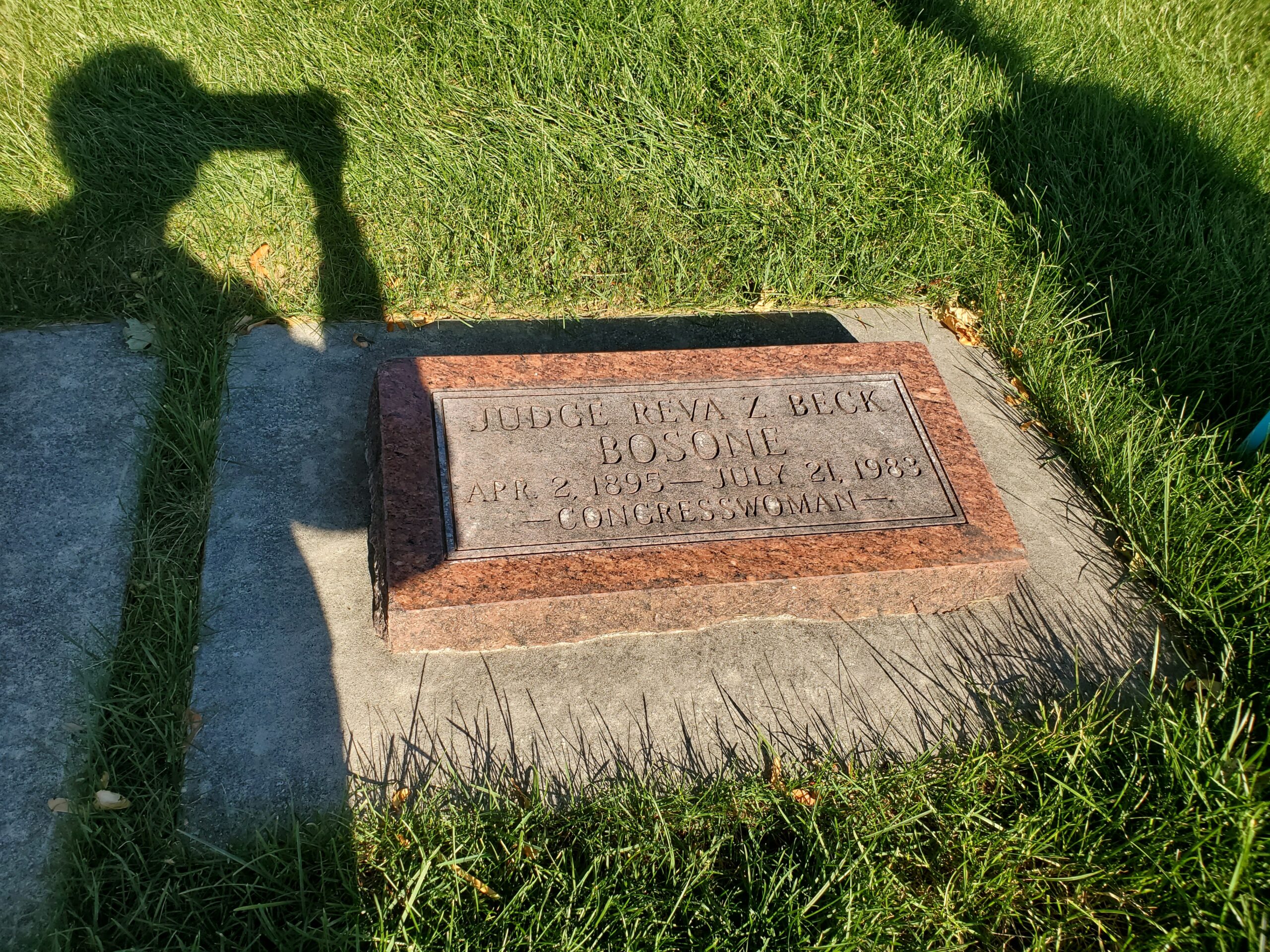
In any case, I wanted to visit American Fork for one reason: to visit the grave of Utah's first female Congresswoman, Reva Beck Bosone. Reva's grave is very easy to find. Go through the cemetery's main entrance and drive near the back. Halfway between the second to last and last drivable rows, park your car on the right hand side of the road. Several of Reva's relatives are all buried together, and a headstone that reads "Beck" is plainly visible from your car. Reva's headstone faces away from the road, low to the ground, but again is easy to find.

Reva Beck Bosone Grave

Here are the few other photos I snapped at American Fork.

Monument to the Pioneers

The cemetery hosts a large monument to the Pioneers of the area. Several of their stories are located on the standing plaques around the sides of the monument (shown here).

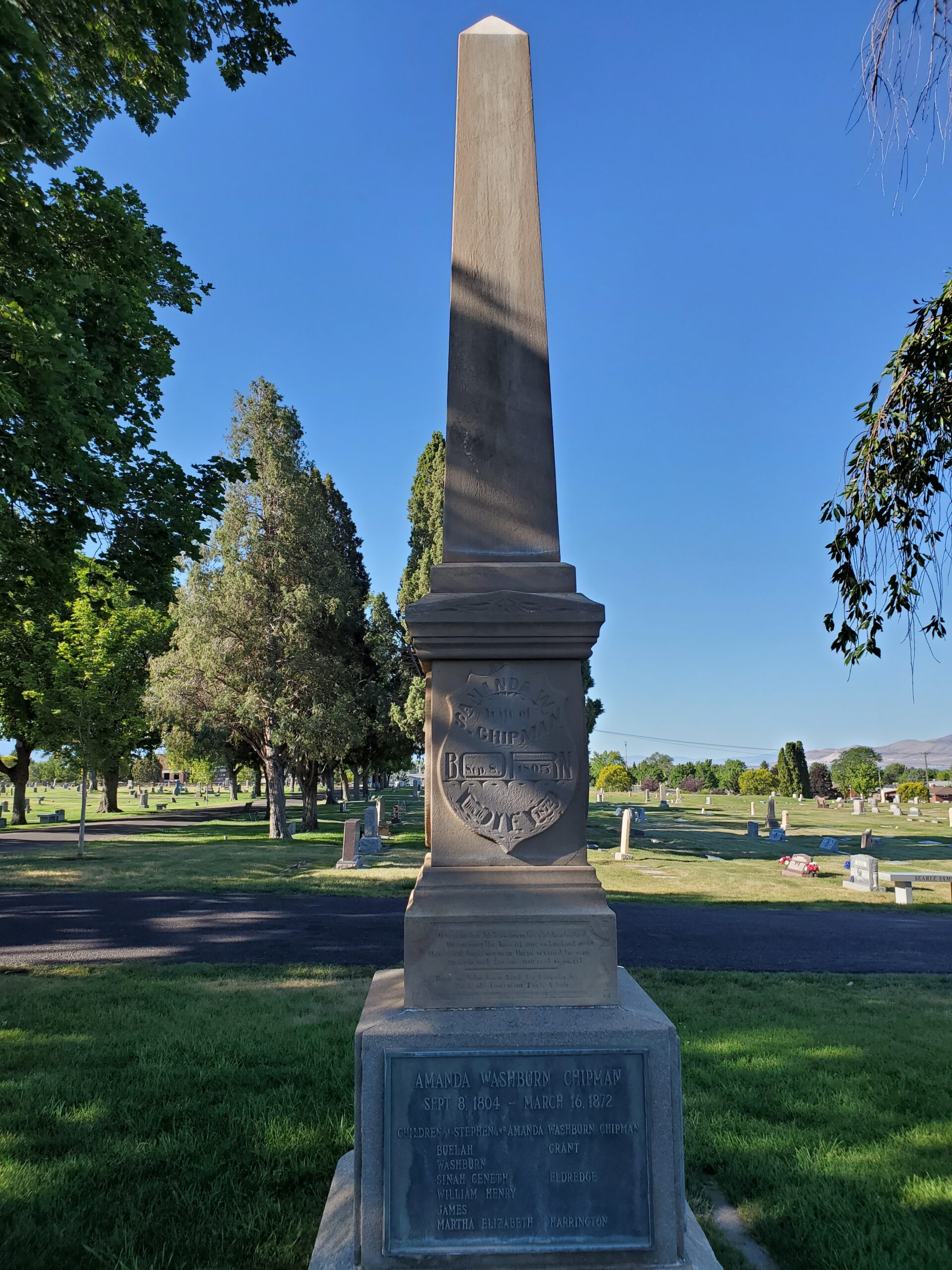
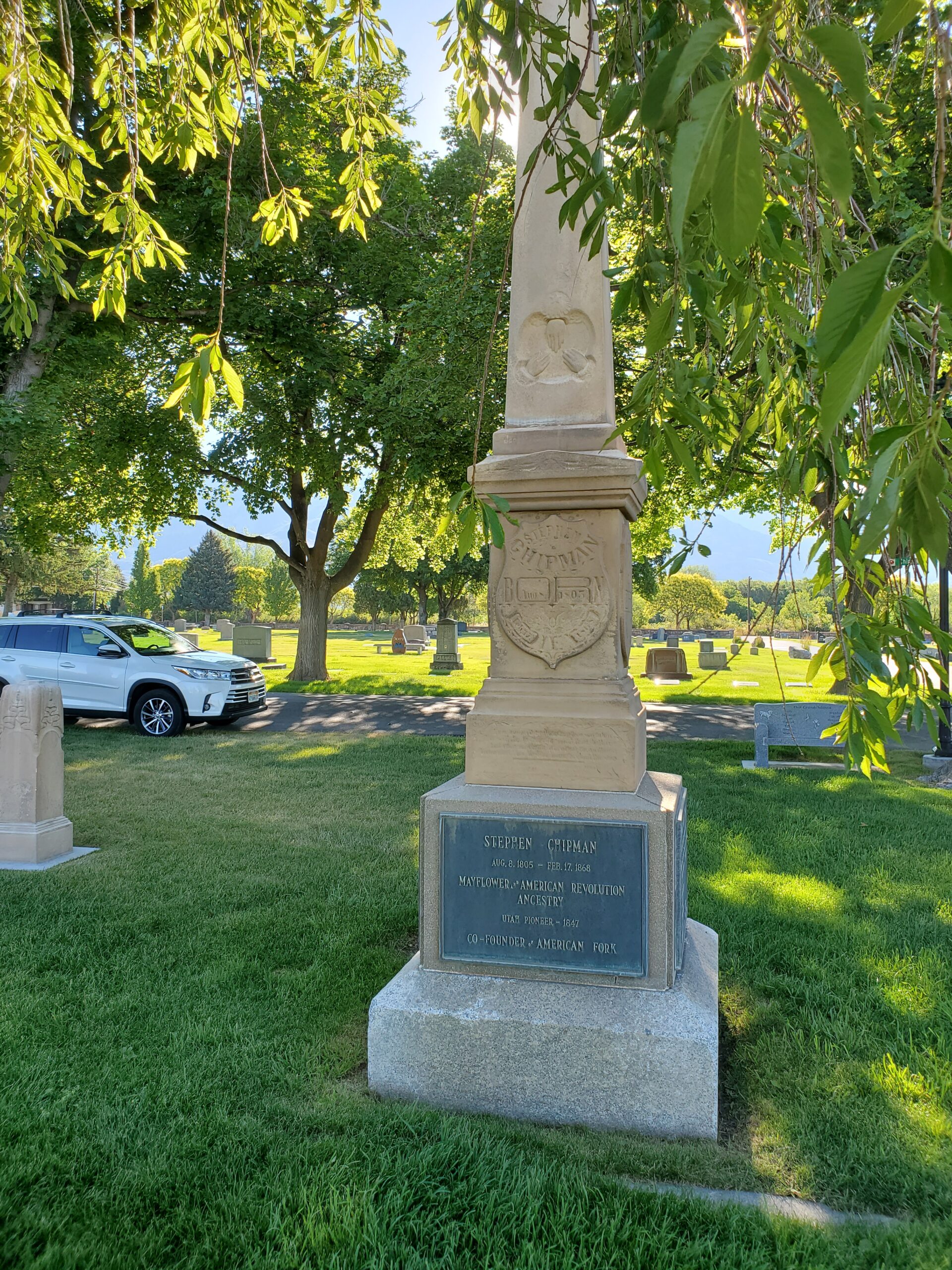
This large obelisk is a monument to the Chipman Family.
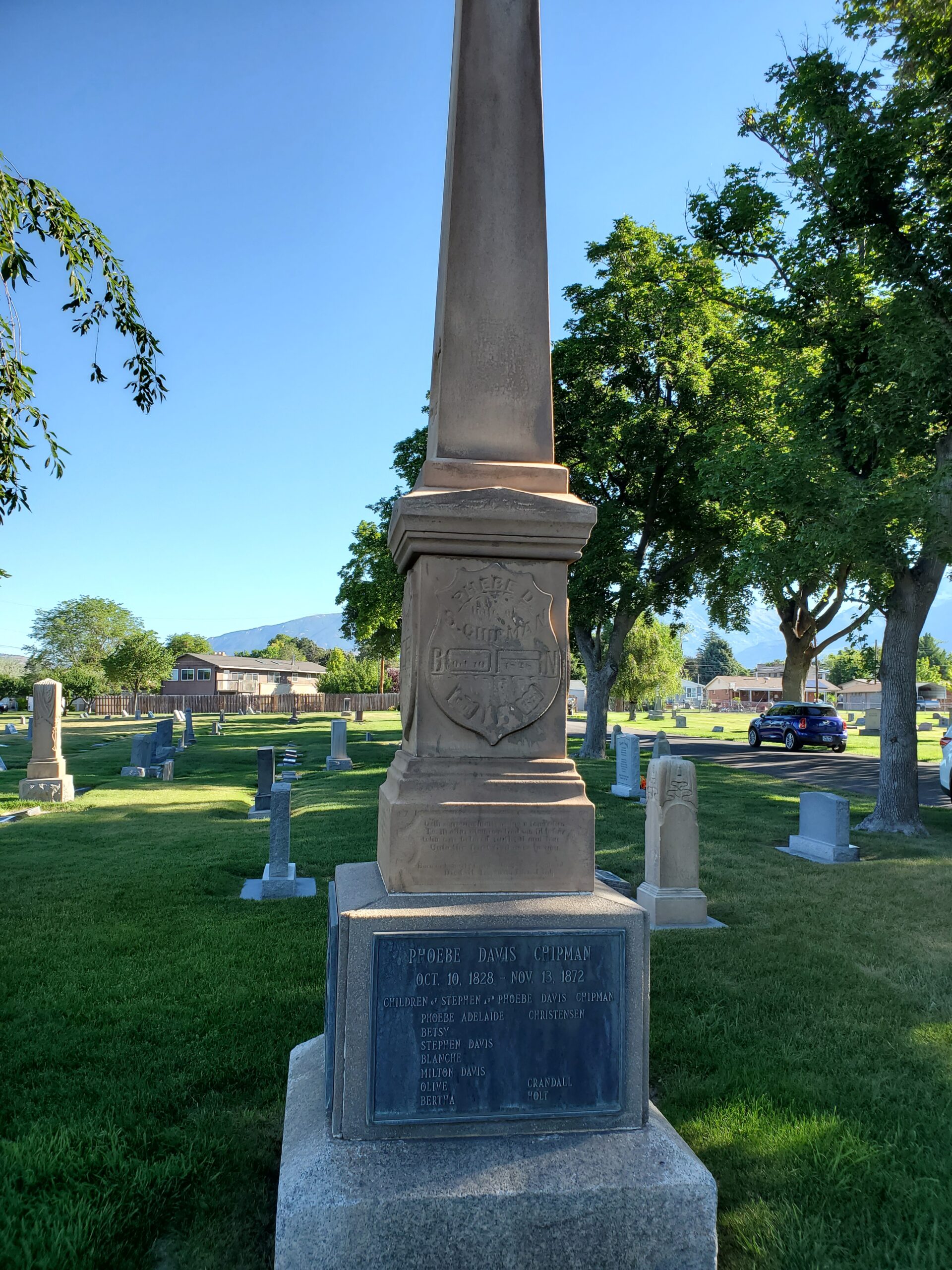
Another side of the Chipman Monument
The third side of the Chipman Monument

After leaving the American Fork Cemetery, my mother and I headed for Wyoming. Because we were visiting Utah on a Sunday, all of the museums and things we were planning on seeing in Ogden were closed. Well, hopefully we'll get a chance to visit again in the future.

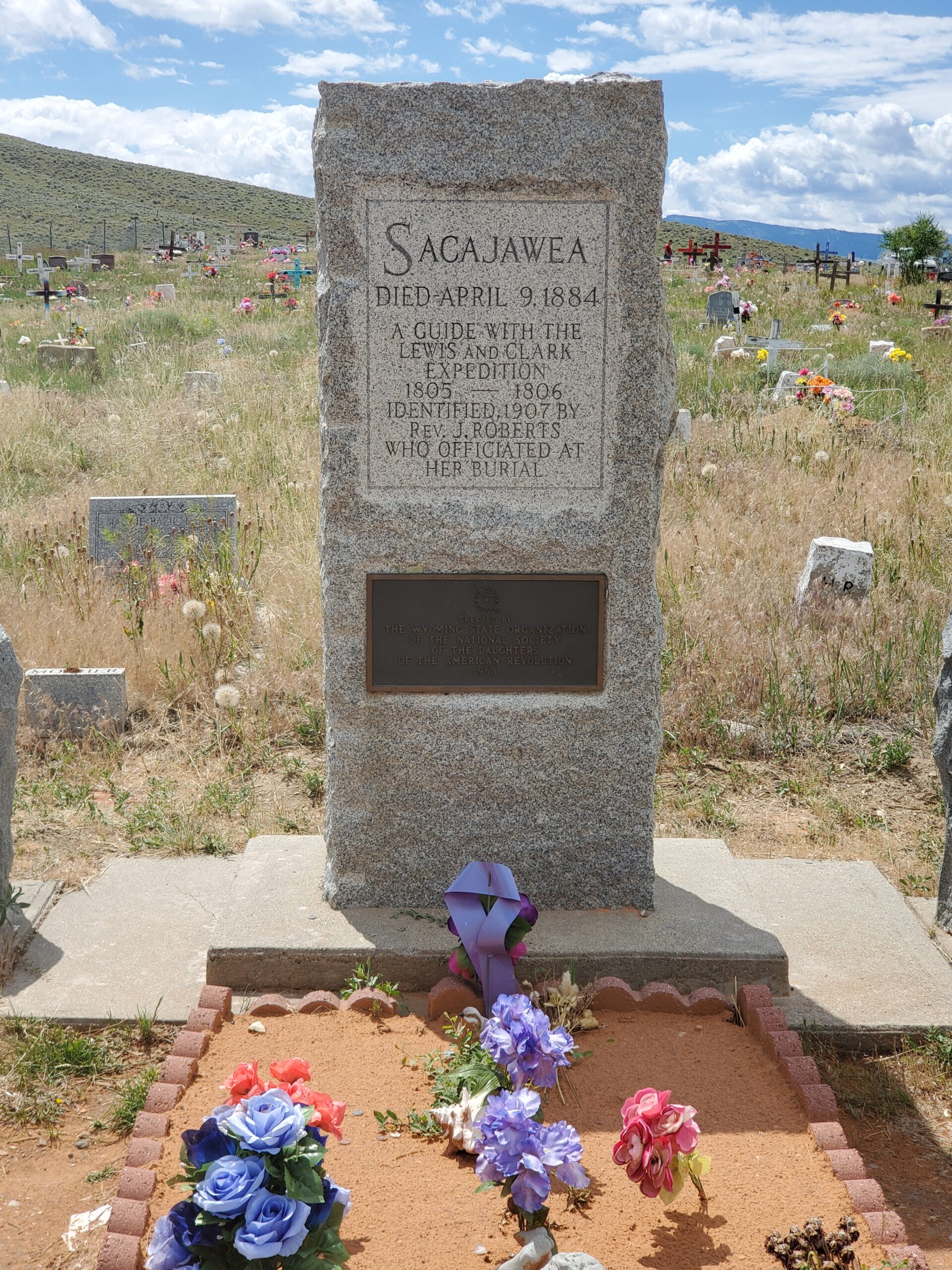
In any case, a few hours into Wyoming we found the Sacajawea Cemetery in Fort Washakie, Wyoming. This cemetery is a still active graveyard on the Wind River Reservation, meaning those buried in the cemetery are tribal members. Because of that fact, as well as the fact that, once again, a majority of the graves are actually new and still visited often, I didn't take many photos of those graves. Instead, I trained my camera instead on the reason the majority of people visit the cemetery in the first place--the grave of famed Shoshone guide Sacagawea.

The monument to Sacagawea
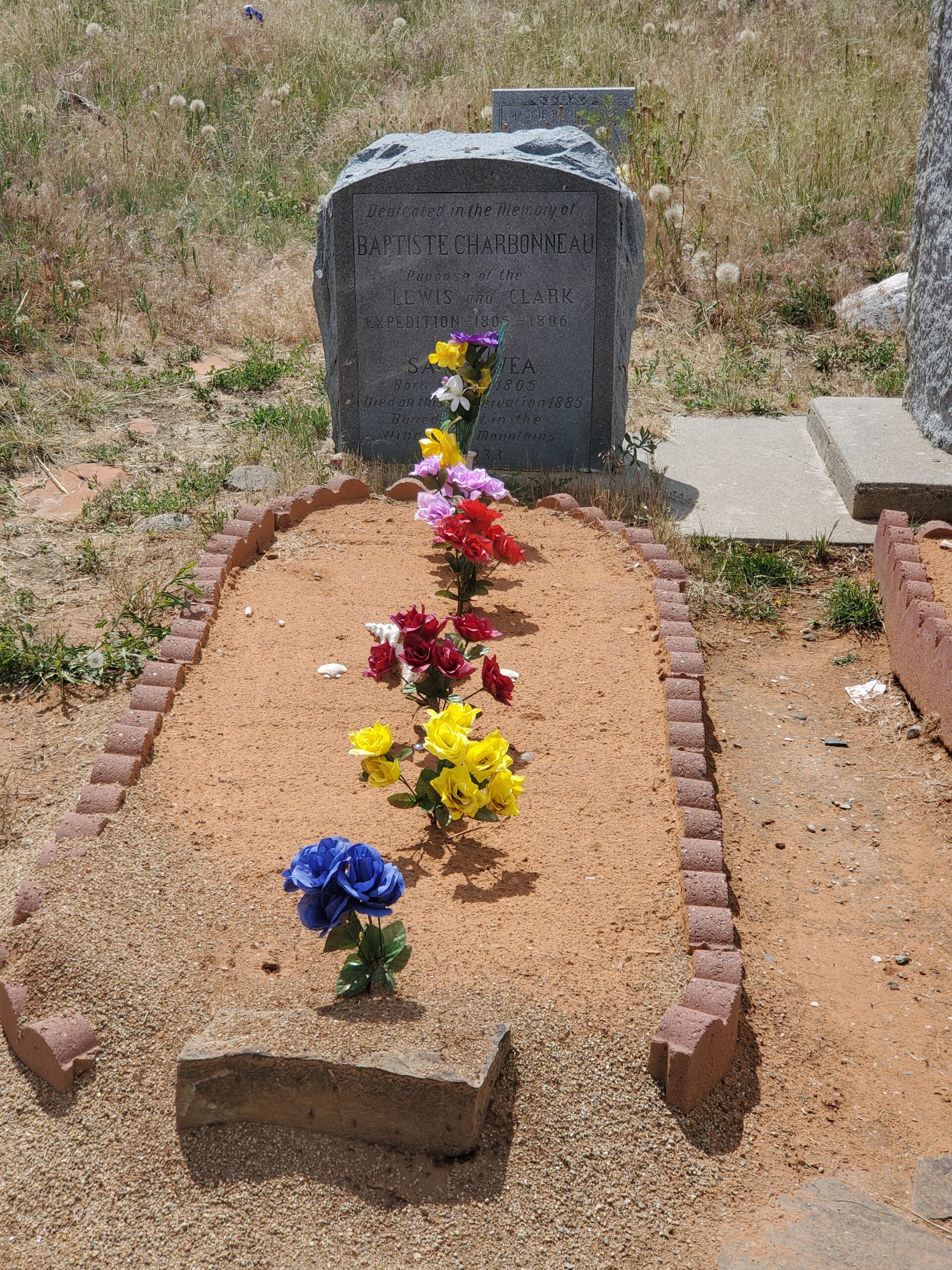
Sacagawea's son Jean Baptiste is honored beside her

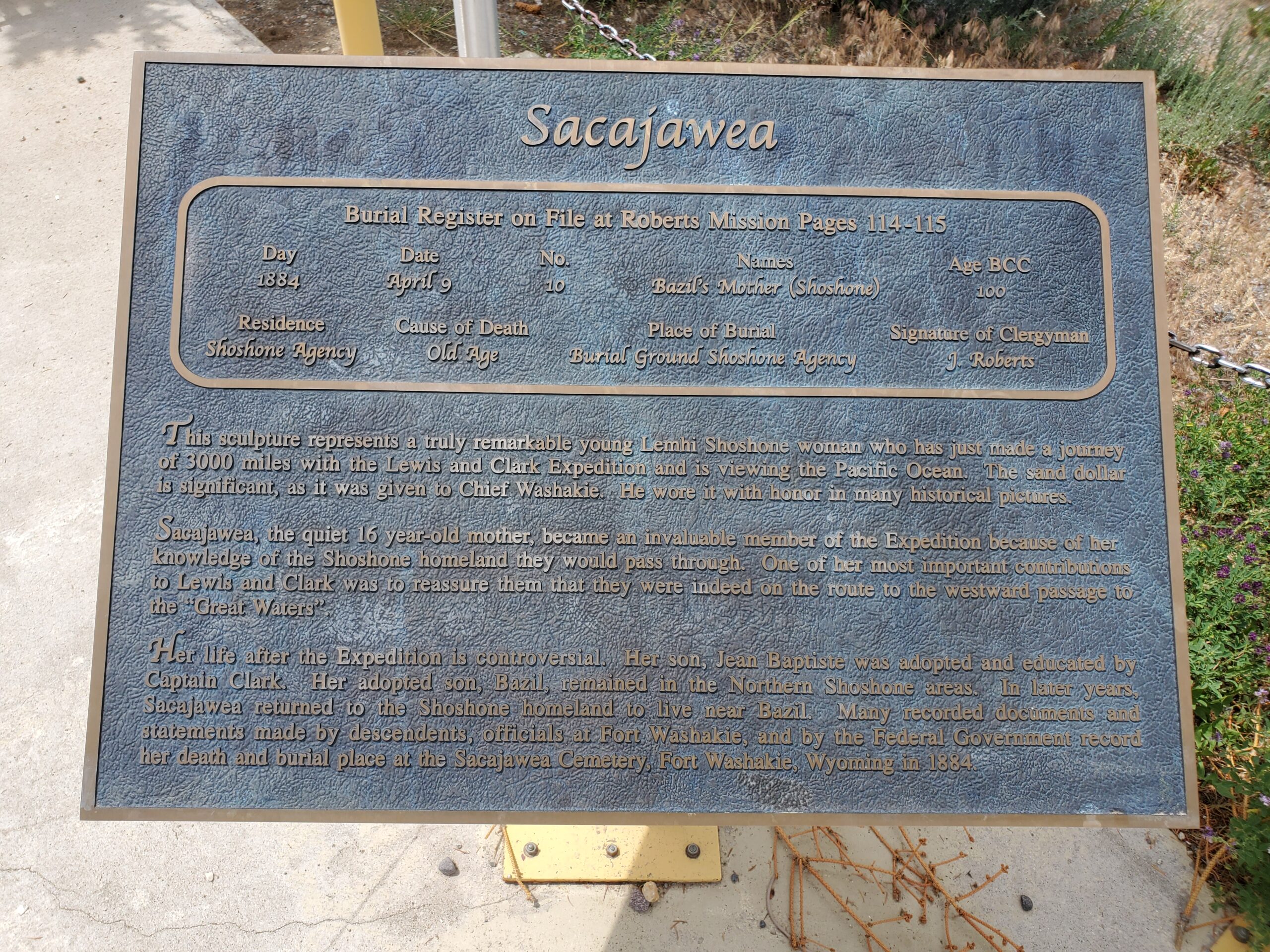
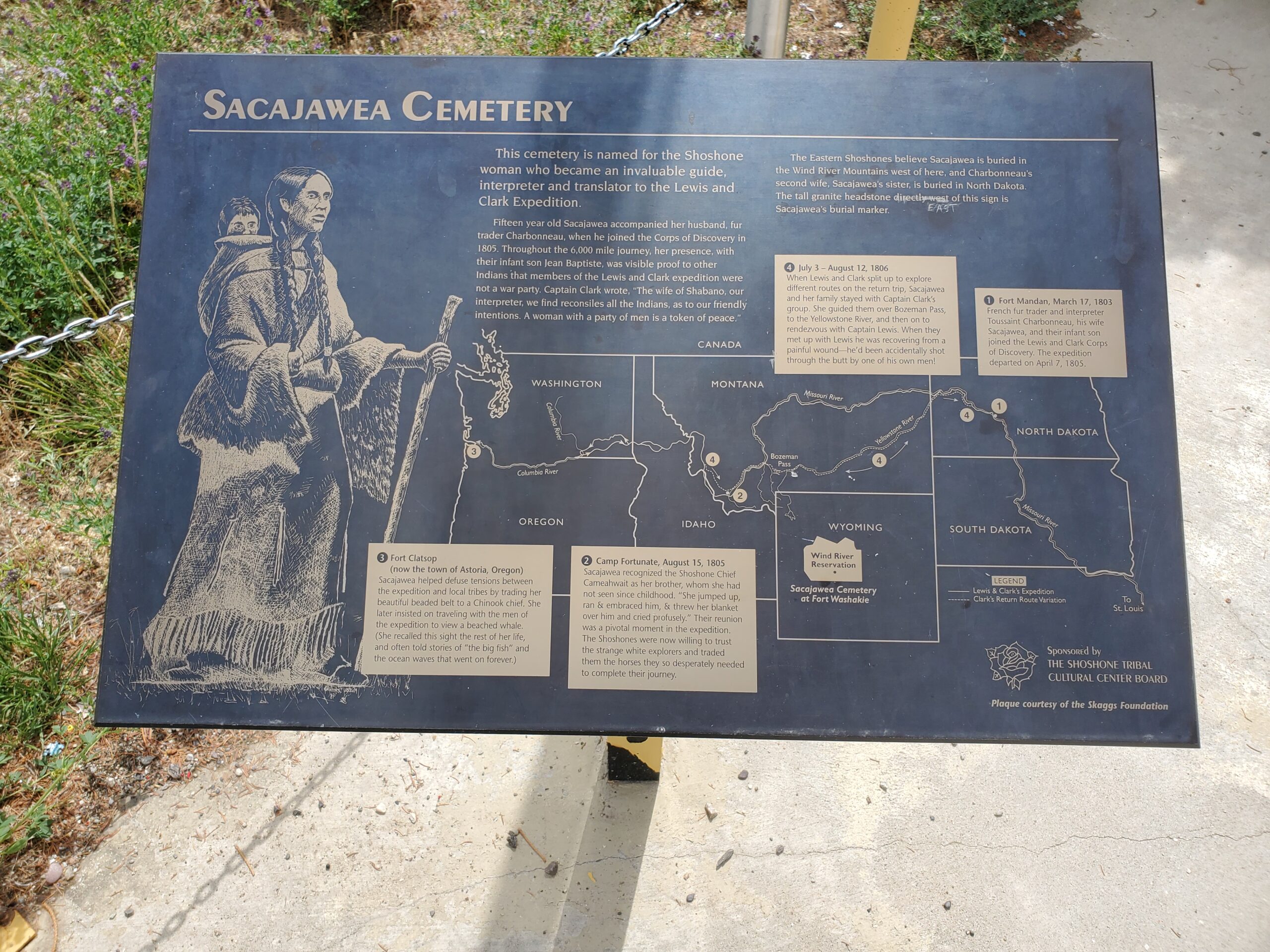
Now, in case you happen to be well versed in your history of Sacagawea, you may be vaguely remembering hearing at some point that the famed guide has two graves. If you remember hearing that, then you would be correct. The site my mother and I visited, in Wyoming, is the site Sacagawea's people claim is her burial site. According to their version of her story, Sacagawea left her French fur-trapping husband, moved away, married a Comanche man, and eventually made her way back to her people and her adopted son Bazil, before dying around the age of 100 in 1884. The woman who claimed to be Sacagawea is who is buried in this grave. But was she really?

The other version of the story is the one I, and most historians, believe today. According to the second story, Sacagawea died in 1812 soon after giving birth to her daughter Lizette. If this story is the correct one, than the second burial site for Sacagawea is located somewhere near where she died at Fort Mandan in South Dakota.

It makes sense that people would prefer the first story to be the accurate one; that the grave my mother and I saw today is where America's most famous Indigenous woman is buried after living a long and happy life. And who knows, maybe it really is the place where Sacagawea was laid to rest. To learn more, I have linked two articles from different sources at the bottom of this blog post.

As for the rest of the cemetery itself; its located on a hillside on an unmarked road, but once again Google Maps will take you straight to the graveyard. When my mother and I were there, about five or six other carloads of people were visiting as well, all of whom were clearly tourists.

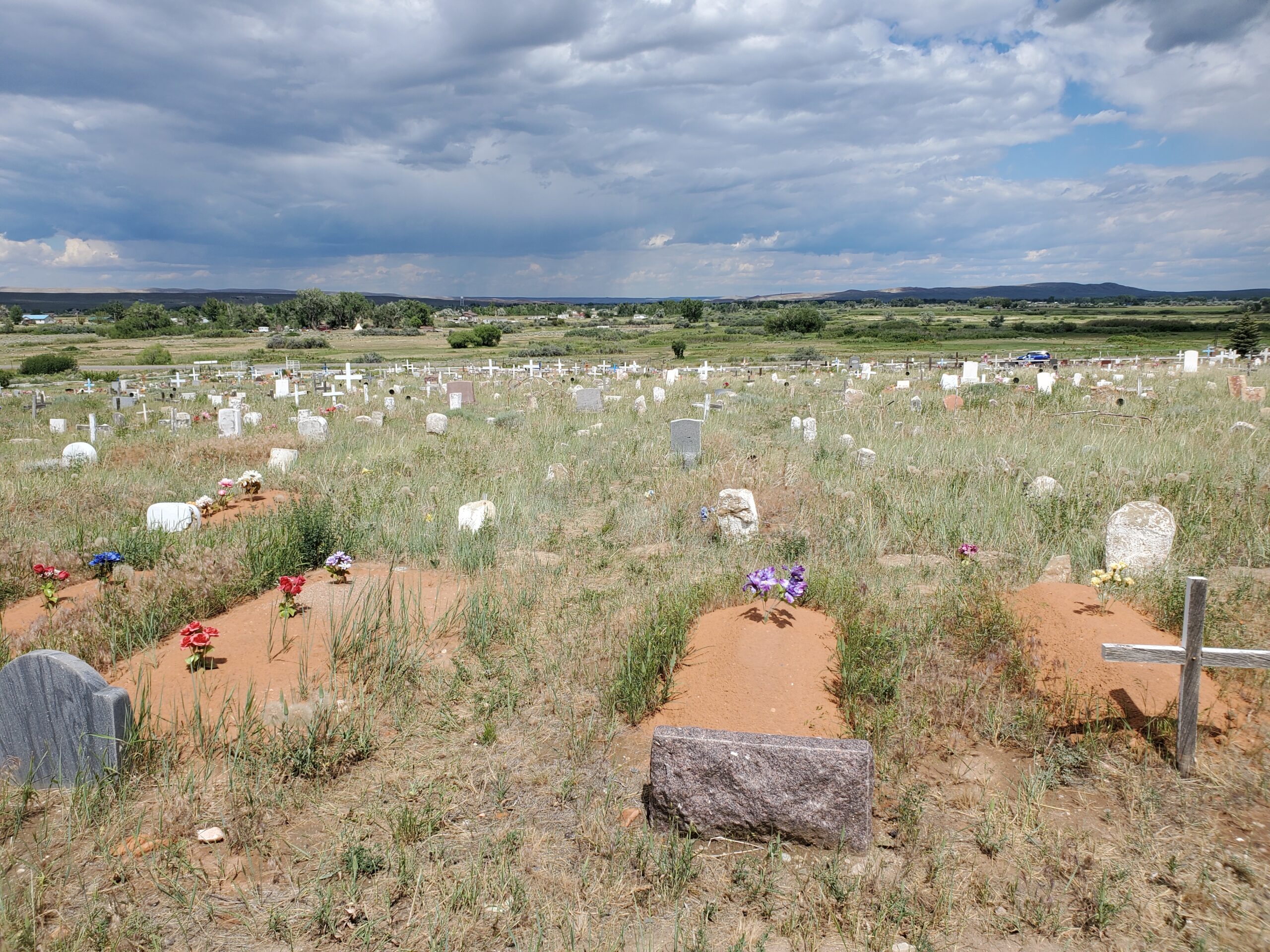
View of the cemetery from the top of the hill

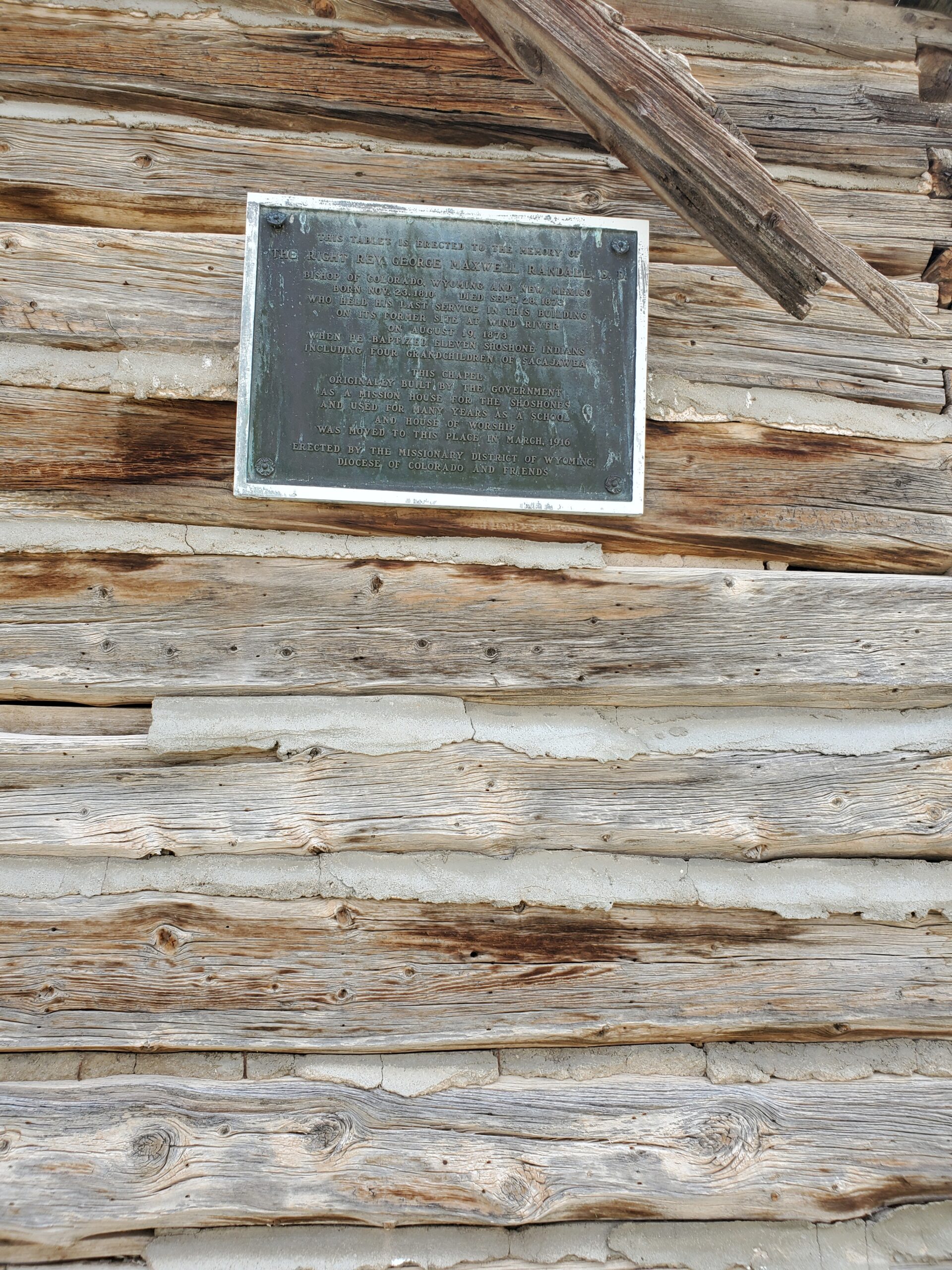
Also on the property is an old church building that has been moved from its original site, as well as informational placards for more information.

The old church building in the cemetery is marked with this placard
Information Placard 1
Informational Placard 2

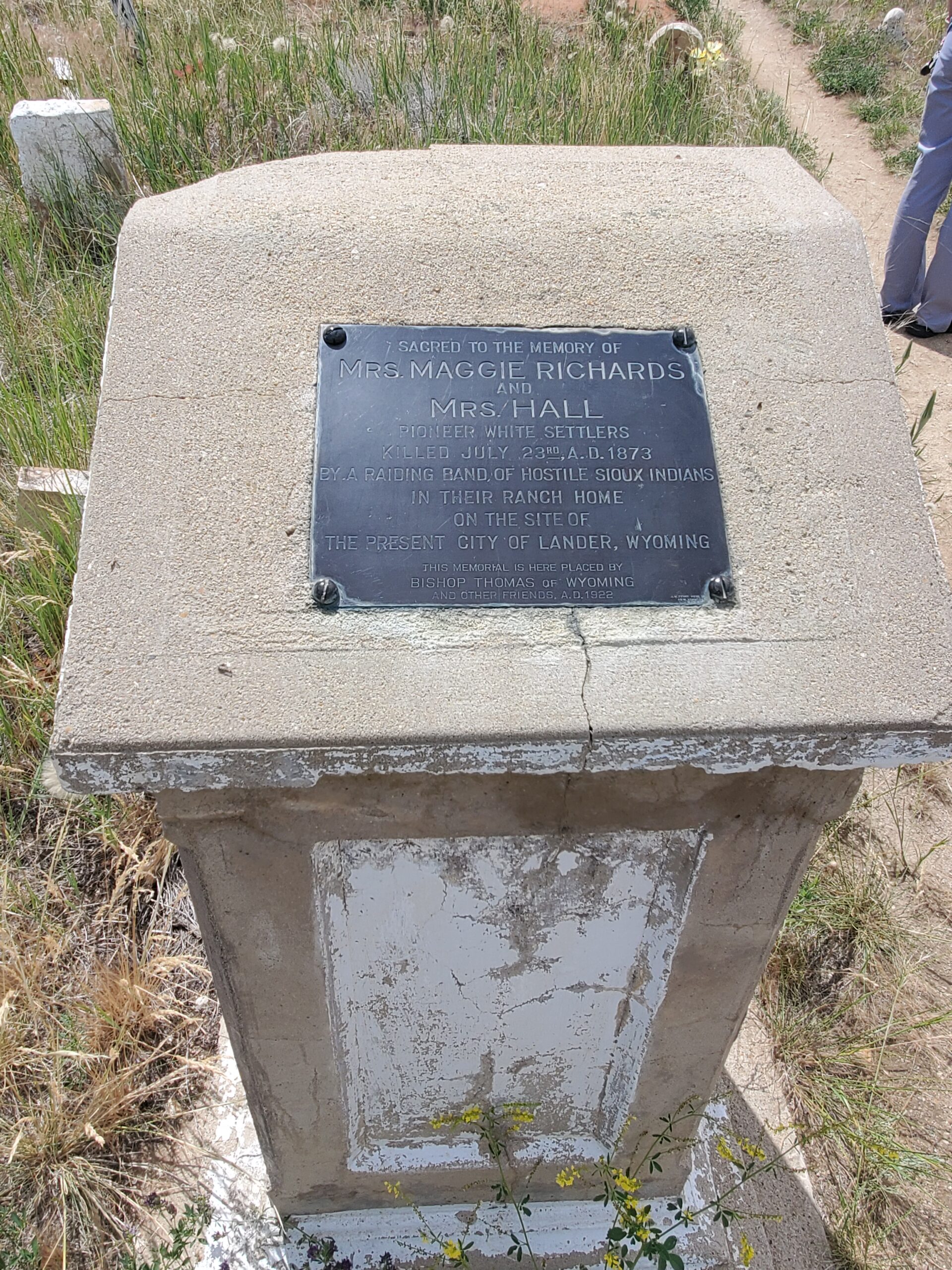
The only other marker I took a photo of is this memorial stone to two pioneers who were killed during a raid on their homestead.

Memorial Placard

The Sacajawea Cemetery is a few miles off of the main freeways, but is still an important place to visit for anyone interested in Native American or Western history of the United States. Please remember that this burial ground is still in use by the tribe today and that appropriate precautions should be taken. Be respectful and kind, and behave as you would hope others would behave near the graves of your own family members. This goes for Grand Canyon Pioneer, Provo City, and American Fork cemeteries as well. Even graveyards that are no longer actively burying folks should be regarded with respect and kindness befitting the dead.


That's all for this post folks. Thanks for taking the time to read! Hopefully we'll be stopping by some other cemeteries in Colorado and New Mexico on this trip so look out for those posts in the future as well.


Further Reading:

https://news.prairiepublic.org/post/sitting-bull-sacagawea-graves

https://www.yellowstonepark.com/things-to-do/attractions/sacajawea-secret-gravesite/

  • Previous
  • 1
  • …
  • 15
  • 16
  • 17
  • 18
  • 19
  • 20
  • 21
  • …
  • 159
  • Next

Categories

Archives

  • July 2025 (10)
  • July 2024 (1)
  • January 2024 (1)
  • August 2023 (1)
  • June 2023 (2)
  • October 2022 (1)
  • July 2022 (1)
  • June 2021 (3)
  • December 2020 (3)
  • August 2019 (1)
  • July 2019 (2)

Search

© 2026 The Exasperated Historian | Powered by Minimalist Blog WordPress Theme