The Exasperated Historian
Menu
  • Home
  • The Women’s List (New)
  • The Men’s List
  • The Animal List
  • Collections
  • The Blog
  • Contact Us
  • FAQ
Menu

Category: Birth Locations

1117) Khuwyt

1117: Khuwyt

One of the Earliest Known Female Musicians

Lived: c. 1960 BCE, Ancient Egypt (Present-day Egypt)

Khuwyt was a singer and musician during the twelfth dynasty of Ancient Egypt. Her name and likeness are recorded in a painting in the tomb of Antefoker, who was a political official at the time.

Khuwyt is therefore considered one of the earliest known female musicians in world history, though of course little else of her life is known today.

Sources:

https://www.brooklynmuseum.org/eascfa/dinner_party/heritage_floor/khuwyt

https://en.wikipedia.org/wiki/Khuwyt

1116) Ka’ahumanu

Courtesy of Aloha from Hawaii

1116: Ka’ahumanu

Queen Consort and Later Regent of the Kingdom of Hawaii

Born: c.1768-1777, Kingdom of Maui (Present-day Maui, Hawaii, United States)

Died: 5 June 1832, Manoa, Honolulu, Hawaii (Present-day Manoa, Honolulu, Hawaii, United States)

Ka’ahumanu was incredibly influential as consort to her husband and regent and advisor to her stepsons.

Ka’ahumanu was born to noble parents. Her mother was related to the king of Maui and her father was an advisor to the king of Hawaii. As a child, Ka’ahumanu was sent to live in the king’s household in order to prepare herself to one day be one of his wives. At the time, the king was thirty.

Though the king had around twenty wives in total, Ka’ahumanu was allegedly his favorite. The king also granted his bride the designation of pu’uhonoa, which granted her the ability to offer sanctuary and absolution to her subjects. Ka’ahumanu was also given the right to sit on the high council, and became the only female member of the council after her father (who had previously sat on the council) died and she took his place. Ka’ahumanu was even named the guardian of the king’s son and successor.

After her husband’s death, Ka’ahumanu consolidated her power and was named advisor and later regent for the next two kings over the next thirteen years. Ka’ahumanu was also dubbed kuhina nui by her stepson, meaning she had just as much power and sway as her stepson now that he was king.

With her new power, Ka’ahumanu helped enact new laws and reforms, like doing away with the tradition that barred women and men from eating together. She also helped remove the law that stopped women from eating certain foods. Ka’ahumanu went so far as to place restrictions on chieftains who overly taxed their poorer subjects.

In 1821, Ka’ahumanu remarried, this time to the king of Kaua‘i. in order to further cement her family’s control of the islands.

In the 1820’s, Christian missionaries arrived in Hawaii and began converting the natives, including Ka’ahumanu. Though the queen ordered the destruction of native religious artifacts in order to further cement the new religion, many of the items were saved and spared for posterity.

Ka’ahumanu urged her people to become literate in the native Hawaiian language so that they could read the Bible, which had been translated into the Hawaiian language. She also opened schools and redrafted the Hawaiian legal system in order to further promote the ten commandments and the Christian religion.

Badges Earned:

Located In My Personal Library:

The Who, the What, and the When: 65 Artists Illustrate the Secret Sidekicks of History by Jenny Volvovski, Julia Rothman, and Matt LaMothe

Sources:

https://www.nps.gov/articles/000/queen-ka-ahumanu.htm

https://www.britannica.com/biography/Kaahumanu

https://ags.hawaii.gov/archives/online-exhibitions/centennial-exhibit/kaahumanu/

1115) Jadwiga

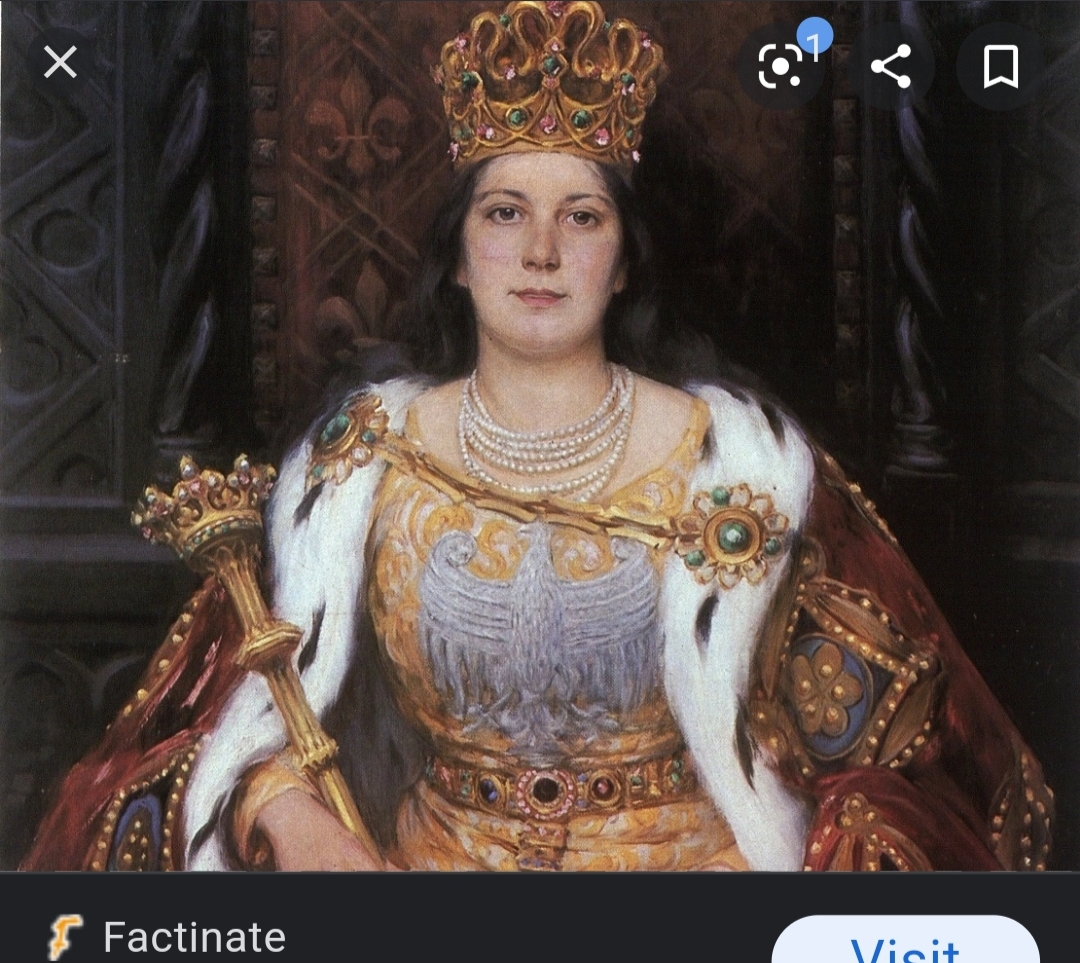
Courtesy of Factinate

1115: Jadwiga of Poland

The First Female Monarch of the Kingdom of Poland

Born: c.1373, Buda, Kingdom of Hungary (Present-day Budapest, Hungary)

Died: 17 July 1399, Present-day Kraków, Poland

Also Known As: Hedwig or Hedvig

Feast Day: February 28

Jadwiga’s father was the king of Poland and Hungary. When her father died, Jadwiga’s older sister was elected queen of Hungary, but Poland did not want to remain united with Hungary and split apart by naming Jadwiga their queen instead. At the time, Jadwiga was only nine years old! The Polish people chose Jadwiga to be their queen because they were tired of being ruled by absentee monarchs who ruled from far off lands.

Jadwiga was sent off to Kraków to rule, and though she was still just a small child, she would never see her mother again despite one source stating her mother was originally supposed to serve as regent. Jadwiga was evidently surprisingly mature for her age and was also well educated, apparently fluent in at least six languages.

In October of 1384, Jadwiga was crowned King of Poland. That’s right, KING, not queen, because though she was a child, Jadwiga didn’t have time to play around with a lower title. In actuality, Polish law stated the monarchy had to have a king as ruler, so Jadwiga had to be named King and not Queen Regnant.

As soon as she was crowned, the Polish nobles began plotting who to marry their new child-king off to. Jadwiga wanted to marry a childhood friend, William of Austria, but the nobles had other plans.

Jadwiga’s marriage to the grand duke of Lithuania ensured the centuries-long union between Poland and Lithuania. The union also helped ensure the Christian conversion of the mostly pagan Lithuanians. At the time of the wedding, Jadwiga was around twelve years old and her husband was twenty-six.

Jadwiga was a patron of religious study, and founded a special college for Lithuanians in Prague. She also helped finance the restoration of the university at Kraków. She evidently gave up her own jewels in order to finance the restoration.

Sadly, Jadwiga died from complications of childbirth and left behind no heirs, as her daughter died as well. Before her death, Jadwiga and her husband ruled jointly, but she was definitely the dominant personality in Poland. After Jadwiga’s death, however, her husband was able to seize total control of Poland and Lithuania both.

Jadwiga was canonized by Pope John Paul II in 1997. She is the patron saint of queens.

Sources:

https://www.britannica.com/biography/Jadwiga

https://www.historyofroyalwomen.com/jadwiga-queen-of-poland/sister-kings/

https://historydaily.org/jadwiga-poland-facts-stories-trivia

http://www.polishamericancenter.org/QueenJadwiga.htm


1114) Isabella Bird Bishop

Courtesy of Wikipedia

“The old Sea God has stolen my heart and penetrated my soul…[it is] like living in a new world, so pure, so fresh, so vital, so careless, so unfettered…I cannot tell you how much I like my life!”

1114: Isabella Bird Bishop

Writer, Naturalist, Explorer, and Historian

Born: 15 October 1831, Boroughbridge, England, United Kingdom

Died: 7 October 1904, Edinburgh, Scotland, United Kingdom

Isabella was the first woman to be elected a Fellow of the Royal Geographical Society. She was also a cofounder of John Bishop Memorial Hospital in Srinagar and the Henrietta Bird Hospital in Amritsar (named in honor of her husband and sister).

Isabella wrote and published many books, mostly focused on her various travels around the world. She went everywhere from the western United States (Colorado and California) to the Hawaiian Islands, Japan, Australia, the Malay Peninsula, Singapore, Hong Kong, Saigon, India, Iran, Kurdistan, Turkey, Korea, Manchuria, Tibet, Morocco and more. Throughout her travels she rode many hundreds, if not thousands, of miles on horseback, and soon after beginning her travels Isabella realized the limitations of riding sidesaddle. Despite her best efforts, Isabella was criticized as being too masculine for riding the way a man typically did, facing forward, and for dressing too much like a man.

Isabella married in 1881. Her husband was the doctor who had cared for her sister before she passed away from typhoid. Despite Isabella and her husband being happy together it would not last. Isabella’s husband died only five years after the wedding and they had no children.

In the 1890’s, on one of her return trips home to England, Isabella used her fame from her various written works to plead with the public and even met Prime Minister Gladstone in order to speak out about the atrocities being committed against the Armenians in the Middle East at the time.

Later in the decade, Isabella had several close calls while on her journeys. In Sichuan she was attacked by an angry mob and locked on the top floor of a house that was then set on fire. Isabella was rescued by a detachment of soldiers that happened to be in the area at the time. Soon after she was hit with stones and knocked unconscious, but she once again survived the attack.

Even more impressive than realizing she traveled all over the world, usually alone in an age when women were expected to marry and remain at home their entire lives, is the fact that Isabella spent the vast majority of her life suffering from various ailments and illnesses.

Isabella took up the art of photography when she was in her sixties, and many of her pictures survive today. She took her last trip, to Morocco, when she was in her seventies!

Though Isabella was not a supporter of women's suffrage, at least publicly, she has been noted by feminists and women's historians alike for her refusal to stay home and be a typical woman of her day. Though Isabella was not necessarily trying to prove women could travel and make a living for themselves through writing, she managed to do just that anyway.

Badges Earned:

Find a Grave Marked

Located In My Personal Library:

Uppity Women Speak Their Minds by Vicki Leon

Sources:

https://www.cogreatwomen.org/project/isabella-bird/

https://biography.yourdictionary.com/isabella-bird

https://www.mylearning.org/stories/leeds-explores-the-world/1169?

http://anthony.sogang.ac.kr/Bird/IsabellaBirdBio.htm

https://www.findagrave.com/memorial/78469741/isabella-lucy-bishop

1113) Isabel de Guevara

1113: Isabel de Guevara

One of the Few Women to Accept the Spanish Crown’s Offer to Colonize in the New World

Born: Unknown, Present-day Spain

Died: After 1556, Most Likely Asunción, Spanish-Controlled Paraguay

Isabel left Spain in late 1534 or early 1535. She was one of approximately 1,500 settlers (of whom twenty were women) headed towards present-day Argentina. The colonists would settle a site known as Buenos Aires, and within three months around two-thirds had died from a multitude of problems including disease, famine, warfare with natives, and lack of supplies.

Because the men of the party were so weak from the various trials they had survived, the women took over the fort. They cooked, cleaned, nursed, planted and harvested crops, and guarded the fort. The survivors eked out a meager existence for several years, but then, in 1541, the natives attacked the fort.

The few survivors abandoned the fort and made a perilous trek eight-hundred miles (1,300 kilometers) up the river, to a new site known as Asunción in present-day Paraguay.

In 1556, Isabel wrote a letter to the princess of Spain, Juana (also known as Joanna of Austria), requesting a land grant and native laborers to work the land. Isabel justified her request by reminding the crown of all the women had done to save the surviving colonists and make the crown’s stake in the New World a permanent one. Isabel’s request was granted; however, she fades from history after the writing of the letter.

Sources:

https://www.brooklynmuseum.org/eascfa/dinner_party/heritage_floor/isabel_de_guevara

https://english.elpais.com/elpais/2012/05/29/inenglish/1338297350_910456.html

https://en.wikipedia.org/wiki/Isabel_de_Guevara

Translated Excerpt from Isabel's Letter (which survives in an archive in Spain today):

"After three months, one thousand were dead, and the scale of hunger was greater than that of Jerusalem, or any other. The men were so reduced that their clothes hung off them, and it was down to the women to wash their clothes, cure them of their ills, and to prepare them what little food was available, keep them clean, make the watch, keep the fires lit, and charge the guns when the Indians attacked... keep order among the troops... if it weren't for them, all would have been finished off; and if it weren't for protecting the honor of the men, I would write many more things based on the women's testimony."

1112) Hortensia

1112: Hortensia

Famed Roman Orator and One of Three Women Known to Have Spoken Publicly Before the Roman Magistrates

Birth Date Unknown, Most-Likely Rome, Roman Republic (Present-day Rome, Italy)

Death Date Unknown, Most-Likely Rome, Roman Empire (Present-day Rome, Italy)

Hortensia reportedly spoke before the Second Triumvirate and bartered for a repeal of a tax on wealthy Roman women. Basically, Hortensia was fighting against something all Americans know well, Taxation Without Representation. The tax was being proposed in order to raise money for a war against the men who had assassinated Julius Caesar.

Hortensia’s father was also a famed orator, Quintus Hortensius. She reportedly studied Latin and Greek literature according to one source, and was a widow with one daughter.

Hortensia’s speech was partially successful; instead of taxing 1,400 women, the triumvirs changed the number to 400 and ended up taxing some men to make up the difference.

Very little else of Hortensia’s life is remembered today, but her story is recounted in two sources from antiquity: the Greek historian Appian and the Roman historian Valerius Maximus, which gives some credence to the validity of the story.

Badges Earned:

Located In My Personal Library:

Goddesses, Whores, Wives, and Slaves: Women in Classical Antiquity by Sarah B Pomeroy

Sources:

https://www.britannica.com/biography/Hortensia

https://www.brooklynmuseum.org/eascfa/dinner_party/heritage_floor/hortensia

https://www.timetravelrome.com/2019/05/17/hortensia-speaks-out-forum-romanum/

“You have already deprived us of our fathers, our sons, our husbands, and our brothers, whom you accused of having wronged you; if you take away our property also, you reduce us to a condition unbecoming our birth, our manners, our sex. If we have done you wrong, as you say our husbands have, proscribe us as you do them… But why do we share the penalty when we did not share the guilt? Why should we pay taxes when we have no part in the honours, the commands, the state-craft, for which you contend against each other with such harmful results?”

1111) Magistra Hersend

1111: Magistra Hersend

Surgeon for Louis IX During the Seventh Crusade in 1249

Birth and Death Dates Unknown (As are Locations)

Magistra is one of two women ever recorded as a royal physician or surgeon in French history.

Magistra reportedly also cared for the queen and other female camp followers throughout the crusade. After the crusade finished, Magistra married the apothecary and earned a pension from the king.

Unfortunately, the only sources readily available for her online are either Wikipedia, or other websites whose sole source is the aforementioned Wikipedia article, so take this information with a grain of salt. I also managed to find a small publication magazine that lists Magistra in one of their timeline entries, but the magazine fails to list any sources for the information that I can see.

Sources:

https://en.wikipedia.org/wiki/Magistra_Hersend

https://www.ecu.edu.au/__data/assets/pdf_file/0003/712416/ECU_GIST_Magazine_July_2016.PDF

1110) Abella of Salerno

1110: Abella of Salerno

One of the First Women Ever Employed at a Medical School

Born: c.1380, Present-day Salerno, Italy

Death Date and Location Unknown

Abella was employed at the Salerno School of Medicine, which is now thought to be the oldest medical school of modern time.

She wrote two medical texts, De atrabile and De natura seminist humani.

The Salerno School of Medicine was the first medical school to allow women to enter and study the field.

Very little other information about Abella is readily available online.

Sources:

https://www.brooklynmuseum.org/eascfa/dinner_party/heritage_floor/abella_of_salerno

https://en.wikipedia.org/wiki/Abella

1109) Alice Kyteler

Courtesy of the Middle Ages

1109: Dame Alice Kyteler

Evil Poisoner or Innocent Victim…?

Born: c.1263, Kilkenny, Ireland (Present-day Kilkenny, Republic of Ireland)

Died: after 1325, Possibly Dublin, Ireland (Present-day Dublin, Republic of Ireland)

Alice was from a wealthy family. Her parents were Norman with some Flemish ancestry mixed in and Alice was the only child in her family. When she married at seventeen, she was already very wealthy, and she married a man of equal wealth and social stature. Alice had a son with her husband, and then he died.

She remarried soon after, and Alice and her new husband became the town moneylenders, meaning lots of folks really didn’t like them. Alice was very adept at driving the locals to huge amounts of debt they could never pay off. And right before her second husband died, he signed over all of his personal wealth to Alice’s son—his stepson—and disinherited his own children as a result.

Alice soon remarried again, and within a few years became a widow for the third time. After hubby number three kicked the bucket, Alice sued his son for a third of her husband’s estate. Alice wasn’t all that sad that her husband was dead, she just wanted his money. A few months later she married for a fourth time.

When hubby number four died, his grown children immediately accused Alice of murdering him. Whether or not she actually killed him, or any of her other husbands, is up for debate. Remember, this was almost eight hundred years ago. Records are spotty to say the least, and take everything you just read with a grain of salt. I'm trying to piece together the details that appear most often in all the sources, but again, with the fact that Alice lived almost eight hundred years ago mixed in, none of the details are really certain.

With that being said, this next part of the story is known for a fact.

Alice was accused of witchcraft alongside her son and several others. She was accused of murdering her fourth husband via poison, sorcery, demonism, and various other crimes. Alice was also accused of acquiring her wealth through "devilish" means.

While Alice was able to escape punishment by fleeing to England, not all of her servants were so lucky. Petronilla de Meath was burned at the stake, and several others may have been as well.

After Alice escaped to England she disappears from history, leaving her final fate unknown.

Badges Earned:

Located In My Personal Library:

Magic and Witchcraft: An Illustrated History by Ruth Clydesdale

The Witchcraft Reader by Darren Oldridge

The Witch-Hunt in Early Modern Europe by Brian P Levack

Sources:

https://www.historyireland.com/medieval-history-pre-1500/the-sorcery-trial-of-alice-kyteler-by-bernadette-williams/

https://www.brooklynmuseum.org/eascfa/dinner_party/heritage_floor/alice_kyteler

https://www.historickilkenny.com/alice-kyteler

https://headstuff.org/culture/history/terrible-people-from-history/petronilla-de-meath-irish-witch/

1108) Petronilla de Meath

1108: Petronilla de Meath

The First Irish Woman Burned at the Stake for the Crime of Heresy

Born: c.1300 AD, Meath, Ireland (Present-day County Meath, Republic of Ireland)

Died: 3 November 1324 AD, Kilkenny, Ireland (Present-day Kilkenny, Republic of Ireland)

Petronilla was a maidservant to Alice Kyteler; both of whom were some of the first Irish women ever accused of witchcraft.

Very little else of Petronilla’s life story survives to this day. When she was born, who were parents were, if she was married, or even what her real last name was has all been lost. It is assumed Petronilla was born in Meath or at least lived there for a significant period of time, as her surname “de Meath” literally means “of Meath.”

In order to obtain more information on Alice, Petronilla was repeatedly tortured. After Petronilla broke and confessed to the crime of witchcraft, she was also forced to publicly announce that she and the others accused were witches and heretics.

Alice was able to escape to England through her family’s connections, and one source says she took Petronilla’s daughter (named either Sarah or Basilia, depending on which source you believe) with her. However, Petronilla and several of the others were left behind and burned alive, which was highly unusual. Most witches were killed first, then burned, at least in Europe. Petronilla's trial happened a century before the real witch hysteria would kick off in Europe, lasting several hundred more and taking several thousand victims with it.

Whether or not Petronilla was actually the first woman burned for witchcraft and heresy is up for debate according to some. However, what is not up for debate is that Petronilla and her friends were the first group of women tried as an organized group of witches in Ireland.

Badges Earned:

Located In My Personal Library:

Magic and Witchcraft: An Illustrated History by Ruth Clydesdale

Sources:

https://www.brooklynmuseum.org/eascfa/dinner_party/place_settings/petronilla_de_meath

https://headstuff.org/culture/history/terrible-people-from-history/petronilla-de-meath-irish-witch/

https://www.historickilkenny.com/petronella-de-meath

  • Previous
  • 1
  • …
  • 11
  • 12
  • 13
  • 14
  • 15
  • 16
  • 17
  • …
  • 159
  • Next

Categories

Archives

  • July 2025 (10)
  • July 2024 (1)
  • January 2024 (1)
  • August 2023 (1)
  • June 2023 (2)
  • October 2022 (1)
  • July 2022 (1)
  • June 2021 (3)
  • December 2020 (3)
  • August 2019 (1)
  • July 2019 (2)

Search

© 2026 The Exasperated Historian | Powered by Minimalist Blog WordPress Theme