The Exasperated Historian
Menu
  • Home
  • The Women’s List (New)
  • The Men’s List
  • The Animal List
  • Collections
  • The Blog
  • Contact Us
  • FAQ
Menu

Category: Birth Locations

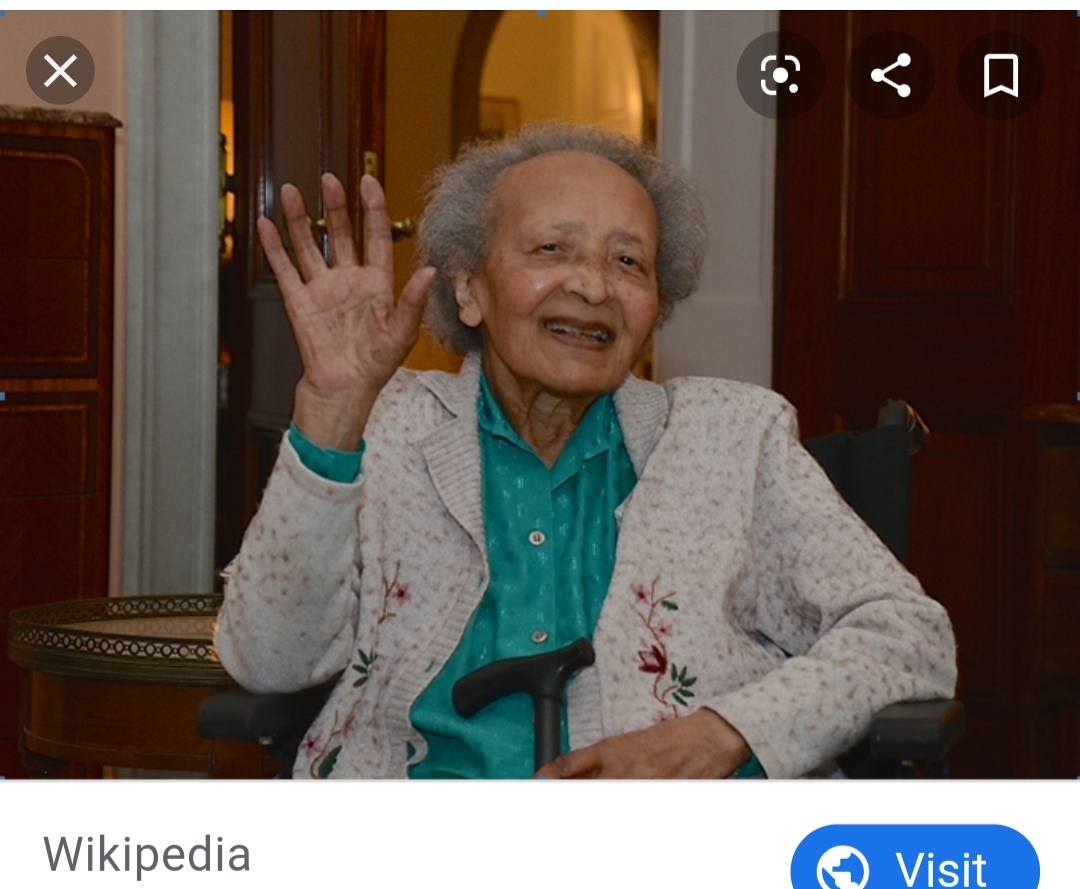
917) Augusta Chiwy

Courtesy of Wikipedia

"A black face in all that white snow was a pretty easy target. Those Germans must be terrible marksmen."

917: Augusta Chiwy

Volunteer Nurse During the Siege of Bastogne in World War II

Born: 4 June 1921, Belgian Controlled German East Africa (Present-day Mubavu, Burundi)

Died: 23 August 2015, Brussels, Belgium

Augusta was born to a Burundian mother during King Leopold II’s reign of terror on the continent. Her father was a Caucasian Belgian who worked as a veterinarian in the Belgian colonies of Africa.

Augusta moved to Belgium aged nine, and at age nineteen went to school to be trained as a nurse. During her youth in Bastogne, Augusta often faced questions and other racist remarks towards her skin tone and texture of her hair.

While volunteering near the front she went so far as to don an Army uniform, so she’d be able to collect the wounded under fire. Had she been captured, this action meant Augusta could have been executed. She is credited with saving hundreds of lives, even though a colored nurse serving white soldiers was against army regulations of the time. The American doctor who had requested her help reminded the soldiers under their care, “You either let her treat you or you die.”

Augusta bravely served during the Battle of the Bulge; helping treat American soldiers in a basement during the harsh bombardment. She splinted, dressed, and tended to various ailments. On Christmas Eve, the building next door was bombed. Augusta was blown through a wall but managed to survive the blast. Among the dead was Augusta’s friend and fellow nurse Renée.

After the war she worked as a nurse treating spinal injuries. Though Augusta rarely spoke of her war experiences, she did marry and have two children.

Augusta did not receive any credit for her heroism until seventy years later, when the King of Belgium awarded her the highest honor a Belgian can receive. Augusta’s story was also turned into an Emmy award winning documentary entitled Searching for Augusta.

She is briefly referenced in the book and television series Band of Brothers under the name Anna.

Badges Earned:

Find a Grave Marked

Sources:

https://liberationroute.com/belgium/biographies/a/augusta-chiwy

https://www.dallasnews.com/news/obituaries/2015/08/29/belgian-nurse-augusta-chiwy-who-saved-hundreds-of-gis-in-wwii-dies-at-94/

https://www.independent.co.uk/news/people/augusta-chiwy-nurse-who-tended-wounded-amid-carnage-battle-bulge-and-was-tracked-down-60-years-later-10495940.html

https://www.findagrave.com/memorial/151154493/augusta-marie-chiwy

916) Ona Judge Staines

Courtesy of Wikipedia

"I was packing to go, I didn't know where; for I knew that if I went back to Virginia, I should never get my liberty."

916: Ona Judge Staines

Martha Washington’s Escaped Slave

Born: c.1774, Mount Vernon Plantation, The Colony of Virginia (Present-day Mount Vernon, Virginia, United States of America)

Died: 25 February 1848, Greenland, New Hampshire, United States of America

Ona escaped by walking out the front door and never coming back despite George’s attempts to recapture her.

Yes, you’re reading that right. Ona literally just walked out the front door one day and decided she never wanted to go home again. Not that anyone could blame her for that of course.

Ona’s mother was a slave named Betty, and her father was a white English tailor employed by the Washington’s (or was possibly an indentured servant, sources differ). From the age of ten onward (or twelve, again, sources differ), Ona served as Martha Washington’s personal maid. Ona, her mother, and her sister were all skilled seamstresses. Another important thing to note is that Betty, Ona’s mother, had belonged to Martha’s first husband, and as such she and her heirs belonged to the Custis estate. So even though they all lived at Mount Vernon and George was their overseer, he was not their owner, Martha and her children were. This also meant that, should Ona or any other member of her family escape, George would be forced to pay the Custis estate back for the value of the escaped slave in question.

When Ona was fifteen, she was one of the slaves selected to follow the Washingtons first to New York, and then to Philadelphia after George was elected president. To avoid the 1780 emancipation law passed in Pennsylvania, Ona and the other slaves were rotated out of the state and back to Virginia at certain times in order for the Washingtons to avoid having to free them.

Ona’s world was opened to new horizons in Philadelphia. For the first time she was able to see what life for free African Americans was like. She was able to attend the circus or the theatre and was given higher quality clothing to go alongside her more visible position as a member of the president’s household. All of these small details added up to something huge in Ona—the desire to be free.

The opportunity presented itself on 20 May 1796. The Washingtons were preparing to return to Virginia for a time, and were busy eating dinner that afternoon. Ona knew this meant she would be returning to Virginia soon too, and she would never again have the means and opportunity presented to her at that moment. And so, Ona walked out the front door of the Washington home and never looked back. George and Martha were incensed, telling everyone Ona had never been mistreated. She’d been given plenty of good clothes, a room of her own (at that moment, previously she’d shared with Martha’s granddaughter who was in boarding school at the time) and Ona was treated more like a member of the family than a servant. Martha also decided Ona would have never left on her own. Instead, she must have been seduced by a Frenchman who took her away. The part about the Frenchman was definitely untrue, and the rest, while possibly true, still don’t excuse the fact that Ona wasn’t a free member of the family, she was their slave.

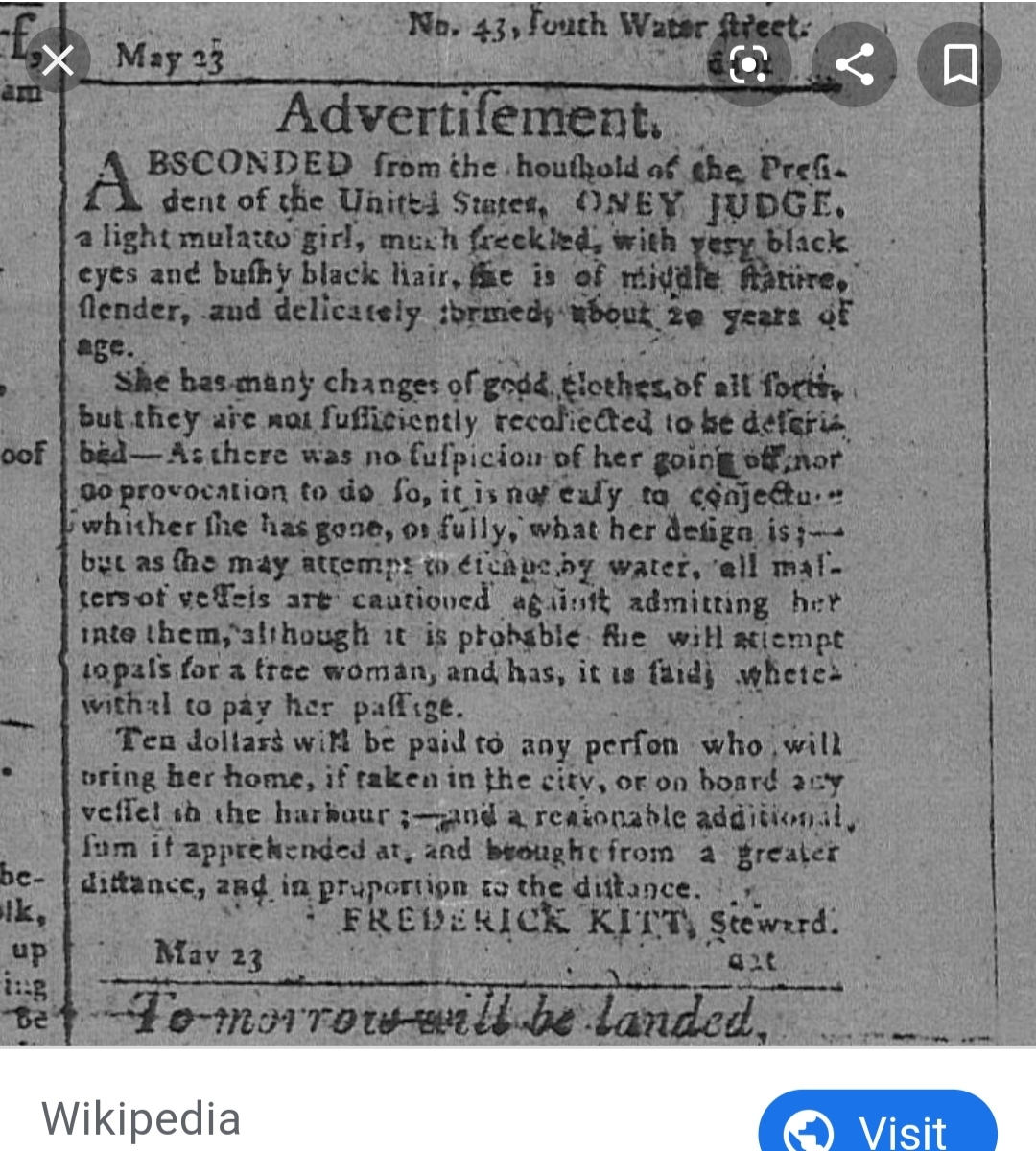
Two days after Ona disappeared, the first advertisement was published in a local paper, describing Ona and offering a reward for her capture. The article went on to state Ona had left with “no provocation” causing her departure. Really? When asked about this later on in life, Ona said she actually had two reasons for running away. The first was her desire for freedom. The second was because Ona had learned she was to be given to Martha’s granddaughter, who was known to have a fierce temper.

A few months after her escape, someone recognized Ona on the street. George enlisted a man in New Hampshire with the goal of enticing Ona to come back to the Washingtons. Ona agreed to return to Philadelphia, if and only if she was promised her freedom upon the death of George and Martha. George was furious and refused to accept her request. But he also warned the man he had hired to recapture Ona to be careful. If George used violence to take back his slave it would anger the abolitionists in the Northern states, and George knew that. If the man made any further attempts to recapture Ona, they have been lost to history.

Unfortunately, Ona’s life as a fugitive slave was incredibly difficult beyond the obvious reason of having to live in fear of being placed back in bondage.

Ona watched her husband and both daughters die while she lived in abject poverty and her son, who was a sailor, went to sea and never came back.

Once, when Ona’s elder daughter was a year old, George Washington made one more attempt to recapture Ona. Her husband was out to sea at the time and so Ona was alone with her daughter. George’s nephew was in town, and after tracking Ona down, he tried to persuade her with words to go back. When Ona refused, he decided he would take her back through force.

The nephew spent that night eating dinner with one of New Hampshire’s senators. When he mentioned his plans to retake Ona, the senator managed to smuggle a message to her in warning (or someone in the house did at least. Its never been proven it was actually the senator but--oh you get the idea!). Ona took her daughter and hired a carriage, escaping to a friend’s home in a neighboring city. George’s nephew failed to locate her and came home empty handed. Ona and her daughter Eliza were safe for the moment, but as I previously mentioned, Ona outlived every member of her family.

Ona did manage to become literate after escaping and converted to Christianity. As she aged, Ona was given financial support from the government after being declared a pauper.

Her sister was freed in later life and tried to track Ona down but was unable to do so in time. And so, Ona died alone, her circumstances not much better than those she had fled from in her younger years, save for one important difference. She may have died alone, but Ona died free, and that distinction made everything else worth it.

Ona’s story is recounted on an episode of Monumental Mysteries titled "Pickles Saves the World Cup, Strowger Switch, Rebel Hope."

Badges Earned:

Find a Grave Marked

Located In My Personal Library:

Here is Where: Rediscovering America’s Great Forgotten History by Andrew Carroll

Never Caught: The Washingtons' Relentless Pursuit of Their Runaway Slave, Ona Judge by Erica Armstrong Dunbar

Sources:

https://www.mountvernon.org/library/digitalhistory/digital-encyclopedia/article/ona-judge

https://www.nps.gov/articles/independence-oneyjudge.htm

https://www.whitehousehistory.org/the-remarkable-story-of-ona-judge

https://www.ushistory.org/presidentshouse/slaves/oney.php

https://www.findagrave.com/memorial/140701095/ona-staines

915) Meresankh III

915: Meresankh III

Ancient Egyptian Royal Woman

Lived: Fourth Dynasty Ancient Egypt (Old Kingdom)

Meresankh means “she loves life.”

Meresankh was the granddaughter of Pharaoh Khufu. She was the wife of Pharaoh Khafre*, whose brother was Meresankh’s father Kawab. This means Meresankh married one of her biological uncles; which was not uncommon for the royal family. She had at least five children: a daughter and four sons.

Meresankh’s mother was Hetepheres II; whose father was also Khufu (meaning Meresankh’s parents were also biological siblings). Meresankh’s mother was very important to her, and images and allusions to Hetepheres are located all throughout Meresankh’s tomb. Some have even speculated that Hetepheres donated her own tomb and sarcophagus to her daughter, seeing as Meresankh died before her mother; possibly from something quick and unexpected.

Meresankh has a famous mastaba tomb, as previously mentioned, which was opened to the public for the first time in 2012 (it was first found in 1927). The tomb is located in the Giza complex and showcases just how important women had become to the royal family by the fourth dynasty.

Her tomb alludes to her holding power in the transitional period between Pharaohs (meaning the time between her husband’s death and her stepson’s coronation) but what that power was exactly is unknown. Meresankh was not the mother of the next Pharaoh, which meant she should have been treated as a minor royal wife. Instead, she was awarded many privileges that are seen throughout the tomb, including being the only royal wife of her generation to be depicted on a throne that also features a lion. Both of these icons were important evocations of power in Ancient Egypt.

*I thought it important to mention that in all the sources I listed below, Meresankh’s husband was definitively named as the Pharaoh Khafre. However, one source stated it might have been Khafre, but it might also have been the Pharaoh Menkaure (the two were father and son). The majority consensus is that her husband was Khafre, but I wanted to mention this discrepancy for total clarity.

Badges Earned:

Find a Grave Marked

Located In My Personal Library:

Ancient Egypt: An Introduction by Salima Ikram

Sources:

http://giza.fas.harvard.edu/ancientpeople/236/full/

https://www.osirisnet.net/mastabas/meresankh3/e_meresankh3_01.htm

http://www.touregypt.net/featurestories/meresankht.htm

http://www.ancient-egypt.org/who-is-who/m/meresankh-iii.html

https://en.wikipedia.org/wiki/Meresankh_III

https://www.findagrave.com/memorial/194588321/meresankh-iii

914) Erika Szeles

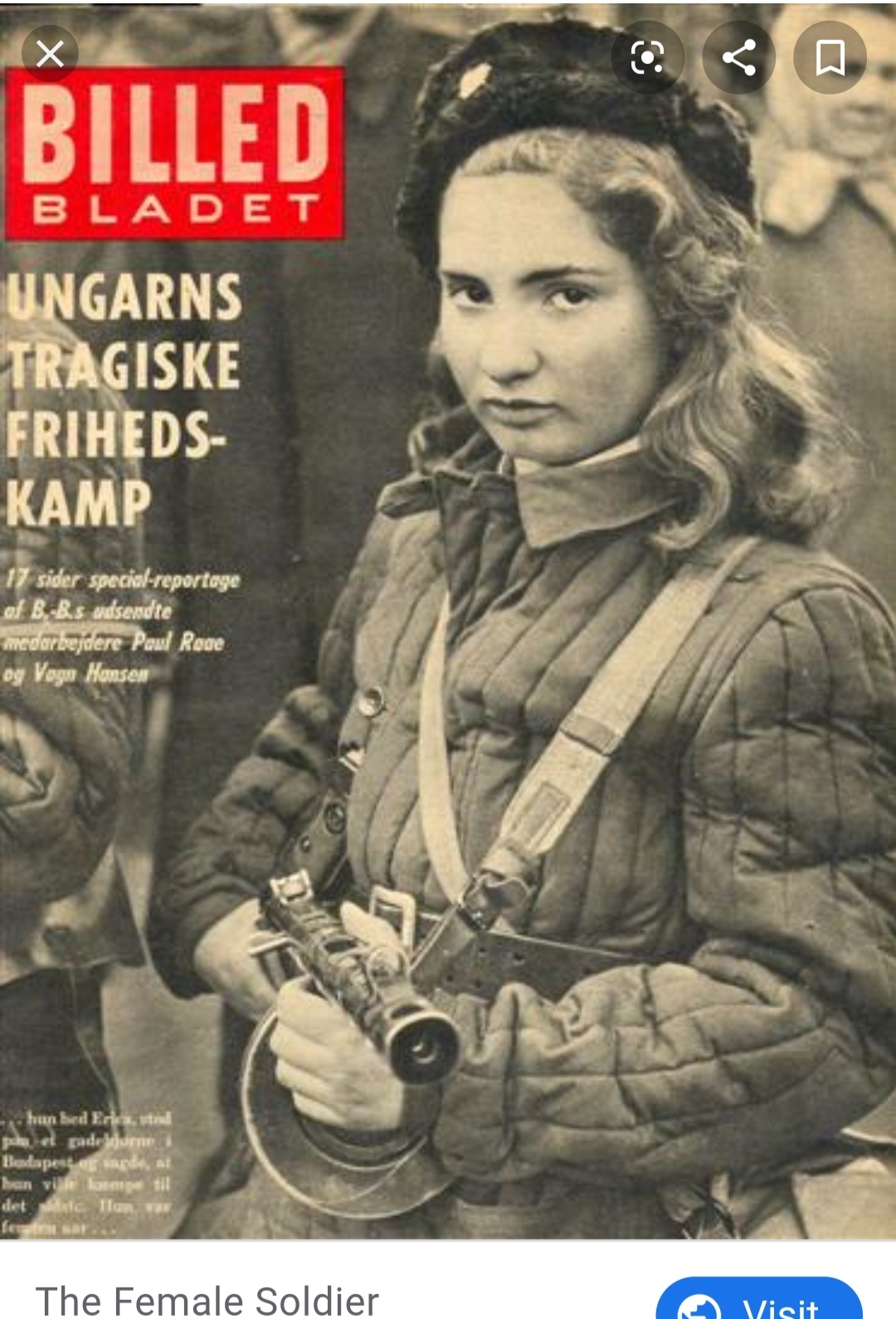
Courtesy of The Female Soldier

“I accidentally managed to take a picture that became world-famous and became a symbol of the revolution.” -Vagn Hansen, the Photographer

914: Erika Szeles

Soldier in the Hungarian Revolution of 1956

Born: 6 January 1941, Budapest, Kingdom of Hungary (Present-day Budapest, Third Hungarian Republic)

Died: 8 November 1956, Budapest, Hungarian People's Republic (Present-day Budapest, Third Hungarian Republic)

Before the fighting broke out Erika was an apprentice cook at a hotel in Budapest. Her family was Jewish, and her father was killed during the Shoah in 1944, though the exact circumstances of his death are unknown. Erika’s mother was a staunch Communist and died herself after hearing of Stalin’s death in 1953 (according to one story, another says she was still alive when Erika died, so who knows).

Even though her mother was a communist, Erika reportedly became disenfranchised with the regime after falling in with an older friend. This same friend would later encourage Erika to join the fighting in the Revolution.

Erika used a machine gun and fought on the frontlines. The 1956 revolution broke out after Hungarians fought to push the Soviets, who had invaded, out of their country and become free of the USSR once and for all. On November first, the now-famous photograph of Erika holding her weapon was snapped by a Danish photographer. Three days later some other friends convinced Erika she was too young, only fifteen, to be fighting. She put down the gun and became a volunteer nurse instead, working for the Red Cross.

Erika was gunned down in the streets of Budapest four days later. At the time, she was tending to a wounded friend, was completely unarmed, and was wearing a uniform with the red cross of a nurse on it.

The photo that had been taken of Erika only a week before soon graced the covers of magazines across the Western world. Few who saw it knew Erika was already dead. Her image inspired others to stand up and fight for their own freedoms. Though Hungary would not become free of the Soviet Union following the Revolution's end, they did slowly gain more and more freedoms, culminating in their complete separation from the USSR in 1989.

The photographer did not know Erika’s identity when he snapped the photo. In 2006, as the fiftieth anniversary of the uprising approached, some who remembered the picture decided to try and track down who the girl in the photo was. It took two years, but finally in 2008 Erika’s story was recovered, and her heroism for her country was remembered once more.

It should be noted that Hungary gave women the same/equal rights as men in 1945. That year, Hungarian men and women were both given the right to vote, and universities began admitting female students. This allowed for women to play a large role in the 1956 Revolution, including being some of the first to come out in large numbers to mass demonstrate in the streets of Budapest. Today, Erika is seen as a hero in Hungary, and rightly so.

Badges Earned:

Find a Grave Marked

Sources:

https://hungary-1956.fandom.com/wiki/Erika_Korn%C3%A9lia_Szeles

https://www.freedomfirst1956.com/women-played-their-part-in-the-1956-revolution/

http://thefemalesoldier.com/blog/erika-szeles

https://www.findagrave.com/memorial/103704387/erika-korn%C3%A9lia-szeles

913) Lana Peters

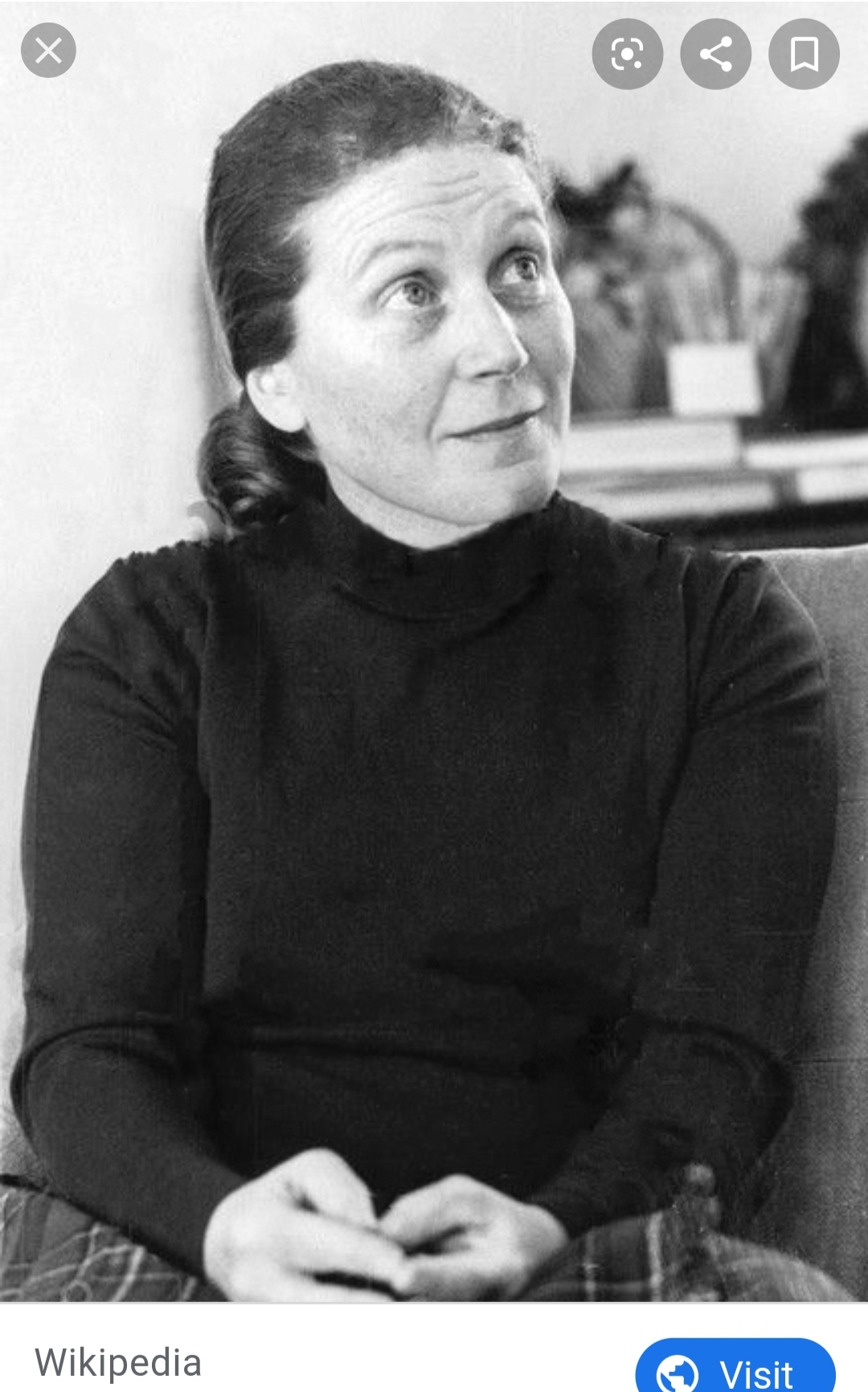
Courtesy of Wikipedia

“You can’t regret your fate. Although I do regret my mother didn’t marry a carpenter.”

913: Lana Peters

Most Known for Being Josef Stalin’s Daughter

Born: 28 February 1926, Moscow, Soviet Union (Present-day Moscow, Russia)

Died: 22 November 2011, Richland Center, Wisconsin, United States of America

Original Name: Svetlana Stalina

Also Known As: Svetlana Alliluyeva

As a child, Lana was known to some as the “Little Princess” of the Kremlin. She was Josef’s youngest and his only daughter. Her mother was his second wife Nadezhda (who committed suicide when Lana was still a little girl). Her father showered the girl with American movies, presents, and even called her his “Little Sparrow.” Thousands of girls across the USSR were named Svetlana, and Lana herself inspired a perfume and was likened as the Soviet Union’s Shirley Temple.

After World War II, Lana decided she wanted to study literature at Moscow University. Instead, her father demanded she study history. Then he demanded Lana become a teacher, which she also did. Lana taught Soviet Literature and the English language; she also later became a literary translator.

When Lana’s father found out she had fallen in love, he banished her boyfriend, a Jewish filmmaker, to Siberia for ten years. The second time she fell in love, Lana did marry him, even after her father smacked her and said he wouldn’t allow it. Lana had one son with her first husband and divorced him after two years.

Two years later, in 1949, Lana married her second husband; who was the son of Stalin’s right-hand man. They had a daughter together but divorced soon after.

The year before her father died, the leader of the USSR after his death, Khrushchev, wrote that Stalin grabbed Lana by her hair and forced her to dance. Obviously, there was some tension between father and daughter, and helped explain Lana’s actions later on in her life.

Lana changed her last name to her mother’s maiden name, Alliluyeva, after her father’s death in 1953. Nadezhda had died when Lana was only six years old, and at the time she was lied to; told her mother had died from appendicitis. Lana would not learn the truth, that her mother had killed herself from a deep depression that Lana’s father had a lot to do with, until she was a teenager.

In the 1960’s, Lana decided she wanted to get married for a third time, to an Indian communist man. However, the new Soviet government refused to allow the marriage to take place, one of the many slights Lana received after her father’s death. Once Lana’s boyfriend died, the Soviet government begrudgingly allowed her to take his ashes home to India. Lana would later refer to him as her husband, though no evidence of a marriage between them has ever been found.

After arriving in India, Lana managed to ditch the KGB agents following her. She raced to the United States Embassy in New Delhi and requested political asylum. News exploded across the world as Lana quickly became the most high-profile Soviet defector in the world. President Lyndon Johnson worried accepting her into the country might damage peace efforts between the US and the Soviet Union. However, President Johnson finally agreed to admit her as long as Lana, as she was now known, agreed to not flaunt her new status for the world to see.

When she arrived in New York, Lana held a press conference in which she denounced the Soviet Union. She also published her first autobiography a few months later. The book reportedly earned her $2.5 million, so not bad. Lana also burned her Soviet passport, called her father “a moral and spiritual monster” and likened the KGB to the Gestapo.

When she left the USSR, Lana’s son was twenty-two and her daughter seventeen. In early interviews, she mentioned she felt lonely in her new home country. However, by 1970 she had married for the third time. She also had a child with this husband, another little girl, but they separated when the girl was eight months old and later divorced.

In 1978, Lana became a United States citizen and told a reporter she registered as a Republican. However, little else is known about her life during that time. In 1982, Lana and her daughter moved to England. Lana also became speaking more favorably of her father again and noted that he would have shot her had he been alive when she defected. That may seem like an over exaggeration, until you consider that Lana’s older half-brother was literally killed during World War II after he was captured by the Germans and their father refused to exchange another prisoner to get him back. Her full-blooded brother died when he was only forty years old from affects of his alcoholism. So yeah, Lana was probably correct in her assumption about her father.

After sixteen years of being apart, Lana finally heard from her son for the first time. The Soviet government had begun to relax their extreme policies against Lana, and so her son was allowed to call her often. He decided he would visit his mother soon; however, the government drew the line there. Lana was going to see her son no matter what though, and so in 1984 she packed up her younger daughter, then thirteen, and moved back to Moscow. Upon arrival, Lana promptly asked that the government take her back.

Once it was certain Lana wouldn’t be kicked out, she began denouncing the United States in an eerily similar fashion to the way she had spoken of the Soviet Union earlier. She claimed she had enjoyed a single day of freedom in the West, that she’d been a virtual captive of the CIA, and she would explode in anger when questioned by any journalist about her new views.

Lana and her daughter were given Soviet citizenship, but it wasn’t the homecoming Lana had expected. Her older children shunned her, and the public at large condemned Lana for refusing to bow to the government’s insistence on Atheism. Lana refused to remove her crucifix, and eventually left Moscow. Taking her daughter with her, Lana settled in Soviet Georgia instead, but it was no better than Moscow had been.

After only two years of being back in the Soviet Union, Lana returned to the United States in 1986. Once she reached Wisconsin, Lana said that she had simply been mistranslated and that everything she’d said in Moscow was misconstrued in the West. Mhm. Meanwhile her daughter went back to school in England.

Friends said that Lana spent the rest of her life unable to stay in one place for longer than two years. Despite publishing two bestsellers, Lana claimed to be impoverished from failed investments and that she had donated the vast majority of her wealth to charity. Her son died in 2008.

When news finally did spread that Lana had died from colon cancer, various officials within Wisconsin and even the local funeral home refused to answer questions or confirm what her last days had really been like. Both of her daughters survived her, though neither wanted to comment much on her mother’s death. Her younger daughter was living in Oregon at the time, having changed her name to help preserve her anonymity. Lana’s older daughter was studying a volcano in Siberia, reportedly.

It was a sad and lonely end for a woman who spent her entire adult life running away from her own past. A year before she died, Lana stated in her interview (regarding her father): “He broke my life. I want to explain to you. He broke my life… Wherever I go here, or Switzerland, or India, or wherever. Australia. Some island. I will always be a political prisoner of my father’s name.”

Badges Earned:

Find a Grave Marked

Located In My Personal Library:

Stalin's Daughter: The Extraordinary and Tumultuous Life of Sveltana Alliluyeva by Rosemary Sullivan

Sources:

https://www.nytimes.com/2011/11/29/world/europe/stalins-daughter-dies-at-85.html

https://www.bbc.com/news/world-us-canada-15931683

https://www.britannica.com/biography/Svetlana-Alliluyeva

https://www.findagrave.com/memorial/81144273/svetlana-iosifonova-alliluyeva

912) Katharine Wright Haskell

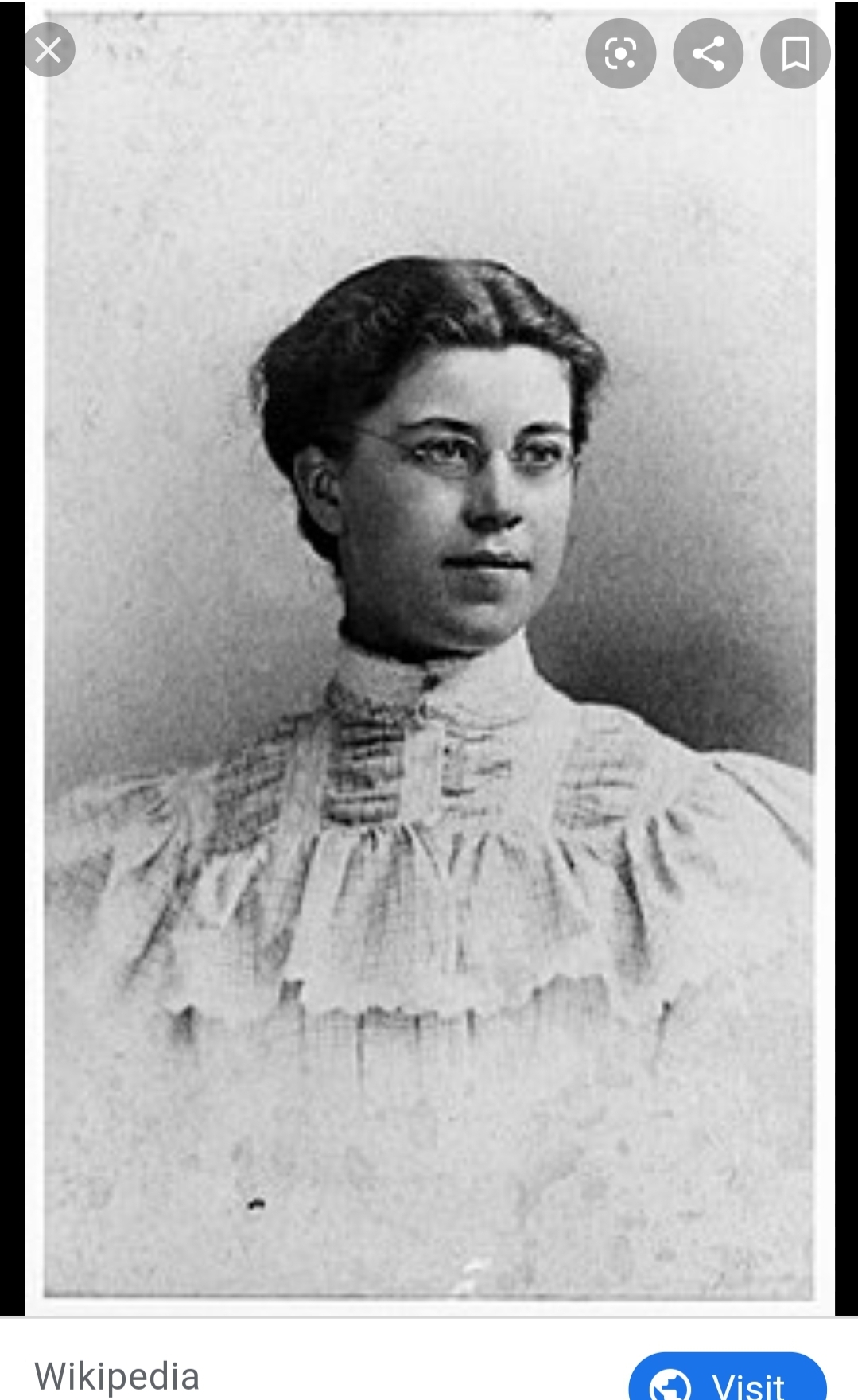
Courtesy of Wikipedia

“In my imagination I walk through our Dayton home, looking for [Orville] and all the dear family things that made my home. But I never find [Orville], and I have lost my old home forever, I fear.”

912: Katharine Wright Haskell

Most Known for Being the Sister of Orville and Wilbur Wright

Born: 19 August 1874, Dayton, Ohio, United States of America

Died: 3 March 1929, Kansas City, Missouri, United States of America

Katharine was also a high school teacher.

Katharine was the youngest Wright sibling, the only girl to survive infancy, and was born on her brother Orville’s third birthday.

When their mother died so did seemingly all of Katharine’s prospects of marriage. Mrs. Wright died just shy of Katharine’s fifteenth birthday, and the loss affected her deeply. Katharine’s father was a traveling minister, who had relied on his wife to run the household and entertain guests while he was away. With Katharine’s mother dead, the young teenager had to take over her mother’s social responsibilities in their entirety. This meant she hardly had time to think, let alone try to find a husband.

Some biographers have speculated further on Katharine’s lack of a marriage in her younger years. Katharine, Orville, and Wilbur were the three youngest Wright siblings, and were especially close. It has been posited that the three siblings vowed to never marry, and instead focus on each other. Whether or not this is true is unknown, but it is true that Orville and Wilbur never did marry.

Katharine had an outgoing personality and was very pretty. She had lots of male admirers but wouldn’t actually get hitched until after her fiftieth birthday. Instead of a secret pact she made with her brothers, a more obvious explanation for this could have been Katharine’s sense of duty to her family and caring for her father as he aged.

In 1893, Katharine’s father insisted she attend Oberlin College to obtain a teaching degree. Katharine became the only Wright sibling to earn a college degree and was able to become a teacher. While in school, Katharine also met the man she would eventually marry; Harry Haskell. However, Katharine and Harry didn’t immediately become involved. Instead, they were both engaged to other people! Katharine’s engagement ended without her ever walking down the aisle.

It took Katharine five years to earn her degree—partly because she had missed a portion of her junior year to help nurse her brother Orville back to health after falling ill with typhoid fever. At first, Katharine failed to find a teaching position, starting her career as a substitute in 1899.

Katharine also resumed her post as head of the Wright household after graduation. She hired a maid to help with the cooking and cleaning but had inherited some of her father’s authoritarian attitude. According to wright-brothers.org; at the beginning of one school year Orville asked his sister for a list of the week’s “victims” and that he was glad her students were receiving some of her ire for a change as opposed to just her family.

By 1901, Katharine had received a full-time teaching position. She taught beginner’s Latin, an exciting prospect seeing as she’d excelled at Latin and Greek in college. Around the same time, Orville and Wilbur’s work on their now-famous flying machine really ramped up. Katharine was equal parts excited and annoyed by her brother’s experiments, complaining that she had nowhere to go in the house for a moment of peace but also knowing she would miss them as soon as they left to test the machine out in North Carolina in 1902. Their first flight (and the first time man ever flew in an airplane) occurred in late 1903.

In 1906, after Wilbur and Orville secured a patent for their flying machine, they decided to begin selling it to interested buyers. Katharine joined the venture and worked as their executive secretary. She answered queries, wrote to newspapers to correct their inaccurate reports, and screened some of the business offers the brothers received. She even got the go ahead from her brothers to allow the Webster Dictionary to publish a photo of the Wright Glider; and she did all of this while still working as a Latin teacher.

Katharine had previously worked for and with her brothers as well. When the brothers left to test out their flying machines in North Carolina, Katharine stayed behind to run their bicycle store: paying bills and everything else needed to keep the shop afloat.

By 1908, both Wilbur and Orville were traveling out of Ohio to demonstrate the glider and secure further business ventures. Katharine was left behind to keep things running at home. She also was left nursing her nephew (from another brother) through typhoid fever. Katharine’s stress increased even more when her school district decided to cut the salaries of female teachers. Katharine’s nephew recovered, but soon after she received word Orville had been in an accident and broke several bones. Katharine was on the train to Washington DC within two hours of receiving the news, leaving her students to a substitute teacher.

When Katharine arrived in the capital, she learned the accident had been worse than previously reported. Besides having a broken leg and several shattered ribs, Orville had also suffered a concussed spine and several scalp lacerations. The passenger on Orville’s flight, a lieutenant in the US Army, had died. Lt. Thomas Selfridge was the first person to ever die in an airplane accident.

For the next six weeks, Katharine worked to nurse her brother, keep the business venture afloat, and even helped investigate what caused the crash. A few months later, Katharine and Orville set sail for France to meet up with Wilbur. Upon arrival, Katharine’s position within the Wright company expanded even more, and she now worked as her brothers’ social secretary as well. She spent two hours each day learning French and spent the rest of the day meeting with potential investors and customers. Wilbur and Orville were lousy at meeting and selling their gliders, but Katharine shown when given the opportunity. She even won over the King of Spain with her dazzling smile.

While in France, Katharine became the third woman to ever fly in an airplane. One of her flights happened before the King of England, in an attempt to prove that even young and impressionable women could survive the adventure. Katharine’s efforts with the airplane and the Wright company didn’t go unnoticed by the French press, and by the time the three siblings left the government had awarded all three of them the Legion of Honor. Katharine remains one of the few American women who can claim that honor.

Upon their return to America, Katharine was heralded by her hometown of Dayton as well as receiving several honors alongside her brothers in Washington DC. While there, Katharine ran into an old friend from Oberlin—Harry Haskell, who was working as a journalist in the capital. Later that same year, Orville was able to pick up where he’d left off the US Army the year before, and after the newest Wright flyer debuted, the Army purchased their first airplane.

Soon after, the Germans became interested as well. With business booming and no end to her work with her brothers in sight, Katharine resigned from her teaching position to work with her brothers’ full time. However, soon after, American investors took over the Wright company, and Katharine no longer had a position within it. She did have enough money she didn’t have to worry about going back to work though.

Katharine pivoted her focus to volunteer work instead. She was an active campaigner for women’s suffrage, the director of the Women’s League of Dayton, and she was able to oversee the construction of the new Wright family home. Called Hawthorn Hill, the Wright home was built just outside of Dayton in Oakwood.

In May of 1912, Wilbur came down with typhoid fever, and he died. Both Katharine and Orville were stunned, but also blamed Wilbur’s death on overwork. He’d spent the past few years in and out of court, fighting to protect the patent for the Wright flyers.

Orville took over as president of the company, while Katharine became the secretary. If anyone purchased stock in the Wright company during that period of time, they would receive a stock signed by both Katharine and Orville. However, Orville wasn’t happy in his role as executive of the company and missed Wilbur terribly.

In 1915, Orville sold the Wright company completely, and built a small research laboratory instead. He and Katharine had said good riddance to the business once and for all as they fought for something much more important: preserving Orville and Wilbur’s work, and their hard-earned place in history. The year before, a man had purchased a flying machine that had been built before the Wrights' but had never managed to actually fly. This new guy made over thirty changes to the machine and finally managed to get it in the air. Normally this wouldn’t have even made headlines, but it just so happens that this new/old machine had originally been built by the now-deceased former director of the Smithsonian Institute. As soon as it became airborne, the Smithsonian claimed they were responsible for the first manned flight, not Orville and Wilbur.

Obviously, this wasn’t true, and Katharine and Orville were out to preserve their good name. The fight wasn’t fully resolved until the early 1940’s, when the Smithsonian finally relented and agreed the Wright flyer was the first true flying machine that worked. The original flyer from the 1903 flight wouldn’t be donated to the Smithsonian until 1948, after Orville’s death (though to be fair, Orville and Wilbur had tried to donate it years earlier, soon after they made history. The Smithsonian declined to accept at that time).

One of Katharine and Orville’s allies in their fight was the journalist, and Katharine’s old friend, Harry Haskell. Soon after, Harry and Katharine were both invited to join Oberlin College’s board of trustees. Katharine was only the second woman ever so honored.

In 1923, Harry’s wife passed away from cancer. The friendship that had been rekindled so many years before blossomed into something more as Katharine and Harry wrote often, exchanging numerous letters. Two years later, the pair realized they were in love (they hadn’t even seen each other in person in years, this was all through letters) and a few months later, after they did meet in person again, they decided to get married.

Katharine was happy to finally be happy and in love, but she was also worried. She didn’t want to leave Orville behind; the pair had grown even closer after Wilbur’s unexpected death, and since their father had died in 1917, they had done almost everything together—even adopting a puppy!

Katharine was so worried about telling Orville the news, she kept putting it off and putting it off. Finally, in May of 1926, Harry finally told Orville of his intentions to marry Katharine. Orville went into a complete depression after hearing the news. He relied on Katharine entirely for all of his social interactions. If she got married, he would have to deal with people himself; gross.

Now, I know what you might be thinking, and I want to be incredibly clear on this. Though Orville and Katharine were incredibly close; they lived together and were each other’s best friends, that was all there was to it. There was nothing incestuous about the relationship at all. Even though Orville was acting like Katharine had cheated on him, she was not! At all! He was just extremely shy and hated dealing with people and was used to his little sister dealing with them for him. Can you blame him for being upset? People are the worst.

On 20 November 1926, Katharine and Harry married in Oberlin, then moved to Kansas City. She never saw Hawthorn Hill again. Though Orville was refusing to speak with her, Katharine’s new life was otherwise extremely happy and fulfilling. She became close with her new stepson, Harry got a promotion, and in 1944 he even won a Pulitzer Prize for his journalistic efforts (though Katharine didn’t live to see this, sadly).

In 1929, Katharine and Harry were supposed to set sail for a vacation in Greece and Italy. They never got on board the boat, however. Katharine had been feeling ill and was diagnosed with pneumonia. Another of the Wright brothers arrived to check on her and immediately sent for Orville. Though Katharine and Orville hadn’t spoken since before her wedding, he got on the train.

Orville arrived in Kansas City one day before Katharine died. She was only fifty-four years old. She is buried alongside her parents and her brothers, Wilbur and Orville, whom she had given so many years of hard work and dedication too.

Upon Orville’s death, he bequeathed in his will $300,000 to Oberlin College, as a final gift to his sister. The money was worth more than $1 Million today. The school used the money to build the Wright Laboratory of Physics, which is still used by the school today.

Katharine's widow, Harry, requested a fountain be built in her honor and dedicated on Oberlin's campus. A recreation of the fountain still exists today, and was restored in 2007. The iconography of the statue was designed and chosen by Harry to commemorate his and Katharine's love of all things ancient Roman and Greek.

In 2020, Katharine began to retake her rightful place in history with the news of a new graphic novel. Aimed at teaching kids fun facts about history, the first in the series is called The Wrong Wrights (Smithsonian announcement article linked below). Here's to hoping someday soon, when taught the history of aviation, school kids everywhere are taught about the Wright Siblings, as opposed to just the Wright Brothers.

Badges Earned:

Find a Grave Marked

Located In My Personal Library:

After the Fact: The Surprising Fates of American History's Heroes, Villains, and Supporting Characters by Owen Hurd

Sources:

http://www.wright-brothers.org/Information_Desk/Just_the_Facts/Wright_Family/Katharine_Wright/Katharine_Wright.htm

https://www.nps.gov/people/katharine-wright.htm

https://wrightstories.com/the-wright-brothers-plus-one-the-influence-of-their-sister/

https://airandspace.si.edu/exhibitions/wright-brothers/online/who/1859/katharine.cfm

https://airandspace.si.edu/exhibitions/wright-brothers/online/icon/feud.cfm

https://www.findagrave.com/memorial/31769874/katharine-haskell

Graphic Novel Announcement: https://www.smithsonianmag.com/smithsonian-institution/new-graphic-novel-writes-the-wright-brothers-sister-back-into-history-180958103/?utm_source=facebook.com&utm_medium=socialmedia

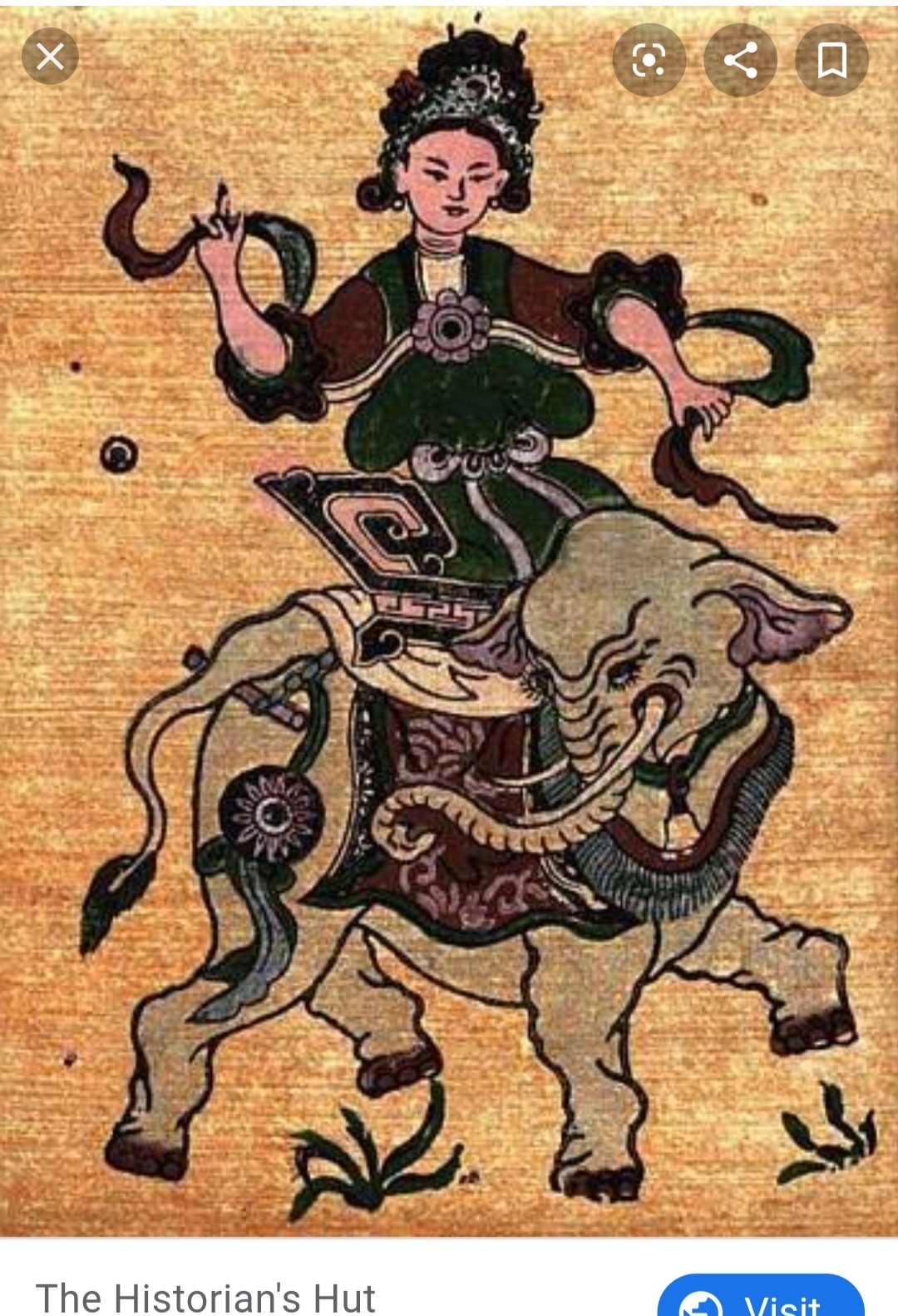
911) Lady Trieu

Courtesy of The Historian's Hut

 “I will not resign myself to the lot of women, who bow their heads and become concubines. I wish to ride the tempest, tame the waves, kill the sharks. I have no desire to take abuse."

911: Lady Triệu

Vietnamese Warrior who Fended Off the Chinese

Born: c.222-245 AD, Present-day Thanh Hoa Province, Vietnam

Died: 248 AD, Present-day Tung Mountain, Vietnam

Also Known As: Triệu Thị Trinh, Triệu Ẩu, or Bà Triệu

Closest English Sound Translation: “Jeu Tea Gin/Chin”

Lady Triệu’s given name at birth is unknown.

She is sometimes referred to as the Vietnamese Joan of Arc by Western scholars.

To those unaware, the treatment of the Vietnamese at the hands of the Chinese was horrible, went on for literally hundreds of years, and led to several standout characters from Vietnamese history who dared to fight back. The Vietnamese were taxed to the point of near extinction, were forced to change their culture and written language to closer reflect their Chinese overlords, lost the vast majority of their precious stones and other items, and lost their arable lands. Basically, the Chinese came in, took over, and screwed the Vietnamese. No wonder they wanted to fight back. The first successful insurrection was led by the Trung Sisters (Trưng Nhị and Trưng Trắc) in 39 AD. They ruled for two years before being forced to commit suicide instead of being captured by the Chinese. After the Trung sisters died, the Chinese ruled over the Vietnamese for around two hundred years.

That little summation of history brings us to our current entry, Lady Triệu.

After being orphaned at a young age, Triệu moved in with her brother and sister-in-law. However, Triệu was not content to the civilian life, and instead spent her time fuming at the horrible way her people were treated by the Chinese. She eventually ran away from home and decided to raise an army of over 1,000 men against the Chinese.

Oh, and she was only nineteen at the time.

By the time she was twenty-one, Triệu had won over thirty battles against the Chinese. She even came to the aid of her brother, who also led a revolt against the Chinese (and when he died in battle, Triệu took over command of his troops).

For several months she ran an administration in the territory she freed from the Chinese, but then the Chinese overtook her forces and she committed suicide by jumping into a river to avoid becoming their prisoner.

It is said she rode into battle wearing golden armor with a sword in each hand atop an elephant, and it is also said that when her brother tried to dissuade her military aspirations (or asked her to get married instead of going to war), she replied to him the quote you see included in this article. I should add that I’ve seen this quote attributed to her in three different places, but the exact wording is slightly different. This is to be expected considering it’s a translation and was spoken around 1,800 years ago.

In 939 AD, the Vietnamese finally won independence from the Chinese. They remained free for the next 1,000 years. The Vietnamese language and culture had survived the centuries of suppression and remain today for the entire world to learn and grow in awe of. In 1771, Vietnam was finally united as one nation, after two ruling factions had ruled the north and the south since 939. Before the 19th century could end, however, the French had overtaken the nation. Then there was a little conflict called the Vietnam War—I’m sure you’ve heard of it. Long story short, Vietnam’s history has been long and bloody, but today the people are free once more (er, as long as you like Socialism anyway).

Today, a temple to Triệu stands in Vietnam. She was also given the title “Truest and Bravest First Lady”, the highest title that can be bestowed in her country.

Badges Earned:

Find a Grave Marked

Located In My Personal Library:

Uppity Women Speak Their Minds by Vicki Leon

Sources:

https://www.encyclopedia.com/women/encyclopedias-almanacs-transcripts-and-maps/ba-trieu-225-248-ce

https://amazingwomeninhistory.com/trieu-thi-trinh-the-vietnamese-joan-of-arc/

https://en.wikipedia.org/wiki/Lady_Tri%E1%BB%87u

https://www.findagrave.com/memorial/194589037/trieu-au

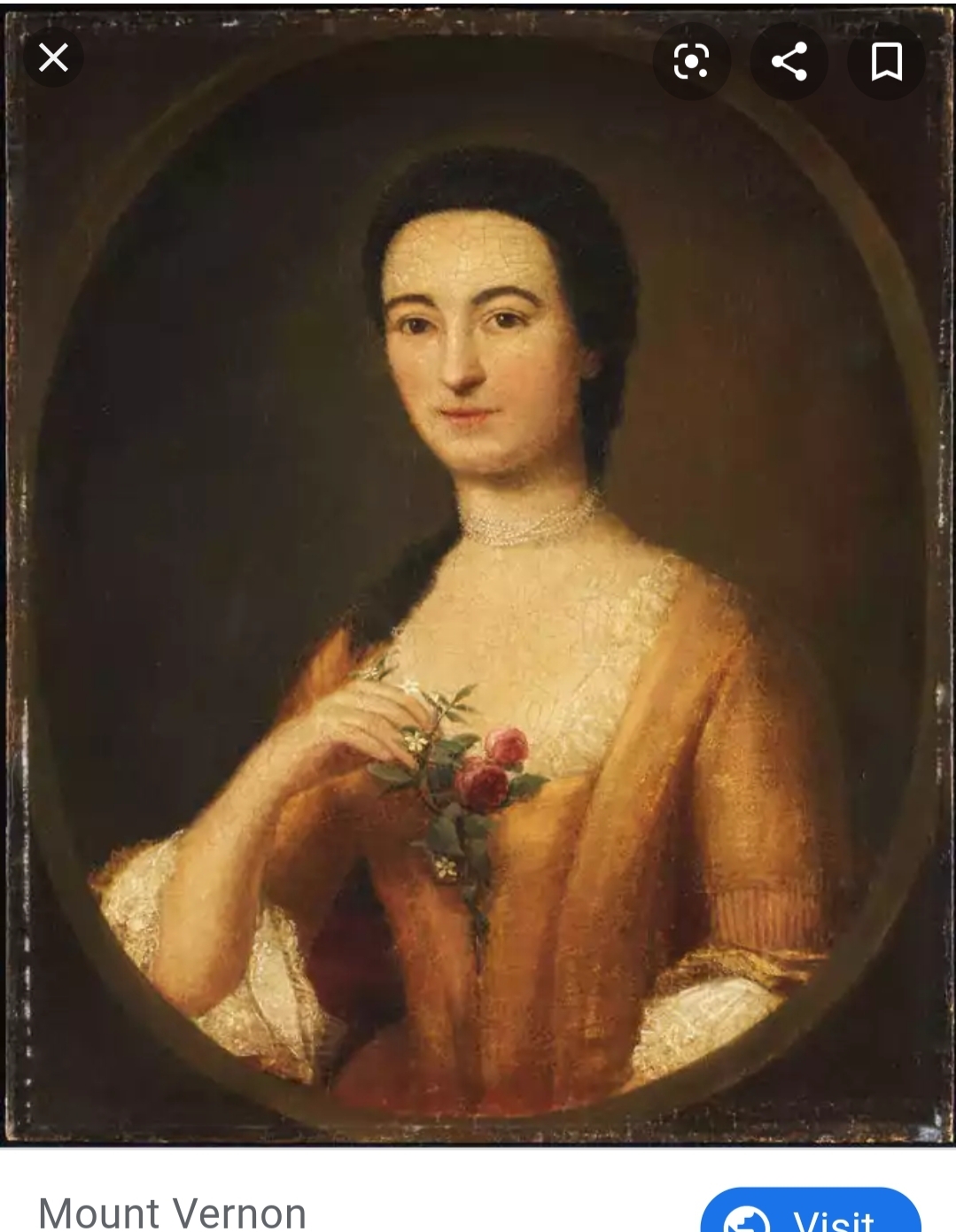
910) Annis Stockton

Courtesy of Mount Vernon

910: Annis Stockton

One of the First Female Poets to be Published in the Thirteen Colonies of the Future United States

Born: 1 July 1736, The Colony of Pennsylvania (Present-day Darby, Pennsylvania, United States of America)

Died: 6 February 1801, Fieldsboro, New Jersey, United States of America

Full Name: Annis Boudinot Stockton

Annis published her first poem at the age of sixteen. Her father owned a copper company and also became postmaster of Princeton, New Jersey. This position elevated the Boudinot family in society and gave Annis new opportunities. Much detail of her early life remains unknown today, but she was obviously well-read, and her poems were beautiful pieces of prose from the very start.

She is most known for being the wife of Richard Stockton, a Founding Father who signed the Declaration of Independence. Annis and Richard married when she was twenty-one, and she continued to write poetry from her home across from what is today Princeton University. They had six children together, four daughters and two sons.

That home, Morven, is now a museum.

Until 1776, Richard was vying for a peaceful solution to the problems between the Colonists and the English crown. However, he soon came to realize no peaceful solution would ever be found, and he was sent as a delegate to the Second Continental Congress in June of that year. In November, Richard was captured and forced to swear an oath stating he would not act out against the English again. The British destroyed the contents of his home and fields, his crops and library were burned. According to one of his descendants, Richard was the only Signer of the Declaration of Independence to be imprisoned by the English forces for the sole reason of signing the document. Richard’s imprisonment would vastly impact his health and possibly helped lead to his death only a few years later.

However, Annis had made no such promises of loyalty to the English and was not held back by her husband’s oath. And she was most likely rightfully peeved that the English had destroyed all of the belongings in her home and out in her fields. They also arrested her husband and took him away for five weeks in the middle of winter. Its really a miracle Annis didn’t become a kamikaze warrior to take out the soldiers then and there.

Her children were between the ages of seventeen and three at the time their house was ransacked. After Richard was taken away, Annis decided to leave the house. She buried the silver and the family’s documents relating to the American Whig Society. She left her twelve-year-old son, Richard, behind with a servant to guard the house (and before you object, Richard was attending classes at the college across the street and so this wasn’t as horrifying as you’re thinking).

Annis is remembered as a true patriot for other reasons as well. She continued to raise money for the Continental Army after her husband’s oath. Her poems described the bravery of the revolutionary army, and she became a frequent correspondent of George Washington through the war and after he became the first Constitutional President of the United States. George and Martha became frequent visitors to Morven when in the area, and they considered Annis and Richard friends.

Sadly, Annis’s husband Richard died of cancer in 1781. Annis remained at Morven until 1795, when she handed the property over to her oldest son Richard. The house continued to pass through the Stockton family until 1945, when it was sold to the governor of New Jersey. He assured the family the property would eventually by transferred to the state of New Jersey. At first, the home was used as the executive mansion, but as previously mentioned now serves as a museum.

Annis was the only woman ever admitted into the American Whig Society thanks to her safekeeping of important documents during the Revolutionary War. These were the documents she buried in the yard of Morven, to protect the identities of the Society’s members from falling into the hands of the English.

Very few of Annis’s poems were published during her lifetime, due to (as the New Jersey Women’s History website phrases it), her uncertainty of women being published. In 1995, after a manuscript of her writings were uncovered, Annis’s poems were finally published in full at last.

Badges Earned:

Find a Grave Marked

Located In My Personal Library:

American Spirit Magazine Article "Wives of the Signers" (November/December 2020 Edition)

Sources:

https://www.mountvernon.org/library/digitalhistory/digital-encyclopedia/article/annis-boudinot-stockton/

http://www.princetonmagazine.com/richard-and-annis-stockton/

https://njwomenshistory.org/discover/biographies/annis-boudinot-stockton/

https://www.ahtheatre.org/characters/annis-boudinot-stockton

https://www.findagrave.com/memorial/11131407/annis-stockton

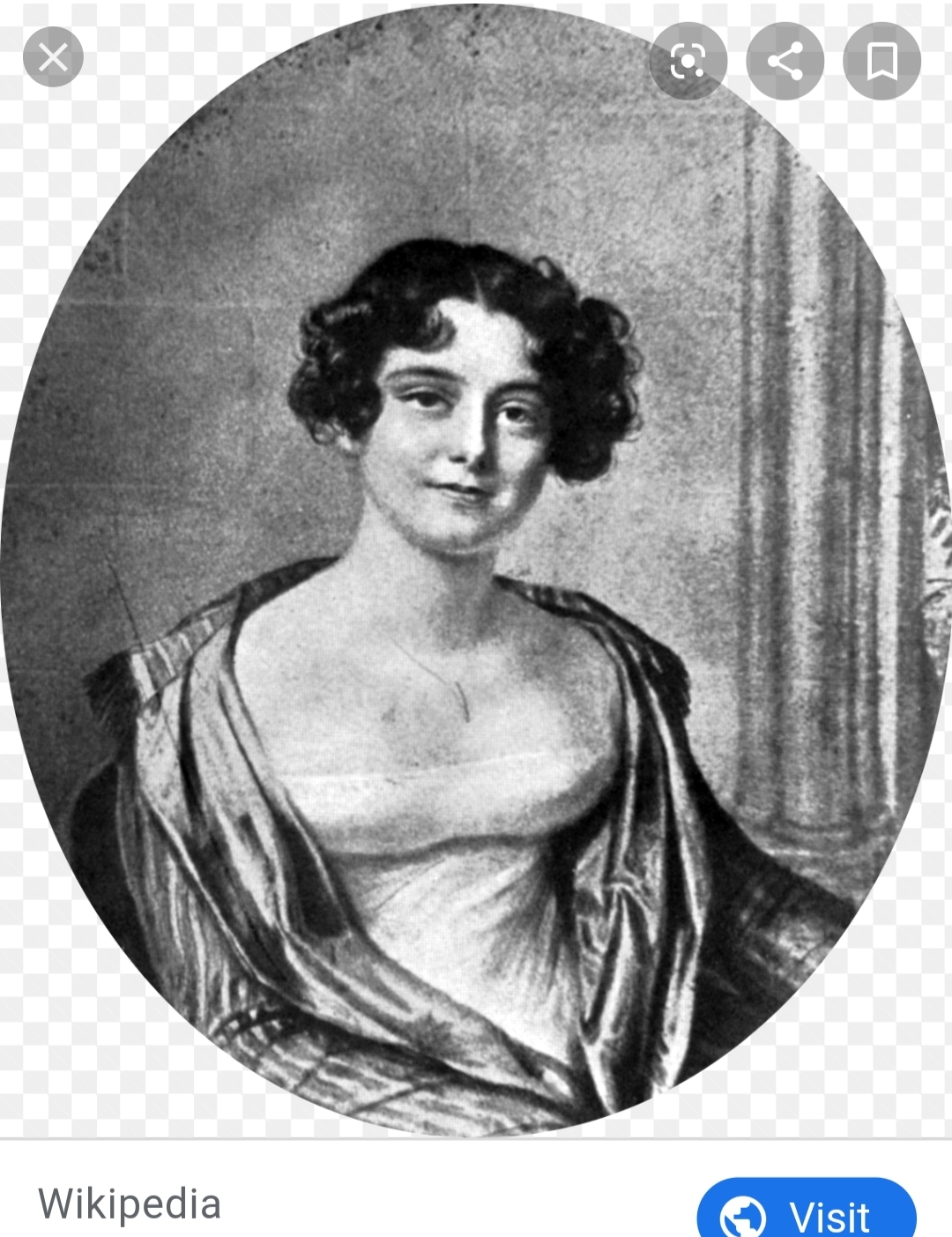
909) Lady Jane Franklin

Courtesy of Wikipedia

909: Lady Jane Franklin

Sponsored Many Voyages to Explore and Map the Arctic

Born: 4 December 1791, London, England (Present-day United Kingdom)

Died: 18 July 1875, London, United Kingdom

Jane’s mother died when she was young. Her father was a silk merchant who educated his daughter in the bare minimum most girls received at the time. He did, however, allow Jane to follow her interests and curiosities. When she was twenty-seven, she married John Franklin, who had already made two trips to the Arctic and was knighted the following year. They never had children.

Jane was quite the explorer herself. Some historians have called her one of the most traveled women of the Victorian Age. Before her marriage, she had voyaged to Australia and New Zealand, all across Western Europe, parts of Asia, and North America. After her marriage, she followed John to the Mediterranean and traveled all around Greece and Northern Africa.

In 1836, John was named governor of the penal colony in present-day Tasmania. Jane followed her husband across the world and enjoyed the political acumen that came with his position. She helped John create the colony, funded projects to expand the sciences and even built a faux-Greek temple to house the natural history museum. She even published a gardening journal and purchased 130 acres to use for her horticulture pursuits.

Jane didn’t stop there though. She also built a state college, helped reform the female prisons, and took in two Aboriginal children for a short time. That last one was a real eye opener for the time, and not at all a popular decision for some. Her final contributions to Oceania history were the facts that she became the first European woman to climb Mount Wellington and she was the first woman to travel between Melbourne and Sydney, Australia over land.

Jane and John left the colony to return to England after John was offered a position to lead another arctic exploration. This one would be the voyage that gave the couple their place in history.

Jane decided to fund the voyages to the arctic after John and his men literally vanished. When John’s expedition tried to find the Northwest Passage in 1845, Jane and the other families of the men aboard the ships knew it would be a long time before they heard from the men again. However, by 1848, three years had passed with absolutely no news. Jane began to request search parties be sent out to try and find her husband and his men. Parties were sent, and the families sent letters along with them, but still no news or sightings turned up.

Jane continued her letter writing campaign, forcing the entire world to sit up and pay attention. She also pored over maps and other material on the subject, becoming an expert on all things arctic from her home in England. It was estimated the crew could survive anywhere between four to six years, based on supplies they had taken with them. If the crew met and made friends with the local Inuit populations, their survival estimate jumped to ten or eleven years. But despite these assumptions, still no evidence of the missing crew was found.

In all, Jane completely or partially funded seven expeditions to find her husband. None were successful. In 1859, one of the expedition leaders returned with a scrap of paper stating, in six different languages, that John had died within a year of the expedition leaving (1845). The paper was found in the desolate arctic, but it wasn’t enough for Jane. Other graves, skeletons, and random artifacts also turned up, but still no definitive answers. Jane wanted more. The final expedition crew left just weeks before she died in 1875.

Despite never finding John, Jane did end up becoming the first woman to receive the Royal Geographic Society Founder’s Medal in 1860. She also ensured John’s legacy was not that of a lost soul wondering in the dark, but a martyr for the cause of English expansion and the discoverer of the mythic Northwest Passage. She ensured a statue was unveiled in his honor, and a monument was dedicated in Westminster Abbey to him.

The ships might not have found her husband, but they did unveil numerous scientific discoveries of various flora and fauna within the arctic and surrounding areas. The Northwest Passage, or what really existed of it anyway, was discovered in 1850 on a voyage trying to find John. The searchers were also able to survey and map Greenland’s coastline.

The two missing ships were both finally located, in 2014 and 2016 respectively. However, finding the ships only caused more confusion. Both ships were miles away from their last reported positions, further south than they should have been. Canada has since launched a project to record the surviving oral histories of the Inuit tribes that witnessed the boats and members of the 1845 crew, but it is unlikely the true mystery of what happened to John Franklin and his men will ever be solved.

Badges Earned:

Find a Grave Marked

Located In My Personal Library:

Who Knew? Women in History by Sarah Herman

Sources:

https://www.rmg.co.uk/discover/explore/jane-franklin-remarkable-woman

https://www.atlasobscura.com/articles/cool-lady-jane-franklin-polar-exploration

https://australian.museum/about/history/exhibitions/trailblazers/lady-jane-franklin/

https://www.britishmuseum.org/collection/term/BIOG123456
https://www.findagrave.com/memorial/7239105/jane-franklin

908) Candalyn Kubeck

Courtesy of People Maven

"She was harassed.They beat up her car. They threatened her with rape. They threatened to burn her house down. After she would land, they were always there waiting."

(Candalyn's mother's account of what happened to her daughter after taking the Eastern Airline job).

908: Candalyn Kubeck

One of the First Female Commercial Airline Pilots

Born: 10 May 1961, Hollywood, California, United States of America

Died: 11 May 1996, Florida Everglades, Florida, United States of America

Also Known As: Candi

Unfortunately, Candalyn was captain of Valujet Flight 592, which crashed in the Florida Everglades due to mislabeled oxygen canisters catching fire in the cargo hold. The fire damaged the flight controls of the aircraft from the intense heat causing it to crash with all lives on board lost. The investigation into what caused the crash of Flight 592 was chronicled in an episode of Air Disasters entitled "Fire in the Hold."

Candalyn took her first flying lesson at the age of fifteen and went on to earn a degree in aerospace science. She wanted to fly from the time she was a child, inspired by her grandfather and uncles who had served in World War I and the Vietnam War.

Before becoming a commercial jet pilot, she worked as a flight instructor. Candalyn also worked as a non-union pilot who flew for Eastern Airlines during the time their union pilots and machinists went on strike. This has led many commercial pilots, who were and are a part of a union, treat Candalyn and her memory with venom, if not outright hatred, for “crossing a picket line” and flying against the union’s wishes.

Candalyn took the job with Eastern Airlines because she had limited flight experience and other companies had already turned her down. She wanted to be a pilot, and that’s what mattered most to her. Candalyn’s husband was a pilot for America West and a member of the union, so he asked her not to take the job because it would force him into an awkward place. Also, the job was based out of Atlanta and at the time Candalyn and her husband lived in Phoenix. But again, Candalyn wanted to fly, and so she took the job.

Candalyn’s mother was afraid for her daughter’s safety after Candalyn made her decision. The machinist union for Eastern Air had been court ordered to stop the violence they showed to non-union employees (they had thrown rocks and other objects at them), and in the 1920’s, Candalyn’s great-grandfather was shot by a striking mine employee. He would later die from his injuries. So Candalyn’s mother feared for her daughter and wanted her to be safe, but again, Candalyn was determined to fly for a commercial airline.

After graduating from the flight training program, Candalyn was assigned to fly an Airbus A-300. Unfortunately, two years later, Eastern Air went bankrupt. Even worse, Candalyn was blacklisted from most major airlines because she had chosen to cross the picket fence. Eventually she was hired by ValuJet, a non-union company. She was the thirty-third pilot hired and eventually went on to become a captain. She even appeared in a ValuJet training film.

Sadly, as you read above, Candalyn’s story did not get any better. All she wanted was to fly, and though she did achieve her dream for a few years, that dream was tragically cut short.

Candalyn was the first female airline captain to be killed in a commercial crash in the United States (a female co-pilot died in 1991). One hundred and ten lives were lost that day in the Everglades, and because of Candalyn’s previous history, her family received next to no sympathy from the airline community at large.

On that fateful May day, Candalyn was flying a DC-9, a much older and less technologically advanced plane than the Airbus she had flown for Eastern Air. The dials and switches are harder to read, and there are so many inside the cockpit you might be mistaken to think you’ve stepped into a NASA Space Shuttle as opposed to a commercial jet liner.

The first six minutes of the flight were completely routine, but then Candalyn and her co-pilot heard a sound, now believed to have been a tire exploding in the cargo hold from the intense heat.

Electrical power started to fail next. Then, Candalyn and her co-pilot heard the passengers and other member of the flight crew screaming about a fire from the back section of the plane. The smoke overtook the cockpit next. The co-pilot immediately requested they be allowed to routine to Miami International Airport, which Air Traffic Control accepted.

Candalyn and her copilot turned the plane around, but before they could reach the airport, they had to make a decision. Though it isn’t known for certain, some aviators and other researchers believe Candalyn decided to ditch the plane in the Everglades instead of trying to make it back to the airport. It was a last-ditch attempt to save the lives of the people onboard, but sadly, it couldn’t be done.

When the plane crashed into the Everglades, some believe parts of the plane had already started to break up from the fire damage. There were several witnesses who saw the plane came down, but sadly, none of the passengers and crew were able to walk away. Most were already dead, or at least unconscious from the smoke inhalation before the plane hit the water, a small mercy for the one hundred ten souls on board.

At the time of the crash Candalyn had nearly 9000 Flight Hours logged.

She was later cleared of any wrongdoing by the NTSB investigation into the crash.

In 2018, the FBI released an update on the Flight 592 case. They have decided to provide a $10,000 reward for anyone able to help capture a fugitive mechanic who “had a role” in mislabeling the oxygen canisters that later took down the flight. He disappeared in 1999 after being indicted on criminal charges. Two coworkers who were also charged were later acquitted.

So, I’ll ask you. Have you seen Mauro Ociel Valenzuela-Reyes? He is believed to be living under a false identity in Chile but also has family in Atlanta, Georgia. If you have information on Maura, contact the FBI immediately. The victims of Flight 592 and their families will thank you if you do. I've included his photo and the age progression picture the FBI released in 2018 at the bottom of this article.

Badges Earned:

Find a Grave Marked

Sources:

https://www.sun-sentinel.com/news/fl-xpm-2001-05-21-0105200322-story.html

https://www.sun-sentinel.com/news/fl-xpm-1996-12-22-9612200308-story.html

https://www.chicagotribune.com/news/ct-xpm-1996-05-14-9605140232-story.html

https://www.nytimes.com/1996/05/14/us/the-crash-in-the-everglades-the-victims-at-the-helm-a-pilot-who-lived-to-fly.html

https://www.news-press.com/story/news/crime/2018/04/08/new-10-000-reward-fugitive-1996-valujet-crash-everglades-killed-110/497044002/

https://www.findagrave.com/memorial/102024091/candalyn-kubeck

Courtesy of the FBI
  • Previous
  • 1
  • …
  • 32
  • 33
  • 34
  • 35
  • 36
  • 37
  • 38
  • …
  • 159
  • Next

Categories

Archives

  • July 2025 (10)
  • July 2024 (1)
  • January 2024 (1)
  • August 2023 (1)
  • June 2023 (2)
  • October 2022 (1)
  • July 2022 (1)
  • June 2021 (3)
  • December 2020 (3)
  • August 2019 (1)
  • July 2019 (2)

Search

© 2026 The Exasperated Historian | Powered by Minimalist Blog WordPress Theme