The Exasperated Historian
Menu
  • Home
  • The Women’s List (New)
  • The Men’s List
  • The Animal List
  • Collections
  • The Blog
  • Contact Us
  • FAQ
Menu

Category: Birth Locations

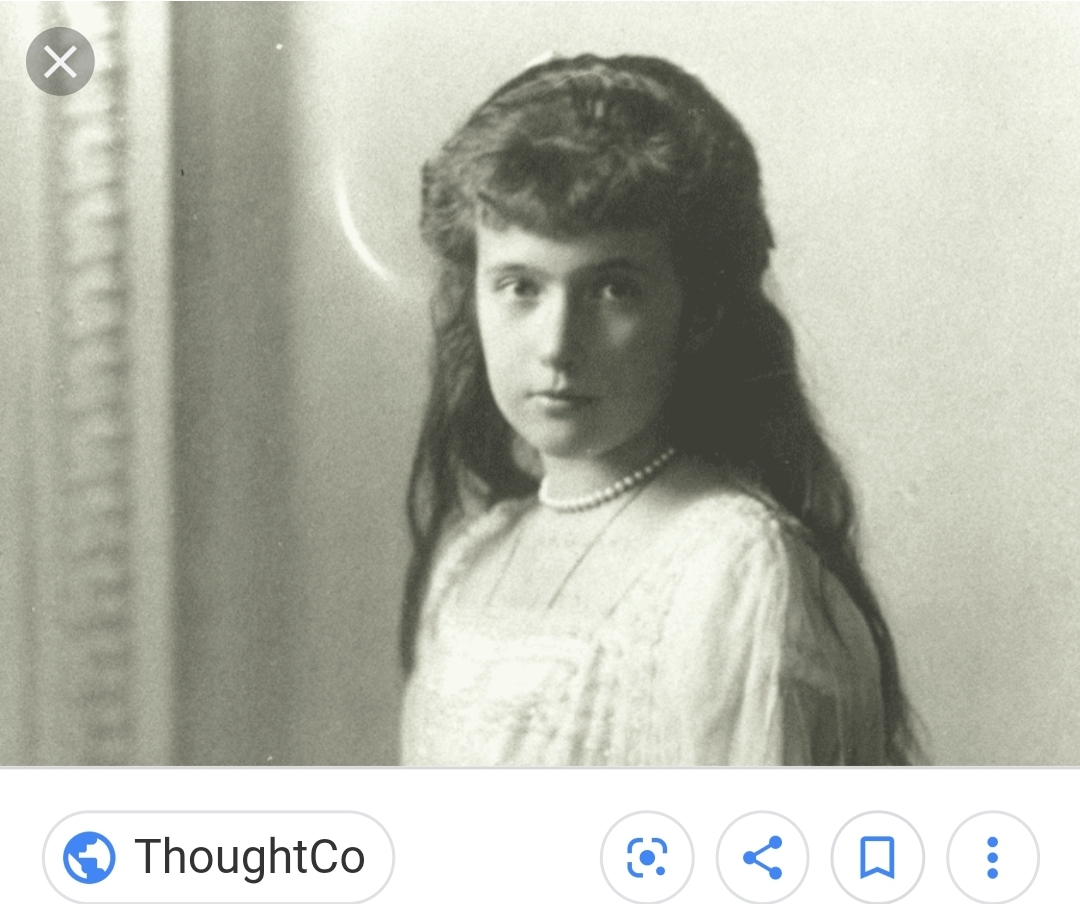
213) Anastasia Nikolaevna Romanova

Courtesy of ThoughtCo

213: Anastasia Nikolaevna Romanova

Russian Grand Duchess and The Most Famous Child in Her Family

Born: 18 June 1901, St. Petersburg, Imperial Russia (Present-day St. Petersburg, Russia)

Died: 17 July 1918, Yekaterinburg, Bolshevik Controlled Russia, (Present-day Yekaterinburg, Russia)

In 1916, the entire imperial family became political prisoners to the new Bolshevik Regime after Nicholas II (Anastasia's father and the Tsar) abdicated the throne amid political and social upheaval and turmoil. In July of 1918, the Bolsheviks determined it was too dangerous to let the family live and ordered the executions of them all.

The four sisters, Alexei, their parents, and several servants were all shot and bayoneted to death in the basement of the house they were staying in.

Anastasia has clung to fame more so than her other family members because after their deaths several women claimed to be her—somehow surviving the terrible night in the basement and wanting to live like a royal. A children’s animated film was also created which is loosely based on her story, but the fact that Rasputin is the villain shoes just how inaccurate the film truly is.

Anastasia and most of her family’s bodies were uncovered in 1976 but were kept secret until the collapse of the Soviet Union when it was safe for them to be brought forward. Genetic testing concluded the bodies were the royal family and that Anastasia had in fact died with the rest of her family.

The false story of her survival lives on in both a play, live action film, and an animated children’s film, she had three older sisters and one younger brother.

Note:

Anastasia’s Actual Title in Russian was Velikaya Knyazhna—a more accurate English Translation would be The Grand Princess. Her title also made her an Imperial Princess, which made her higher ranking than all other European Princesses who were “only” Royal Highnesses.

Badges Earned:

Find a Grave Marked

Located in My Personal Library:

Alexandra: The Last Tsarina by Carolly Erickson

Alice Princess Andrew of Greece by Hugo Vickers

Lost Bodies by Jenni Davis

National Geographic History Magazine Article "Death of a Dynasty" sub-article "Michael the First Romanov" (July/August 2018 Edition)

The Race to Save the Romanovs: The Truth Behind the Secret Plans to Save the Russian Royal Family by Helen Rappaport

Risked by Margaret Peterson Haddix (Historical Fiction)

The Romanov Sisters by Helen Rappaport

A Short History of the World in 50 Lies by Natasha Tidd

Sources:

https://www.britannica.com/biography/Anastasia-Russian-grand-duchess

https://www.biography.com/royalty/anastasia-romanov

https://www.findagrave.com/memorial/6612434/anastasia-nikolaevna-romanova

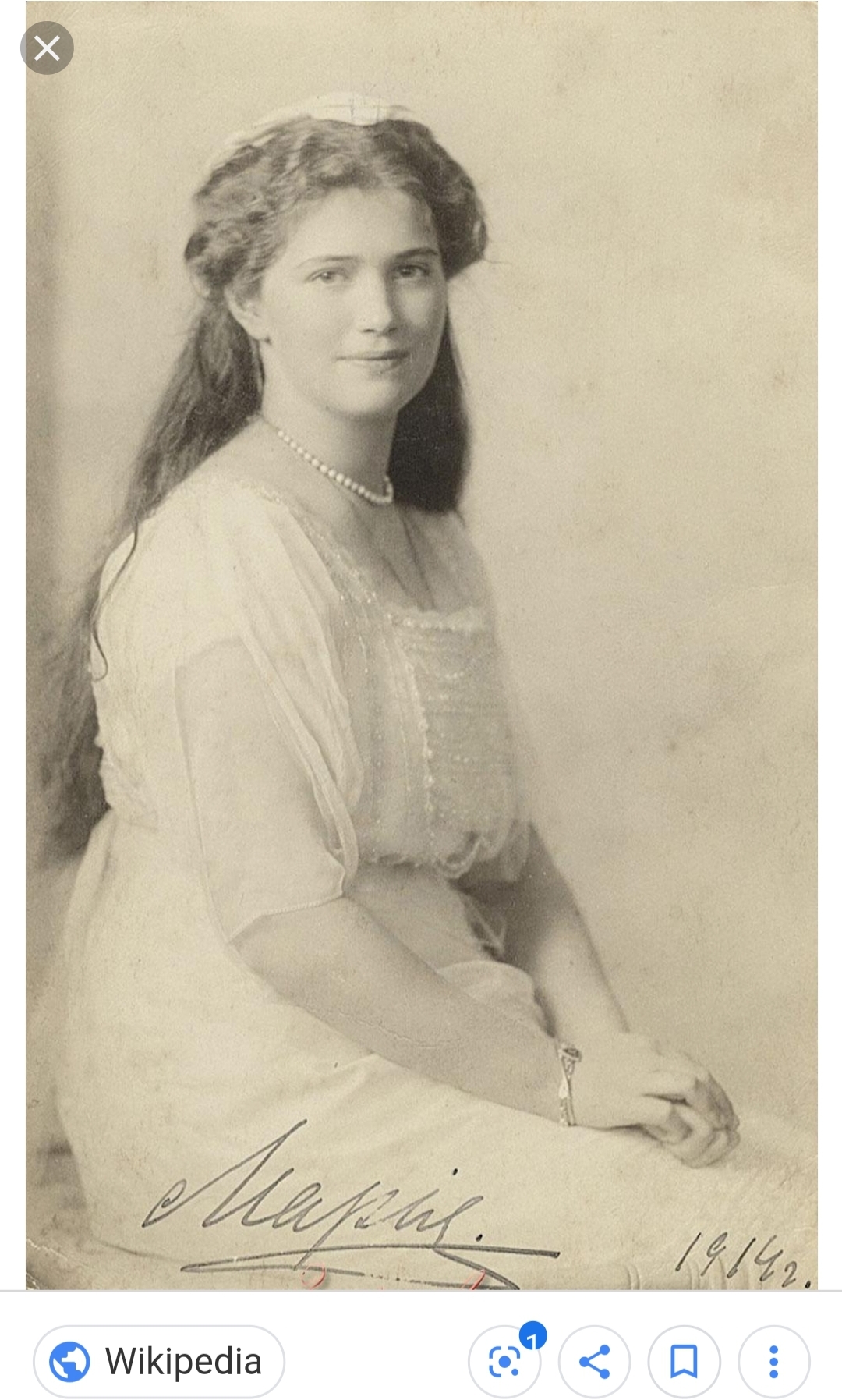
212) Maria Nikolaevna Romanova

Courtesy of Wikipedia

212: Maria Nikolaevna Romanova

Russian Grand Duchess and Third Oldest in Her Family

Born: 26 June 1899, St. Petersburg, Imperial Russia (Present-day St. Petersburg, Russia)

Died: 17 July 1918, Yekaterinburg, Bolshevik Controlled Russia (Present-day Yekaterinburg, Russia)

It is said that when Anastasia (Maria’s Younger Sister) would go around teasing people and kicking them Maria would follow behind apologizing profusely.

Maria was also known as being the most beautiful of her sisters.

Lord Mountbatten was their cousin and wanted to marry Maria—he kept a photo of her by his bedside until his death.

In 1916, the entire imperial family became political prisoners to the new Bolshevik Regime after Nicholas II (Maria’s father and the Tsar) abdicated the throne amid political and social upheaval and turmoil. In July of 1918, the Bolsheviks determined it was too dangerous to let the family live and ordered the executions of them all.

The four sisters, Alexei, their parents, and several servants were all shot and bayoneted to death in the basement of the house they were staying in.

Biography.com wrongly states that Anastasia’s body was recovered beside her brother Alexei’s; in actuality it was Maria’s body found near Alexei’s.

Maria and Alexei’s bones were only discovered in 2007—after the rest of the family had been buried in St. Petersburg—without full rites because the Orthodox Church of Russia contested the DNA findings.

Maria and her brother remain in cold storage in a university laboratory awaiting burial.

The church refuses to recognize the bones as authentic because the family was canonized in 2000 and if they are in fact authentic (read: they are) they would then be Holy Relics, which apparently puts burying these children (Maria was nineteen and Alexei thirteen at the times of their deaths) beside their family so they can actually rest in peace a bit of a conundrum.

Note:

Maria’s Actual Title in Russian Was Velikaya Knyazhna—a more accurate English Translation would be The Grand Princess. Her title also made her an Imperial Princess, which made her higher ranking than all other European Princesses who were “only” Royal Highnesses.

Badges Earned:

Find a Grave Marked

Located In My Personal Library:

Alexandra: The Last Tsarina by Carolly Erickson

Alice Princess Andrew of Greece by Hugo Vickers

Lost Bodies by Jenni Davis

National Geographic History Magazine Article "Death of a Dynasty" sub-article "Michael the First Romanov" (July/August 2018 Edition)

The Race to Save the Romanovs: The Truth Behind the Secret Plans to Save the Russian Royal Family by Helen Rappaport

Risked by Margaret Peterson Haddix (Historical Fiction)

The Romanov Sisters by Helen Rappaport

Sources:

https://allthatsinteresting.com/maria-romanov

https://www.thevintagenews.com/2019/04/09/mountbatten-and-romanova/

https://www.biography.com/royalty/anastasia-romanov

https://www.google.com/search?rlz=1C1CHBF_enUS847US847&ei=x81dXdW2NaOr0PEPxs2ksA4&q=maria+romanov+burial&oq=maria+romanov+burial&gs_l=psy-ab.3..0.2285.2699..2937...0.0..0.120.678.0j6......0....1..gws-wiz.......35i39j0i22i30.lWnEHFBQhiM&ved=0ahUKEwiVttypiZXkAhWjFTQIHcYmCeYQ4dUDCAo&uact=5

https://www.findagrave.com/memorial/6612033/maria-nikolaevna-romanova

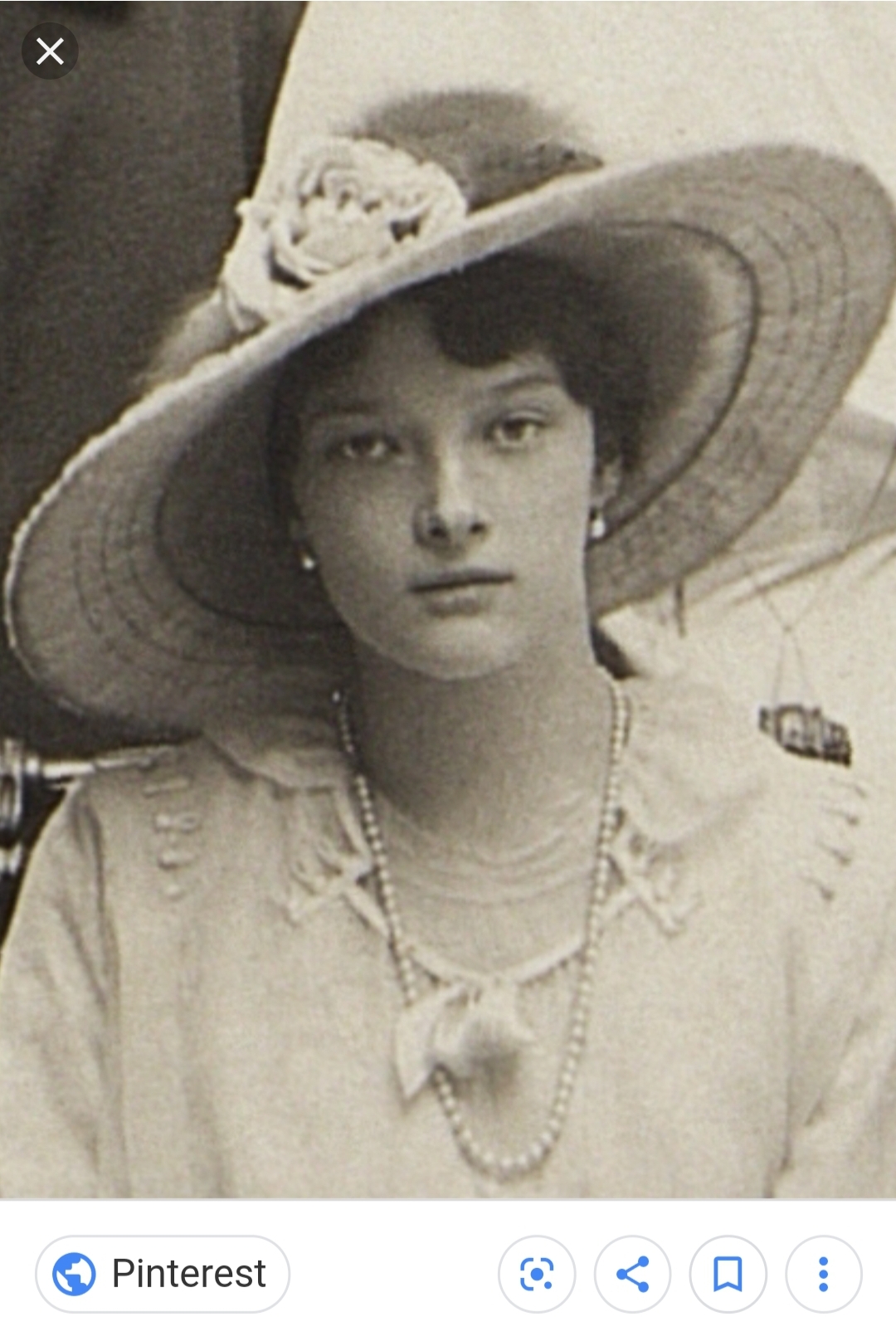
211) Tatiana Nikolaevna Romanova

Courtesy of Pinterest

211: Tatiana Nikolaevna Romanova

Russian Grand Duchess and the Second Oldest in Her Family

Born: 10 June 1897, St. Petersburg, Imperial Russia (Present-day St. Petersburg, Russia)

Died:  17 July 1918, Yekaterinburg, Bolshevik Controlled Russia (Present-day Yekaterinburg, Russia)

Tatiana was the most well-known of her sisters during her lifetime.

She was also known for being the most regal of the four sisters.

Her siblings called her the Governess because of how organized and put together she was.

She was extremely close to her older sister Olga; Tatiana was also closest to her mother of all the siblings and would help soothe her anxiety anytime Alexei began to hemorrhage from his hemophilia.

Tatiana, her mother, and older sister Olga trained as nurses with the Red Cross at the start of World War I.

Tatiana then set up her own committee for helping refugees and did all the paperwork herself after leaving the hospitals every day.

In 1916, the entire imperial family became political prisoners to the new Bolshevik Regime after Nicholas II (Tatiana's father and the Tsar) abdicated the throne amid political and social upheaval and turmoil. In July of 1918, the Bolsheviks determined it was too dangerous to let the family live, and ordered the executions of them all.

She reportedly died while clinging to her sister Olga. The four sisters, Alexei, their parents, and several servants were all shot and bayoneted to death in the basement of the house they were staying in.

Note:

Tatiana’s Actual Title in Russian Was Velikaya Knyazhna—a more accurate English Translation would be The Grand Princess. Her title also made her an Imperial Princess, which made her higher ranking than all other European Princesses who were “only” Royal Highnesses.

Badges Earned:

Find a Grave Marked

Located in My Personal Library:

Alexandra: The Last Tsarina by Carolly Erickson

Alice Princess Andrew of Greece by Hugo Vickers

Caught in the Revolution: Petrograd, Russia, 1917--A World On the Edge by Helen Rappaport

Lost Bodies by Jenni Davis

National Geographic History Magazine Article "Death of a Dynasty" sub-article "Michael the First Romanov" (July/August 2018 Edition)

The Race to Save the Romanovs: The Truth Behind the Secret Plans to Save the Russian Royal Family by Helen Rappaport

Risked by Margaret Peterson Haddix (Historical Fiction)

The Romanov Sisters by Helen Rappaport

Sources:

https://allthatsinteresting.com/tatiana-romanov

https://www.findagrave.com/memorial/6610991/tatiana-nikolaevna-romanova

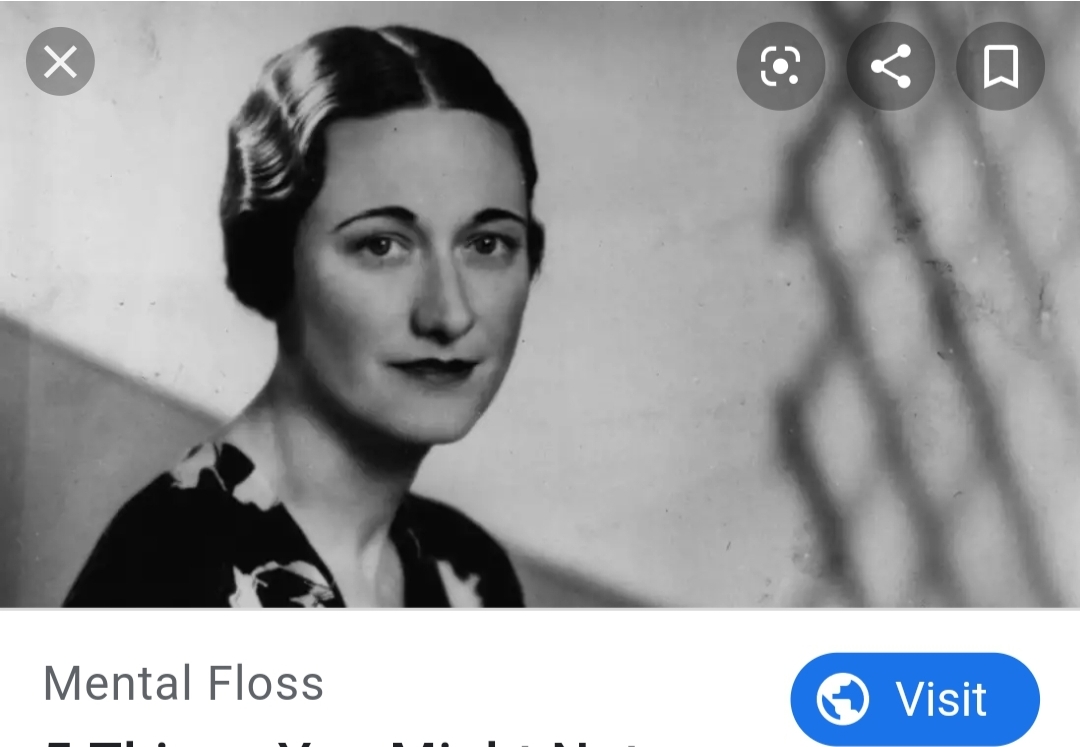
210) Wallis Simpson

Courtesy of Mental Floss

210: Wallis Simpson

American Socialite and Twice Divorcee who Nearly Toppled a Monarchy

Born: 19 June 1896, Blue Ridge Summit, Pennsylvania, United States of America

Died: 24 April 1986, Paris, France

Also Known As: Wallis Warfield, Duchess of Windsor

Wallis met the prince of Wales while still married to her second husband.

They were friends first then lovers—and she sued for divorce from her second husband in 1936 with the hopes of marrying Edward. However, her status as twice divorced and American made her socially unacceptable to be the wife of the future king.

Edward renounced the throne after being told he would never be able to marry Wallis. After he was no longer the king, he did just that—a year later once Wallis’s divorce from her second husband came through.

They moved to Europe following the abdication.

For most of World War II they remained in the Bahamas as Edward had been named Governor of the islands by his brother George.

However, it is important to note that Wallis introduced Edward to Nazi Germany, and they visited Hitler in his Wolf’s Lair. Papers have also been uncovered indicating Edward planned on ruling as a puppet king of England once the Third Reich conquered the island nation.

After the war they lived in style—traveling and partying.

Edward died in 1972 and Wallis lived in increasing isolation in their Paris home until her own death fourteen years later.

 Badges Earned:

Find a Grave Marked

Located In My Personal Library:

Sex With Kings by Eleanor Harmon

That Woman by Anne Sebba

History’s Naughty Bits by Karen Dolby

Kings and Queens of England and Scotland by Plantagenet Somerset Fry

Royal Love Stories by Gill Paul

Royals and the Reich by Jonathon Petropoulos

The Roosevelts and the Royals: Franklin & Eleanor, the King & Queen of England, and the Friendship That Changed History by Will Swift

Time Magazine's 100 Women of the Year (Wallis appears in the 1936 article, "Wallis Simpson")

The Royal Wardrobe: Peek Into the Wardrobes of History's Most Fashionable Royals by Rosie Harte

Sources:

https://www.britannica.com/biography/Wallis-Simpson

https://www.findagrave.com/memorial/4252/wallis-simpson

209) Gennifer Flowers

Courtesy of NBC News

209: Gennifer Flowers

Model and Actress who Revealed in 1992 That She had had an Illicit Affair With Then-President Bill Clinton

Born: 24 January 1950, Oklahoma City, Oklahoma, United States of America

Clinton later admitted to the affair when under oath.

Gennifer claimed the affair had lasted twelve years and produced tapes of phone conversations between the two of them to prove it. According to the book Sex With Presidents, Gennifer's neighbor had video evidence showing President Clinton entering her apartment with his own key. However, after the neighbor came forward, his own apartment was broken into and he was beaten half to death. When he woke up, the video tapes were gone.

In 1999 and 2000 Gennifer sued several people in the media for defamation—including Hillary Clinton.

The case was dismissed in 2004.

Even though Flowers supported Hillary Clinton’s run for president in 2007 she changed her mind in 2016 and came out in support of Donald Trump instead.

Gennifer is also a singer.

Badges Earned:

Located In My Personal Library:

Sex With Presidents: The Ins and Outs of Love and Lust in the White House by Eleanor Herman

Sources:

http://www.genniferflowers.com/bio.html

https://www.nytimes.com/search?query=Flowers%252C+Gennifer

https://en.wikipedia.org/wiki/Gennifer_Flowers

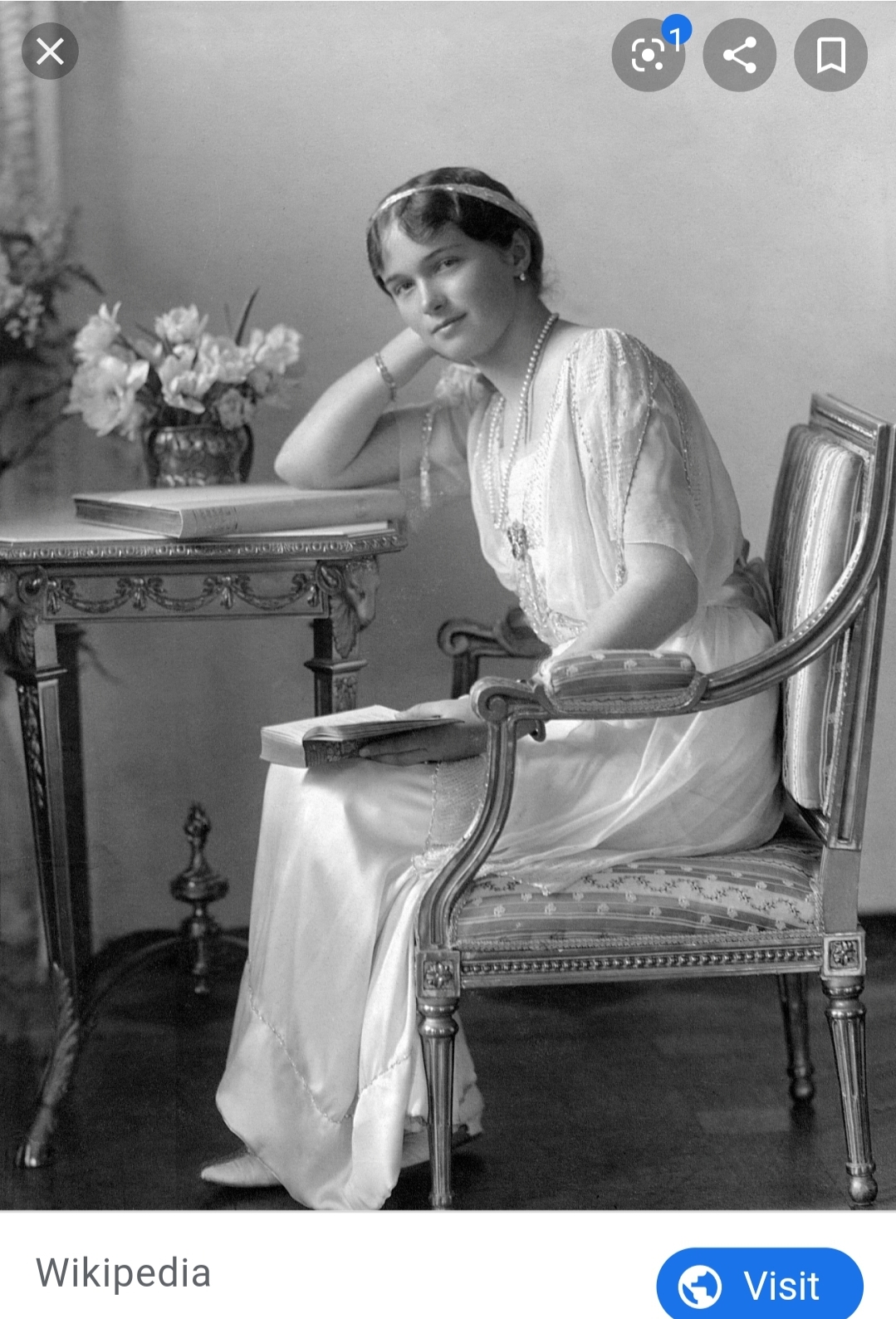
208) Olga Nikolaevna Romanova

Courtesy of Wikipedia

208: Olga Nikolaevna Romanova

Russian Grand Duchess and the Oldest Child in Her Family

Born: 15 November 1895, St. Petersburg, Imperial Russia, (Present-day St. Petersburg, Russia)

Died: 17 July 1918, Yekaterinburg, Bolshevik Controlled Russia (Present-day Yekaterinburg, Russia)

Upon her birth the military fired off the 101 rounds indicating a girl—not the hoped for 300 to indicate a boy.

Because she was a girl, Olga was not a legal heir to the throne of Imperial Russia.

One person witnessing the birth wrote that Olga weighed ten pounds and had to be removed with forceps. In a letter her father wrote to Queen Victoria—Olga’s great-grandmother through her mother, he thanked her for her good wishes but also told her that Alexandra had chosen to breast feed Olga herself instead of using a wet nurse—something Victoria vastly disapproved of.

When she was only a few months old her parents took Olga across Europe to visit neighboring countries and meet all her relatives.

From a young age Olga was devoted to her father, loved the outside world, and was very stubborn and compassionate.

She was seven years old when her favorite cousin Ella died from typhoid while they were all staying together—a tragedy that would stay with Olga the rest of her life.

Olga was also a devoted reader, and as a child liked researching Medieval Times. According to the longtime governess of all the Romanov Children, when Olga learned the story of Prince Llewellyn of Wales, who was beheaded by the English, Olga reportedly told her governess, “I really think people are much better now than they used to be. I’m very glad I live now when people are so kind.”

In 1909 Olga was made the commander-in-chief of the third Elizabetgradsky Hussars Regiment; her duties included the design of her men’s uniform—in 1911 her men were given short white fur lined coats—which they were extremely thankful for. Also, in 1911—after Olga had her coming of age party—she, her father, and sister Tatiana were at a play when the prime minister was assassinated on the floor of the theatre beneath the royal box.

Olga was also put in charge of trying to fix her brother’s bad behavior and manners (evidently, she wasn’t entirely successful, Alexei was remembered for being stubborn till the end).

Olga fell in love when she was seventeen, but he ended up marrying someone else once it was established that—as a soldier—he wasn’t good enough for the daughter of the Tsar.

She trained as a nurse in World War I but was quickly relieved of work on actual patients and given administrative duties instead.

It is said that near the end only Olga realized the danger their parents and themselves were in.

In 1916, the entire imperial family became political prisoners to the new Bolshevik Regime after Nicholas II (Olga's father and the Tsar) abdicated the throne amid political and social upheaval and turmoil. In July of 1918, the Bolsheviks determined it was too dangerous to let the family live, and ordered the executions of them all.

She reportedly died while clinging to her sister Tatiana. The four sisters, Alexei, their parents, and several servants were all shot and bayoneted to death in the basement of the house they were staying in.

Note:

Olga’s Actual Title in Russian Was Velikaya Knyazhna—a more accurate English Translation would be The Grand Princess. Her title also made her an Imperial Princess, which made her higher ranking than all other European Princesses who were “only” Royal Highnesses.

Badges Earned:
Find a Grave Marked

Located In My Personal Library:

Alexandra: The Last Tsarina by Carolly Erickson

Alice Princess Andrew of Greece by Hugo Vickers

Caught in the Revolution: Petrograd, Russia, 1917--A World On the Edge by Helen Rappaport

Lost Bodies by Jenni Davis

National Geographic History Magazine Article "Death of a Dynasty" sub-article "Michael the First Romanov" (July/August 2018 Edition)

The Race to Save the Romanovs: The Truth Behind the Secret Plans to Save the Russian Royal Family by Helen Rappaport

Risked by Margaret Peterson Haddix (Historical Fiction)

The Romanov Sisters by Helen Rappaport

Sources:

https://www.theromanovfamily.com/grand-duchess-olga-nikolaevna/

https://www.findagrave.com/memorial/6611102/olga-nikolaevna-romanova

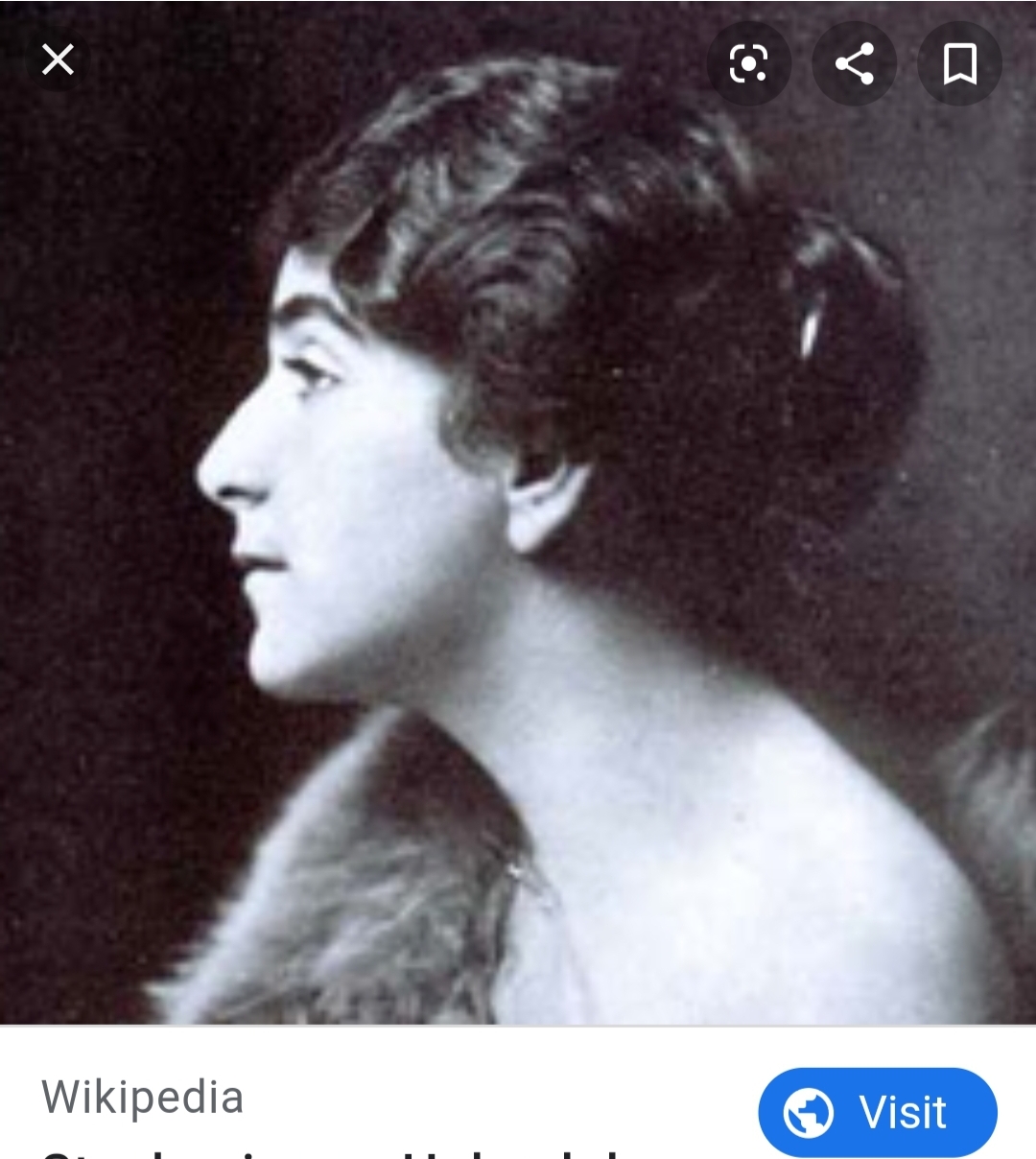
207) Stephanie von Hohenlohe

Courtesy of Wikipedia

207: Stephanie Julianne von Hohenlohe

Austrian Princess and Nazi Spy

Born: 16 September 1891, Vienna, Austro-Hungarian Empire (Present-Day Vienna, Austria)

Died: 13 June 1972, Geneva, Switzerland

Original Name: Stephany Julienne Richter

Stephanie was born to a poor Jewish family and before and during World War II worked with those in Britain who believed in appeasement (the policy of acquiescing to Hitler’s demands to avoid a war).

President Franklin D Roosevelt reportedly stated she was more dangerous than 10,000 men.

Stephanie was one of three women to earn the Golden Party Badge of the Nazi regime—the other two being Magda Goebbels and Emmy Goering.

She used the title of Princess for the rest of her life despite divorcing her husband (who had royal blood and therefore gave her the title) in 1920.

Stephanie was paid £5,000 per year by Harold Sidney Harmsworth—1st Viscount Lord Rothermere—to promote appeasement with The Third Reich in Britain.

In 1938 she came to be in charge of Leopoldskron Castle in Salzberg (after it was seized from Max Reinhardt—a Jewish theatre director) and was tasked with dressing the place up for high ranking visitors of the Third Reich to stay in.

Stephanie was captured by the FBI after Pearl Harbor and interned until the end of the war when she was paroled.

She lived out the rest of her life as a journalist.

Badges Earned:

Find a Grave Marked

Located in My Personal Library:

Princesses Behaving Badly by Linda Rodriguez McRobbie

Sources:

https://ww2gravestone.com/nazi-princess-hitler-lord-rothermere-and-princess-stephanie-von-hohenlohe/

https://en.wikipedia.org/wiki/Stephanie_von_Hohenlohe

https://www.findagrave.com/memorial/189810883/stephanie-maria_veronika_juliane-von_hohenlohe_waldenburg_schillingsf_rst

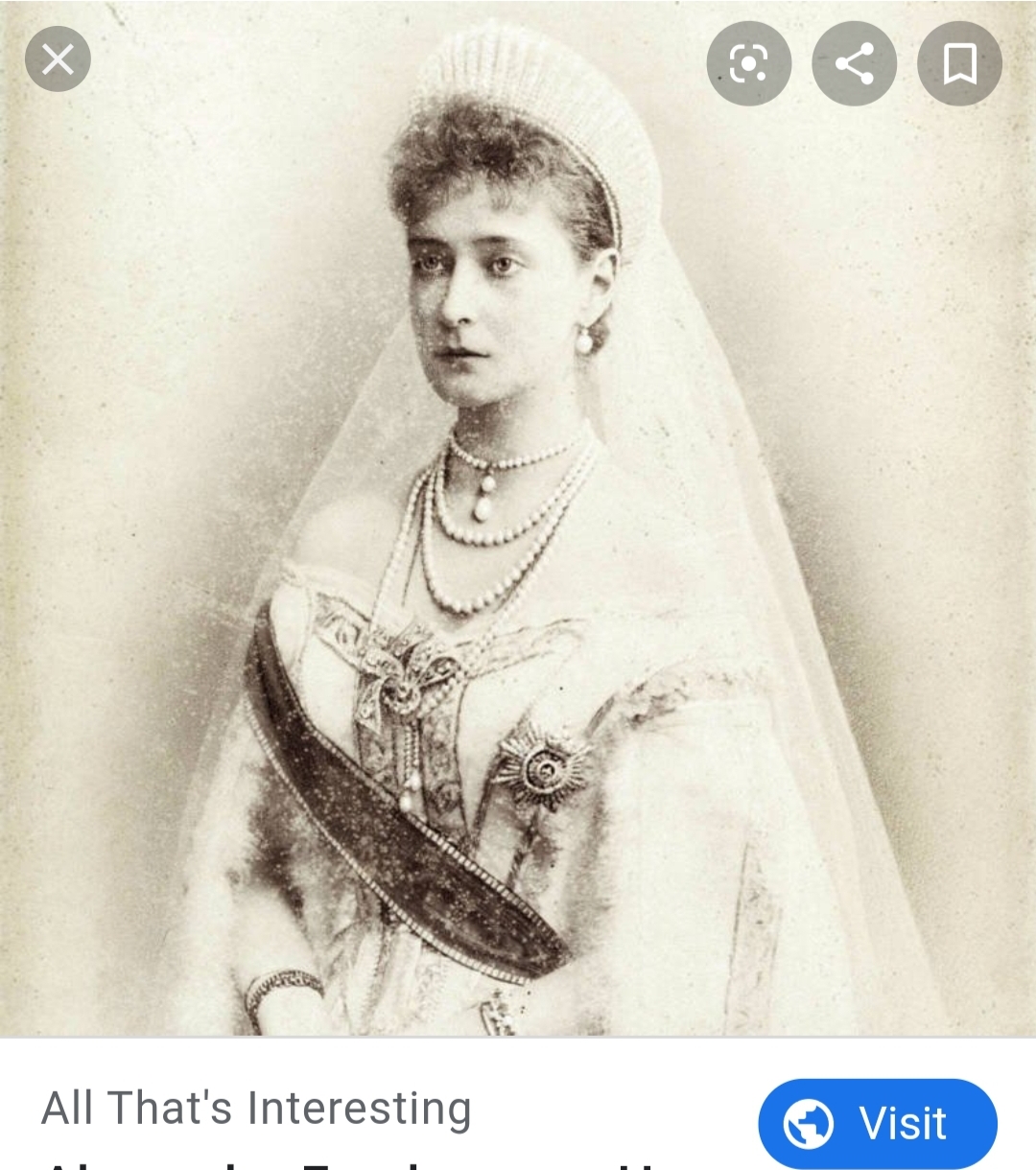
206) Alexandra Feodorovna

Courtesy of All That's Interesting

"Who is against us? Petrograd, a bunch of aristocrats playing bridge and understanding nothing. I have been sitting on the throne for twenty-two years, I know Russia, I have travelled around the whole place, and I know that the people love our family."

206: Alexandra Feodorovna

The Last Russian Tsarina

Born: 1 November 1872, Present-Day Darmstadt, Germany

Died: 17 July 1918, Yekaterinburg, Bolshevik Controlled Russia (Present-Day Yekaterinburg, Russia)

Previously Known As: Princess Alix of Hesse

Alexandra was the mother of four daughters (Olga, Tatiana, Maria, and Anastasia) and one son (Alexei). She was the wife of Tsar Nicholas II.

Alexandra was also the granddaughter of Queen Victoria. Her own mother died when she was six, so she was raised primarily in England with her cousins.

It was suspected (though not proven until her son was born) that Alexandra carried the gene and would pass hemophilia on to her son Alexei. The royal families of Europe (of whom the vast majority were all intermarried with their own cousins) knew hemophilia was becoming an issue, but at the time they continued to intermarry anyway which only exacerbated the problem.

Alexandra met her future husband when she was twelve and they quickly formed a friendship and later relationship—primarily through letter writing seeing as he was in Russia most of the time.

Alix married Nicky (as he was known to his family) in 1894 and moved to Russia—adopting her new name and joining the Russian Orthodox Church. Alix had been refusing to marry Nicholas for many years, with one of the reasons being her devout faith to the Lutheran Church, but she finally acquiesced and became just as devout a follower to the Russian Orthodox faith.

Nicholas was twenty-six and Alexandra twenty-two when they married—neither of them having any idea how to run a country—which was to be their undoing seeing as Nicholas’s father had died just before the wedding leaving Nicholas in charge of literally one of the largest empires on the earth at that time.

In Russia at the time, only a male descendant of the Romanov familial line could inherit the throne; which quickly became a problem as Alexandra gave birth to four successive daughters in a row. Finally Alexandra and Nicholas were blessed with a fifth child, this one a son. Unfortunately as I already mentioned, Alexei was very sickly his entire life and spent most of his life being protected from harm at all costs.

The Russian public had no idea the heir to the throne and their future Tsar (or so they believed at the time anyway) had this deadly disease. But they weren't stupid either. Everyone knew something was up, and the forceful air of trying to cover up Alexei's illness was only one of the many issues Alexandra and Nicholas would face. But I'm getting ahead of myself a little here.

Alexandra made the decision to breastfeed Olga, her eldest, (and most likely the rest of her children as well) despite her grandmother’s misgivings and was particularly attached to her son Alexei—which was understandable as she constantly fretted over his illness.

Alexandra turned to Rasputin for help and alienated the public in the process. Rasputin was a mystic from Siberia who promised to help cure Alexei of his ailments through his mystic arts. Alexandra completely fell under his spell, but the peasant class and the aristocracy both became more and more fed up with her behavior.

By the time World War I broke out, there were multiple plans that had been talked about, but never implemented, to remove Alexandra and Nicholas from power. By that point, the Russian aristocracy, and the royal family's numerous cousins across the European continent, were becoming more and more frustrated and ill-at-ease with the Tsar and Tsarina. It was more than obvious to anyone who was in with the family that Nicholas was hardly anything more than a pushover who did anything his wife wanted, and Alexandra was a physically weak but still tempestuous autocrat.

Many relatives and other royals across Europe warned Nicholas Russia wanted and needed change. He received advice on everything from helping his country become more democratic and also reigning in his vastly unpopular wife, but Nicholas failed to pay any of the counsel any mind.

Nicholas would eventually fire the leader of the Russian armed forces, deciding to lead his armies from the front lines himself.  Meanwhile, Alexandra was back in her palace, sort-of running the country but also spending most of her time locked away in the palace. Her daughters languished within with nothing to do, while her son became the focus of many of the plots to overthrow the Tsar and Tsarina.

Rasputin was assassinated in 1916, and for a time revolutionary ideas cooled in the country. However, Nicholas and Alexandra's harsh punishment on Rasputin's murderers would alienate much of the aristocracy once more. By the next year, Nicholas had no choice but to give up the throne, becoming the last Romanov to rule Russia after over three hundred years of rule.

After Nicholas's abdication, the royal family lived under house arrest for two years. During that time, the entire government of Russia was overhauled, from an autocratic royal head of state to a new Communist regime, known today as the Bolsheviks.

At first, the royal family were held under house arrest but still had several creature comforts, but that would change. By 1918, the White Army (those Russians who wanted to see a return to royal rule) were closing in, and the Bolsheviks decided the royal family were expendable after all. They had to be done away with before any of them had a chance to reclaim the throne.

The royal family and their loyal servants were living in the Ipatiev House in Yekaterinburg in July of 1918. The Romanovs had started to think there was a chance they would be rescued, and the girls had started to sew their precious jewels into the lining of their dresses. And so on the night of 16/ 17 July, when the family were roused from their beds and told they were being moved for their safety, Alexandra and her daughters dressed in those jewel encrusted gowns.

The seven family members (Nicholas, Alexandra, Olga, Tatiana, Maria, Anastasia, and Alexei) were led into a basement with four of their servants. After requesting chairs, Alexandra and Alexei were allowed to sit. Then one of the Bolshevik revolutionaries came forward and informed Nicholas he and his family were to be executed.

Alexandra and Nicholas's downfall had come after repeated warnings from their family and those closest to them, but unfortunately the couple had decided they knew what was best, until it was too late to turn back and try to do things over.

Alexandra and her husband died in the first volley of bullets—unfortunately her daughters were not so lucky. Because the girls had been wearing their jewel-encrusted, practically bullet proof vests, they survived the initial round of shots. The girls were all clubbed and bayoneted until they finally, mercifully died.

When the family disappeared in 1918, the world suspected the worst but had no idea what had actually happened. By then, the world had been waiting for news of Nicholas's death, but they weren't suspecting the eradication of the entire family. The Bolshevik leaders did everything in their power to cover up what had happened, including moving the bodies to multiple locations, coating them in acid, and in the case of Alexei and Maria, burning them with fire and dismembering them.

In 1976, Alexandra’s and the bodies of Nicholas, Olga, Tatiana, and Anastasia and the four servants were uncovered, but then quickly reburied for fear of what the Communist Regime would do if they learned the remains had been rediscovered. After the fall of the Soviet Union, the bodies that had been located were reburied in an elaborate funeral; however, the bodies of two of Alexandra's children—Maria and Alexei, which were found separate from the others several years later, remain in cold storage as of 2020 thanks to the urging of the Russian Orthodox Church (Click on Maria’s profile to learn more).

The Tsar and his Family have all been made Saints in the Russian Orthodox Church.

Badges Earned:

Find a Grave Marked

Located In My Personal Library:

Alexandra: The Last Tsarina by Carolly Erickson

Alice Princess Andrew of Greece by Hugo Vickers

Caught in the Revolution: Petrograd, Russia, 1917--A World on the Edge by Helen Rappaport

Historical Heartthrobs by Kelly Murphy

Lost Bodies by Jenni Davis

National Geographic History Magazine Article "Death of a Dynasty" sub-article "Michael the First Romanov" (July/August 2018 Edition)

Queen Victoria's Matchmaking: The Royal Marriages That Shaped Europe by Deborah Cadbury

The Race to Save the Romanovs: The Truth Behind the Secret Plans to Save the Russian Royal Family by Helen Rappaport

Risked by Margaret Peterson Haddix (Historical Fiction)

Royal Love Stories by Gill Paul

Royals and the Reich by Jonathon Petropoulos

Sex With the Queen: 900 Years of Vile Kings, Virile Lovers, and Passionate Politics by Eleanor Herman

Victoria's Daughters by Jerrold M Packard

Sources:

The Books Listed Above

https://allthatsinteresting.com/alexandra-feodorovna

https://www.findagrave.com/memorial/8391065/alexandra-feodorovna-romanova

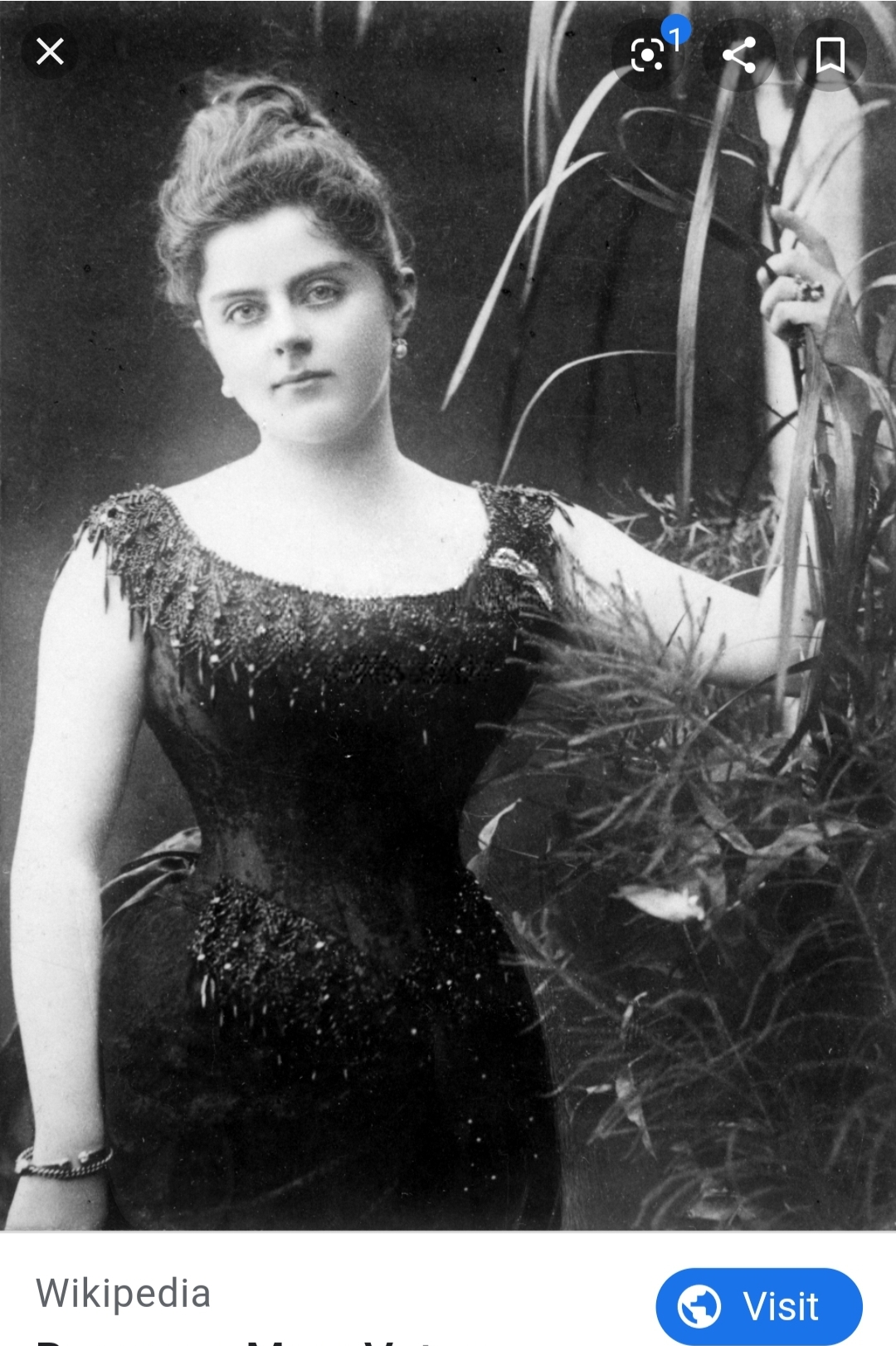
205) Mary von Vetsera

Courtesy of Wikipedia

205: Mary von Vetsera

Austrian Baroness and Mistress of Crown Prince Rudolf

Born: 19 March 1871, Vienna, Austro-Hungarian Empire (Present-Day Vienna, Austria)

Died: 30 January 1889, Mayerling, Austro-Hungarian Empire (Present-Day Mayerling, Austria)

In what has become known as the Mayerling Incident both the bodies of Mary and Rudolf were found together in what looked like a murder/suicide instigated by Rudolf, but the mystery has never quite been solved.

Her entire life, Mary was groomed by her mother to marry well into an upper-class family and Mary reportedly wrote to a friend that her mother had never loved her and instead only wanted to be rid of her in the most advantageous way.

Accounts differ as to how long Mary and Rudolf knew one another and continued their affair—from three months to three years. Unfortunately, Rudolf was already married so you can imagine this did not go over well with her family. Rudolf was also seriously dating another woman at the time of his death and reportedly asked her to take part in the same suicide pact he would fulfill with Mary—she rejected the idea thinking it was a joke.

Mary’s body was secretly removed from the hunting lodge in which she had died and buried in secrecy.

After World War II the Soviet Army dug up her coffin in the hopes of looting any jewelry she might have been wearing and instead noticed she had no visible holes in her skull. Further analysis in 1959 proved she had no bullet holes in her head but instead showed evidence of blunt force trauma to the skull. Her grave was disturbed again in 1991 when a mentally unwell man stole her bones and kept them for two years. They were reburied for the last time in 1993.

In 2015 the Vetsera family publicly released the letters Mary had written to family members proving she was planning on committing suicide with Rudolf—ending that part of the mystery once and for all.

Badges Earned:

Find a Grave Marked

Located in My Personal Library:
Royal Love Stories by Gill Paul

Sources:

https://www.nytimes.com/1964/01/26/archives/mayerling-remains-a-mystery.html

https://www.thejournal.ie/vetsera-mystery-mayerling-letters-2247340-Aug2015/

https://en.wikipedia.org/wiki/Baroness_Mary_Vetsera

https://www.findagrave.com/memorial/7055272/mary-alexandrine-von_vetsera

204) Lakshmi Bai

Courtesy of Cultural India

204: Lakshmi Bai

The Rani (or Queen) of Jhansi

Born: c.1828 (Possibly as late as 1834) Varanasi, Uttar Pradesh, Present-Day India

Died: 18 June 1858, Gwalior, Madhya Pradesh, Present-Day India

Alternate Name: Lakshmibai or Laxmibai

Original Name: Manikarnika

Leader of the Indian Mutiny against British Rule in 1857-1858, she was trained as a child in martial arts, horse-riding, and sword fighting.

Lakshmi married the Maharaja of Jhansi, but he died before they could have a biological heir (some sources state they had a child but they died when they were only a few months old). As was custom he adopted a boy just before his death and Lakshmi raised him as her own.

The British Governor-General of India refused to recognize the boy as the legitimate ruler of Jhansi and annexed the kingdom under British rule.

Lakshmi refused to submit and was quickly named Regent of Jhansi to rule on her son’s behalf—determined to not let Jhansi fall into British hands. She led the troops herself and refused to give up even after a series of defeats. Lakshmi would ride through battle with her son on horseback behind her.

She was eventually killed in combat, but afterward became a symbol for resistance and Indian nationalism.

A film about her life story was released in November of 2019. The link to the trailer can be viewed in this article.

Badges Earned:

Find a Grave Marked

Rejected Princess

Located In My Personal Library:

Princesses Behaving Badly by Linda Rodriguez McRobbie

Warrior Queens by Antonia Fraser

Bygone Badass Broads by Mackenzi Lee

Rejected Princesses by Jason Porath

The Book of Awesome Women: Boundary Breakers, Freedom Fighters, Sheroes, and Female Firsts by Becca Anderson

National Geographic History Magazine September/October 2020 Edition (Article "Lakshmi Bai, Freedom Fighter of India" by Alessandra Pagano)

Sources:

https://www.britannica.com/biography/Lakshmi-Bai

https://www.rejectedprincesses.com/princesses/rani-lakshmibai

https://www.findagrave.com/memorial/200151979/lakshmi-bai

  • Previous
  • 1
  • …
  • 115
  • 116
  • 117
  • 118
  • 119
  • 120
  • 121
  • …
  • 159
  • Next

Categories

Archives

  • July 2025 (10)
  • July 2024 (1)
  • January 2024 (1)
  • August 2023 (1)
  • June 2023 (2)
  • October 2022 (1)
  • July 2022 (1)
  • June 2021 (3)
  • December 2020 (3)
  • August 2019 (1)
  • July 2019 (2)

Search

© 2026 The Exasperated Historian | Powered by Minimalist Blog WordPress Theme