The Exasperated Historian
Menu
  • Home
  • The Women’s List (New)
  • The Men’s List
  • The Animal List
  • Collections
  • The Blog
  • Contact Us
  • FAQ
Menu

Category: Birth Locations

206) Charles Joughin

206: Charles Joughin

Titanic’s Famously Inebriated Baker

Born: 3 August 1878, Birkenhead, Cheshire, England, United Kingdom

Died: 9 December 1956, Paterson, New Jersey, United States of America

Charles was the Chief Baker aboard RMS Titanic on her doomed maiden voyage. As Chief Baker, his responsibilities covered the entire bakery department onboard the ship, overseeing the baking and creation of all manner of pastries and other delectable goods. According to his later testimony, Charles oversaw thirteen other bakers aboard the ship.

Charles had four full siblings and two half-siblings. His father died when Charles was only around eight years old, and his mother had to take up nursing to keep the bills paid for her family. By the age of eleven, Charles had gone to sea to work and earn money for his family. He would not be the only seafarer in his family (two of his brothers served in the Royal Navy), and it was while working onboard these ships that Charles learned to be a baker by trade. In 1915, one of Charles’s brothers actually died while serving aboard the HMS Cornwallis and was buried at sea.

In his own personal life before Titanic, Charles was married and had two children; a son and a daughter. He had been serving as chief baker on the Olympic when he was transferred to service aboard Titanic. At the time, Charles was being paid £12 per month!

When Titanic struck the iceberg and began to sink, Charles wasted no time. He directed other kitchen staff to begin loading breads and other baked goods into the lifeboats to provide provisions for passengers (after receiving an order to do so by the ship’s officers). He also helped direct passengers to the lifeboats themselves—things below deck could be a bit confusing for some, especially in an emergency situation.

Charles himself was not one of the lucky ones who found his way onto a lifeboat. Instead, he chugged some whisky* before finding himself afloat in the frigid North Atlantic. The whisky seems to have kept his body from succumbing to hypothermia, and eventually he was pulled from the water and into a lifeboat by other survivors. In his own recount, Charles stated he believes he was in the water for around two and a half hours (though his biography on the Encyclopedia Titanica website describes this amount of time as “highly questionable.”) The water was only -2°C (28°F) that night!

Upon his return to England, Charles was called to testify on Day Six of the British Inquiry. His testimony can be read at one of the links below.

After the Titanic disaster, Charles went back to sea and continued to serve throughout World War I. In 1916, he actually survived another disaster when the SS Congress caught fire and was destroyed—though luckily not a single person died in that calamity.

Sadly, the heartbreak and tragedy didn’t end there. In 1919, Charles’s wife died while pregnant with their third baby, and their son Richard also died during the birth. Charles soon left the UK, and his two children behind. He moved to the United States, and obtained citizenship there in the 1930s. In 1925, Charles remarried a woman who had a daughter from a previous marriage. His second wife would pass away in 1944, widowing him for a second time. Charles’s surviving son, Roland, died in 1955. Neither Roland, or Charles’s daughter Agnes, had any children of their own.

In 1941, Charles was once again onboard a ship when disaster struck. The SS Oregon was rammed by the USS New Mexico and sank—luckily Charles would once again survive.

When Charles died in 1956, he had been in contact with Sir Walter Lord, but sadly did not live to see A Night to Remember’s release. His estate was divided between his daughter and stepdaughter.

*While today, Charles’s story is often told from the point of view that he drank copious amounts of whisky and was drunk at the time of the sinking, Charles himself maintained throughout his life that he had drank some whisky, but was not drunk by any means and was still fully aware of his surroundings.

Badges Earned:

Find a Grave Marked

Located in my Personal Library:

Titanic: First Accounts by Tim Maltin and Nicholas Wade

Sources:

https://www.encyclopedia-titanica.org/titanic-survivor/charles-john-joughin.html

https://allthatsinteresting.com/charles-joughin

https://www.titanicinquiry.org/BOTInq/BOTInq06Joughin01.php

https://www.glenoradistillery.com/our-blog/2024/3/15/how-charles-joughin-survived-the-titanic-by-drinking-whisky

https://www.findagrave.com/memorial/6852885/charles-john-joughin

205) Percy Newberry

205: Percy Newberry

Egyptologist

Born: 23 April 1869, Islington, London, England, United Kingdom

Died: 7 August, 1949, Godalming, England, United Kingdom

Percy studied botany and archaeology at King’s College, London. He spent many years with the Egypt Exploration Fund (later the Egypt Exploration Society), rising through the ranks all the way to Vice President.

Percy Newberry was a renowned Egyptologist in his own time and in the decades after his death. One of his explorations he partook in saw him working alongside WF Petrie, another famed Egyptologist. Percy’s work in Egypt saw him excavating from the late 1890s through the 1930s. He also taught at several universities in England and Egypt both.

One of the things Percy was most known for, was his collection of ancient textiles he was able to amass. The samples of ancient textile work ranged in date from the 10th to the 19th centuries and he had around 2,000 pieces in all. Some of the pieces came from India originally, and others were Islamic texts written in Egypt. The textiles are a unique indicator into Percy’s life and work; showcasing he was interested in not just the Pharaonic period of Egypt, but also the later periods as well. Other pieces that Percy collected were from other geographical areas from all over the world—some as far afield as Central Asia, the Middle East, various Greek Islands, and other parts of North Africa.

After his death, his wife Essie oversaw his estate being divided up and donated to various institutes in England to continue to spread the knowledge of what he had excavated during his lifetime. Essie was his second wife; he divorced the first after eleven years of marriage. Percy had no children with either wife.

Badges Earned:

Located In My Personal Library:

King Tutankhamun: The Treasures of the Tomb by Zahi Hawass

Sources:

https://www.britishmuseum.org/collection/term/BIOG118809

https://egyptartefacts.griffith.ox.ac.uk/people/percy-e-newberry

https://archivesearch.lib.cam.ac.uk/agents/people/13262

https://jameelcentre.ashmolean.org/collection/6/1272

https://archive.griffith.ox.ac.uk/index.php/newberry-percy-edward

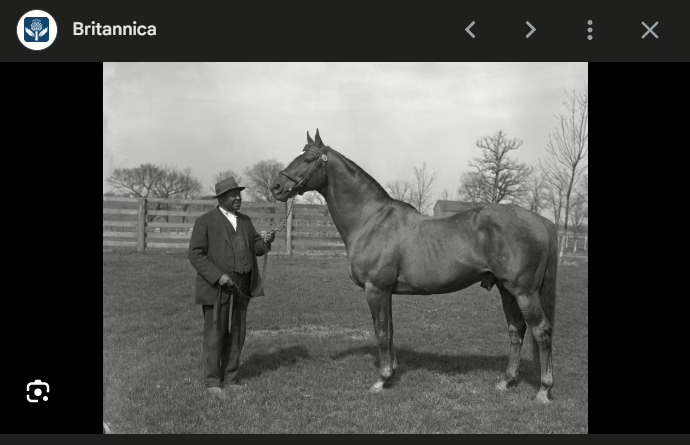
25) Man O’ War the Racehorse

Man O’ War

The Racehorse who was Embalmed After Death

Born: 29 March 1917, Lexington, Kentucky, United States of America

Died: 1 November 1947, Lexington, Kentucky, United States of America

Also Known As: Big Red

Man O’ War has been dubbed by some as the most famous racehorse in history, despite never winning the coveted American Triple Crown.

Man O’ War was originally named “My Man O’ War” by his original owner’s wife, after her husband was called up to serve in World War I. As a consequence of his time in the military, Man O’ War’s original owner, who was a very well noted thoroughbred breeder in his day, sold off his entire crop of horses. Man O’ War, whose named had been shortened to drop the “My” part, sold for $5,000.

Though Man O’ War lived to be thirty years old, he only competed as a professional racehorse for two of those years—sixteen months to be more precise! Out of the twenty-one races he took part in, Man O’ War was victorious twenty times! The only race he ever lost, Man O’ War still came in second place. He had managed to win seven records and had earned more money than any other thoroughbred in history at that point. In his sixteen-month long career, Man O’ War would bring home $249,465. Adjusted to 2026 inflation, that would mean Man O’ War earned his owners $4,042,854.70!

Today, his famous gravesite is topped by a large bronze statue of the literal stud; it is said Man O’ War sired somewhere between 379 and 386 children (depending on the source)! Two of those children would go on to be Kentucky Derby winners, while a grandson, Seabiscuit, became one of the most famous racehorses in American history.

Man O’ War was posthumously inducted into the National Racing Hall of Fame in 1957.

To learn more about Man O’ War’s embalming after his death, check out Lauren the Mortician’s video on the subject, linked in this article. Man O’ War is the only horse to have ever been embalmed—that we know of anyway.

Badges Earned:

Find a Grave Marked

Sources:

https://www.espn.com/sportscentury/features/00016132.html

https://kyhorsepark.com/explore/man-o-war/

https://explorekyhistory.ky.gov/items/show/325

https://www.racingmuseum.org/hall-of-fame/horse/man-o-war-ky

https://www.britannica.com/topic/Man-o-War

https://www.roadsideamerica.com/story/3613

https://www.findagrave.com/memorial/663/man_o%27_war

204) Albert Gallatin

204: Albert Gallatin

The Swiss Founding Father

Born: 29 January 1761, Geneva, Switzerland

Died: 12 August 1849, Astoria, New York, United States of America

Original Name: Abraham Alphonse Albert Gallatin

Albert was born to an aristocratic family and was able to amass a wealth of education in a variety of topics, setting him on the path to being a humanitarian and financier throughout his life. Though he was orphaned before his tenth birthday, Albert did not let these early tragedies hold him back, accomplishing much in his lifetime.

In 1780, Albert arrived in the newly-established United States as a tea merchant, then a land surveyor. He eventually made his way to Pennsylvania in 1790, helping to establish the Commonwealth’s constitution. In 1793, he was elected to the national congress as a senator (though he was unable to serve in that capacity thanks to the Federalist Party arguing he did had not been a US citizen for long enough to serve) and then representative. His major topics of interest were the abolition of slavery, public education, and land acquisition rights. Albert eventually served as the Secretary of the Treasury from 1801 to 1814, working to help pay down the national debt the US took on after making the Louisiana Purchase. If only our current politicians cared so much! According to Encyclopedia Britannica, Albert was able to drop $23 Million from the national debt in eight years.

Before becoming Secretary of the Treasury, Albert had spent his previous years in elected office fighting with Alexander Hamilton, who was the Secretary of the time. Thanks to Albert, a law was passed stipulating that the Treasury had to submit an annual report to the federal government to help oversee the Treasury Department. Albert also helped create the Ways and Means committee in Congress, which also ensures Treasury oversight and accountability. Albert’s tenure of thirteen years is the longest of any Treasury Secretary as of 2025.

Albert also helped ensure Thomas Jefferson was elected as the third president of the United States. According to Thomas Jefferson’s Monticello’s website, Albert was the single most influential member of Jefferson’s cabinet.

Throughout the War of 1812 (which actually lasted until 1814), Albert’s primary concern was negotiating a peace deal in order to save the already unstable US economy, which was in no position to fight and pay for a war. After peace was negotiated, Albert also appointed as Minister to France, then Great Britain, and helped resolve a boundary dispute with Canada.

After returning to the US in 1827, Albert retired from government life and instead shifted his focus to helping found New York University, opening a bank, and establishing the American Ethnological Society, which helped pave the way for the modern scientific study of anthropology. Some have dubbed him the “Father of American Ethnology.”

In his personal life, Albert was married twice. His first wife, Sophie Allègre, died soon after their wedding. His second wife was named Hannah, and she was the daughter of a Revolutionary War veteran who held major political clout. This advantageous match was directly responsible in helping Albert’s early political career. Albert and Hannah both died in 1849 and are buried together in her family’s crypt.

A statue of Albert now stands outside of the Treasury building in Washington DC. He also, randomly, has a county in Montana named after him, despite never visiting the land that would one day become Montana in his lifetime.

Badges Earned:

Find a Grave Marked

Located In My Personal Library:

American Spirit Magazine May/June 2020 Edition

Sources:

https://www.nps.gov/people/albert-gallatin.htm

https://home.treasury.gov/about/history/prior-secretaries/albert-gallatin-1801-1814

https://trinitychurchnyc.org/stories-news/albert-gallatin-and-trinity-church

https://www.britannica.com/biography/Albert-Gallatin

https://www.gallatinmt.gov/about-gallatin-county/pages/albert-gallatin

https://www.findagrave.com/memorial/375/albert-gallatin

203) Tobias Lear

203: Tobias Lear

Diplomat and Personal Friend to George Washington

Born: 19 September 1762, Portsmouth, The Colony of New Hampshire (Present-day Portsmouth, New Hampshire, United States of America)

Died: 11 October 1816, Washington, District of Columbia, United States of America

Tobias had a fairly good education as a young person for someone of his era. He attended a school in his youth and then went on to attend Harvard for four years from 1779 to 1783.

In 1784, Tobias was hired to be the personal tutor to Martha Washington’s grandchildren, as well as being in charge of George’s correspondence and expense reports to Congress. Soon after, he became George’s personal secretary, and followed him to New York City once Washington became president (New York City was the new country’s capital city at the time). Tobias would serve the president as personal secretary from 1786 to 1799.

In 1790, Tobias married his first wife. They had one son together before she died in a Yellow Fever epidemic in 1793. Tobias’s wife passed away in the President’s House, and her funeral was the only one George attended while serving as President of the United States (according to Wikipedia anyway). Tobias’s second wife was Martha Washington’s favorite niece, who was a widow herself with three young children. George gifted the new blended family 360 acres to live on (but not actually take ownership of the land) taken from the Mount Vernon estate. Sadly, this marriage was even shorter lived. The wedding took place in August 1795, but Tobias’s wife, Fanny (who was actually blood related to George and not Martha), had contracted tuberculosis before the wedding and died in March 1796. In 1803, Tobias would marry another of Martha’s nieces, also named Fanny.

When Tobias’s second wife died, he informed the Washingtons in a letter stating, “the partner of my life is no more!” Martha replied in kind, stating, "It is the nature of humanity to mourn for the loss of our friends; and the more we loved them, the more poignant is our grief."

Tobias was given the rank of colonel as George Washington’s chief aide, though he never saw military action. It is thought that George gave Tobias this military rank to help assuage Tobias’s debts. According to Wikipedia (though I want it known that this is NOT mentioned in any other source I found), Tobias on two occasions kept money that didn’t belong to him as his debts continued to mount. Many people faced economic hardships in the early days of the United States, as the fledgling government had a very unstable economy, and Tobias was one such sufferer.

Tobias also tried to go into business, founding a company that was intended to scout out potential locations for the future, permanent, site of the nation’s capital. The business also tried to promote river traffic on the Potomac River, and Tobias traveled to Europe to try and sell plots of land for the business in what would eventually become Washington DC. The venture failed, pushing Tobias further into debt.

Tobias remained close to the president throughout George’s life, and was with him when he died. Tobias recorded the president’s last moments and planned his funeral. One of the final orders he was given by George was to compile and create an inventory of George’s correspondence from throughout his life. Tobias started the project before George died, and continued to work on it after. Martha tasked Tobias with drafting and then sending letters to acknowledge the many condolences Martha and the Washington family received. As Tobias worked on the letters, Martha busied herself with destroying the letters she and George had exchanged throughout their marriage.

After George died, Tobias was appointed by President Thomas Jefferson to serve as commercial agent to the island of Santo Domingo. Tobias did not stay in the position long, and ended up fleeing the island after a slave rebellion broke out. The island is today the dual countries of Haiti and the Dominican Republic.

In 1803, Tobias was next appointed Consular General to the North African Coast, again by President Jefferson. Tobias was a lead negotiator to end the First Barbary War and oversee the signing of the Treaty of Tripoli. He lived in Algiers with his wife for nine years, before returning to the United States.

During the War of 1812, Tobias served as a secretary in the US War Department.

Tobias ended his life suddenly, by shooting himself with a pistol and committing suicide, but the reason why has been lost to history; if there even was a reason. For a man who had spent his entire adult life as a prolific writer and editor of other people’s correspondence, it seems odd that he left no note behind to explain his decision. Tobias had apparently been suffering from headaches and bouts of depression in the lead up to his death, and afterwards he was vilified in the media for his various misfortunes throughout his life.

Today, one of Tobias’s journals is held at the Historical Society of Pennsylvania. He is remembered by some as being "George Washington's Right Hand Man."

Badges Earned:

Find a Grave Marked

Located In My Personal Library:

Affairs of State: The Untold History of Presidential Love, Sex, and Scandal (1789-1900) by Robert P Watson

American Spirit Magazine Article, “George Washington’s Right-Hand Man” by Bill Hudgins

Sources:

https://www.mountvernon.org/library/digitalhistory/digital-encyclopedia/article/tobias-lear

https://hsp.org/history-online/digital-history-projects/tobias-lear-journal-account-death-george-washington

https://web.archive.org/web/20120402024736/http://seacoastnh.com/history/rev/lear.html

https://en.wikipedia.org/wiki/Tobias_Lear

https://www.findagrave.com/memorial/73306072/tobias-lear

202) RADM Edwin Layton

“As my intelligence officer, you are more valuable to me than any division of cruisers.” -Admiral Nimitz

202: RADM Edwin Layton

United States Intelligence Officer in World War II and the Korean War

Born: 7 April 1903, Nauvoo, Illinois, United States of America

Died: 12 April 1983, Carmel-by-the-Sea, California, United States of America

Edwin achieved the rank of Rear Admiral. His main contributions to the war effort in both World War II and the Korean War was in creating and developing Naval Intelligence for the Pacific Theatre.

Edwin graduated from the US Naval Academy at Annapolis in 1924. In 1925, Edwin was a part of a special ceremony in San Francisco in which Japanese and US Naval officials met for the Japanese naval cadet training squadron. One of the things Edwin and other US Navy officials immediately noticed was that all of the Japanese spoke either fluent English or French, and not a single American spoke a lick of Japanese. Edwin soon discovered that the US Navy did have a program to teach Japanese to their officers, but only two officers were accepted per year. It would take Edwin five years before he was finally accepted into the program.

In 1929, he was assigned to work as an attaché to the US Embassy in Tokyo to learn the Japanese language, one of the first navy officers to ever be given that opportunity. Edwin then served in China from 1932 to 1933. He spent the next few years serving on ships in the Pacific Ocean as well as in Washington DC. Edwin returned to Tokyo in 1937, again as an attaché. He would stay for two years, leaving Tokyo in 1939. During his two-year tenure in Tokyo, Edwin was introduced to several men who would eventually be high ranking members of the Japanese Imperial Forces during World War II, including Admiral Isoroku Yamamoto, who oversaw the attack on Pearl Harbor.

In 1940, Edwin was sent to serve as Fleet Intelligence Commander to the Commander in Chief of the Pacific Fleet at Pearl Harbor, Admiral Kimmel. After the attack on Pearl Harbor, the new Commander in Chief of the Pacific Fleet, Chester Nimitz, asked Edwin to stay on in his role as Fleet Intelligence Commander. Edwin was one of only two officers who remained in their same position in the Pacific Fleet throughout the remainder of World War II. He helped plan naval operations including the Battle of Midway and other parts of the Pacific Theatre, helped make the decision to target and shoot down Japanese Admiral Yamamoto, and was present aboard the USS Missouri when the Japanese surrender was formally signed in September 1945.

Amazingly, Edwin had been deemed an “alarmist” by members of the military before the attack on Pearl Harbor. Edwin had been trying to convince his superiors that the Japanese would attack the Dutch East Indies and then the Philippines (which were controlled by the United States at the time). The Navy ignored him, but only hours after Pearl Harbor was attacked, the Japanese also attacked the Dutch East Indies and the Philippines. After it became clear that Edwin did in fact know what he was talking about, the military took his role much more seriously.

Admiral Nimitz would later say to Edwin:

“I want you to be the Admiral Nagumo of my staff. I want your every thought, every instinct as you believe Nagumo might have them. You are to see the war, their operations, their aims, from the Japanese viewpoint and keep me advised what you are thinking about, what you are doing, and what purpose, what strategy, motivates your operations. If you can do this, you will give me the kind of information needed to win this war.”

In 1948, Edwin was sent to Washington DC to create the first Naval Intelligence School and serve as the school’s director. In 1950, Edwin was then assigned to be the Senior Intelligence Officer of the 14th District in Hawaii. During the Korean War, Edwin served in intelligence based in Tokyo. He continued to serve in various capacities within the US Navy until he retired in 1959.

Following retirement from the Navy, Edwin then worked for Northrop Corporation and helped open their first office in Tokyo, working there until 1963. In 1971, Edwin was honored with a chair of naval intelligence opened in his name at the Naval War College in Newport, Rhode Island. Edwin spent the rest of his life lecturing on World War II intelligence and naval history. His memoir was published posthumously in 1985.

In 2001, an award called the Rear Admiral Edwin T. Layton Leadership Award was established by the Director of Naval Intelligence. In life, Edwin received various awards including the Distinguished Service Medal, the Navy Commendation Medal, and the Legion of Merit.

Edwin had a stroke on his eighty-first birthday, and passed away in hospital a few days later. His ashes were scattered at sea. According to Wikipedia, he was married three times.

Edwin is portrayed by Patrick Wilson in the 2019 film “Midway,” which I personally think is one of the best World War II films I have ever seen.

Badges Earned:

Find a Grave Marked

Sources:

https://warfarehistorynetwork.com/article/edwin-t-layton

https://www.usni.org/press/oral-histories/layton-edwin

https://navy.togetherweserved.com/servlet/tws.webapp.WebApp?cmd=LegacySBV&type=Person&ID=615909

https://en.wikipedia.org/wiki/Edwin_T._Layton

https://www.findagrave.com/memorial/80594892/edwin-thomas-layton

201) Lt. Cmdr. Richard Best

201: Lt. Cmdr. Richard “Dick” Best

Pilot at the Battle of Midway

Born: 24 March 1910, Bayonne, New Jersey, United States of America

Died: 28 October 2001, Santa Monica, California, United States of America

Richard graduated from the US Naval Academy at Annapolis in 1932. He would eventually climb to the rank of Lieutenant Commander. Richard’s entire service career lasted from 1928 to 1944, when he was medically discharged.

He was awarded the Navy Cross and the Distinguished Flying Cross, both for his service in World War II, notably at the pivotal Battle of Midway in June 1942 and for his service over the Marshall Islands in February 1942.

Richard was a bomber pilot whose base was the USS Enterprise during the Battle of Midway. Richard’s flight career was especially notable because he was able to assist in the sinking of two Japanese ships, the Akagi and the Hiryū, both aircraft carriers. Richard is believed by some to be the first US naval aviator to assist in the sinking of two aircraft carriers in a single day.

Part of the citation given for when he was awarded the Navy Cross read:

Defying extreme danger from concentrated anti-aircraft barrage and powerful fighter opposition, Lieutenant Commander Best, with bold determination and courageous zeal, led his squadron in dive-bombing assaults against Japanese naval units. Flying at a distance from his own forces which rendered return unlikely because of probable fuel exhaustion, he pressed home his attacks with extreme disregard for his own personal safety.

Despite his bravery and heroism, Richard did not walk away from the Battle of Midway unscathed. He was one of several pilots who experienced oxygen supply issues in their aircraft after reaching over 20,000 feet in altitude. Remember, when the battle of Midway happened, human flight had only been possible for thirty-nine years. Soon after Richard returned to the USS Enterprise following the battle, he began coughing up blood. By the following morning, Richard had a fever of 103°F. He was eventually admitted to the Pearl Harbor Hospital, where the oxygen issue was discovered.

What eventually came out about the issue was pretty scary. Richard had tried to fly his plane at 15,000 feet to mitigate the risks, but this did not do enough. Because of how long he flew the day of the Battle, alongside the heat generated within the rebreather device itself, a chemical reaction caused the sodium hydroxide inside his device to overheat—converting the sodium hydroxide to caustic fumes. Richard breathed in these horrible fumes during the battle, and because he already had a history of latent tuberculosis, the fumes exacerbated his condition. Richard went from having the latent form of tuberculosis, to a full-blown infection, very quickly. He would spend the next thirty-two months in the hospital before being honorably, medically discharged with 100% disability. He would never pilot a plane again, as it was discovered that the damage to his lungs was permanent.

After serving in the Navy, Richard went on to work for Douglas Aircraft Corporation and later Rand Corporation after the two companies merged. At Douglas, Richard worked within the research division, but after moving to Rand he moved to the security department. He retired in 1975.

In his personal life, Richard was married twice, had a son, a daughter, and a stepdaughter. He was also survived by a grandson, according to his obituary.

Richard is buried at Arlington National Cemetery and had a full military ceremony with honors. At the time of his death, Richard was the longest-surviving squadron commander from the Battle of Midway. He was ninety-one years old when he died. An attempt was made for Richard’s name to be put forward for the Medal of Honor after his death, but the efforts were not successful.

Richard is portrayed by Ed Skrein in the 2019 film “Midway,” which I personally think is one of the best World War II films I have ever seen.

Badges Earned:

Find a Grave Marked

Sources:

https://www.legacy.com/us/obituaries/latimes/name/richard-best-obituary?id=28211718

https://valor.militarytimes.com/recipient/recipient-19777

http://veterantributes.org/TributeDetail.php?recordID=877

https://screenrant.com/what-happened-to-ww2-pilot-dick-best-after-battle-of-midway

https://www.warhistoryonline.com/world-war-ii/richard-best-battle-of-midway.html

https://www.findagrave.com/memorial/8791567/richard-halsey-best

24) Mike the Headless Chicken

24: Mike the Headless Chicken

The Rooster who Survived for Eighteen Months After Being Decapitated

Born: Most Likely Fruita, Colorado, United States of America*

Died: c.1946-17 March 1947, Phoenix Arizona, United States of America

Mike was a Wyandotte Rooster who literally survived for an entire year and a half after having his head chopped off. This is an actual, true story, with photographic evidence to prove it, as shown above.

In October of 1945, LIFE Magazine even ran an article about Mike, and TIME Magazine picked up the story as well.

As the story goes, on 10 September 1945, a famer’s wife in Colorado decided she wanted to cook a chicken for dinner. When someone usually cooks a chicken, the first stop on the journey is to remove the chicken’s head, which USUALLY kills the fowl. Not this time. According to the LIFE Magazine article, the farmer’s wife swung her axe and managed to hit the poor rooster just wrong. Instead of near-instant death, instead the housewife hacked off most (but not all) of the skull, leaving one ear intact, along with the jugular vein and the base of the brain. Evidently in chickens, the majority of the brain is not behind the eyes but further back in the skull closer to the neck. The base of the brain controls motor function, enabling the poor rooster to keep on…well not clucking but you get the point.

(Encyclopedia Britannica claims it was the farmer himself who did the chopping, and not his wife! Apparently, the farmer was preparing chickens to sell at market the next morning in this iteration of the story).

The rooster immediately became a curiosity, and was put on tour all over the Southwestern United States. He visited carnivals, fairs, and other public events, with hundreds of people paying money to see the curious bird.

Mike was able to survive eighteen months by humans feeding him manually, using an eye dropper to drop sustenance directly into his esophagus, which was accessible through the open hole in his neck. It is believed a blood clot formed and stopped him from bleeding to death after the initial blow. Sadly, Mike passed away after suffocating from a mucous buildup in his neck that his human handlers were not able to clear in time.

Today, Mike’s legacy lives on with an annual festival to celebrate this whacky story in his hometown of Fruita, Colorado. He has also been given the title of the rooster with the longest life span after decapitation by the Guinness Book of World Records.

*Mike's Wikipedia lists an exact birth date in 1945, but considering no other source lists that date and I haven't been able to confirm it, I did not want to definitively list it here. Similarly, one source listed his death date as being in 1946, but all the rest listed the 1947 date.

Sources:

https://www.life.com/animals/life-with-mike-the-headless-chicken-photos-of-a-famously-tough-fowl

https://www.britannica.com/story/how-mike-the-chicken-survived-without-a-head

https://www.bbc.com/news/magazine-34198390

https://www.miketheheadlesschicken.org

23) K9 Hurricane

23: K9 Hurricane

The Most Highly Awarded K9 Dog in US History

Born: 26 April 2009, Location Unknown

Died: 12 February 2025, Alexandria, Virginia, United States of America

Hurricane is most well known for protecting the Obama White House from an intruder in October 2014. The intruder scaled a fence around the White House property and was first attacked by another K9. The man was able to fight off the first dog, named Jardan, badly injuring Jardan in the process. Then the intruder ran into Hurricane. Hurricane was able to quickly tackle the man to the ground and hold him until Secret Service agents could arrive and apprehend the suspect. The intruder was only about 100 yards away from then-president Obama and his wife Michelle.

Sadly, Hurricane was injured during the attack, which left him with damaged hips, swollen legs, and interfered with his ability to jump as high as he had before. The injuries ultimately led to his retirement two years later, in 2016. After being awarded the Top Dog of 2016, all of his medical bills were covered for the rest of his life.

Hurricane was a Belgian Malinois who joined the USSS Emergency Response Team Tactical Canine unit in November of 2012. He protected President Obama, as well as then-Vice President Joe Biden, their wives, and other visiting dignitaries to the White House.

Hurricane was fifteen years old when he died. Among the numerous awards Hurricane received were the Department of Homeland Security Award for Valor, the United States Secret Service Award for Merit, the PDSA Order of Merit, AMC's Top Dog in 2016, and one of the first spots in the Guinness Book of World Record’s recently added category, the Animals in War and Peace Distinguished Service Medal.

Hurricane’s longtime handler (who adopted Hurricane after his retirement), Marshall Mirachi, founded and run’s a non-profit called K9 Hurricane’s Heroes.

Hurricane is buried at the National War Dog Cemetery in Glen Cove, New York.

"Rest easy Hurricane. You were a damn good boy." -From Hurricane's official tribute after his death.

Badges Earned:

Find a Grave Marked

Sources:

https://www.k9hurricanesheroes.org/meet-k9-hurricane

https://www.secretservice.gov/newsroom/releases/2022/03/former-uniformed-division-k-9-officer-hurricane-awarded-distinguished

https://en.wikipedia.org/wiki/Hurricane_(dog)

https://www.findagrave.com/memorial/280103626/secret_service_k-9_officer-hurricane

22) Peanut the Squirrel

RIP Peanut and Fred
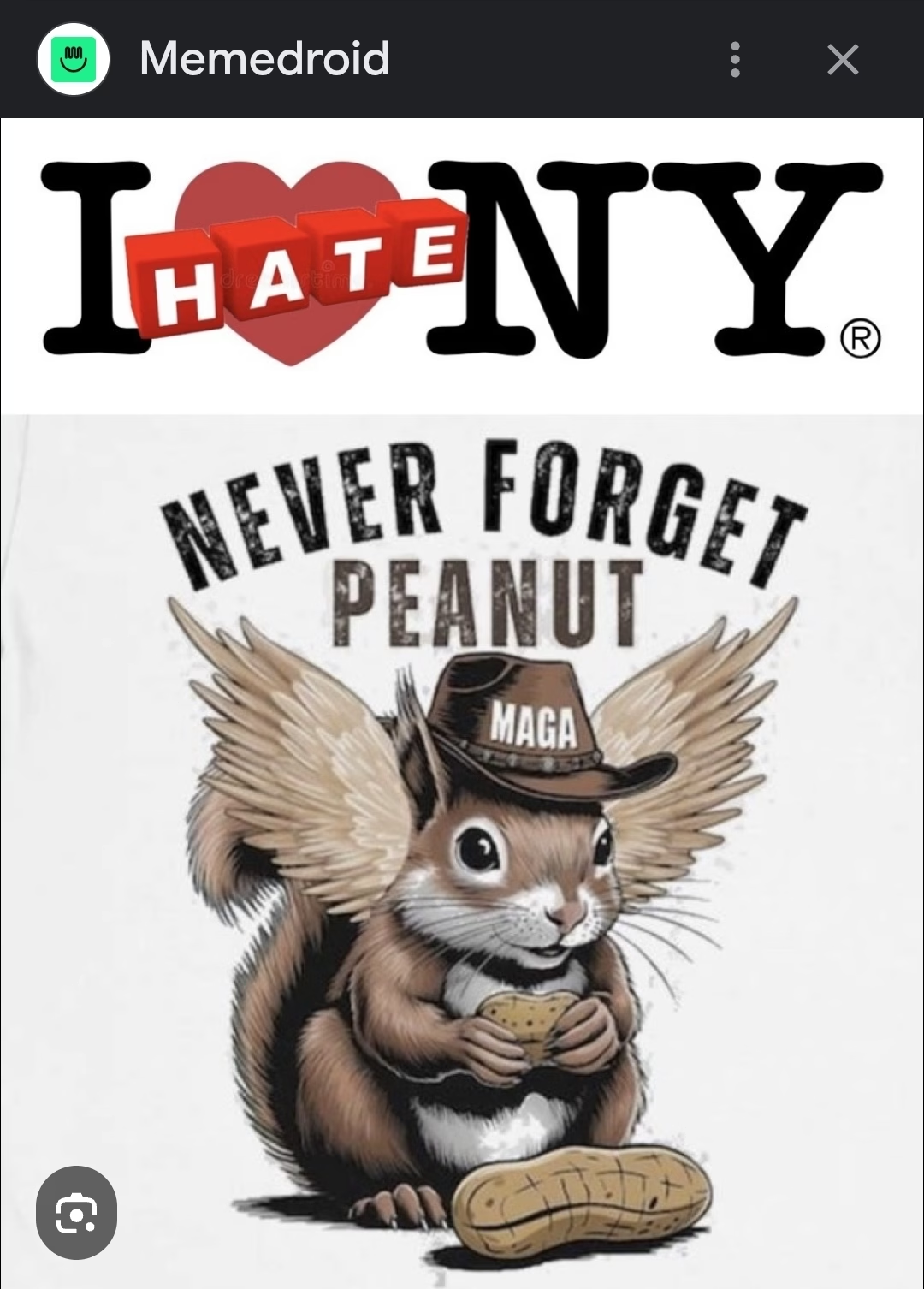
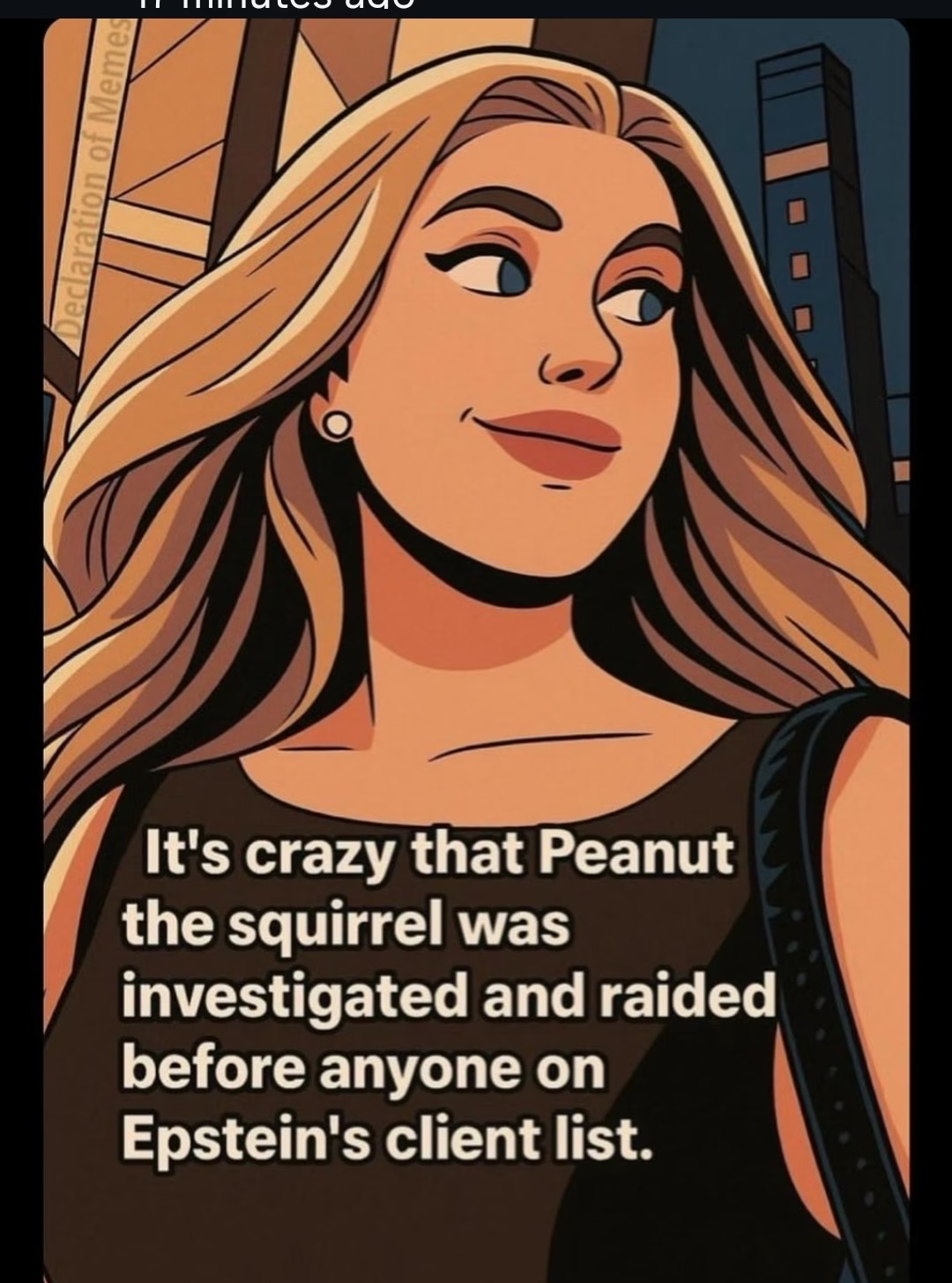
A Peanut Meme
Another Peanut Meme
Meme

22: Peanut the Squirrel

Peanut’s Story is Proof of How One Tiny Life Can Impact Thousands of Hearts

Born: c.2017, Possibly New York City, New York, United States of America

Died: c.30 October 2024, New York State, United States of America

Also Known As: P’Nut

Peanut was an Eastern Grey Squirrel, who had been injured as a baby and was living with humans Mark Longo and Danielle Bittner, who had rescued Peanut and a raccoon named Fred and rehabilitated them in their home. Peanut’s mother had been hit by a car when he was tiny, and so Mark rescued Peanut and raised him to adulthood, bottle feeding him for eight months. Once he reached adulthood, Mark tried to release him back into the wild, but the effort failed and so Mark decided to keep Peanut as a pet.

Mark planned on releasing Fred back into the wild once he was rehabilitated.

Mark also made social media posts featuring Peanut and Fred, as a way to help raise money for his sanctuary. He already had made quite the following for himself, but after the death of Peanut and Fred, Mark’s social media following jumped considerably as more and more attention turned to this developing story.

Mark is not some random guy that just happened to keep a squirrel in his house, by the way. He owns a three-hundred-acre property called “P’Nut’s Freedom Farm Animal Sanctuary”, and he houses several hundred animals of all different species on the property.

On 30 October 2024, the state of New York’s Department of Environmental Conservation (or DEC) raided Mark’s home, seized both Peanut and Fred, and then euthanized them. During the raid, which lasted over five hours, nine agents ransacked the house (though Wikipedia claims there were actually twelve agents present), detained Mark and his wife, and they questioned his wife’s immigration status (she is a legal immigrant from Germany). The agents claim that Peanut bit one of them during the raid.

According to Big Brother, I mean, the government, the raid occurred after several complaints were filed. Evidently, a few random people decided Fred might be carrying rabies (even though they had no proof of this whatsoever), and so the state came in, seized both animals, and killed them. The reason why both animals were euthanized so quickly is because there is no way to test for rabies in an animal while it is still alive, because brain tissue has to be examined to find signs of rabies. The tests came back, unsurprisingly, negative.

It is also illegal to keep a raccoon as a pet in New York State. While you can keep squirrels in the state of New York, you can only legally do so after jumping through bureaucratic hoops to become a licensed wildlife rehabilitator. Mark attempted to complete this process but never managed to actually obtain the license, but he did try.

Also important to note, there are NO known cases of a human contracting rabies from a squirrel anywhere in the US.

In the wake of their sudden deaths, the DEC also refused to allow Mark to have the remains of his beloved pets Peanut and Fred. News of the detainment and death of the animals hit the internet immediately, and as someone living in the United States at the time, I can personally attest to the fact that it seemed to cement a lot of voters’ opinions on government overreach only days before the United States’ Presidential Election, where Donald Trump beat out Kamala Harris in both the popular vote and the electoral college.

Memes exploded across the internet showcasing Peanut and Fred. Even then-Vice-Presidential Candidate JD Vance denounced their deaths as horrendous overstepping by the state of New York. Joe Rogan, Donald Trump Jr, and Elon Musk also commented on the case. Supreme Court Justice Neil Gorsuch mentioned Peanut in a speech on the dangers of government overreach. The DEC even received bomb threats in the wake of the news. Saturday Night Live even got in on the public frenzy, airing a skit in November 2024 supposedly featuring Peanut’s widow (portrayed by a human actor).

A few months after the raid, the DEC commissioner released a statement that admitted they, “know that we can do better moving forward.” Efforts have also been made to force agents from agencies like the DEC to wear body cameras.

In April 2025, Mark and other lawmakers advocated for Peanut’s Law to be passed in New York State, which would require the government to hold animals for a set period of time after they are seized, to giver the owner’s time to try and rescue them by proving the animals are not actually dangerous.

In June 2025, Mark filed a lawsuit against the state, claiming government overreach and a violation of his rights. The suit is requesting $10 Million in damages. According to USA Today (article linked below):

“The suit says the DEC officers acted outside the scope of a warrant that authorized the search of the home and seizure of the animals but not their euthanasia, and in doing so violated the couple's right to due process. It also says the killing of Peanut and Fred also economically harmed Longo and Bittner and their animal sanctuary. They received donations and generated revenue thanks to the social media popularity of the animals.”

The suit also claims that Peanut and Fred were executed, not euthanized. I personally agree with that statement.

As of August 2025, no trial date or further action about the lawsuit has been made public.

Also, in the spirit of total honesty, I want to include the fact that apparently Mark either was, or possibly still is, running an OnlyFans account that was making him thousands of dollars a month, and marketing himself as “Peanut’s Dad” on the platform. That’s…kind of gross, but doesn’t really have anything to do with Peanut and Fred being murdered for no reason.

Sources:

https://www.usatoday.com/story/news/nation/2025/07/11/peanut-the-squirrel-lawsuit/83475019007

https://www.newsweek.com/pnut-squirrel-fred-racoon-lawsuit-owners-seek-10-million-dollars-new-york-2111657

https://apnews.com/article/peanut-squirrel-rabies-new-york-investigation-55bae101240c088ffa0c427cac803e3f

https://en.wikipedia.org/wiki/Peanut_(squirrel)

  • 1
  • 2
  • 3
  • 4
  • …
  • 159
  • Next

Categories

Archives

  • July 2025 (10)
  • July 2024 (1)
  • January 2024 (1)
  • August 2023 (1)
  • June 2023 (2)
  • October 2022 (1)
  • July 2022 (1)
  • June 2021 (3)
  • December 2020 (3)
  • August 2019 (1)
  • July 2019 (2)

Search

© 2026 The Exasperated Historian | Powered by Minimalist Blog WordPress Theme