The Exasperated Historian
Menu
  • Home
  • The Women’s List (New)
  • The Men’s List
  • The Animal List
  • Collections
  • The Blog
  • Contact Us
  • FAQ
Menu

Category: Birth Locations

21) Carlo the Newfoundland

21: Carlo

Emily Dickinson’s Beloved Dog

Born: 1849, Possibly near Hadley, Massachusetts, United States of America

Died: January 1866, Amherst, Massachusetts, United States of America

Carlo was gifted to the young author by her father in the Autumn of 1849 or 1850. While the exact reason cannot be known for certain, it is thought that Emily’s dad gifted Emily the Newfoundland as someone to accompany her on her walks through the woods near Amherst.

Carlo may have been born to Newfoundland breeders and family friends of the Dickinsons. Emily chose his name after a dog named Carlo in Jane Eyre the famous novel by Charlotte Brontë, which she read around the same time she received her companion.

Emily was extremely fond of her dog, and wrote of him often in letters to friends and some poems as well. In one letter to a friend, Emily wrote:

“Gracie, do you know that I believe that the first to come and greet me when I go to heaven will be this dear, faithful old friend Carlo?"

After Carlo died, the already introverted Emily became even more of a recluse, spending the rest of her life in mourning for her beloved pet. She was only thirty-two herself when he died and lived to be fifty-five, spending the last twenty-three years of her life without her beloved companion. Carlo was around seventeen years old when he died, and a few months after he passed, Emily paid tribute to her Newfie with the following poem:

Time is a test of trouble

But not a remedy –

If such it prove, it prove too

There was no malady.

Badges Earned:

Located In My Personal Library:

The Who, The What, and The When by Matt Lamothe

Sources:

https://www.emilydickinsonmuseum.org/carlo-1849-1866-dog

https://www.emilydickinsonmuseum.org/roomitem/carlo

https://www.thenewfoundland.org/dickenson.html

https://www.lindaborromeo.com/post/2015/09/18/the-mirror-world-of-emily-dickinson-and-carlo

20) Jenny the Cat

20: Jenny the Titanic Cat

Supposedly Aboard the Doomed Ship

Birth and Death Dates and Locations Unknown

As most of you know, I consider myself a bit of a Titanic expert, and while I knew the stories of many of the dogs onboard, a cat was a different story.

Supposedly, as the story goes, Jenny was the ship’s mascot and was cared for by a laborer named either Jim or Joseph Mulholland. Jenny lived near the ship’s galley (or kitchen) and was brought on board to help fight rodents. She had previously served in the same capacity aboard the Olympic.

During Titanic’s Sea trials, Jenny gave birth to a litter of kittens. Jim found the tiny family a place to keep warm near the galley.

Everything seemed fine, and Jenny and her kittens stayed abord the ship as it docked in Queenstown and Cherbourg. However, things changed when the ship docked for a final time in Southampton.

Apparently, Jenny could sense the coming danger. One by one, she picked each kitten up by the scruff of their neck and carried them down the gangplank, to dry land and safety, disappearing into the annals of history.

Jim decided that Jenny must have had a sixth sense about the ship, and supposedly he also took his belongings and left the ship as well.

Supposedly, the source for this story (according to Facebook) is what I am assuming was a newspaper called “Irish Road” that talked to Jim as an old man, who claimed his life had been saved by a mama cat and her babies.

Yahoo News and Mental Floss both state that the famous survivor Violet Jessop saw Jenny and her kittens, but I have no idea how anyone could actually verify that claim. Yahoo and Mental Floss also states that Jenny and her kittens were still abord the ship when it sank and so their fate is unknown.

It is very likely that there were multiple cats onboard Titanic, as mice and rats were a very real problem on ships in that day and age. Whether or not any of them survived the sinking, or what the names of those other felines would have been, is lost to history.

Just like the story of Signalman Jack the Baboon, Jenny’s story is recounted on a number of pop culture websites, but I haven’t been able to see any reliable cited historical sources about her story. The photo included in this article was posted on The Vintage News, but apparently there are no known actual photos of Jenny, and this one honestly looks like it might be photoshopped anyways. If Jenny and her kittens were real, I really hope they were able to escape the doomed ship with their lives!

What I was able to verify is that Joseph Mullholland was a real crew member, and he did disembark in Southampton. According to his Encyclopedia Titanic entry (linked below), Joseph left the ship partially because he saw the ship’s cat (presumably Jenny) leaving the ship, but also because of several other crewmembers making comments that worried him about the safety of the ship—including Thomas Andrews himself.

There is very little other information about Joseph in the article, and Encyclopedia Titanic even admits they do not have a death date for Joseph as he disappeared from history after 1962. Well, at least there is a grain of certifiable fact in this story!

Sources:

https://www.yahoo.com/lifestyle/tragic-story-jenny-titanic-cat-193714174.html

https://titanic.fandom.com/wiki/Jenny_(Cat)

https://www.mentalfloss.com/history/titanic/jenny-titanic-cat

https://www.facebook.com/groups/catsaddicted/posts/1605414517504486

https://en.wikipedia.org/wiki/Animals_aboard_the_Titanic

https://www.thevintagenews.com/2022/07/25/jenny-the-cat-titanic

https://www.encyclopedia-titanica.org/titanic-biography/joseph-mulholland.html

19) Signalman Jack the Baboon

19: Signalman Jack the Baboon

Worked at a Railroad Station for Nearly a Decade

Born: Date Unknown, Probably South Africa?

Died: 1890, Near Uitenhage, South Africa (Present-day Kariega, South Africa)

As the story goes, one day in the 1880s, a railway signalman named James Wide was visiting a market in South Africa when he saw an amazing sight—a chacma baboon driving an oxcart through the market. Wide was instantly enamored by the baboon, and decided to purchase him, name him Jack, and make Jack his personal assistant.

You know, as one does.

Evidently, James wanted an assistant because he had lost both of his legs in an accident years before. James had made it a habit of jumping between moving train cars, and one day he jumped at just the wrong moment and was run over by the train, losing both of his legs around the knee. Somehow he wasn't killed in the freak accident, and instead made himself peg legs and went back to work.

At first, Jack the baboon would cart his boss back and forth to work every day, but soon he had picked up on how to help around the house, like sweeping floors, collecting firewood, and taking out trash.

It wasn’t long though, until Jack picked up on his boss’s job as a railway signalman for the Uitenhage train station. At the time, trains would blast their whistles a set number of times to indicate which track they wanted to use. The signalman, listening to the whistles, would then change the tracks according to the train’s wishes using a series of levers. Jack picked up on this system rather quickly, and began pulling the levers to change the tracks all on his own. Some sources state he was even able to deliver keys to various train conductors when needed as well.

James Wide realized he had made the wisest monetary purchase of his life. Soon enough, James would kick back and goof off during the work day while Jack—who was apparently CHAINED to the work area, would pull all the levers and literally do all the work, all without being paid because, well, he was a baboon.

One day, a train passenger noticed Jack pulling the levers and she filed a complaint. Not because she thought there was a case of animal cruelty happening, but because she was disturbed by the thought of a monkey doing a human’s job. Considering this was the late 1880s…I don’t blame her!

An official investigation was launched into the matter, and in 1890, a railway superintendent noted that Jack knew every lever and every whistle, possibly even better than the superintendent himself. Jack was actually promoted! He was given an official employee number and uniform, and was paid half a bottle of beer every week and twenty cents a day pay.

Jack ended up passing away in 1890—though what killed him is up for debate. Most sources say he died of tuberculosis while another said he was run over by a train. He had worked for the railways for nine years and never made a single mistake.

Apparently, Jack’s skull is on display in the Albany Museum in Grahamstown, South Africa.

...

I like this story, really, I do. But I have one glaring issue with it—all of the articles I have listed as sources below are pop culture articles, have no basis in cited historical works, and NONE of them list their own sources. There are several photos in the articles as well, but honestly, they all look photoshopped to me (including the one I posted in this article). I was able to verify that the museum in South Africa is real—it is actually apparently the second oldest museum in the country. The museum itself is a natural history museum with lots of different exhibitions and artifacts from South Africa’s natural history, but I couldn’t find anything on the website about Jack the Baboon.

Even the Wikipedia article has mostly sources that are the same as I found (including the same Mental Floss article I linked below). Wikipedia also says the famed actor Ricky Gervais talked about the story of Jack on a radio show during a segment titled “Monkey News” but evidently Gervais dismissed the story and found it just as unbelievable as me.

I even attempted to look up Jack's owner, James Wide, on Find a Grave to try and verify his story, but there are no burials for a James Wide in South Africa listed on the site. Even a simple Google search of his name turned up no results.

If any of you have ever visited the Albany Museum in South Africa and have seen Jack’s skull, please let me know! Without seeing some actual, verifiable, evidence however, I am going to take this entire story with a grain of salt…

Sources:

https://www.mentalfloss.com/article/559031/signalman-jack-baboon-worked-railroad-south-africa

https://theexpeditionproject.com/jack-the-signalman-baboon-a-remarkable-tale-of-animal-ingenuity

https://fieldethos.com/jack-the-baboon

https://allthatsinteresting.com/jack-the-baboon

https://am.org.za

https://en.wikipedia.org/wiki/Jack_(baboon)

18) Balto the Mixed Siberian Husky

18: Balto

Helped Deliver Medicine to Sick Children

Born: 1919, Nome, Territory of Alaska, United States of America (Present-day Nome, Alaska, United States of America)

Died: 14 March 1933, Cleveland, Ohio, United States of America

Balto was a Siberian Husky whose story has been immortalized for helping deliver medicine to children dying of Diphtheria in February 1925.

(Another, lesser-known dog, who actually covered more ground that frozen winter was Togo, who can be read about by clicking their name!).

In 1924 and 1925, Nome was a much smaller and remote town in Alaska than it is today. The population in 1924 just over 1,400 people, while in 2025 that number had climbed to around 3,600. Still a small town sure, but not quite as small or difficult to reach.

That chilly winter back in 1924/25, Nome only had one doctor, and he worked at the local hospital—which was also very small. In November, he began to receive patients suffering from what he assumed was tonsilitis—but the patients started dying, and he quickly realized the problem was much more serious.

By January, the doctor had officially confirmed the mystery illness to be diphtheria. While the hospital did keep the medicine used to treat diphtheria on hand, their supply had already expired. The new shipment did not arrive before Nome’s port shut down for the winter. Even after a quarantine was put into effect, more people were confirmed to have the disease, which could quickly turn fatal if left untreated.

Because of the treacherous winter weather, getting the medicine to Nome’s remote location was easier said than done. Various methods were ruled out, including deliver by airplane (flying had only been possible for just over twenty years at that point!). The territorial governor finally decided to ship the medicine by train as far as they could, but the nearest train depot was still over 600 miles away. The final stretch of the journey would have to be completed by dog sled.

Over 150 dogs and twenty human mushers (or drivers) were chosen for the mission, which was dubbed “The Great Race of Mercy.”

Balto was one of the dogs chosen for the mission. Balto’s musher was a man named Gunnar Kaasen, an assistant to the better-known Leonhard Seppala, who actually owned both Balto and Togo.

Although Balto was dubbed a “Siberian Husky” during his lifetime, in 2023, genetic testing on his remains revealed that Balto was not a purebred husky. He also had links to Tibetan Mastiffs, as well as dogs from Vietnam and Greenland. These various genetic traits allowed Balto, and Togo, to survive the harsh climate even better than purebred huskies.

When dogs were first being chosen to participate in the journey, Seppala did not want Balto as a lead. Seppala viewed Balto as being much better suited to hauling heavier freight thanks to his stocky build. Seppala personally chose Togo, who was twice Balto’s age (twelve instead of Balto’s six) to lead his team. Once Kaasen was allowed to choose his own team, however, he chose Balto. Balto had no previous experience as a racing sled dog, but Kaasen saw something in the dog that Seppala did not.

On 27 January 1925, the diphtheria medicine arrived by freight train in Nenana. The medicine had been specially packaged to protect it from the freezing weather, and good thing to. With windchill factored in, the dogs and their mushers were operating in weather that is believed to have gotten as low as −85 ℉ (−65 °C). Each team would cover approximately thirty miles before handing off to the next team. The only team that ran further, much further, was Seppala’s team (led by Togo) which covered ninety-one miles of the most treacherous stretch of terrain.

Gunnar Kaasen’s team, led by Balto, was supposed to be second to last. When Kaasen arrived at the drop off spot, however, he found the next musher asleep. Knowing there was no time to waste, Kaasen and his team continued on. Balto entered the halls of history when his team successfully delivered the medicine to Nome, saving upwards of hundreds of lives.

The fifty-three mile stretch that Balto and his team covered were particularly hazardous. At one point, Kaasen reported that wind swept the entire sled up and over, burying the medicine in the snow. Kaasen had to dig for the medicine with his bare hands, luckily finding it so the journey could continue.

At another point, Balto suddenly stopped and refused to continue on. When Kaasen investigated, he discovered that one of Balto’s paws had punched through the ice. He had stopped to protect the rest of the team from following suit!

Balto’s team arrived in Nome at approximately 5:30 AM on the morning of 2 February 1925. According to Smithsonian Magazine (article linked below), historians today don’t even know for sure if Balto was the lead dog that pulled the medicine the final stretch into Nome. It could have been Balto, or one of the other dogs on the team. What is known, is that when the team was staged to take a photo later on, Balto was placed in the lead position for the photo, and he has been given the credit ever since.

The race from Nenana to Nome took around 127.5 hours, or five days. Normally the same journey would take a single sled team a month!

In December 1925, Balta was forever memorialized with a statue in Central Park, New York City. For two years following the momentous delivery, Kaasen and his entire team of dogs toured the lower forty-eight states, showcasing the heroes.

Leonhard Seppala was less than enthused with Balto’s sudden fame, because he didn’t think it fair that the other dogs were forgotten. Luckily, another team, this one led by Togo, was also given a national tour.

Balto and six of his teammates were later sold to a promoter, and put on display in a museum in Los Angeles (yes, while they were still alive!). Luckily, a businessman visiting from Cleveland, Ohio, stumbled upon the exhibit and was appalled by the neglect the dogs were facing. He purchased all seven dogs for $2,000 (or $36,000 in 2024!). Kimble put the news out across the country that he needed help to raise the money to save the dogs, and within ten days he had raised $2,300.

On 19 March 1927, the seven dogs arrived by train in Cleveland. After a parade through the town in their honor, Balto and his fellow teammates were transferred to the Brookside Zoo, where they resided for the rest of their lives.

Balto lived to be fourteen years old.

After Balto’s death, his body was preserved and was put on display at the Cleveland Museum of Natural History, where it remains to this day.

In 1995, Balto’s story was cemented in the minds of children around the world after Steven Spielberg’s production company created a (highly fictionalized) version of his story. The movie was an instant hit, and had two direct-to-video sequels. (The smash hit film was actually the second made about Balto, but the first, a silent film released only months after the 1925 sled run, was silent and forgotten about soon after its release).

Today, Balto’s heroism is remembered annually in Alaska by the Iditarod Trail Sled Dog Race. This race follows the path of the original Great Trail of Mercy, but further safety measures are in place. The race must be completed by the same dogs running the entire race, and so they are given much more time to complete the journey. Unfortunately the race can still be hazardous, and according to an article written by PETA, over 150 dogs have either been injured or killed during the races.

I tried to locate a list of names of all the dogs who ran the trek to save the Diphtheria patients, but sadly there doesn't seem to be one anywhere, online at least. I did manage to compile what I could find, and have included that information below. Like Leonhard Seppala, I believe all of the dogs should be remembered, not just Balto.


List of All Mushers and The Information I Found on Their Dogs:

Musher Wild Bill Shannon led a team of nine huskies. Cub, Jack and Jet, all died of lung injuries following their journey. Five other huskies on this team were not named. The team was led by Blackie.

Dan Green was the next musher, no dogs named but he had eight on his team.

Johnny Folger next musher, no dogs named but he had an eight dog team.

Sam Joseph was next and had a team of seven Alaskan Malamutes, none of which were named.

Titus Nikolai was next and there was no information on his dogs other than there were seven on his team.

Dave Corning was next, no info on his dogs though.

Edgar Kalland was next and again, no info on dogs.

Harry Pitka had a team of seven dogs.

Bill McCarty's team  was led by Prince, and had seven total dogs on his team.

Edgar Nollner, had seven malamutes led by an eight-year old dog named Dixie.

George Nollner, used same team as Edgar (his brother).

Charlie Evans, had a team of nine dogs, two of whom suffered injury during the run.

Tommy “Patsy” Patson ran next, but there is no information on the dogs.

Jack “Jackscrew” Madros, no info on dogs but he jogged alongside the team for part of the journey to lighten the load.

Victor Anagick had eleven dogs on his team.

Myles Gonangnan had a team of eight malamutes.

Henry Ivanoff was next but there was no info on his dogs.

Leonhard Seppala, had twenty huskies that he ran, dropping some off along the way to be ready to head back on the trek later once the medicine had been handed off to the next musher. Seppala's lead dogs were Togo, Scotty, and Fritz, but I haven't been able to find the names of his other dogs.

Charlie Olson was next. He had two dogs that suffered injury, his lead dog was named Jack, and he had seven total Malamutes on his team.

Gunnar Kaasen was the final musher. His lead dogs were Balto and Fox, while other dogs on the team were named Alaska Slim, Billie, Tillie, Tye, and Old Moctoc. One source says there were actually thirteen dogs on this team, but only seven were eventually purchased and moved to Ohio.

Badges Earned:
Find a Grave Marked

Located In My Personal Library:

American Spirit Magazine Article “Dogged Determination” by Jeff Walter (May/June 2024 Edition)

Sources:

https://www.britannica.com/animal/Balto-dog

https://www.smithsonianmag.com/history/this-heroic-dog-raced-across-the-frozen-alaskan-wilderness-to-deliver-life-saving-medicine-but-his-contributions-were-long-overlooked-180985905

https://www.smithsonianmag.com/smart-news/baltos-dna-provides-a-new-look-at-the-intrepid-sled-dog-180982076/?itm_source=related-content&itm_medium=parsely-api

https://www.akc.org/expert-advice/lifestyle/balto

https://en.wikipedia.org/wiki/1925_serum_run_to_Nome#Sled_dog_credit

https://www.alaskamushingschool.com/learn/1925-serum-run-to-nome

https://mushing.com/uncategorized/who-were-the-participants-in-the-1925-serum-run

https://www.findagrave.com/memorial/9169/balto_the_wonder_dog

17) Ken Allen the Orangutan

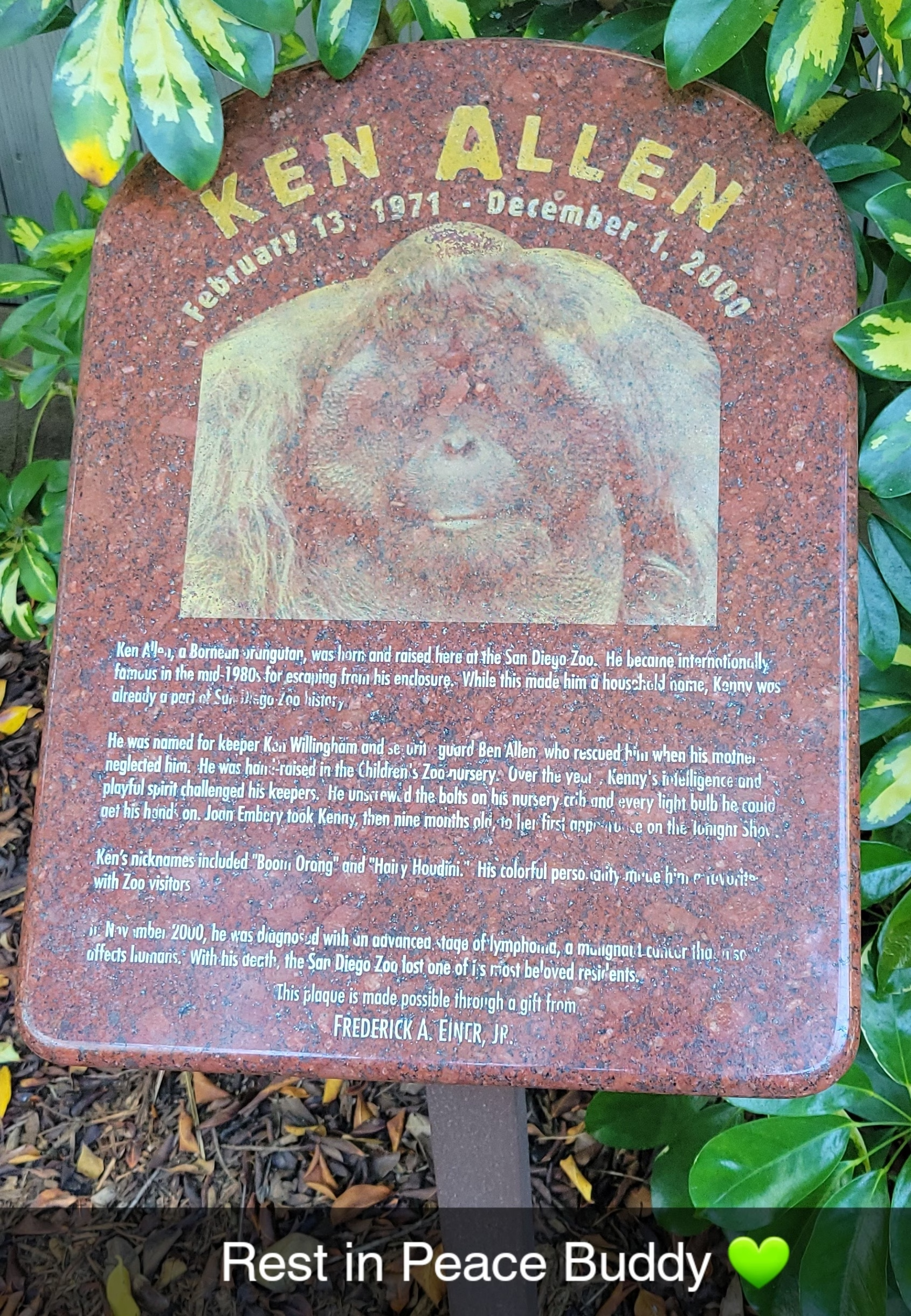
Ken Allen Memorial at the San Diego Zoo

17: Ken Allen

Bornean Orangutan who Playfully Terrorized the San Diego Zoo

Born: 13 February 1971, San Diego Zoo, San Diego, California, United States of America

Died: 1 December 2000, San Diego Zoo, San Diego, California, United States of America

Even if you don’t like Count Dankula for his political views or other content, I have to say, his Absolute Mad Lads episode about Ken is hilarious! I linked the video here in the article and I highly recommend checking it out if you haven’t seen it already.


Ken Allen is remembered today for being the world’s best escape artist—at least for an Orangutan anyway.

His first daring escape happened on 13 June 1985, when Ken climbed a retaining wall and escaped from his exhibit. But while this was technically his first real escape, Ken’s ability to outmaneuver his human handlers had started much earlier when he was just a baby in the nursery.

Ken Allen, named for two zookeepers named Ken and Allen who had saved the baby orangutan’s life, had had a unique story from the start. Ken Allen’s mother, named Maggie, was another captive orangutan, but she tried to smother her baby soon after he was born. The baby orangutan was moved into the zoo nursery in order to save his life. He was kept in the nursery until he was old enough to be returned to the adult exhibit.

While in the nursery, Ken Allen quickly learned how to take apart his baby pen at night when he was left alone in the building. Ken learned how to unscrew the bolts, letting him escape, and then re-screw the bolts back into place in the morning before the zookeepers returned, leaving them none the wiser…for a while at least. The zookeepers eventually caught on to what Ken was doing and made sure to reinforce his baby pen so that he couldn’t continue to wander around.

Apparently, the zookeepers didn’t think that his quests for freedom would continue once moved into the adult exhibit, but they were wrong.

When Ken climbed out of his exhibit for the first time in 1985, he did so largely because he was curious and bored. The human visitors of the zoo stood by in astonishment as the several hundred pound hairy ape wandered around and looked at the other animals. He wasn’t violent, he didn’t hurt anyone, or even cause a scene. He simply wandered around like any other visitor to the zoo. Eventually, zookeepers caught up to him and led him back to his enclosure—but by then it was too late, Ken had tasted freedom.

The general public immediately fell in love with Ken, and as he continued to escape again and again, he became something of a celebrity. The zoo began to sell t-shirts and other merchandise with Ken’s face on them, bumper stickers that read “Free Ken Allen!” began to appear on cars all across the country, a song was written in his honor, and more recently in the 2010s, a local brewery created a beer in his honor. A newspaper article published in the 1980s dubbed Ken the “Hairy Houdini”—a nickname that cemented itself in Ken’s story from there on out.

Ken even had his own fan club, called the “Orang Gang.”

A few weeks after Ken’s first escape from the adult exhibit, in July 1985, Ken managed to escape again. The zookeepers thought they had reinforced the enclosure, but clearly, they hadn’t done enough. Ken escaped his enclosure, and was found throwing rocks at another orangutan, named Otis, whom Ken clearly had beef with to say the least.

And then, a few weeks after that, Ken escaped again! In August 1985, workers had accidentally left a crowbar behind in the orangutan exhibit. Ken and another female orangutan named Vicki worked together to use the crowbar to pry apart a window, allowing Ken to escape.

After the window escapade, Ken was temporarily moved to an indoor exhibit while the zookeepers worked to reinforce his actual enclosure, to stop him from escaping again. While Ken was kept indoors, he was only given a black and white television with a single channel to watch, and no other enrichment. Poor guy.

The zoo was determined to prevent further escape attempts from Ken. They hired rock climbers to scale the walls of the exhibit to find potential escape routes, added electric wiring to the fence line outside the exhibit, and even began to post zookeepers in civilian clothes around the exhibit once Ken figured out what zookeeper uniforms looked like.

Around this time, security cameras caught Ken scaling the exterior wall of his enclosure, but when his paw brushed up against the electric wiring, he seemingly gave up and climbed back down.

For the next two years, Ken seemed to calm down. He had a harem of female orangutans in the enclosure with him and had multiple children with them. It seemed like Ken was a typical family man—er, orangutan that is, and zookeepers started to relax around the Hairy Houdini.

But just when the keepers started to think Ken’s escape artist days were over, the pump that worked in the enclosure’s moat clogged. The moat quickly dried up, and Ken, not one to waste an opportunity, simply walked across the dried-up moat, and hoisted himself up onto a pile of rocks outside the enclosure.

Once free, Ken posed for photos with tourists and wandered around, like he had other times before. Unfortunately, he was quickly spotted by staff, and after security and zoo veterinarians caught up to him, Ken was returned to his enclosure—grumpy but without further incident.

Zookeepers thought that maybe Ken was still jealous of his old rival Otis. Otis had three female companions in his enclosure. Ken was given four more, on top of the few he already had with him. Zookeepers hoped the new ladies would help keep Ken distracted.

Instead, Ken apparently taught his new friends all about the wonders of tools. Within months, two of the new orangutans were able to use a five-foot long squeegee, left behind by zookeepers, to scale the fence and escape. One of the orangutans had to be tranquilized in order to return her to the exhibit, while the other went much more peacefully.

The San Diego Zoo had no choice but to spend $45,000 to make improvements to the enclosure, and the escapes finally stopped. According to official reports, between all of the orangutans, there were nine escapes or escape attempts in a short period of time.

(The first time Ken attempted to escape, he built a ladder! Though the attempt was unsuccessful, its still incredible to think about how brilliant this orangutan actually was. A zoo employee described the ladder event thusly:

“He would carefully put the foot of the ladder on the ground, and pound it with his hand to be sure it was solid, and then he would climb to the top of the wall and climb back down.”)

Ken’s star faded, and eventually he was just another orangutan in the exhibit like all the rest—except for the fact that he apparently liked to give small human children the finger. Yeah, that finger!

Sadly, in 2000, zookeepers noticed that Ken began to act strangely, not like his normal self. Zoo veterinarians diagnosed him with B-Cell Lymphoma. There was no hope for a meaningful recovery, and so, Ken Allen was euthanized and cremated by staff on the first of December that year. He was twenty-nine years old.

He has a memorial plaque installed at the San Diego Zoo, which I photographed while visiting the zoo in 2023.

Badges Earned:

Find a Grave Marked

Sources:

https://www.newsweek.com/2016/06/24/orangutan-ken-allen-san-diego-zoo-escape-artist-469908.html

https://www.all-creatures.org/articles/ar-orangutans.html

https://tilln.com/season-4/ken-allens-incredible-escapes-from-the-san-diego-zoo-ep-257

https://www.findagrave.com/memorial/194966056/ken-allen

Scandinavia’s Oldest Town– A History of Ribe, Denmark

Posted on July 28, 2025August 27, 2025 by nickssquire12
https://theexasperatedhistorian.com/wp-content/uploads/2025/07/ribe-bridge.mp4

One of my favorite meme formats I often see online is "The European Mind cannot comprehend [insert random thing only Americans would understand]" or the reverse, "The American Mind cannot comprehend [insert thing]". These memes are funny because of the surface level joke they present about how different various cultures really can be, even when we have a common or shared ancestry however many generations back.

european-mind-cannot-comprehend-memes-14-4-11-2024-600x705

I have seen these jokes online over the previous years, ever since meme culture exploded across the internet. And while I always thought they were funny, I never really understood the actual depth behind the humor until I visited Europe (Denmark anyway!) and got to speak with my future-in-law family that lives in Denmark.

When you visit a foreign country and only speak with tour guides, hotel staff, and so on, you get to know a little about the culture of the place you are staying in, but you don't get the finite nuances of those cultural differences unless you are speaking with someone of a much closer relationship, like family or friends.

My first shining example of this happened when I innocently showed some of the Danish cousins one of my favorite photos of my brother, posted by my dad on Facebook a few months ago.

Logan with the racecar

When I tell you my future Danish cousin-in-law's eyes nearly popped out of his head when I showed him this photo, that is an understatement.

The cousin's eyes were wide, and he looked at me like I was nuts. He said to me, "All blades longer than 6.7cm are banned in Denmark!"

I laughed and replied, "My brother keeps his machete next to the sofa in the living room!"

(Don't even get me started on the differences in our gun laws!)

Anyways--where I am going with this is, the cultural differences are a two way street. Just like how the Danish cannot comprehend an American man having a machete lying beside his sofa, I was just as astounded when I started to dig into the history of Ribe, the town we stayed in when visiting Denmark.

The closest I can come to describing Ribe in a way Americans will understand is this--its sort of like Colonial Williamsburg in Virginia, only so much cooler.

(Don't come for me colonial history lovers! I don't mean it as an insult, just trying to make a comparison!)

For those unaware, Ribe is not only the oldest town in Denmark, its the oldest town in ALL of Scandinavia.

In the United States, our oldest town that was able to be permanently settled and occupied (Jamestown) was first colonized in 1607. The first documented history of Ribe was in around 710 AD (that's only an eight hundred and ninety-seven year difference!).

The United States is about to celebrate our 250th birthday next year (in 2026!). This is a huge deal for Americans and certain groups like DAR (Daughters of the American Revolution) have been planning cultural celebrations to commemorate the massive achievement for years. I first started to get involved with DAR in 2018 and they were already starting plans for 2026.

Yeah uh, Ribe celebrated its 1,300th birthday in 2010.

Do you know how insane a number like that sounds to an American? Even someone as well versed in history as I am, that number is still almost unfathomable. Not only is that number absolutely insane--the fact that Ribe has been continually occupied all one thousand and three hundred of those years is even more crazy.

Sure, we have archaeological sites that old in the US--some Native American sites go back even further, thousands of years further (like the Clovis, New Mexico site that shows people occupied the Americas up to 13,000 years ago). But just because we have ridiculously old archaeological sites doesn't mean people have lived there that whole time. The oldest continually-occupied town in North America (which was originally settled by the Spanish and so is not counted as the first American city, despite it being located in America--confusing I know) is St. Augustine, Florida, which was founded in the mid-1500s.

We as citizens of the United States simply do not have places like Ribe anywhere in our country, and that's what makes Ribe, and other older occupied cities like it, so fascinating to "The American Mind." In fact, this is highlighted in a Percy Jackson book of all things! In the second series, Heroes of Olympus, the character Leo Valdez has an iconic line in one of the books, when he is complaining about looking at ruins all across Europe. Leo complains (and I'm paraphrasing here so excuse me if I don't have this line exactly correct) "Take me back to the United States, where our oldest buildings are Ye Olde McDonalds and High Schools." While the line isn't historically accurate, it does show how Americans feel and think about our own history and archaeology.

All of this was crashing around in my head as I found myself standing in Ribe. For the past three years, my fiancé has been telling me how much he loves visiting Denmark and the cousins and family he has there. He loves the cultural roots his family still celebrates here in the States (and now I do too, put a plate of Frikadeller in front of me and I will die happy!) and he has told me how excited he is to pass that legacy on to our children one day.

As an informally-trained genealogist myself, I latched onto this history just as tightly. Every branch of my own family tree has much deeper roots in the United States--my last relative to reach the US was a great-great-great-grandmother who came across from England in the early 1800s. My earliest relatives have been here since North Carolina, New York, and Pennsylvania were still colonies. Not so for my fiancé--his great-grandfather arrived in the US from Denmark in 1921, passing through Ellis Island on his way to Arizona.

Luckily for my fiancé, his great-grandfather never forgot his family in Denmark. My fiancé's grandmother visited Denmark for the first time when she was eleven or twelve years old, and has continually gone back to visit ever since. This also allowed her to foster relationships with the cousins, aunts, and uncles she would have never gotten to know otherwise.

The Danish relatives are just as grateful to have family in Arizona and Idaho. Several times a year, some of the Danes visit the United States and come stay with my fiancé's grandma (or her sister in Idaho). Over the past three years, this allowed me to get a taste of Danish culture before I ever got to visit the country myself. One of the most fascinating conversations I had was with one of the cousins, who told me she was shocked how much of my genealogy I have memorized and floating around in my mind. She told me that genealogy is not nearly as popular in Denmark, because for most of them, their family has always been Danish. There's no need to research when you know the basics! But this also means that, in her opinion, a lot of the Danes don't know the names of their great-grandparents, let alone generations further back. Apparently there is also less emphasis on getting to know extended family as well.

When I did get to visit the country in June of 2025, part of our celebration was a birthday party for my future-grandmother-in-law. While we were visiting the relatives (over seventy people came to the party!) I learned that the relatives have admitted that, were it not for my fiancé's grandmother and great-aunt, the Danes would not know their second cousins as well, let alone have a good relationship with them.

The Danish Family

Now I'd like to note, that this is not a blanket statement on Danish culture as a whole and merely what I heard from the family while I was there. The photo above was our turnout for the birthday party!

With all of that said, I clearly spent a lot of time in Ribe (and Vilslev!) walking around in deep fascination and appreciation for the history beneath every step I took. When I got home, I knew I wanted to make a post about my time in Denmark, but I didn't know exactly what I wanted to say.

So I started off easy, by compiling all of the notes I had taken from the various places we visited. From those notes, I started to make a timeline of events in Ribe. Once I had my timeline from my notes, I found myself spiraling deeper and deeper down into Danish history, wanting to flesh out the timeline to make it much more concrete than what I had--because while I took lots of notes while in the country, there were huge gaps in between the several periods of history documented in the places I visited.

For example, at the VikingeCenter, I learned about Ribe's earliest roots from circa 700 AD to 1000 AD. At the Cathedral, I learned history from 1100 to 1400 AD. At the Hex! Museum of Witch Hunt, I learned history from the 1500s and 1600s. But I also knew that Ribe had been continuously occupied for the last 1,300 years, so I wanted to know what I had missed from the in-between periods, how did the town change after the Middle Ages ended, and how did it get to be the town I visited today?

The first thing I noticed when doing my online research was this--there are many articles on the history of Ribe, but they all focus on one aspect or another, and again, had big gaps in time. I wanted to know the full story, from the very beginning up to today. And with that, I wanted to know more about the village where my fiancé's family came from--Vilslev, which is only a ten minute drive from Ribe. Once I had all of that information, I realized my timeline had a few random events from Denmark's history at large, and so then I found myself looking up important dates that affected the entire realm.

What I ended up with was an eighteen-page -long Microsoft Word Document, with almost two-thousand years worth of history from start to end. Along the way, I discovered that the school I watched one of the cousins graduate from in June has been open for over one thousand years! Imagine what Leo Valdez from the Percy Jackson books would have said to that! Another discovery I made, completely by accident, was that it was illegal for two men or two women to dance together in Denmark until 1973. Maybe Footloose should have been based in Denmark instead of Texas! I also discovered that my fiancé's great-grandfather was actually a second-cousin of a well-known figure from Tempe, Arizona History--a man whose home still stands as a local museum--a house that my own father lived in the neighborhood behind for many years.

After clicking on more articles, scanning more websites, and crossing all corners of the internet for the past week, I finally told myself I had to stop, or else the research would never end!

With all of that said, let me take you down the rabbit hole, back in time, to tell you all about the oldest-continually-occupied town in Scandinavian history, and how that town eventually brought my fiancé and I together 5,500 miles later so that I can share the story of Ribe with all of you today.

Ribe in Denmark

The first thing I want my readers to understand is Denmark's unique geography. Before I visited the country in person, I had Denmark's layout all completely wrong in my head, so I figured I would provide some maps to help everyone out.

When I flew into Denmark, we landed in Copenhagen. As you can see on the map above, Copenhagen is to the far east of the realm, and on a completely separate island than most people associate with Denmark as a country (the big taller one to the north and west).

Ribe, on the other hand, is all the way to the far left of this map. When you zoom out this far on Google Maps, Ribe doesn't even show up as a city. All you get is the red dotted area you see on the map. I put the marker representing Ribe in as close to the area as I could.

When we drove from Copenhagen to Ribe, it took us about three hours to make the drive. If you drive three hours in my home state of Arizona, we make it (almost) the whole way to my fiancé's family's other ancestral homeland of Taylor, Arizona (which I should really do a whole separate post on sometime but I digress!). Just like the American mind cannot fathom living in a 1,300 year old city, the European mind has a hard time understanding that if you drive five hours in the state of Texas, you're probably still in Texas!

So, now that you can visually see where Ribe is, we can start telling the tale of this quaint little town with a bit more background information to set the stage.


Historically speaking, Ribe was the Dane’s Gateway to the West and served as a major harbor town from 700 to 1700 AD, the only medieval North Sea port in Denmark. Because of Ribe's unique location on the far western coast of Denmark, this allowed the early settlers of the area to use Ribe as a point to travel further into parts of Europe like (what is today) the United Kingdom to the direct west, and Germany, the Netherlands, Belgium, France, and so on to the west and south.

Today, Ribe is the oldest and best-preserved town in Denmark and all of Scandinavia. It is only four miles (or six and a half kilometers) from the North Sea and twenty miles (or thirty-two kilometers) from Esbjerg, Denmark’s fifth largest city.

Ribe Vilslev and Esbjerg
This is a map, screenshotted from Google Maps, showing the distance between Ribe, Vilslev, and Esbjerg.

Now, when one thinks of Denmark, they often think of Vikings, and Ribe is one of the more-famous Viking towns in Denmark.

The famous raids on England and other parts of Europe associated with Viking Culture did not start until the late 700s AD and did not fully pick up until mid-800s AD. This means Ribe, which was first established somewhere between 700 and 710 AD, was founded with the very beginning of Viking culture, and pre-dates what the Vikings are famous for by several decades.

(If you just visually saw the mind-blown emoji character in your head, that's okay, I did too when I first realized this!)

When we visited the VikingeCenter (which I will go into more detail about in a bit), we also got to see just how important the Nordic Religious Culture was to the early settlers in Ribe and other parts of Scandinavia, and since I had so many notes about that part of the culture, I figured I would also fill you in on a bit of that here as well.

There is scant evidence of early Viking religious culture—though some believe the Aesir (one of the Nordic pantheons they believed in) were first worshipped up to 300 years before the start of Viking culture, so mythological information about the Aesir would have been present in Ribe from the very beginning.

Jeff with the Norns

Some of the beliefs these settlers would have held in their every day lives would be The Norns. (The Norns appear to be strangling my future-uncle-in-law in a photo he took outside of the VikingeCenter in June of 2025!)

The Norns live at the Well of Urd under the World Tree Yggdrasil. They draw water to pour over the tree every day to prevent it from rotting or drying out. The Norns represent the Past, Present, and Future; they decide the destinies of humans and gods. The Norns appear at the birth of a person to determine their future, and weave the thread of life to reveal that future. The fewer the knots in a person's line, the easier their life will be.

My Yggdrasil Necklace

(My "first" engagement ring--my fiance bought me this necklace at the Viking Museum in Ribe when he visited Denmark in June of 2022. The necklace has a gold pendant of Yggdrasil, the world tree, as well as a heart made of amber on a gold chain. I told him I would wear the necklace every day until he gave me an actual engagement ring. Despite us getting officially engaged last October, I continue to wear the necklace every day!)

Other important Norse Gods the people of Ribe would have worshipped include Odin, god of war and the upper class; earls and kings would bring him gifts. Frigga is Odin’s wife and the goddess of matrimonial love. Thor is the god of farmers and son of Odin; he brings thunder and rain during the dry summer and saves harvests. Thor holds the Jötnar (or giants) and chaos in check. Balder, god of light and son of Odin and Frigga was “So just his verdicts cannot be carried out," (according to signage at the VikingeCenter). Freyr was the ruler of Vanir (the other pantheon the Nordic people believed in) and the god of fertility. Freyja was the sister of Freyr and goddess of love. Tyr was the god of justice and oversaw contracts and oaths. He bound Fenrir, the large mythological wolf, after sacrificing his hand to bind Fenrir until the day of Ragnarök sets the beast loose. Loki is a Jötunn or giant, and not originally born of the Aesir or Vanir, but he became welcomed and is a blood brother of Odin. Loki is a trickster, causing trouble wherever he goes, but he also tries to remedy wrongs. It is his fault Thor's famous hammer Mjölnir was created and he is to blame for Balder’s death after Loki tricked another god into hurling mistletoe at Balder, the one substance in the universe capable of killing him.

Runes From the VikingeCenter

Another important aspect of early Viking and Danish culture was their written alphabet, or runes.

Runes, from the Germanic word rûna, means “whisper, advice, or secret.” During Viking times, the spoken word and runes themselves were thought to be capable of influencing the physical world. Words and runes can bring good or bad influence to the world at large and the people in it. “Níð” or "Nid" was the term for disparaging or spiteful words that could impose penalties on anyone who used them. At the VikingeCenter, carver Erik the Red took 300 hours to carve a 4.8 tonne granite rock into a monument to the farmer Vestein (Shown above in photos I took in June of 2025). A translation of the inscription reads “Vestein raised this stone in memory of Asvid, his son, a very good boy, who drowned on the way back from Norway” on the west side. On the east side, “The Danes in Hviding made furrows in the pale sand. The Danes in Ribe make these tracks come alive. Karen and Bjorne had this monument made to give the Danes power and life. Eric the Red carved.” This is meant to attract Viking power to benefit the Center, those who live and work there, and its visitors.

Its also just really freaking cool to look at. Runic writing that survives to this day rarely has the paint still on it, and so this giant granite stone gives us a glimpse into what Viking monuments would have looked like in their own time.

Runes Sign at the VikingeCenter
This is the sign explaining Runes at the VikingeCenter. Signs at the center are displayed in Danish, English, and German and also include a fictionalized version of what the Vikings would have been doing at the time with whatever the subject matter of the sign is.

Now that I have provided some background information on Ribe's geography and early cultural history, we can get into what we are all actually here for today--the timeline.

As we delve deep into Denmark's past, I will provide the date the event in question happened, as well as some more background information (when applicable). Sometimes you will get way more information than you could ever think to ask for (just wait until we get to the section on Viking animal husbandry!), but hopefully this is all still just as intriguing and keeps your attention. And just remember, all of this is not only true, but happened in a country that is today roughly the size of Massachusetts!

The (Not Quite So Sacred) Timeline

You couldn't expect me to talk about a timeline in a Scandinavian country without referencing Marvel's Loki TV show, could you?

c.10,000 BC, Early Humans first begin to settle what is present-day Denmark.

c.200 AD, People living in present-day Denmark begin using the runic alphabet (like I showed examples of above).

705 AD, Dendrochronology (the study of tree rings, yes this is a thing and yes it is really cool) dates an oak plank from a surviving well structure to this time, the oldest archaeological evidence of Ribe (The town was actually known as Ripa at this time and I will refer to it as such from here on out until the name changed).

c.705-720 AD, Ripa is most likely a seasonal Summer Market before the town becomes a permanent settlement. Ripa is most likely able to become a permanent settlement under the King’s decree. We know this because of nearby Viking-era surviving archaeological sites like Kanhave Canal on Samsø (established under decree of the king in 726 AD) and Danevirke Fortification (also formed under the king's decree in 737 AD).

Beads created in Ripa's market at this time are colored blue and white. The blue is crafted from blue mosaic pieces, and white from green fragments that appear white thanks to air bubbles in the glass. Beads such as these are one of the oldest forms of archaeological evidence from Ripa's early history that have survived to present-day.

c.700-900 AD, Ripa’s Market is fully established and operating throughout these centuries. A version of this market is shown in the VikingeCenter today. The Market is the oldest archaeological evidence of Ripa's existence and pre-dates the town. Coins were minted in the town throughout the Viking Age. The ruling king at the time controlled the use of currency, and demanded traders from outside of Denmark exchange their foreign coins for Ripa coin, helping bolster the town’s economic importance.

More information on the Ripa Market, which is representative of what the actual market would have looked like around 750 AD is open today at the Ribe VikingeCenter. At the VikingeCenter Market, you will find several large buildings with goods that would have been carried in by the water. By 800 AD, the sailing ship had reached the area, allowing for trade networks to be developed to far away places. Ripa is the “Bridge Between Worlds” in the VikingeCenter's words. Craftsmen settled in the town because of the availability of raw goods and customers. Remnants of ironsmiths, amber workers, leather workers, comb makers, and silversmiths have been found in the surviving archaeological evidence. These craftsmen put down roots and stayed for generations. Several beadmakers with multiple temporary workshops and one large permanent one have been uncovered by archaeologists in the area as well.

The VikingeCenter has re-erected the remnants of actual houses that once stood in the Ripa Market. One such house is believed to have perhaps belonged to the local Silversmith who lived in the larger house present in the VikingeCenter today. The larger-than-average home would show off his wealth and influence to others in the town. Built of solid oak trunks, the home has a footway from the main street, which follows along the house, and down to the pier. Glass beadmakers would also have lived on the main street but were not as affluent. Their homes were constructed of wattle and daub, with wooden boarding which faces the main street to “give a nice impression” according to the VikingeCenter.

House in Town at the VikingeCenter
Craftsman's Home Reconstructed in the VikingeCenter
Above are photos of some of the houses in the VikingeCenter that have been rebuilt from pieces of houses that survived in the archaeological record. It is a wonderfully strange feeling to walk into a house, knowing it was once home to early Viking people over a thousand years ago!

750-850 AD, The Port of Ripa is established.

The port of Ripa is shown in the VikingeCenter with three boats sized for transporting goods across the North Sea. The harbor shown at the center is similar to what it would have looked like around 750 AD. The actual Ripa Harbor's exact location has not been found yet because the river’s exact route from twelve-hundred years ago has not been mapped, but archaeologists know a harbor did exist in the eighth century.

Extensive trade with Southern Europe must have been present during this time. Clues as to this trade network lie in the evidence found in the surviving marketplace's archaeological documentation.

Heiðabýr, (or Haithabu in Low German) was a town known as Hedeby today. The town was a Viking settlement near present-day Schleswig in Germany. The town's harbor has been excavated, and inspired the VikingeCenter harbor visitors can see today. The harbor includes a number of landing areas that were extended and joined together over the years. These expansions allowed for bigger ships with deeper draughts to be able to be brought in closer to Ripa. The river Ribe Å allowed for “broad-bowed trading ships” “awe-inspiring longboats”, and small fishing and river boats to traverse up to the harbor itself. An anchor weighing 27.5kg and other artifacts found in the area near Ribe provide evidence of ship's being repaired, and again provides more clues that a harbor once existed within this coastal town.

Ripa Harbor at the VikingeCenter
An Example of a Boat At the Ripa Harbor, VikingeCenter
Above are photos of the VikingeCenter harbor and one of the boats built to resemble what Viking boats would have once looked like.

750-850 AD, Ripa is firmly established as a thriving town in the archaeological record.

c.760-780 AD, A Glass alchemy building was built, with surviving archaeological evidence excavated to show proof of this workshop.

The evidence shows that several craftsmen would have worked inside the building. Among the evidence discovered in this workshop were clay crucible shards. The remnants of the crucibles, used for heating glass to make beads, show “technical knowledge” beyond what was previously believed glassmakers in Ripa were capable of at the time (according to Museet Ribes Vikinger's exhibit). The glass shards and crucible pieces show evidence of glass and metal being mixed to create different colors. Advanced knowledge of glass properties are also shown in surviving “contemporary alchemical manuscripts;" Making Ripa home to “highly specialised expert glass craftsmen.”

The archaeologists were able to reconstruct major pieces of two glass-heating crucibles. Inside the pieces, one can see red and green glass coatings and drops of other colors like yellow. These crucibles were made from imported clay. The raw materials used to make the beads, mainly shards from broken cups, vessels, and small cube shaped mosaic stones recycled from Roman times, were also found during the excavations. The glass was made in Egypt centuries before it was recycled in Ripa. After leaving Egypt, the colored glass was used to make mosaics in the Roman-controlled Rhine Valley. After the fall of the Western Roman Empire, the glass eventually made its way to parts of the Viking world, including Ripa. These beads included the famous “wasp beads” and other varieties crafted in Ripa at this time. Air bubbles in the green glass make them appear white. Beads were made in a workshop behind the beadmaker's house, and hundreds of beads were likely made. The surviving evidence of the workshop shows a clay floor and at least six kilns on the floor itself. One or two ovens would have been used at a time to heat the kilns and ignite the whole process.

Glass Shards Discovered in the Workshop
Glass Pieces
Wasp Beads from Ripa
The top two photos are examples of glass shards discovered during archaeological excavations. The bottom photo shows "Wasp Beads" as well as other varieties crafted in Ripa during this era.

c.780 AD, Beads from as far afield as Syria arrive in Ripa, running the local beadmakers out of town. As the VikingeCenter puts it, these beadmakers were an “early victim of globalisation.” Reconstructed workshops in the center are described as being “Birka” and “Hedeby” types; meaning similar to workshops discovered at other archaeological sites in the area.

793 AD, Vikings raid Lindisfarne in what is today England, setting off what historians view as the “Viking Age.” While there is no way to know if any of those raiders were from Ripa, what we can see from this timeline is that the Viking culture did not start with bloodthirsty warfare like we are often taught to believe, at least in the United States school system.

c.825 AD, The VikingeCenter showcases multiple buildings in their reconstructed town from around this era of Ripa's history.

At this time, the river is the western border of town. In the ninth century, a two to three meter wide moat is created, not for defense but instead to mark the town’s borders. This is done as a way to physically point out where the town’s laws and traditions are to be observed. In the last half of the tenth century, the ditch is turned into a proper moat to fortify the town. Ripa is located at a place where two rivers intersect, (known as Ribe Å and Tved Å today). The Vikings could take the river by boat to get to town. Ripa is located on the edge of a marsh where flood risk is lessened. The VikingeCenter town has been reconstructed to how it looked around 825 AD. Plank built roads around town were constructed and were necessary to avoid mud from foot traffic. Eight houses from two areas of the ancient town have been reconstructed. Three houses which lie to the north are three versions of the same house with different types of roofs. Five houses to the south were found east of the station and are shown standing in a group exactly as they would have been seen during the Viking Age.

Editor's Note: The VikingeCenter signage refers to "the station" on multiple occasions but I'm not quite sure what they mean by "station." I'm assuming they mean the market or center of what used to be Ripa Town but I'm not entirely sure. Just wanted to put that in for clarification purposes.

Ripa town shows more evidence of imported goods than other Viking Age settlements that have been excavated, and it shows a high number of craftsmen lived in town. Archaeological digs continue to this day with new pieces of the puzzle of Ripa always appearing, but archaeological digs are made difficult by the fact that, as a continually occupied town, there are more modern structures existing over top the old. Most people don't appreciate archaeologists asking if they can dig up the homeowner's floor to look for pieces of the past!

A House in town
House in town 2
Above are more photos of reconstructed houses within the VikingeCenter.

c.850-950 AD, The VikingeCenter's interpretation of Ansgar’s Church and burial ground are a representation of what Ansgar’s church may have looked like during this era. (More on him in a moment down below).

The church would have been built of wood and was the first Christian church ever built in what is today Denmark. King Horik II also allowed Ansgar to build a church in the aforementioned Heiðabýr (also known as Haithabhu or Hedeby). King Horik II was economically inclined to allow for the building of churches in his realm because some Christian traders would not do business with Pagans.

As for the VikingeCenter's church, it's size and construction are based on finds from Tostedt near present-day Hamburg where Ansgar was Bishop. Wood carvings on the outside of the center's church are done in the Viking-era style gleaned from surviving jewelry and plate found by archaeologists. The inside of the church is made of Christian designs based on Southern-European styles. The church is consecrated.

Ansgar Church From the Outside
Ansgar church Outside close up
Ansgar Church Inside
Ansgar Church Inside closeup
Ansgar Church's Painter
Here are some photos I took of the center's church while visiting in June of 2025. Most of the paint is made from original materials the Vikings themselves would have used at the time. I also snapped a photo of the center's painter, who works diligently to make the church look as authentic to the time period as possible. When my fiancé visited the center in 2022, the church had been constructed but not painted, meaning all of the painting has been done in the last three years!

862 AD, The first surviving written account of Ripa is created when the bishop Ansgar writes to King Horik II for permission to build a church in the town.

Ansgar’s work as an early missionary, along with knowledge passed through trading routes, allowed for Ripa to convert to Christianity much earlier than other places in Europe. At this time, the majority of the Danes were still Pagan. The remains of this early church may stretch to underneath the present Cathedral, but excavations only a few yards away (which is now a museum) show evidence of finds related to the church, like grave goods. No actual evidence of Ansgar's church itself has been uncovered yet, but archaeologists continue to hunt for evidence of this important early Christian site.

974-981 AD, Ringborgens are established around various settlements in present-day Denmark and Sweden as warfare and raiding become more widespread in the countryside.

While there was never a battle fortification such as this built in the ancient town of Ripa, a version of what these fortresses would have looked like are currently under construction at the VikingeCenter (as of June 2025). The center of the ring wall is sixty-five meters across, half the size of the ring built in Trelleborg, Zealand.

Five such ring fortresses that were built in Viking times have been uncovered. Two were found in Jutland, two on Zealand, and one on Funen. Another was uncovered in Scania in Sweden. While Ripa itself was never fortified, the trench around town was expanded into a proper moat to help protect the town. 

These fortifications across the Danish countryside were constructed by King Harald Bluetooth, as a way to protect his people from war spreading in southern Europe. King Bluetooth pressed his people to convert to the new religion, Christianity, as a way to avoid becoming the next target from southern raiders. Unfortunately, while his actions did protect his people from the south, they did not protect his people from the north; with Norway and Sweden looming across the North Sea.

The Ring Fortresses would have been the only tall structures in the area at the time, save for the city walls in Ripa, Heiðabýr (also known as Haithabu in Sweden), and Aarhus (Denmark). There was never a ring near Ripa, but Ripa was fortified with a semicircle trench which became a moat, eight meters wide and one meter deep. The inner side was six meters wide and had a two meter tall rampart. Ripa was a “Lucrative Business” locale at the time, which made the moat necessary to protect the town. A grave found near the ancient city had a soldier with a horse in full battle regalia inside, leading archaeologists to speculate warfare was very near the city during this era.

Denmark’s largest fort was that of Aggersborg in Northern Jutland, which measures 240 meters across. This fort has also been called the world's largest ring fort, and is today a UNESCO World Heritage Site. 

Bows and arrows were also made in the Viking Age for war and hunting. Arrowheads were mainly made of iron. The bows themselves were sometimes made of wood or animal bones. Longbows were made of yew or elm, and strung with flax. 

Fortress Ring at the VikingeCenter
Houses within Ring Fort
Visitors to the VikingeCenter can help in the construction process of the Ringborgen and surrounding buildings by hammering out wooden dowels. Here is my fiancé giving it a try for himself!
Making Dowels

948 AD, The Bishopric reaches Ripa when the town becomes an Episcopal Residence. This means a Bishop officially resided in the town full time from then on. A document from this time also states that the town is called "Ripensis". Ripa may come from the Latin word meaning "River Bank."

c.965 AD, King Harald Bluetooth has the famous Jelling Stones carved, as a way to show his conversion to Christianity publicly and to convert other Danes away from Paganism.

For centuries this was believed to be the first real evidence of Christians in Denmark but this has now been disproven thanks to artifacts from Ansgar's church, and Ansgar's biography resurfacing in the archaeological record, which prove Christians existed in Denmark for at least one hundred and three years before the carving of the Jelling Stones.

httpswww.worldhistory.orgimage13750jesus-christ-depicted-on-jelling-stone for photo
Photo originally posted at https://en.natmus.dk/historical-knowledge/denmark/prehistoric-period-until-1050-ad/the-viking-age/the-monuments-at-jelling/the-jelling-stone/ , by Irina-Maria Manea from the National Museum of Denmark.

This image shows the original Jelling Stone to the left with a re-created and re-painted image to the right, allowing people to see what the original stone may have looked like during Harald Bluetooth's time. The image shows the figure of Jesus Christ as a way to demonstrate Harald's conversion to Christianity.

980 AD, Farming life is fully established in Ripa by this time, with recreations of what these Viking Era farms may have looked like at the VikingeCenter.

Hvidinggården’s buildings, gardens, and animals show what farming and agriculture being central to Viking life would have looked like at the VikingeCenter. Cattle provided meat, milk, butter, leather, drinking horns, and bones for spoons. Sheep would have given milk, meat, and wool for cloth. Bullocks were field drought animals. Horses were kept for riding. Vikings loved pigs and kept them for pork. Geese were kept for down pillows and arrow feathers. Hens and chicks were kept for eggs, and kittens were raised to control mice.

Farmhouse At the VikingeCenter
Viking Era Farming at the VikingeCenter
Above are photos of the farmhouse, as well as fields currently used to grow crops in the VikingeCenter.

Below is more information on Viking Era farming provided by the VikingeCenter. It is probably way more information than any of you wanted to know about ancient farms and animal husbandry, and so I am highlighting this area in colored text. If you are uninterested in this topic, you can skip ahead to when the text goes back to the standard gray color.

All of the animals I am highlighting below are kept at the VikingeCenter in their farming area, called the Hvidinggården.

The Icelandic Horse is a direct descendant of horses the Vikings took to Iceland in the ninth century, with no other horses being introduced to the area after 1100 AD. As a result, these horses retained their original characteristics. According to the Vikingecenter, these horses are “Unusually healthy, study, hardy, and can stand all types of weather.” They also have the aptitude for five gaits: walk, trot, pace, gallop, and tölt, which means one hoof remains on the ground with the rider hardly moving in the saddle, allowing the horse and rider to travel for miles on uneven ground without getting tired. These horses are very versatile and live for a long time. This breed is first ridden around the age of four years old to create their stocky build. Icelandic horses are all small and tough but their colors vary greatly with individual character traits. Names given to the foals are Icelandic and refer to color, time of birth, character, or temperament. Examples of this include Ganti = Mischief or Solfari = One who travels with the Sun.

https://theexasperatedhistorian.com/wp-content/uploads/2025/07/Icelandic-horses.mp4
Above is a short video showing Icelandic horses at the center.

Icelandic Cattle, are a Viking Age cattle smaller than modern beef and dairy cows. Today’s cattle are genetically closest to older breeds like the Doele, Telemark, and Troender, all of which come from Norway. Icelandic cows are direct descendants of Norwegian Viking Cattle, which were taken to Iceland during the ninth century's colonization of the island. Icelandic cattle have a wide variety of colors and markings. They have no horns because of selective breeding, but these cattle would have had horns in the Viking Age.

Icelandic Cattle
Above is a photo of Icelandic Cattle being kept at the VikingeCenter.

In the Iron Age, Vikings kept hens for eggs, much like humans continue to do today (evidence of these hens have been found in the archaeological remains of kitchens). The breed Vikings would have kept originated in the Himalayas and may have come to Scandinavia, as eggs or “travel provisions," (as the VikingeCenter puts it). The breed is question is called the Brown Danish Hen, and is one of the few pure breeds left in Europe. Geese have been kept in Denmark since antiquity. Geese eggs may have been taken from wild nests and hatched to domesticate them. This was a  standard practice until the middle of the twentieth century when the practice was banned. Archaeological finds show geese were popular during the Viking Age, with the birds providing meat and flight feathers which were used for arrows.

Hen inside the house
https://theexasperatedhistorian.com/wp-content/uploads/2025/07/Chicken-in-the-House.mp4
Above are a photo and video of some of the hens that are allowed to roam the VikingeCenter.

Also held at the VikingeCenter are the nearly pure-bred sheep that are similar to what real Vikings would have had. This breed is very small with a short tail. Both sexes have spiral horns but the rams are larger, with their fleeces in various shades of grey. Lambs are typically born in late spring. Their fleece is coal black during the first month of their lives.  Lüneburger Heidschnucke is the official breed name for these sheep. Unfortunately, the actual breed the Vikings kept died out in Denmark because their wool couldn’t complete with English breeds that were being imported--more evidence of the cost of globalisation on a local scale. Luckily the breed survived to the south of Denmark and was reintroduced in 1950. Unfortunately I did not get any photos of the sheep while I was at the VikingeCenter.

The Pig was valued in the Viking Age for being easy to keep, allowing the flavorful fatty meat to be apart of the Viking diet. Sortbroget Landrace is this breed's name and they are similar to the Danish land-pig. These pigs are very hardy and can be kept outdoors, year-round! The sows are very maternal and usually have large viable litters. Pigs were so renowned in the Viking Era that they are mentioned in various stories in Norse Mythology.

Pigs
Warning about Pigs
When I visited the center, all of the pigs were taking a nap. What a life!

The farm stables and living quarters were kept under the same roof for lots of cultures and during most of ancient history, and this was true in the early Viking era as well. In the Viking age, the stable usually faced to the east. At the end of Viking Age, unattached stables become more common. At the archaeological site that was reconstructed at the VikingeCenter, a small stable found at the eastern end of the longhouse led researchers to believe another larger one must have stood nearby. It is possible that this building was made of wattle and daub.

The Farm Smithy was placed away from the usual wind direction and “slightly out of way” of the rest of the town’s estate buildings, but still within the fence line of town. This building was 3.5 meters by 4.5 meters built with horizontal planks, probably of oak. A raised forge was located in the center of the dirt floor. Bellows in the smithy would provide extra air for the fire, bringing the temperature to 1000 degrees Celsius, which is the temperature needed to work iron.

Another building reconstructed at the VikingeCenter is dubbed The Inn. In the Viking Age, when entering Ripa from the South East, one would find a 17 meter long by 5.25 meter wide wattle and daub building near the river bank, with a road leading from a fence to the fort. This house’s function is unknown, so the center calls it the inn.

Farm Equipment

Another friendly face my fiancé and I discovered while visiting the VikingeCenter was this cat who apparently loves people and lives by the chicken coop!

Friendly Kitty
Kitty

980 AD, Hviding Manor, a building later excavated and rebuilt in the VikingeCenter, was erected in Gammel Hviding (a site to the south of Denmark).

The site at Gammel Hviding has traces of buildings erected from 400 BC to approximately 1150 AD, making it hard to tell which buildings were erected when, and which stood at the same time or separate times from others. The VikingeCenter shows the archaeologists' best estimate of how the manor looked in 980 AD.
The house is of Trelleborg-Fyrkat style (which I have ascertained are two separate archaeological sites in Denmark). The longhouse was built with 160 solid oak trunks and the roof made of 5,000 handmade shingles. The good side of the longhouse faces west, with stables to the east. Originally, the manor had small and large service buildings. One such addition was the 50 meter square workshop with many uses depending on the time of year. The workshop could have been used for carpentry, joinery, butchery, tanning skin, bundling straw, wickerwork, pottery, or more. It may have also served as sleeping quarters for workers or slaves.
The Cobbler’s House is another building at the VikingeCenter, reconstructed from archaeological finds east of the station. Archaeologists found five houses close together, with remnants of different craftsmen inside. One may have been a cobbler who made different types of shoes, found all around Ripa. Large quantities of leather pieces left over from shoemaking have been found. The cut scraps and poor use of materials shows skins were in good supply.

Editor's note: When my fiancé and I visited the VikingeCenter, we interacted with the cobbler working and living at the center at the time. The cobbler also had a weiner dog!! Sadly the weenie was not very interested in me because I didn't have any food for him (at least, that's what the cobbler's wife told me anyway!)

Cobbler
You can see the black weiner dog in the background of this photo!!

980 AD, The Thing Wall is a 30 meter long house, built around this time and discovered east of the station. The house was rebuilt at the VikingeCenter after being discovered.

The house has slightly curved wattle and daub walls and a thatched roof, resembling the main buildings from nearby farms. The size of the house makes one think it was an influential owner, maybe in charge of the marketplace? The house has a sleeping area, an entrance hall, a main hall, and a two-room kitchen area. This may mean the house was for a large household.

The Old Norse word þing (or Thing) meant governing assembly of free members of the community. There is no evidence of such a gathering in Ripa at this time. Þing assemblies may be early evidence of introducing democracy to Denmark, and that disputes were not settled purely through violence and no other means. Þing ideas came from Northern Scandinavia and traveled south to the Viking Settlements across northern Europe.

Evidence of a shared Norse Heritage can be seen in the names of towns like Gulating in Norway, Tingvalla in Sweden, Thingvellir in Iceland, Tinganes in the Faroe Islands, Tingwall in Shetland and Orkney (two separate sites), Dingwall in Scotland, Tynwald in the Isle of Man, and and Fingay Hill in England, all of which are derived from the word Þing.

Examples of shared geographic heritage
(This is a Google Maps screenshot, taken and mapped by me, of the various cities with shared heritage named at the VikingeCenter. As you can see, they are all fairly close together and share the common Þing name).

c.982-985, Erik the Red reaches Greenland and establishes a Viking Settlement there.

9-12th Century, A Christian burial ground is established and operates at the church established by Bishop Ansgar.

Eighty-two burials have been excavated from the church graveyard. Archaeologists estimate there are between two and three thousand surviving burials in the churchyard. The size of the graveyard indicates that this may have been the sole (or at least most used) Christian burial ground for all of Jutland at the time.

Skull from cathedral graveyard
Leprosy bones from Ribe cathedral graveyard

Editor's Note: The previous two photos are examples of bones discovered in the Cathedral graveyard. I believe this is the same graveyard as the early church graveyard, but I'm not 100% certain, so I wanted to point this out. These bones are part of an exhibit within the Cathedral itself, which I will be getting to very soon!

Surgical Instruments early 12th century
Above is an example of surgical instruments found near the Cathedral that would have been used in the 12th Century.

11th and 12th Century Kings Knut the Great, Harthacnut, Sven Estridsson, and Nils all have coins minted with Ribe’s name on them, helping further solidify the town's standing as an economic force.

Editor's Note: I haven't been able to track down a definitive date on when the town's name switched from Ripa to Ribe, but I believe it was after the Viking Age came to an end, so from here on out I will refer to the town as Ribe.

1127 AD, King Niels son is married in Ribe, showing that Ribe is a special location that even the royal family visits and lives near.

Gold Wedding Rings
Above is an example of a pair of wedding rings found near the Cathedral. Though the sign doesn't indicate a date, they are at least a few centuries old. According to Google Translate's version of Danish, the sign reads:
"A pair of wedding rings of gold of that kind which has been used for centuries. The wedding ring must be worn on the fourth finger, when it was believed that there was a direct vein from the liver to the heart." 

1137 AD, The first Danish king is buried in what will one day be Ribe Cathedral.

Erik II is killed by Chief “Sorte Plov”, a local nobleman whose exact reasoning for killing the king is lost to history. Erik II’s three-year reign was marred by infighting and violence, and the Black Plough’s reasoning for killing him could have been anything from avenging his own father (who the king may have killed), or just being mad at the king for siding against him in a legal dispute.

1150-1225 AD, Ribe Cathedral is constructed.

The Cathedral's proper name is “The Church of Our Lady” or “Vor Frue Kirke” in Danish. Originally dedicated to Mary (or Maria), the mother of Jesus; the church was constructed in a Romanesque style with a flat wood ceiling, originally designed as a three aisled basilica.

The ability to make clay bricks becomes more widespread in Denmark around this time. The oldest bricks were smaller but grew larger by the year 1200. All subsequent cathedral building additions made after 1200 are made with brick. The sandstone blocks are from the Weser River in Westfalen, which are used by stonemasons to make fine carvings. The Volcanic Tufa stone is sourced from a quarry owned by the Bishop of Cologne. The Granite boulders are used for plinths and corner stones. Dark and Heavy chalkstone is from quarries near Tournai in present-day Belgium. The first stone churches in Denmark are made from calcareous tufa which is hard to find. Excavations find well-preserved oak timbers from the Viking and Middle Ages also still present in the church. The street level around the church has raised 1.5 meters over time, leaving the church in a depression despite originally being built on a rise. Ribe Cathedral is believed to be the oldest cathedral in Denmark.

Various Stones Used in Building Cathedral
The various types of stone and rock used to construct the church over time, as displayed in the Cathedral's museum.
Cathedral in 2025
The Cathedral as it looks as of June 2025.

1145 AD, The Cathedral chapter and school are founded, known as the “Ribe Katedralskole” today.

The school is still in operation as of 2025. The oldest still surviving building from the school was built in the 1400s and it is one of the oldest schools in the world.

While I was visiting with the Danish family in June of 2025, I was able to watch one of the cousins receive the first part of her graduation celebrations from this school! Danish graduates are often given a special cap with different colored bands around the edge depending on what their area of study was. The caps also have embroidery with the name of the student inside. According to one source I found, the caps “cost about 2400 Danish crowns, or 350 US dollars.”

When I was sitting in the courtyard witnessing the cousin receiving her graduation cap, I had no idea the school she was graduating from was almost nine hundred years old! I thought the high school my grandma graduated from was old, but the first location she attended was only built in 1909, a literal baby compared to the Ribe Katedralskole.

Ribe Katedralskole
No Confetti!
The Red Door
The top photo is a screenshot from Google Maps of the school's courtyard. When I first saw this image on Google my mind was blown because I instantly recognized it from the graduation festivities I had attended. The second photo is of my fiancé and I sitting with the confetti we were evidently not allowed to set loose, and the third photo is of the graduate and her family posing for a photo with her cap on in front of the school's apparently famous red door. Trying to imagine how many students have graduated from an eight hundred and eighty year old school is also completely unfathomable to me!

1175 AD, The Vilslev Church is constructed.

The town of Vilslev existed before the church's construction, but unlike Ribe I have been unable to locate an exact date for when the town was founded. This church is dedicated to St Nikolaj (St Nicholas), who protects skippers and fisherman and is the patron saint of children, also known as the inspiration behind Santa Claus. Vilslev’s church’s construction was similar to Ribe Cathedral's earlier construction and that is how the date of Vilslev Church's building was established.

Vilslev Church
Vilslev Church as it appeared in June 2025.

1205 AD, The beautiful and legendary Queen Dagmar arrives in Ribe.

1212 AD, Dagmar dies in Ribe.

Dagmar was queen to Valdemar II known as either The Victorious or The Conqueror. Whether or not Dagmar was a historical figure is questioned on monuments in Denmark but online she is listed as having an official birth and death date so…I'm a little confused as to what part of her story is classified as legend and what part is known as fact. There is even a listing of her burial place and that a golden cross was found on her breast in her tomb in the 1600s. She is said to have died in childbirth. Dagmar is not mentioned in her husband's Encyclopedia Britannica article.

Reliquary Cross that once held a piece of the true cross, probably
According to the Cathedral Museum, this small artifact is a reliquary cross that would have once held a piece of the "True Cross", meaning the cross that was used to crucify Jesus. Apparently the piece of the True Cross has gone missing sometime in the past few centuries, but still an interesting artifact!

1225 AD, The first Maria Tower is built at Ribe Cathedral.

1228 AD, St Catherine’s Monastery is first constructed with the Black Friar’s Monastery in Ribe.

1225-1250 AD, Frescoes are added to walls of the Vilslev church.

1231 AD, The Oldest Sepulchral Monument in Scandinavia is erected in Ribe Cathedral, a monument to King Valdemar II’s son who died.

1232 AD, The Franciscan Monastery is founded in Ribe.

1241 AD, The Jyske Lov, or the Law of Jutland, is passed into law by Valdemar II; this law codex covered the Danish kingdoms with parts of present-day Germany as well.

Before 1250 AD, Parts of Ribe Cathedral are replaced by brick Gothic arches as styles change with the times.

After 1250 AD, New chapels are added to the north and south aisles of the cathedral.

1259 AD, King Christopher I dies under “mysterious circumstances” and is buried at the cathedral.

He was possibly poisoned for political purposes, but no one knows for certain today. He was only forty years old when he died.

1271 AD, Layers of burnt earth in the archaeological record reveal major fires in Ribe around this time.

1283 AD, The North Cathedral Tower collapses on Christmas morning, killing many people who had come to church for mass.

14th Century AD, The First Night Watchmen take to the streets of Ribe.

These men were responsible for protecting the town and keeping order during the night. They also sang songs for every hour of the evening, helping the townsfolk keep time in an era when clocks and watches were few and far between.

The Night Watchman
A modern actor hired to show tourists and locals alike a glimpse into what the Night Watchmen looked and sounded like. This photo was snapped by my future uncle-in-law on the steps of Ribe Cathedral in June 2025.

1320 AD, Riberhus, a castle built on the outskirts of Ribe, is first documented in the historical record.

Riberhus was a four winged building with spires and towers. The ruling King’s bailiff attended the king’s investments in Ribe from the castle. To the northwest, the castle had a view of the marsh landscape. To the south is the Medieval town with the Cathedral at the center, still visible today as it would have been when the castle was constructed. Archaeologists believe the castle was built on an eight meter high mound and was square shaped; approximately 90 meters by 90 meters at the base and surrounded by a 30 meter wide moat.

Riberhus from the mainland
Riberhus's ruins as they appeared in 2025, with the cathedral visible in the background.

1330 AD, The Commoner’s Tower, or “Borgertårnet” in Danish, is built at Ribe Cathedral.

The tower was originally crowned with a four sided spire, but this was destroyed when the northwest corner of the tower collapsed later on.

Commoner's Tower Diagram
A Diagram depicting the various floors within the Commoner's Tower as it appears in the modern day.

1333 AD, The First Storm Bell is added to the cathedral and the Commoner’s Tower is inaugurated.

The storm bell was originally used to warn Ribe’s residents of oncoming inclement weather like storms, floods, fire, etc. 

1397 AD, The Kalmar Union is established, uniting Denmark, Greenland, Iceland, Norway, and Sweden under one crown, that of Margrethe I.

1402 AD, A fire breaks out and damages the Ribe Cathedral.

The chapels are rebuilt with double aisles, making the church a five-aisled structure, the only such building in all of Denmark.

1436 AD, The Maria Bell is inscribed and placed in Ribe Cathedral.

“In September 1436, church funds paid for me to be cast. Let the bell, when consecrated, be called Maria. Hinrik Dobbran cast me.” The inscription is written in Low German and Latin. There is also a small relief on the bell of Maria (Mary) and her child (Jesus). The bell’s diameter is 132 centimeters. Despite the bell still hanging in the church, it no longer rings.

The Maria Bell as it Appears in 2025
The Maria Bell as it appeared when I visited the Cathedral in 2025.

1450 AD, St. Catherine’s Priory, or "Sct Catharinae Kirke" in Danish, opens.

The priory is one of the oldest and best-preserved monastic buildings in Scandinavia.

https://en.wikipedia.org/wiki/St._Catherine%27s_Priory,_Ribe#/media/File:Ribe_St,_Catherines_Dominican_priory_church_-_panoramio.jpg
The priory as photographed by Tanya Dedyukhina, posted on Wikimedia Commons.

1475 AD, The oldest surviving artwork in Ribe Cathedral is placed.

1496 AD, The town hall (today known as Old Town Hall) is constructed in Ribe, one of Denmark’s oldest still surviving municipal buildings.

(Photo by Sydvestjyske Museer)
https://www.vadehavskysten.com/ribe-esbjerg-fano/ribe-esbjerg-fano/old-town-hall-ribe-gdk610602
The Old Town Hall, photographed by Sydvestjyske Museer.

During the 16th Century AD, Ribe's use as a major trade network begins to die out, thanks to the Reformation, sand buildup in the river, plague, fires, flooding, and warfare all contributing to Ribe's economic demise.

Mid-1500s AD, The corner of the second or third story of the Cathedral's Commoner’s Tower is turned into a gun placement as war with Sweden breaks out. (Sources differ as to which floor of the building was used).

1500 AD, St. Catherine’s School is first built in Ribe.

1523 AD, Sweden breaks from the Kalmar Union.

1536 AD, The Reformation sees fourteen Catholic churches, chapels, and monastic buildings demolished in Ribe.

The properties are taken over by the king, and only Ribe Cathedral and St. Catherine’s Priory survive. The priory later becomes the town’s first public hospital. After the Reformation, services in Danish begin to be performed in Ribe Cathedral for the first time.

https://theexasperatedhistorian.com/wp-content/uploads/2025/07/95-Theses-in-the-Cathedral.mp4
It is hard to tell in the video, but all Ninety-Five of Martin Luther's original theses have been hung up inside of Ribe Cathedral.

1550 AD, The Bible of King Christian III is printed.

This is the first Bible ever printed in Danish and is held in the Cathedral’s Museum today (photo below).

First Danish Bible

1569 AD, The first royally authorized Danish hymn book is published, written by Hans Thomesen and held in the Cathedral's museum today (photo below).

1569, The First Danish Hymn Book

1572 AD, Johanne Rygge is burned after being found guilty of witchcraft, the first witch to be killed in Ribe.

1577 AD, Giertrud Povels from Hviding is brought to Ribe, tried for witchcraft twice, found guilty, and burned. Maren Christens Praekfader is also found guilty and burned that same year.

1580 AD, Fire breaks out in Ribe.

The fire destroys 213 houses and eleven streets. Houses built after the fire still stand to this day in part thanks to no major fires breaking out since then. 

1581 AD, Anders Sørensen Vedel settles in Ribe and composes “Hundredvisebogen” or "100 Danish Ballads", and creates the “Complete History of Denmark” written in the Danish language.

1590 AD, Catharina Larsdatters is convicted of witchcraft and burned.

1594 AD, The northwest corner of the Commoner’s Tower of the Ribe Cathedral collapses.

The tower's collapse damages the first storm bell and causes the spire to fall. As of 2025, the tower is approximately fifty-two meters tall and is between 239 and 248 steps to the top. When I visited, my fiancé and I counted 239 steps, but an online source says it is 248 steps to the top of the tower.

1595 AD, Maren Povlsdatter is beheaded with an axe after being found guilty of witchcraft and failing to comply with her banishment from Ribe.

1599 AD, The Storm Bell is recast after it was damaged in the collapse five years earlier.

The Storm Bell is recast at the Bishop’s Palace at Bispegade, and then dragged to the cathedral “by a flock of scholars” from the school (yes that was the actual phrase used by the source I read online!). The Bell is 147 centimeters in diameter and weighs 3 tons. The Danish inscription on the bell reads “Anno 1599 Did Ribe have this bell cast when Albert Friis was Lord Lieutenant and Ib Thornom and Kjeld Jørgensen Mayors” and the inscription in Low German reads “Out of the fire was I poured, master bell founder Melchior Lucas in Husum did cast me in God’s name. Eternal is The Word of the Lord.”

The Storm Bell as it Appears in 2025
The Storm Bell as it appears in the Cathedral in 2025.

During the 17th Century, Riberhus's demolition begins with the castle's materials reused elsewhere in town. Ribe itself also further loses its economic importance, and so very few houses are built in the old part of town after the 1500s, allowing houses built between 1580 and 1600 to still stand to this day.

1610 AD, Plans for the new Commoner’s Tower are abandoned.

The flat roof that had been built after the initial collapse remains to this day and the walls are built to the tower’s current height. The outer walls measure approximately 9.2 by 9.2 meters, while the third story measures 10.5 by 10.5 meters. The top of the Commoner’s Tower is the highest point in all of Ribe, and visitors can climb to the top to this day to see the town and its surroundings thanks to Denmark's very well known flat geography.

Ribe From Top of Commoner's Tower
From Top of Commoner Tower
https://theexasperatedhistorian.com/wp-content/uploads/2025/07/From-Cathedral-top.mp4
Above photos and video show the view from the top of the tower as of 2025.

1610 AD, Ingeborg Harchis is found guilty of witchcraft and burned in Ribe.

1613 AD, Anne Lourops from Fanø is accused and found guilty of witchcraft and burned in Ribe.

12 Oct 1617 AD, The Sorcery Decree officially bans all uses of Magic in Denmark.

1618 AD, "Limp" Sidsel Jensdatter is found guilty and burned as a witch in Ribe.

1620 AD, The Pulpit is added to Vilslev's Church.

7 Aug 1620 AD, Birthe Olufsdatter is found guilty and burned as a witch in Ribe.

12 Sept 1620 AD, Karen Roeds is found guilty and burned as a witch in Ribe.

31 Oct 1620 AD, Johanne Moltisdatter is found guilty and burned as a witch in Ribe.

Somewhere between 1625-1650 AD, The Organ in Vilslev church is painted (the source didn't have an exact date!).

11-12 October 1634 AD, The famous Burchardi Flood leaves damage in Vilslev Church and Ribe Cathedral, along with killing thousands of people.

Unfortunately despite this source being dubbed as "famous" online, the only online sources I could find about the flood are all Wikipedia based, and Wikipedia itself says their article needs additional sources to verify information.

With that said, what I was able to ascertain was that between eight and fifteen thousand people drowned in the horrific flood. The major difference in numbers is because eight thousand people listed in the Parish records are said to have died, while historians estimate up to fifteen thousand may have died overall. The flood hit during the Thirty Years’ War which had already devastated the area, making the flood damage that much worse.

Quotes from Wikipedia:

“On Strand alone at least 6,123 people (or 2/3 of the entire population of the island) and 50,000 livestock lost their lives due to 44 dike breaches. The water destroyed 1,300 houses and 30 mills. All 21 churches on Strand were heavily damaged, 17 of which were completely destroyed. Almost the entire new harvest was lost. And the island of Strand was torn apart, forming the smaller islands Nordstrand and Pellworm and the halligen Südfall and Nordstrandischmoor. The Nübbel and Nieland halligen were submerged in the sea.

On the Eiderstedt peninsula, 2,107 people and 12,802 livestock drowned and 664 houses were destroyed by the flood according to Heimreich's chronicle. Heimreich counts 383 dead in Dithmarschen. 168 people died, 1,360 livestock were lost, and 102 houses "drifted away"...in Busen parish (today's Büsum) and the areas along the mouth of the river Eider. Numerous people were killed in the coastal marshlands and victims were recorded even in settlements in the back-country like Bargum, Breklum, Almdorf or Bohmstedt. Even in Hamburg dikes broke in the Hammerbrook and Wilhelmsburg quarters. In Lower-Saxony, the dike of Hove broke at a length of 900 m.”

“In southwestern Jutland, the Danish town of Ribe (a historically very important location and the main and largest town in that region) was entirely flooded and all dikes were penetrated. The Ribe Cathedral, which is located at a high point in the town that is c. 4 m (13 ft) above normal sea level, was flooded by 1.6–1.8 m (5–6 ft) of water. Although southwestern Jutland has experienced several severe floods, this is the highest ever recorded (also exceeding the historical Saint Marcellus's flood and the modern Cyclone Anatol flood) and today it is marked as the top point on a flood pillar in Ribe. Markings after the flood can also still be seen on the cathedral's walls. Limited data is available on the number of fatalities, but in Nørre Farup parish (just north of Ribe) about half the population drowned and there were records of people drowning as far as inland as Seem, normally located 14 km (8.7 mi) from the sea.”

10 November 1641 AD, Maren Spliids is burned after being found guilty of witchcraft in Ribe. A memorial plaque has been installed on what used to be her home at Sønderportsgade 3, Ribe.

14 December 1641 AD, Anna Thomasdatter is found guilty and burned as a witch in Ribe.

1643-August 1645 AD, A Swedish army company entrenches itself outside of Riberhus Castle to the north west of the cathedral.

The Danes fire at the Swedes from the top of the Cathedral. The Swedes shoot back and damage some of the church balusters. The balusters are replaced with wood bound in copper which remain to this day. This conflict was called the “Torstenson War," after the Swedish field marshal who led the conflict.  

April 1652 AD, Anna Bruds is the last woman convicted and then burned for witchcraft in Ribe

1658 AD, Riberhus is destroyed by the Swedish.

That same year, Denmark is forced to cede land areas including the provinces of Skåne, Halland and Blekinge to Sweden, where they remain to this day. The humiliating losses help perpetuate a more absolute monarchy in Denmark for the next few centuries.

Remnants of Riberhus
Some of what remains of Riberhus as photographed in 2025 above.

1659 AD, The Plague kills 900 people in Ribe between 9 June and 28 October of that year.

1661 AD, The Højesteret is established, the Danish Supreme Court.

Surprisingly this new higher court did not end the witch hunts in parts of the country outside of Ribe (the last Danish witch was killed in 1693).

1683 AD, The Jyske Lov is replaced with Christian V’s “Danish Law” in Denmark, but the Jyske Lov remains in effect in Schleswig (in Germany) until 1900.

Part of the 1683 law vehemently denies the rights of LGBT people to have relations, with the translated wording being “intercourse that is against nature is punished with fire and flames.”

1687 AD, Ribe’s First Mayor is Given the Vilslev Church by the Danish crown.

1696 AD, Tower clocks are added to Ribe Cathedral's Commoner's Tower.

The clocks are connected to four clock dials within the tower and also trigger the mechanism for hour and quarter strikes and chimes four times daily. The clock has always been driven by two weights—when fully extended they reach six meters down to the floor below. The clock is wound daily with no fewer than 348 turns of the handle to the left.

1696 Clock Bells
Above is a photo of the 1696 Bells, which I was able to witness being rung while I visited the Cathedral in June 2025.

1780 AD, David Grønlund publishes a book entitled Historical Information About the People Persecuted and Burned in Ribe Town for Witchcraft

1784 AD, Social reforms across the kingdom help the peasants gain more control over their lives from wealthy landlords.

1786 AD, Vilslev’s residents purchase the church to retain ownership of it in the town itself.

That same year, my fiance's ancestors build a farmhouse that members of the family still live in to this day. I got to stand inside of the house when I visited in June of 2025, and wow was that cool! 

Vilslev FarmHouse
The family farmhouse as it appeared in June 2025.

1790 AD, The first Maria Tower at the Ribe Cathedral is demolished due to structural damage and poor maintenance. The original Maria Bell once hung in the first iteration of the Maria Tower, but the bell was moved to the sixth story of the Commoner's Tower around this time.

Early 1800s AD, The Cathedral's storm bell stops swinging out of fear that the bell might destabilize the tower. A mechanical hammer is installed and strikes the bell from one to twelve times to signal the hour for town residents.

1814 AD, Norway’s sovereignty is transferred to Sweden away from Denmark.

Universal primary education is adopted in Denmark in this year as well.

1848-1851 AD, Denmark goes to war with the German Confederation over the duchies of Schleswig, Lauenburg, and Holstein. Denmark wins and retains control of all three. The King declares himself a constitutional monarch during this time.

1848 AD, The Second Maria Tower Bell is cast, both bells hang in the Commoner’s Tower until the Maria Tower is reconstructed. The bells are rung every morning and evening for three to four minutes followed by chimes, and are used to call people to divine service and other religious ceremonies.

Editor's Note: I'm a little confused about the Maria Tower bells. Only one hangs in the Cathedral today (as far as I am aware), but I don't know if its the first or second bell. Logically I would think it is the second, but because of the way the bell is positioned in the tower itself I really don't know.

Maybe one hangs in the Commoner's Tower (where I walked on my visit to the Cathedral), and maybe the other is in the Maria Tower? I really don't know. Hopefully I will be able to visit the Cathedral again someday and take better notes, because the online sources don't really explain this discrepancy. Anyways, wanted to add that in there in case anyone else is confused!

1849 AD, Jacob A Riis is born in Ribe. He later immigrates to the USA and becomes a journalist.

1849 AD, The Danish Constitution is written and signed into law.

This constitution separates the Supreme Court from the Crown’s power and removes the absolute power of the Danish crown, turning the country into a constitutional monarchy. Only four amendments have been added since 1849.

1855 AD, Ribe’s oldest provincial museum is founded.

1856 AD, St Catherine’s School closes after four hundred and six years. The building still stands despite the school's closure.

1864 AD, Southern Jutland is taken over by the German Confederation, which takes the duchies of Schleswig, Holstein, and Lauenburg, but Ribe remains a Danish town.

1864-1920 AD, The River Kongeåen separates the towns of Vilslev and Jedsted. Vilslev is in the Kingdom of Denmark and Jedsted in the German Duchies.

1866 AD, Christian V’s law is updated somewhat, doing away with the death penalty for LGBT couples and instead changing the punishment to hard labor.

1875 AD, The railroad arrives in Ribe.

1882-1904 AD, Ribe Cathedral undergoes major restoration work. The Maria Tower reaches its current appearance (as of 2025) during this time.

1884 AD, Jacob Frederich Kinch publishes Ribe Town History and Description.

1886 AD, Two large supporting arches are added to the cathedral after the structure was found to be in imminent danger of collapse. The arches fixed this issue by adding stability to the building.

1887 AD, Niels Petersen (of the Petersen House Fame) returns to Vilslev from Arizona and recruits his cousin Hans Peter (my fiancé's great-great-grandfather), with two other men, to settle land in what is today Tempe, Arizona. Petersen paid for the men's passage to the United States and their debt is paid back by working the land.

1899 AD, Denmark’s first preservation society is founded in Ribe, helping ensure the town's historic buildings survive to present-day.

Ribe Streets and Cathedral
A street in Ribe showing historic buildings as well as the Cathedral.

1901/1902 AD- Hans Peter returns to Vilslev and marries Kirstine, abandoning plans to return to Arizona. The couple will have seven children, including three sons who will eventually move to Arizona.

1902 AD- The Last Night Watchman goes off duty in Ribe.

1905 AD, The “Ribelund” is established, a welfare program for the psychologically and physically disabled.

1911 AD, The Ribe Seminarium, or the Teacher Training College, is established.

1913 AD, A statue of Queen Dagmar is erected on the Riberhus grounds, made to commemorate the 700th anniversary of her death in Ribe.

Queen Dagmar
Photos of the statue as it appears on the Riberhus grounds as of 2025.

1915 AD, Vilslev church becomes independent, and remains so as of 2025.

1918 AD, Iceland becomes independent from Denmark.

1919 AD, The Danish Prosecution Service is created as a way to clearly divide up the duties between the prosecutor, the investigating judges, and the police which was unclear before the creation of this law.

Imagine that, it was “unclear” how to settle and investigate criminal cases in Denmark for over a millennium apparently!

1920 AD, The Northern piece of Schleswig returns to Danish control following the end of World War I (Denmark remained neutral throughout the course of the war).

1921 AD, My fiance's great-grandfather (one of Hans Peter's sons) emigrates to the United States, aged only seventeen. He eventually makes his way to Arizona to work for Niels Petersen like his father before him.

1928 AD, My fiancé's great-grandfather becomes a naturalized US citizen.

1931-1933 AD, Further Ribe Cathedral Restoration takes place.

1933 AD, The Carillon Bells are added to the Cathedral. Originally there are seven bells, which play “Queen Dagmar’s Death” at 12 and 3 PM every day.

1935 AD, Ribe’s tourism society revives the Night Watchman, as a tour for visitors to learn about the ancient practice.

They have continued to do so (save for during World War II) to this day, and I was able to watch one of these tours when I visited in 2025.

1938 AD, Two more Carillon Bells are added to the cathedral. The additional bells allow for “Now Found is the Sweetest of Roses” to be played at 8 AM and 6 PM every day.

9 April 1940 AD, Denmark is invaded by Germany and remains occupied throughout the course of World War II.

1940-1941 AD, Archaeological excavations take place at Riberhus, revealing the lower part of the tower, which was uncovered and preserved and remains visible today.

Excavations show the castle used to be a complex of irregularly shaped buildings on a paved courtyard, with a drawbridge and gatehouse near the present-day river crossing.

Riberhus Excavated Ruins
Riberhus info plaque
Above are photos of my fiance and I exploring the ruins of Riberhus as they appear in 2025, as well as the information plaque installed at the site as well.

5 May 1945 AD, Denmark is liberated from Nazi rule.

1953 AD, Denmark changes Greenland’s status from a colony to a district, allowing further control of the island to go to its citizens living on Greenland itself.

1963 AD, Ribe’s Preservation Society “Gammelt Praeg Ribe Bybevaring” places more than 100 houses in the old part of town under national preservation laws.

This means the outside of the structures, when repaired or restored, must be made to look exactly as they were when first constructed (or maintained to what they looked like when the new rules went into effect at least). The society also pays for the Night Watchman Tours to be maintained.

Ribe's Streets
Streets in Ribe
Ribe Streets
Above photos are examples of Ribe's current appearance, allowing visitors to feel as though they are being transported to the past. Photos taken by my future uncle-in-law in June of 2025.

1972 AD, Denmark joins the EEC, later renamed the European Union.

Denmark is also a founding member of the United Nations and joined NATO.

1973 AD, Denmark reverses its “Dance Ban.”

Before 1973, it was illegal for two men to dance together as a way to curb LGBT couples from, well, being gay in public I guess.

1979 AD, Denmark cedes governmental control of Greenland to her own people.

1980 AD, My fiancé's great-grandfather passes away in Arizona and his body is transported back to his home town of Vilslev.

When we visited the family graves (which are in the Vilslev Church graveyard), I learned that Denmark, like other European countries, practice "grave leasing." Evidently when you pay the church to be buried in the churchyard, your headstone isn't guaranteed to remain in-situ forever. From what my future grandmother-in-law could remember, headstones are guaranteed a spot for twenty-five to thirty years, but after that the family has to keep paying the church to keep it in place. Here is a photo of my fiancé's great-grandfather's grave (edited for privacy reasons), as well as the pile of headstones at the edge of the graveyard.

I couldn't find specifics on grave leasing in Vilslev, but here are some other sources for people wanting to learn more:

https://cphpost.dk/2016-05-25/news/prices-rising-at-danish-cemeteries/

https://www.quora.com/Are-graves-rented-in-Germany

Gunnars-grave
Headstones at Vilslev Churchyard

1983 AD, The latest artwork (as of 2025) is placed in Ribe Cathedral.

1986-1994 AD, The Hviding Manor is excavated (and later reconstructed at the VikingeCenter as chronicled above).

1992 AD, The Ribe VikingeCenter opens.

The park is a twelve hectare area representing Viking culture from approximately 700-1000 AD, surrounded by a 3000 meter willow fence and has 200 hand sewn suits, twenty-five historic buildings, and hosts twelve major events per season. Below is a video of the Midsommer Festival that took place in June 2025.

https://theexasperatedhistorian.com/wp-content/uploads/2025/07/Midsommer-at-VikingeCenter.mp4
School Volunteers at the VikingeCenter
Another aspect of the VikingeCenter I found really interesting is that local schoolchildren will often volunteer in the center, to learn more about their cultural history by literally living it! You can spot the kids by their brown outfits they wear over their street clothing.

June 1995 AD, The Ribe Viking Museet (Museum) opens.

Excavations done on the site before the museum opened revealed finds dating all the way back to the 700s AD, including several waste pits and what may have been a farm belonging to the Danish king in the 1200s. The museum houses around 14,000 objects from the Viking Period.

2000 AD, The top of the Commoner’s Tower at Ribe Cathedral begins to rent space to a local telecommunications company.

2007 AD, Ribe County, Ribe Judicial District, and Ribe’s Municipality are abolished.

This major overhaul of the Danish judicial system reduced the number of judicial courts in the country from eighty-two to just twenty-four as part of the Police and Judiciary Reform Act of 2007.

2008-2013 AD, Excavations at Ribe Cathedral give new insight into early Christianity in Denmark.

The finds included burials from the 9th century of local people—definitively proving the Danes began to convert to Christianity 100 years before Harald Bluetooth publicly converted and pushed for his people to follow.

2010 AD, Ribe celebrates its 1300th birthday!

A mural was painted in the VikingeCenter's þing Hall to celebrate the momentous occasion. The mural is 20 meters long and depicts the founding of Ribe. Paints used in the mural were made of Earth pigments bound with chalk in the traditional Viking way; even ultramarine, which is from ground up lapis lazuli. The figures and style within the mural are taken from the surviving runic carvings and woven imagery from the Viking Era. I took a video of the mural while I was at the center, but it isn't the best quality, so I am also including a photo of the mural from the VikingeCenter's website, which can be looked at in its original format here.

https://theexasperatedhistorian.com/wp-content/uploads/2025/07/Mural.mp4
https://www.ribevikingecenter.dk//en/explore/the-mural-in-the-thing-hall

2014 AD, The Viking-era grave which revealed a man with a fully-equipped warhorse is discovered and excavated near Ribe.

2015 AD, A statue of the Bishop Ansgar is unveiled near the Cathedral.

The Ring Wall Fortress also begins construction in Ribe VikingeCenter.

Ansgar Statue
The Ansgar statue at the Cathedral Grounds as photographed in 2025.

2018 AD, Excavations are Undertaken at the Old Ripa Market Grounds.

The archaeological dig shows the old market grounds were rocky and uneven, with remnants of several large structures still in situ. One of the structures was a workshop, where three amulets or pendants showing the cross of St. Andrew were uncovered, giving further credence to the early Christian roots in Ribe. 252 coins from the era are also discovered around the same time, by accident.

Coins from Ribe, Medieval.eu
An example of what some of the coins from the 2018 excavation looked like, photo taken from medieval.eu.

2022 AD, Archaeological digs of Ribe up to this point have uncovered over 100,000 artifacts and have dug through 2.5 meters of stratigraphic layers, allowing research to be done decade by decade into the town's storied past.

2022 AD, The Palisade, Gate, four houses, and a courtyard house begin construction inside the ringed fortress at Ribe VikingeCenter. As of 2025 this area was still under construction.

2025 AD, The population of Vilslev is somewhere between 447 and 600 people (depending on which source you believe). Jedsted and Vilslev have also merged into one town despite still being on opposite sides of the river. Today, Vilslev and Ribe are a fifteen-minute car ride away from each other, though most locals will travel by bicycle.

Ribe to Vilslev
A screenshot from Google Maps showing the distance between Ribe and Vilslev.

2025 AD, Ribe Cathedral holds 2 Michelin Travel Guide Stars, belongs to the Evangelical Lutheran National Church of Denmark, and is Ribe’s Cathedral Parish, with 3200 members.

The Cathedral is the mother church of the largest geographical diocese in Denmark,. Members pay a church tax and are able to use church facilities for weddings, funerals, and other events for free. Each parish has their own elected parish council.

June 2025 AD, I get the chance to visit Denmark for the first time and am inspired to create this timeline of events, and to share all about Ribe with all of you 🙂

Us as Vikings
Cimetière de Ribe 2
Cimetière de Ribe

The previous two photos were taken by my fiancé and I in the Cimetière de Ribe graveyard, located right behind the Byferie where we stayed in Ribe. Evidently "Fred" means "Peace" in Danish! Also, that is an actual cat that was roaming around the grounds and hopped up to sit on Arnold and Margrethe's headstone. I even made sure to take a photo of Leif Eriksen's headstone as well, because, well, how could you NOT name your child after the man who discovered the New World? (Take that Christopher Columbus!).

I hope you enjoyed this journey through over a thousand years of Danish and Nordic history. As I mentioned in the beginning, I found several articles about the history of Ribe, but none that were as thorough as this one. It has been a labor of love to compile all of this information over the last few months, but I am so grateful to have been given the opportunity to not only visit Ribe and Vilslev in person, but also to realize my own blood family's connection to that part of the world as well.

If I have learned anything since meeting my fiancé three years ago, it is that the world is a much smaller place than we usually think it is. So whether or not you have Danish roots yourself, or are just naturally curious about this medieval town, I hope you learned something from this article and have a new appreciation for Vikings, the Medieval Period, the Reformation, or any other aspect of European history that has impacted the town of Ribe.

Below you will find some of my over-arching sources I used for this article, but there were also many others that I used as hyperlink sources throughout the article itself. Any time you see a word that is underlined, just know that if you click on that word or phrase, it will take you to an external source that I used for that particular passage.

Thanks for reading!

Sources:

History of Ribe

https://www.vadehavskysten.com/ribe-esbjerg-fano/experience-ribe/ribes-history

https://www.vadehavskysten.com/ribe-esbjerg-fano/experience-ribe/timeline

https://www.britannica.com/place/Ribe-Denmark

https://www.vikingeskibsmuseet.dk/en/professions/education/viking-knowledge/the-viking-age-geography/vikingetiden-i-skandinavien/ribe

https://www.forbes.com/sites/davidnikel/2025/03/31/the-viking-history-of-ribe-denmarks-oldest-town/

https://www.medieval.eu/the-story-of-viking-age-ribe/

https://www.vadehavskysten.com/ribe-esbjerg-fano/experience-ribe/well-preserved-medieval-town

Viking Age and VikingeCenter

https://www.vadehavskysten.com/ribe-esbjerg-fano/experience-ribe/traces-vikings

https://www.ribevikingecenter.dk/om-ribe-vikingecenter/historien-bag

https://www.ribesvikinger.dk/en/our-history/

https://en.natmus.dk/historical-knowledge/denmark/prehistoric-period-until-1050-ad/the-viking-age/the-monuments-at-jelling/the-jelling-stone/

https://www.medieval.eu/amazing-treasure-of-viking-coins-discovered-at-ribe/

https://www.britannica.com/topic/Viking-people

Ribe Cathedral and St Catherinae's

https://www.vadehavskysten.com/ribe-esbjerg-fano/ribe-esbjerg-fano/ribe-cathedral-denmarks-oldest-cathedral-gdk610468

https://www.vadehavskysten.com/ribe-esbjerg-fano/ribe-esbjerg-fano/st-catharinae-church-and-abbey-ribe-gdk1077053

https://www.ribe-domkirke.dk/visit/cathedral

https://danhostel-ribe.dk/en/ribe-cathedral/

Vilslev

https://esbjerg.eu/new-in-esbjerg/housing/neighbourhoods/vilslev-jedsted

http://www.kongeaastien.dk/en/content/vilslev-church

https://www.tempe.gov/government/community-services/tempe-history-museum/history-and-research/niels-petersen

https://arizonasheephistory.com/2020/12/31/the-thude-family-part-1/

Danish History as a Whole

https://denmark.dk/people-and-culture/history

https://denmark.dk/people-and-culture/greenland

Danish Witches and Sankt Hans Aften

Posted on July 25, 2025July 30, 2025 by nickssquire12

In the Autumn of 2021, one of the first classes I ever attended at Arizona State University was called "The Witch Hunt in Early Modern Europe." I'll be honest, the class was pretty boring. It was all online, the professor seemed entirely disinterested in the topic of the class, and every week all we had to do was read a couple dozen pages from two different textbooks, watch a few videos, and then take a quiz--over and over again. The final project was writing an essay about something to do with the topic of witchcraft and Europe in general. It was one of the worst essays I have ever written, but I still got an A!

With that said, in the months and, well honestly years, leading up to my first trip to Denmark, my fiancé kept telling me how excited he was to take me to the witch museum that had just opened in the town of Ribe before the last time he visited in 2022. I was also very interested in the museum, and with the other "witchy" activity his family participates in every year, the Sankt Hans Aften witch burning.

No, I promise they do not burn an actual witch (anymore), but evidently Sankt Hans Aften (that's Saint John's Eve to all us English speakers), aka June 23rd, is one of the only days in the entire year that Danish citizens are allowed to have bonfires, and a lot of people also add a wooden effigy of a witch to the top of their piles. The photo above is of my future grandmother-in-law at the family Witch Burning in 2022. Someone had gifted her a wooden broom that morning as a joke, which is probably why she has it in the photo!

Witch Hunts in Europe

While the modern Witch Burning festivities are light and fun, that was not always the case in Denmark and the rest of Europe. In this article, I will take you through the history of witchcraft in Denmark (and other parts of Europe, but mostly Denmark since that is what the museum I visited focused on). I will take you through what the Vikings believed about magic, through the more well-known witch hunts between the 15th and 19th centuries, and bring you to modern day, where we discuss why Danish people alive today burn a witch effigy on a Christian holiday that also relates to the Summer Solstice.

(The above is a photo of an interactive map in the museum that lets you select every country in Europe that was affected by witchcraft, giving you a more in-depth look at how different the hunts were depending on where you lived at the time).

An Interpretation of Modern Witches

Danish history is very closely tied with Viking culture, and in fact I will be doing an entire article about the Viking Center and Viking Museum I visited, both of which are also in Ribe!

Most people, however, don't normally immediately jump to witches when thinking of Vikings. Magic, yes (anyone else thinking of Loki and Freyja in the Marvel movies?), witches, not so much. However, there is in fact recorded history from the Viking Age that tells us women with magic--what we might think of us "witches" today, were very much present in Viking culture.

It is important to note that men in the Viking Age could also wield magic. For Viking men, magic was usually done through the use of their runic alphabet, singing songs called Galdr, or performing rituals and using potions.

The Viking word for their form of a female witch was "Völva" which means something like a person who holds a wand. Most depictions and accounts show the völva as holding wooden staffs, not the kind of wand we associate with witches today, but don't confuse these women with Harry Potter or Gandalf. Völva were mostly seeresses, or women who could pronounce prophecy or see aspects of the future. The Viking word for this form of magic was called Seiðr, which is similar to the words for "to bind". Völva could also cast spells too though, for things like healing, love, and victory in battle.

Editor's Note: My Danish and Scandinavian pronunciations leave much to be desired, so I couldn't even guess how to pronounce Seiðr or Völva on my own. I tried to look them both up online and as far as I can tell, Völva is pronounced "vool-vah" and Seiðr is pronounced as either "say-ther" or "say-der" depending on which source you believe. Yes, I do notice that völva and the English word vulva sound similar, and yes I think its interesting that this is another, albeit not so straightforward, way that the völva and feminine traits are interconnected.

Völva were not condemned like the later European witches would be, but they weren't exactly welcomed in with open arms either, and instead were set apart from society as being "other."

Viking magic did not derive from the better-known Norse gods like Odin or Thor (classified as Aesir gods who ruled from Asgard). The Aesir gods ruled over Midgard (or what we know as Earth today) and were associated with law and order. Instead, magic came from the less well-known Vanir gods, who ruled from their own home in Vanaheim and were more chaotic and tied to nature.

In the beginning of time, the two sides went to war, but the war ended with a truce. Part of the peace agreement included different gods being exchanged from the two sides, and among those exchanged was Freyja, who originally came from the Vanir and went to live with the Aesir on Asgard. The Vanir gods had already been practicing Seiðr, and continued their tradition after moving to Asgard.

One story recounts how Odin asked Freyja to teach him the art of Seiðr, which she did. In the legend, Loki apparently insults Odin for practicing such a feminine form of magic--but I doubt Odin cared. What the story does tell us, however, is that Seiðr has always been seen as a magical art practiced by women.

The staff carried by the völva practicing Seiðr in surviving art looks very similar to the staff women used to spin and weave cloth. Throughout time, spinning has always been seen as a feminine art, so this is another way we can see how Seiðr and the völva are associated with women.

This attribute also shows how the völva were associated with the Norns. The Norns are three women who represent the Norse version of Fate. The Norns live at the base of Yggdrasill, the world tree, and they affect fate by spinning the cords of fate. This is another way the völva are seen as having inherently feminine traits, and how they were seen as being close to the Norns and were able to get close enough to the cords to change fate somewhat.

The Norns at the Viking Center

The Norns are depicted in statue form outside of the Viking Center in Ribe. I snapped this photo in June of 2025.

The Volva's Seiðr magic could be temperamental and highly volatile. According to The Collector (article linked below):

In one story, the god Thor gets a rock lodged in his skull in a fight with the giant Hrungnir. He goes to see the Volva Groa to have it removed. She begins to sing an enchantment, which starts to work. This makes Thor excited, and he tries to encourage her, but he makes the mistake of talking about her husband, who she thought was dead but is only lost. She becomes so emotionally overwhelmed that she forgets the spell. Thor lives the rest of his life with the stone lodged in his head.

As we can see from the above example, völva worked with both mortal men and women as well as the gods. In another famous tale, a völva is visited by Odin, who is disguised as an old and frail man. The völva recognizes him despite the disguise immediately, thanks to the fact that he only has one eye, and she agrees to tell him his future. Odin is told about the earliest times of Viking history, the creation of Midgard, and then moves on to Ragnarök, the end of the Viking world, when the gods will battle the giants and bring about the end of everything. The völva reassures Odin that the world will be rebuilt, but evil will take root when it does. This story is a great example of the reverence mortal and divine held for the women who practiced magic in the Viking world.

Unlike most who lived in Viking society, the völva would not stay with one encampment or village. Instead, they would travel throughout the countryside, earning their keep by speaking prophecy. They were highly regarded and could speak with anyone in Viking society regardless of rank, and yet they were still viewed as outside of the social norm.

Today, archaeological and written evidence of the völva is scant. While they are mentioned in several sources, none are very extensive save for The Saga of Erik the Red, (a translated copy of the saga can be read by clicking here). which speaks of a völva named Thorbjorg from what is today Greenland.

The Collector notes that in the Saga, Thorbjorg's clothes are described thusly:

When she arrives at Erik’s hall, her clothing is described in detail. She wore a floor-length blue or black cloak trimmed with precious stones sewn into the hem. She also carried a jewel-encrusted wand and wore a stunning crystal necklace, which may have been in imitation of Brisingamen, the necklace worn by Freyja. She had a pouch at her waist in which she concealed her other magical tools.

The Volva also wore a hood made of black lamb skin and trimmed in ermine fur, calfskin slippers, and wildcat skin gloves lined with ermine fur. Cats were associated with Freyja, so this may be another reference to the goddess. While her clothes are very rich, suggesting wealth and status, her shoes, gloves, and hood also suggest her wandering existence.

I don't know about you, but if I saw a lady dressed like that, in the Viking Age of all times, I would immediately give her whatever she wanted out of sheer respect!

According to the saga, Thorbjorg is served a dinner of animal hearts with goat's milk. After she eats, Thorbjorg is able to perform a magical spell after having another woman sing a Galdr (the special songs I mentioned earlier). While the other woman sings the song, Thorbjorg is able to reach a place between the boundaries of life and death, and while in that state she is able to practice her magical arts.

I found a translated copy of the saga, as I noted above, and found Thorbjorg's story in Chapter Four, for those curious to read it themselves.

According to the website Lufolk Blacksmithing (their article is also linked below), the link between the völva, nature, and the spirit world was completely interconnected and unbreakable. In Lufolk's wording, "Preparation, intention, and respect for the spirits and the environment were paramount in ensuring the effectiveness of these practices."

Besides the story of Thorbjorg in Erik the Red's saga, there is also a burial site in Denmark dating from the 9th century that some archaeologists believe may be of a völva woman. The burial is at a site called Fyrkat in what is today near Hobro. The woman was dressed in a dress of red and blue cloth with gold thread, had an iron staff with bronze details, wore several silver toe rings (which have not been found in any other Scandinavian burials from the time according to The National Museum of Denmark), and was buried with an ornate carriage with horses to draw it. Also in her grave were several objects that seem to indicate a magic practitioner, like silver amulets, lead powder, poisonous seeds, animal bones, and bowls that may have come from Central Asia. She also had more practical feminine grave goods like scissors and spindle whorls. The finds indicate she had royal status.

While the völva were highly respected among both mortals and the divine in earlier Viking history, the same was not true once Christianity took root in their society. By the 13th Century, Christian laws were beginning to dismantle the use of Seiðr magic, including the use of wands. The völva fade from history soon after, and as we will soon see in later European history, Christianity has always had a negative impact by those who practice the magical arts.

Today, there has been a resurgence of people who practice Seiðr and other traditional pagan practices from Antiquity and the pre-Christian period (including me!). Some modern Pagans use historical and archaeological evidence to recreate ancient rituals as a way to keep these traditions alive, and others take ancient folklore and adapt it to fit their own modern personal lives. Neither way is correct or incorrect, and instead I find it really cool that there are other weirdos in the world out there like me who are literally incorporating history into their everyday lives. If you'd like to see how I used a piece of history in my own personal life recently, you can read my article about the Handfasting ceremony my fiancé and I did back in March by clicking here.

Now that our knowledge of how the Vikings practiced magic has been established, let's move forward in time to the early-modern period of European history, and how that impacted Danish men and women accused of witchcraft.

Editors Note 2: I have seen another term for a female magic practitioner from this time period, Seiðkona, but when I tried to research it further it seems as though this is a similar word or term for someone like a völva and some use the terms interchangeably. I didn't want to ignore the Seiðkona term entirely but also didn't want to add it into the main body of the article because I don't want to confuse people with unfamiliar terminology. 

Danish Witch Effigy on Sankt Hans Aften

A few centuries after the Vikings adopted Christianity, the Danish people's language had also changed with the times. In the Middle Ages, the Danish word for "witch" became "vølve" which is very similar to "völva."

Now, a quick note--a lot of the information I will provide in this section came to me courtesy of Hex! Museum of Witch Hunt in Ribe, Denmark. While I was visiting in June of 2025, I took photos of almost every infographic available in the museum and then wrote them out in my own note form afterward. The museum signage is in Danish, English, and I believe German, and the audio tours are available in multiple languages as well. I highly recommend visiting the museum if you ever find yourself in Ribe or the nearby areas. When we visited, it cost us about $17 US per person to get in and it was completely worth it. I also visited on Sankt Hans Aften, June 23rd, which I will explain more at the end why that was also really cool to be able to do. Anyways, with that said, let's get into the more infamous parts of European witch history.

The Museum's Interpretation of a Pyre

The above photo is the museum's interpretation of a pyre used to burn a witch. It is a recreation, not an actual piece of a fire used to execute someone. I don't know how anyone could think it was real, given that we are talking about a literal fire here, but wanted to clear that up!

Between the years 1540 and 1693, approximately 1,000 people in the Dano-Norwegian Realm (because Denmark and Norway were ruled as a joint kingdom at the time) were burned at the stake for the crime of practicing witchcraft. It is believed a similar number of people, around 1,000, are accused but later acquitted of the crime. Those who are accused spend the rest of their lives with a cloud of suspicion over their heads and a "frayed reputation" (in the museum's wordage) following behind them.

The witch problem was not exclusive to Denmark though. In the three hundred year gap between 1450 and 1750, approximately 100,000 Europeans across the continent are accused of witchcraft, or "Colluding With the Devil." Of those, between forty and sixty thousand are found guilty of witchcraft and executed. Not all are burned at the stake. In fact, despite that being known as the stereotypical method of killing witches, most are actually not burned (though that seemed to be the most used method in Denmark).

Editor's Note: Apparently some non-academic publications were claiming up to nine MILLION people (mostly women) were executed for witchcraft in Europe. I've never seen that number myself, and it honestly sounds laughable to even think that many people were alive in Europe at the time (though I'm sure there were in non-plague years). Anyways, uh, no nine million people did not die in the witch trials. Also to note, I have seen the claim that midwives were disproportionally accused of witchcraft because of how many women and children died in childbirth in that area, but this is not true either.  

How did the Europeans get to a place of killing so many people for a crime that, today, most people believe does not even exist? What sparked the witch mania craze, and how did so many people end up dying because of it?

While the witch hunts did begin before the Protestant Reformation of 1517 (in fact the earliest hunts date as far back as 1428), the numbers were much fewer and far between. It was only after Europe (and the rest of the Christian world), was rocked by this major schism that the witch hunts began in earnest.

For those who don't know, and want a brief synopsis, the Protest Reformation began in 1517, when Martin Luther, a local monk, nailed his 95 Theses to the door of a Catholic church in Germany in October of that year. Martin Luther had been growing more and more disillusioned with the church as time went on, and he finally became so incensed with the church's "indulgences" (which were financial disagreements Luther had with the church, and the fact that the rich could pay their way into Heaven essentially among other issues) he came up with ninety-five distinct reasons to reform the Catholic church.

At first, Martin Luther had no intention to break away from the Papal authority, but because of the recent inventing of the printing press, the ninety-five theses were quickly translated from the original Latin to German and then spread all across the country in a matter of weeks. The word continued to spread like wildfire. By December, word had reached Rome, and from there it could not be stopped. Eventually, Martin Luther and his followers would be excommunicated from the Catholic Church.

As a result of Luther's actions, the Protestant church, and its many different denominations, were born. Because of the breakup of the church, Catholics and Protestants would do battle, both physically and through the written word, for centuries to come. Even up to the modern day the rift between them causes socio-political issues (just look at Ireland for instance).

Another unforeseen consequence of the Reformation were the witch hunts. With both sides already suspicious of the other, accusations soon began to be thrown into either camp. Then the Thirty Years' War broke out (the 1618-1648 European Thirty Years' War that is). Though the war had many causes, only some of which were religious in nature, as a result the fear and suspicion of witches became even more widespread.

Another cause of witch hunting in Europe during this period was the Earth's naturally changing climate. This period of history has been dubbed "The Little Ice Age" today, and the extra coldness that blanketed Europe blighted crops and devastated livestock. Disease prevention was also near non-existent thanks to germ-theory being little understood.

All of these issues wrapped up together and culminated in one of the darkest periods of European History--The Witch Hunts.

https://theexasperatedhistorian.com/wp-content/uploads/2025/07/20250623_135209.mp4

This is a virtual recreation of what a Danish town might look like during the early-modern period when the witch hunts were taking place. This video was taken by me in Hex! Museum of Witch Hunt. The following quote was taken from a sign in the museum and chillingly explains the mindset of witch's accusers.

"[Witches] use magic to undermine society, and they are in league with the Devil..."

Of the 100,000 or so people accused of witchcraft in Europe, 75-80% are women, the vast majority but definitely not all. At the end of the 14th Century, Christian philosophers and theologians begin to write down and share their belief that witches, male and female alike, sell their soul to the Devil in order to obtain magical powers. These powers are not all dark (or maleficia if you want to use the Latin term) magic, there is such thing as white magic too. Whichever form of magic was being used, it could help the witch do everything from baking break to murder, all of which is usually done with the help of demons they summoned. Christian doctrine teaches further, that the Devil is making these pacts with witches in order to build an army, and this army is what he will use in the final battle on the Day of Judgement. If the witches are not stopped, well, all Hell could break lose, literally.

Between the 16th and 17th centuries, the "science" of demonology also becomes more widespread. Demonologists across the continent share their "knowledge". These Demonologists are not just theologians, but also scholars outside the church, different members of royal families, and more. They view themselves as God's soldiers, and contribute to the witch hysteria by writing books and crafting anti-witchcraft legislation across Europe. These laws are passed at different times with varying results, and its important to note that the witch hunts looked very different depending on what region of the world you were in at the time, partly because of the laws and partly because of the already existing cultural practices that gave the people living there a different point of view towards witches in general.

As I mentioned before, the way the witch hunts took place varied wildly from place to place. In the same period where the majority of Danish witches killed were women, the majority in Iceland were men. The same was true for Russia, which executed many more men for witchcraft than women. In Ireland, it is believed only four people were ever executed for witchcraft, while in Germany over 25,000 died. In England, 90% of those accused are women, yet over in Estonia, the numbers were closer to half and half regarding gender.

On 12 October 1617, all magic is officially banned in Denmark under "The Sorcery Decree." This new law bans all magic, not just dark but white magic (which is usually seen as harmless or even being practiced for good by most) as well. As a result, legal cases against witches skyrocket. A previous legal ruling, the Jyske Lov or "The Law of Jutland" from 1241 had been the official law of the land before, but did not have much to say about magic or witchcraft, making the addition of the 1617 law necessary to battle back from the Devilish forces.

Let me give you a brief explanation of the Danish law system of the time as well. In Denmark, private individuals would make accusations of witchcraft before the secular courts. If a witch was found guilty, they would then have to be tried at a higher level (after 1576 at least--earlier cases were settled at the local court). The local judges would then appeal in the Landstig (the kingdom's supreme assembly at the time). If the witch was once again found guilty, they would be executed.

All court cases, regardless of what the trial was being held for, were overseen by eight witnesses in Denmark at the time, as well as a scribe that would record everything. In homicide cases, there were twelve jurors present. In witchcraft cases, that number raised to fifteen, usually made up of the nearest neighbors to where the alleged crime took place. Each guilty verdict had to be approved by the town clerk. I'm not sure if witnesses and jurors means the same thing in this context--this information is from the Hex! museum and that is the wordage they used.

All of those condemned to die as witches in Denmark were given a half jug of wine, mead, or brandy. Gunpowder was usually tied in a sack against their back--which would allow the victim to die faster after being put to the flames. Danish witches were also tied to a ladder, and then the ladder was pushed into an already roaring pyre. I'm sorry for putting that imagery into your head, but nobody ever said studying history was all sunshine and roses.

The accused also had some legal rights in this time. They could not be sentenced based on their own confession, or statements made by others accusing them of witchcraft--more evidence had to be brought forth to prove the accusation other than just someone's say so. Torture was also not allowed until after a witch had been sentenced to death. After the sentence was handed down, a witch would often times be tortured to ensure their complete confession could be made, and that any other information they might know about other witches would be made public before they died.

The church was not directly involved in these court cases, but they did have some influence over them.

The first executions for witchcraft take place in Denmark in 1540. More than half of the Danish cases, however, would take place between 1617 and 1625. During that seven year period, an average of one witch was executed every five days. The number of cases would fall off dramatically after 1625. The last Danish witch, Anne Palles, was executed in 1693. In 1800, the last lynching of a suspected witch took place with the death of Anna Clemens. In 1866, the prohibition of magic in Denmark was formally repealed, making it no longer legal to execute a person on the basis of witchcraft. Think about that, 1866--for the Americans reading this, that is one year AFTER the end of the War Between the States.

Let's take a brief look at Iceland as well, which was under the dominion of the Danish Kingdom at the time of the witch hunts. In 1600, the population of Iceland was around 50,000 people. The 1617 Law against magic that passed in Denmark was formally put into effect in Iceland in 1630--news traveled slowly back then, okay? I don't know the actual reason why it took so long, but this information was also provided by museum signage so...anyways. 130 witchcraft cases were brought before the Icelandic courts, but the majority of people survived their case. Of the twenty-two executions of witches in Iceland, twenty-one were men. All of the executions took place between 1625 and 1683, and torture was not known to have been used in any of the cases. Each of the death sentences had to be upheld by the Supreme Court in Copenhagen, which also helped explain why so many of the cases ended in acquittals.

Back to Denmark.

As previously mentioned, after 1576, convicting someone of witchcraft became harder in Denmark, but that didn't stop the trials. Approximately half of all those accused of witchcraft in Denmark would be acquitted, and the vast majority of those accused were poor, elderly women.

The Hex! museum provides a much more detailed analysis on the witches killed in Ribe (where the museum is located) than the rest of Denmark, and by doing so we get a closer insight into these poor men and women's lives.

Another important thing to note was Ribe's special status at the time. Ribe had the local court, but this court has the same status as the higher, provincial courts in Malmö and Copenhagen. Because of this fact, those accused and tried in Ribe had a higher likelihood of being found guilty than some other Danish witches. In other cases, when a witch is brought before a higher court, they are usually tried before judges who do not know them personally, but because Ribe's witches are being tried by judges who do know them and do know those accusing them, it is easier to find them guilty based on what is known about them in the local community. The following stories are all of Danish witches, some from Ribe and some from other parts of the country. Ribe's acquittal rate for these cases was a very low 39%.

In Ribe alone, there are twenty-six witch trials. Of those, twenty people are accused (some of them unfortunately more than once), fourteen people are killed, and one is exiled from the kingdom. The first trial, and death, is in 1572, when Johanne Rygge is burned. The last trial in Ribe is in 1652, when Anna Bruds is put to the flames.

Editor's Quick Note 3: For many centuries, Danish surnames were not passed down from the father to his children like they are around the world today. As you will see, many of the following names end in "Datter", which means "daughter." For example, the surname "Larsdatters" meant "Daughter of Lars" and so on. Just wanted to slip that in there for those curious.

In 1572, Johanne Rygge is accused of taking another woman's health. She is the only woman tried in Ribe before the 1576 edict demanding a higher court uphold a verdict goes into effect. Unfortunately for Johanne, this means she is only found guilty of witchcraft at a lower court, and is sentenced to death. Before she is killed she is tortured and then put to the flames.

In 1577, Giertrud Povels from the nearby town of Hviding is tried twice and put to the flames.

That same year, 1577, Maren Christens Praekfader is accused and convicted. Before her death she accuses Ingeborg Harchis of being a witch as well. Ingeborg's husband immediately steps up to defend her during her 1578 case, and Ingeborg's life is spared...for now.

In 1590, Catharina Larsdatters is executed. No other information of her case survives.

In 1595, Maren Povlsdatter is beheaded with an axe after being found guilty of witchcraft and failing to comply with her banishment from Ribe.

In 1610, Ingeborg Harchis is once again accused of witchcraft and this time is found guilty. Under torture, she accuses her own daughter, Bodil Harchisdatter, and also Else Peder Mortens. Ingeborg recanted her daughter's name before she was killed, but by then it was too late. Bodil and Else initially escape the flames, but in 1614, Bodil accuses Else and another woman Karen Kallis while under torture. She later recants the names and Karen is acquitted. Not so for poor Else. Else is convicted by the city court, but is later acquitted by the city council court, and she is spared. Bodil is believed to be a liar, which allowed Else and Karen to survive.

Ingeborg, Bodil, Else, and Karen are all formally accused by the same man, meaning one man tried to be responsible for the deaths of four women. From what I could ascertain, it was somewhat common for one individual to accuse multiple people of witchcraft.

In 1613, Anne Lourops from Fanø is accused and found guilty. She accuses other women from her town under torture.

In 1618, "Limp" Sidsel Jensdatter is executed in a case that gains notoriety. Sidsel was an elderly poor beggar from East Jutland, who went door to door selling both white and black magic. A woman who had already been convicted of witchcraft accuses Sidsel, and a local man raises a case against her. Multiple people from the town come forward to further accuse Sidsel. "Since she cannot refute the accusations with other testimonies in her own favour" she is sentenced to burn. This quote is from Hex! and the museum has also created a six minute long film, that can be listened to in multiple languages, about Sidsel's story.

Editor's Note 4: All seven cases that take place in Ribe during the 1610s are overseen by a man named Ebbe Morgensen. Part of the Hex! museum is now located in the home he built in Ribe in 1583!

In 1620, The same man who accused Ingeborg, Else, Karen, and Bodil now accuses another woman, Birthe Olufsdatter. Five days later, Karen Roeds is also accused by the same man (whom the museum named on their signage but I refuse to do so!). Karen is also accused by several others, including her own granddaughter. Her husband cannot afford to help the women. Birthe is burned on 7 August 1620, and Karen is put to the flames on 12 September.

That same man continued his personal warpath, and accuses Johanne Moltisdatter on the 24th of August that same year, 1620. She is burned on the 31st of October. Johanne's case will be the last witchcraft trial in Ribe for seventeen years.

In 1621, Christenze Kruckow is another Danish witch executed for her crimes. She is beheaded by sword because, as a member of the nobility, it is seen as a more honorable death than being put to the flames. She is the only Danish noblewoman executed for witchcraft and died at around the age of sixty-three.

In 1630, Hans Poulsen is banished from the realms of the Danish King for performing white magic. He is lucky to escape with his life.

In 1637, arguably the most famous of all Danish witchcraft cases breaks out. Maren Spliids is accused, despite her being of middle class and married to a wealthy tailor in Ribe. Maren is accused of making a man sick--THIRTEEN YEARS after she was seen scolding him. According to Hex! she "promised misfortune" upon him--which must not have been a very strong spell if it took thirteen years before the man got sick but that's just my opinion.

Maren is at first acquitted of the crime, but in 1640 she is retried after her case is brought before Denmark's witch-hunting king, Christian IV, and his court. The king has Maren imprisoned in Copenhagen's infamous Blåtårn prison for nine long months. Maren finally breaks while imprisoned and confesses to being a witch. She is brought back to Ribe and made to publicly confess to being a witch--a humiliating ordeal. Maren then accuses Cripple Anna Thomasdatter, and the two women confess to being a part of a witch's coven. Maren is burned on the 10th of November 1641 and Anna on the 14th of December. Four other women named by Maren and Anna are tried for witchcraft crimes: Maren Matthesen, Anna Ebbis, and Niels Holdensen are acquitted. The fourth woman, Maren Jellis Skraedder is acquitted as well, but is then retried in Ribe's last trial in 1652.

On 16 February 1652, Anna Bruds is accused of witchcraft, which she confesses to. She then accuses Niels Holdensen and Maren Skraedder, but later recants Niels's name. Maren appears in court to deny that she is a witch. On 7 April 1652, Anna Bruds is condemned, the last witch from Ribe. Luckily, the judges find Maren once again not guilty, and her life is spared.

A Piece of Maren's Home

The above photo is of a door lintel from Maren Spliids home in Ribe. Her case was both famous and infamous in her own time as well as today for a variety of reasons. The biggest reason was that the Danish King, Christian IV, known today as Denmark's "Witch-Hunting King" (think the equivalent of James I and VI of England and Scotland) became personally involved in Maren's case. She was also from the upper class of society, was subjected to an illegal form of torture (she was tortured while in prison before she ever confessed to being a witch), and was held in Denmark's most infamous prison at the time, Blåtårn Prison in Copenhagen. The Hex! Museum recounts Maren's story in a six minute film that can be viewed in multiple languages.

The door lintel from her house in Ribe, shown above, is the only physical evidence of her life that survivors to today. The lintel's engraving recounts the philosophy that God rewards and protects those who live a good Christian life. It also has the phrase "Memento Mori" on it, a common Latin phrase meaning "Remember You Must Die"--simply a reminder that everyone dies one day. The hourglass and skull motifs were common of the time and are imagery meaning the same. The lintel was made sometime between 1580 and 1630, and because it was over Maren's front door during her life, she must have walked underneath it hundreds of times. A sad reminder of an innocent woman's death.

In 1693, Anna Palles is the last witch is burned in Denmark, and in 1783, Anna Göldi becomes the last person officially executed for witchcraft in Europe. The witch hunting fever finally began to die down as skepticism around whether or not it is actually possible to enter into a pact with the Devil arises, and the science behind disease culture and how it is spread becomes better known. Judges also begin to demand more evidence in all criminal cases, to protect the innocent, and witchcraft--a case which was already hard to prove, becomes next to impossible.

In 1780, a priest named David Grønlund published a book entitled Historical Information About the People Persecuted and Burned in Ribe Town for Witchcraft. He was able to gather information on twelve of fourteen court cases he was interested in by reading through existing court documents. In 1884, Jacob Frederich Kinch publishes Ribe Town History and Description, which also provides more information on Ribe's witch hunting past.

A Piece of Clothes From a Ribe Witch
A Witch's Pot
A Preserved Toad
A Hand of Glory

(Previous images all taken by me at the Hex! Museum)

I didn't mention it in the article, but the book most infamously attached to the story of Witch Hunting is the Malleus Maleficarum or Hammer of Witches. The book was written by a Catholic Clergyman in 1486 and was widely seen as the how-to guide on how to find and locate witches for many years. Twenty editions of the book were made in the ensuing decades, and because of the recently invented printing press, the book spread across the continent like wildfire, appearing in a multitude of royal courts. The Catholic church denounced the book as being inconsistent with church doctrine, but that didn't stop it from exploding in popularity. Copies of the book can be purchased in the museum gift shop which I found highly, well, let's just say I did not bring one home with me. I told my fiancé that I literally would not feel safe in my home with that piece of evil literature in my house, but maybe that's just the spiritualist Pagan in me.

The Witch Effigy and Song

Now that we have an understanding of the basis for witches in Danish history and culture, let's take a look at why modern-day Danes burn effigies of witches on Sankt Hans Aften.

The above photo is from the "Witch Burning" I attended on 23 June 2025. The bonfire was done at one of my future family-in-law's houses, and you can see a paper we were given with part of the song we sang during the burning itself.

https://theexasperatedhistorian.com/wp-content/uploads/2025/07/20250623_204506.mp4

So first, what is Sankt Hans Aften (or Saint John's Eve in English), and what does it have to do with witches?

Sankt Hans is the Danish cultural celebration tied to both Saint John the Baptist (whose birthday was June 24th, supposedly) and also the summer solstice (which isn't always on the 23rd or 24th but is somewhere around there!). Up until 1770, summer solstice celebrations were a national holiday, and from what I understood from the Danish relatives, it is seen as a holiday today, but I don't know if its necessarily a "national" holiday. In ancient times, the Vikings would celebrate the summer solstice with bonfires, a tradition that has clearly survived to present day.

Other ways the Danish people have celebrated the solstice throughout history include several ways a young woman could find out who her future husband would be (at least according to an article from The Guide Collective, article linked below). Apparently if a girl wanted to find out the identity of her future husband she could do one of two things on the solstice. The first was gather nine flowers and put them under her pillow. That night, she would dream of the man who she would one day marry. The other ritual involved a young woman gathering water from a sacred spring into a bucket. When it became midnight on the solstice, she could look into the water and see her future husband's reflection staring back at her.

(It would be really weird if you saw a face of someone you had never seen before. I know if that happened to me my first thought would be, "Great! How the heck am I supposed to find someone I don't know in this day and age?!")

Sources disagree as to when the witch effigy began being added to the bonfire celebrations, with the dates I have seen being anywhere from the late 1800s to the 1920s. Some say this is done as a way to remember the men and women who had been killed in the witch hunts of previous centuries, while others say it doesn't have anything to do with real witches at all, and instead this part of the celebration was imported from Germany, because Germans celebrate in a similar manner on "Walpurgis Eve".

Another explanation is that in medieval times, bonfires were believed to help keep away dark spirits and malevolent forces like witches, and so the bonfires are lit today as a way to remember the literal darkness of the past.

As I showed in an above photo, the Danes also like to celebrate holidays with songs. We had a song we sang during the Witch Burning, and the cousins had also made a song specifically for my future grandmother-in-law's birthday party we had while over there.

Our Celebration

This was the group for our family's celebration--and was still only part of the extended family we saw while in Denmark. Groups of people gather all across the country to burn fires and celebrate every June 23rd. The gatherings can be for personal families (like ours was), or public gatherings at churches and even places like Tivoli Gardens (which I wrote about in my Copenhagen article that can be read here).

The Danish relatives also told me that Sankt Hans is one of the only days in the entire year that the Danish government allows its citizens to have a massive bonfire, and so all across the country people will pile up their roughage, waiting for that specific June day when they can light it up. Unfortunately Danish weather is also unpredictable, and so sometimes the stuff to be burnt is so wet it doesn't want to light. That is what happened this year (2025), so enjoy this example of what the solution to the problem is.

https://theexasperatedhistorian.com/wp-content/uploads/2025/07/IMG_8110.mp4

There really isn't a lot of readily available information online about the Sankt Hans celebration, other than what I've included in this article, but I hope this section was illuminating and interesting to read as well.

Out of everything I've written about my trip around the world so far, this article has been by far my most favorite to research and work on. When I took that class at ASU nearly four years ago, I had no idea that one day I would not only be attending a "witch burning" of my own, but that I would be doing so side-by-side my future in-law family, surrounded by love, laughter, and joy.

That Autumn Semester at ASU was one of the hardest periods of my life. I was truly lost in my personal life, and experienced a really bad blow in regards to my future romantic prospects as well. The reason why my final essay for my witchcraft class was so bad is because of the horrible state of mind I found myself in those few months, but somehow I pushed on and rallied myself. I reconnected with my oldest friend (shout outs to Meg, we've been besties since preschool so over twenty years now!) that January, and started to shake myself out of my funk. Then, on March 5th, I met the man who is now my fiancé and handfasted husband 😊. The point to adding this bit of poignancy to the end here is my way of reminding everyone that you never know what the future holds, and things really can (and hopefully will!) get better, as long as you don't give up and you "Keep Moving Forward" as Walt Disney once said.

Whether you are here because you wanted to learn more about Viking magic, because the European witch hunts fascinate you and you wanted to pay your respects to the many victims of them, or because you wanted to read more about my journey around the world, I hope you learned something here today. Like I said, things can always get better, but sometimes it is good to look back and reflect on those who came before, and never forget the struggles they went through to bring us into the modern day.


PS...

My fiance with the burn pile

My fiancé always likes to pose with the burn pile! His grandmother is the one in the very first photo at the top of this article. We circumnavigated the globe with her (literally!) for her birthday. She called the trip "Betty's Big Bash Before She's Ash" and we did this for her 75th birthday. My point in telling you this is that apparently my fiancé gets his attitude about posing for photos from her, ha! My future grandmother-in-law also started shouting once we got out to the pile "Don't throw this witch in! I'm not ready to burn yet!" 😂

Oh Mamor, don't ever change.

https://theexasperatedhistorian.com/wp-content/uploads/2025/07/20250623_211530.mp4

Sources:

Special Thanks to Hex! Museum of Witch Hunt in Ribe, Denmark. Their website for more information can be reached by clicking here.

Viking Witchcraft

https://www.thecollector.com/volva-viking-witches/

https://lufolk.com/en-us/blogs/vikings-and-norse-mythology/seidr-viking-witchcraft

https://en.natmus.dk/historical-knowledge/denmark/prehistoric-period-until-1050-ad/the-viking-age/religion-magic-death-and-rituals/viking-seeresses/

https://sagadb.org/eiriks_saga_rauda.en

https://en.natmus.dk/historical-knowledge/denmark/prehistoric-period-until-1050-ad/the-viking-age/religion-magic-death-and-rituals/a-seeress-from-fyrkat/

Witch Hunts in Later Europe

Hex! Museum of Witch Hunt

https://www.britannica.com/event/Ninety-five-Theses

https://www.britannica.com/event/Thirty-Years-War

https://www.executedtoday.com/2015/06/26/1621-christenze-kruckow-philanthropic-witch/

https://www.thecollector.com/european-witch-hunting/

https://www.gendercide.org/case_witchhunts.html

Sankt Hans Aften Celebrations

https://www.scandinaviastandard.com/sankt-hans-aften-in-denmark/

https://cphpost.dk/2023-06-23/life-in-denmark/explainer/why-the-danes-burn-witches-on-skt-hans-aften/

https://denmark.dk/people-and-culture/danish-traditions

https://www.guide-collective.com/gc-magazine/eve-of-sankt-hans-danish-celebration

Copenhagen, Denmark

Posted on July 22, 2025July 22, 2025 by nickssquire12

When I visited Denmark in June of 2025, we flew into Denmark, then drove to visit family in Ribe and Vilslev for a few days, and then went back to Copenhagen before flying out the following morning. This article will talk about the things we did on both days I spent in Copenhagen.

The above photo was captured by my future uncle-in-law of a street along Copenhagen's famous canal system. As you can see, the houses and businesses are all brightly colored in real life! Before visiting Denmark, I always associated that style and color of buildings with Amsterdam--which I believe has similar architecture, but now I know Copenhagen has them as well.

https://theexasperatedhistorian.com/wp-content/uploads/2025/07/20250617_164416.mp4
The Little Mermaid

One of the things we did while in Copenhagen was a canal tour. According to the pamphlet I picked up, the company we used for our tour has been operating and doing tours since 1904! How cool is that?

Our tour was about an hour long and took us all around the city via the canal system in "eco-friendly" boats that have nets dragging along the bottom to help keep the canals clean. Tours are available in English, Danish, and German (according to our guide who apparently speaks all three languages!) Along the way I learned just how short Copenhagen's bridges are (as you can see in the video above). Another thing I got to see was the Little Mermaid statue, one of Copenhagen's most famous (and "one of the most disappointing" according to our tour guide!) spots. We could only see the backside from our boat, but there she is!

For those wondering, the reason why there is a Little Mermaid statue in Copenhagen is because Hans Christian Andersen, The Little Mermaid's author, was Danish and lived in Copenhagen at various points in his life. Our tour guide pointed out two of the houses he used to live in along our journey. Our tour guide didn't give her opinion on Disney's Little Mermaid live action controversy, but I know that some people with Danish ancestry were, let's say, not amused by the actress Disney chose to cast. I don't want to say too much because I don't want to cause any offense, but yeah, just figured I would put that out there in case some didn't know--in the original story The Little Mermaid is Danish.

The statue was unveiled in 1913 and is one of the most famous attractions in Copenhagen, but to those who have seen her from the front, they walk away a little uh, disappointed? She's not as pretty as she is in the Disney cartoon, and let's be honest its just a statue after all, its not like she actually does anything other than sit on a rock all day.

Some people have decided to go a bit further with their issues with the statue--whatever those issues may be. According to our tour guide, and Visit Copenhagen, the statue has been vandalized a number of times. She's been doused with paint, lost an arm, and has even lost her head, TWICE, as of 2025. Every time the statue is restored to its original appearance as quickly as possible so she can continue to bemuse audiences that come to see her.

Other sights we spotted on our tour were the Copenhagen Opera House, the Black Diamond Library, and two royal houses--Amalienborg Palace and Christiansborg Palace. Our guide was also really funny, and readily admitted her knowledge of Danish history was a bit muddled in her mind because of how many Danish kings were named either Frederick or Christian. I don't blame her because I get them confused as well!

The Whoopsie

Another story our canal tour guide related was of this Danish naval ship from the Cold War Era. Today the boat is decommissioned and sitting in Copenhagen today, but one winter several decades back, a Danish sailor "Accidentally" set off a missile that destroyed four houses and damaged another 130 in a civilian neighborhood. It was officially ruled an accident, even though the sailor's ex-mother-in-law happened to own a house in the neighborhood that was hit. According to our tour guide, nobody was hurt or killed in the accident and so today everyone has a good laugh about it--hence the nickname "The Whoopsie."

Surprisingly, the story is true! I didn't doubt our tour guide but I didn't think I would find anything to back it up online. To my surprise, there's an actual Wikipedia article about the event titled "1982 Harpoon Missile Misfire Incident." Apparently the accident took place in September of 1982, and my tour guide was spot on the money with the story!

Wikipedia phrases the incident thusly:

The missile traveled 34 kilometers at low altitude, severing several power lines before eventually striking a group of trees and exploding. The fireball and subsequent shockwave destroyed four nearby unoccupied summer cottages and caused minor damage to a further 130 buildings in the area. There were no injuries.

If Wikipedia is to be believed, the missile system itself was undergoing maintenance at the time and really did fire on accident--the launch key was never activated when the missile went off. While the sailor involved was convicted of several crimes including negligence, most of the charges were dropped after a second investigation. The missile's manufacturer ended up paying the Danish government to help cover the cost of the damage caused by their wayward missile. 

I even managed to find an archived newspaper article about the accident, from an Australian newspaper no less! So this incident made headlines around the world.

Unfortunately our guide's quip about the affected neighborhood being where the sailor's ex-mother-in-law lived seems to have been a joke on her end, but the fact that the rest of the story is actually hilarious given that no one was injured.

Royal Guards

After leaving our canal tour, we walked to see the Danish Royal Family's main residence in Copenhagen, Amalienborg Palace, which has ceremonial royal guards much like you see in the United Kingdom.

We were able to watch a changing of the guard ceremony, and felt really bad when we noticed one of the guards tripped--but luckily didn't fall!--in the middle of the marching. My future brothers-in-law were joking that the poor guard probably got teased mercilessly by his fellow guards once they were safely inside!

I looked up the palace to get you a bit more background information and apparently we didn't get to see the actual "Changing of the Guard Ceremony" which has much more fanfare and spectacle. What we got to see instead was a smaller version of what basically amounts to the guards on shift change, where one small group was swapped out with another. That would explain why we were the only people there to watch this taking place.

Statue of a King

I didn't get many photos, but this is a statue in the courtyard of the royal residence with one of the buildings in the background. None of the royals were in residence when we visited. I did learn something interesting though. Instead of having one large building or castle, the Danish royal family instead occupies multiple houses with a shared courtyard in the center.

According to Visit Copenhagen, the four identical houses on the property are divided thusly:

Amalienborg is composed of four architecturally identical buildings. These are Christian VII's Palace (also known as Moltke's Palace, used as a guest residence), Frederik VIII's Palace (also known as Brockdorff's Palace, home of His Majesty King Frederik X, Her Majesty Queen Mary, and their children), Christian IX's Palace (also known as Schack's Palace, home of Queen Margrethe II) and Christian VIII's Palace (also known as Levetzau's Palace, used as a guest palace for Prince Joachim and Princess Benedikte). 

Please keep in mind that the information in blue was accurate as of 2025 and will change in the future along with the royal family's future.

After looking up palace online, I found out that this is a statue from 1768 of King Frederik V. Also included in the palace square is a museum (located in the Lezetzau's Palace). Unfortunately the museum was already closed for the day by the time I got to the square. The museum recounts Danish royal history and its ties to other branches of European royal families. The modern palace was built on the site of an existing palace that burned down in 1689, with the new one being completed in 1750. The royal family, however, did not move into the palace until 1794 after the old palace at Christianborg burned down.

Amalienborg Palace was caught up in World War II, with an actual firefight between Danish and German soldiers taking place in the square. Today, the area is a major tourist attraction and parts are open to the public, including the aforementioned museum.

Tivoli Gardens

On our last night in Copenhagen, we visited one of the oldest still-operating amusement parks in the world, Tivoli Gardens, which opened in 1843. Apparently the oldest amusement park in the world is located elsewhere in Denmark, but Tivoli also claims to have the world's oldest wooden rollercoaster (operating since 1914 according to the park's website!), which I got to ride on. It was only a little sketchy but also really cool. One highlight of the ride is that it is still operated with manual brakes. That's right--a ride operator goes onto the ride cars with you and manually operates the brakes by pulling on a series of levers! One source I found said that The Rollercoaster in Tivoli is one of only seven such rollercoasters in the world today.

https://theexasperatedhistorian.com/wp-content/uploads/2025/07/Snapchat-1707561627.mp4

For my Tivoli souvenir, I got this hat that I absolutely love. It was FREEZING cold and raining when we were there (at least in my thoroughly Arizonan opinion) so I figured a warm and fuzzy hat was an appropriate souvenir to buy.

The Flying Trunk

When we visited Tivoli, I had Tokyo Disney still fresh in my mind, and I'll be honest--I liked Tivoli better. Tokyo Disneyland was really fun, but after our disastrous day at Tokyo DisneySea, the whole experience has a dark cloud in my mind. Despite the rain at Tivoli, it was really fun!

I spent the majority of our time at Tivoli (which was only a few hours) with my fiancé. During our time there we went on quite a few rides, including:

The Monsoon, The Camel Trail, The Vintage Cars, The Galley Ships, The Mine, The Milky Way Express, The Roller Coaster, The Flying Trunk, and my fiancé tried the Daemon Coaster. We also hit the Aquarium which was really cool as well!

The oldest roller coaster in the world, that I mentioned above, is literally just called "The Roller Coaster." My three favorite rides are all tied in my mind: The Galley Ships, The Flying Trunk, and The Monsoon.

The Galley Ships and The Flying Trunk (pictured above) are both kids attractions but don't let that stop you! The Flying Trunk takes you through a series of scenes from various Hans Christian Andersen fairy tales. It has also been updated in the past few years (according to my fiancé who last visited the park in 2022), and now includes English audio alongside the original Danish. The Flying Trunk is especially heartfelt to the park given that A) as previously mentioned Hans Christian Andersen was Danish himself, and B) that according to the park's website Hans was a visitor the park on opening day in 1843.

The Galley Ships puts you on a two-seater pirate ship alongside several other passengers in other boats. The boats will be whipped up and down while also circling around, with fog, music, and other dancing pirate imagery. The boats seem to go faster and faster and it was REALLY FUN. My fiancé had never done that ride before so it was extra special that we both got to experience it together for the first time.

The Monsoon is for bigger kids (aka adults). On The Monsoon, riders are locked into the same kind of restraint you see on higher-stakes roller coasters, with four people in a line and another four directly across from where you sit. There are a couple groups of eight so it fits quite a few people. Riders are slowly lifted further and further into the air while swinging back and forth, with water jets coming up underneath you. Its really fun and we were riding it in the rain so it was even more wet and cold than normal!

The reason why I didn't go on the Daemon rollercoaster is because I had a complete meltdown/panic-attack on California Adventure's IncrediCoaster last year, and so I decided I would rather keep my feet on the ground this time around. Good thing to, because my fiancé told me he had to take his glasses off before riding. I would have been completely blind! No thanks!

https://theexasperatedhistorian.com/wp-content/uploads/2025/07/Snapchat-507350514.mp4

This is footage from the ride "The Vintage Cars", where if you are an adult only one person can fit per car so I took a video of my fiancé up ahead of me!

https://theexasperatedhistorian.com/wp-content/uploads/2025/07/20250626_184904.mp4

I did NOT go on the ride shown in this video, but thought it was another fun clip to include (featuring my future cousin-in-law at the end!).

Some other fun and interesting history about the park...according to Tivoli's website, the oldest building in the park today was built in 1874!

When the park first opened in 1843, it existed outside the walls of Copenhagen, but is now smack in the middle of the city, which literally grew up around the park.

The first Ferris wheel in the park was steam operated and opened in 1884--as of 2025 the park is on its third iteration of the attraction (but is no longer steam powered)!

According to one source, Tivoli is not just beloved in Denmark and by visitors to Copenhagen--evidently Walt Disney himself visited Tivoli several times before and soon after Disneyland Anaheim opened (in 1955), using Tivoli as inspiration for his own "Happiest Place on Earth".

Another major draw to Tivoli, besides the rides, are the gardens themselves. I didn't have as much time to look through them as I would have liked, but all throughout the park there are beautiful blooming flowers of all kinds. I saw more hydrangea and dahlias than anything else while I was there, but we even saw some wild peacocks making their way throughout the park as well. There is even a large chicken coop in the center of the park!

In case you want to see the gardens but are not a fan of attractions, you're in luck! Visitors to Tivoli have a multitude of options when entering the park. The basic entrance fee gets you inside the gate, where you can wander around, visit the gardens and shops, and eat at a variety of restaurants or the food hall. More expensive passes can also be purchased, which allow you to ride the various rides in the park. Visitors also have the option to buy the basic pass at the gate and then purchase individual passes per ride once inside as well. One thing I found particularly interesting about our ride passes (which allowed us on every attraction open while we were there), was a wristband with an RFID chip inside, which allowed us to scan the entrance point and get on every ride. I've never had a pass like that before so I found it very cool.


I hope you enjoyed my short tour of some of Copenhagen's sites. One day I hope to be able to spend more time in Copenhagen and other parts of the country to see and learn more about it, but as you will see in my next few posts about Denmark, I spent most of my time there visiting with my future-family-in-law, and I consider that time very well spent. Thanks for reading!

Sources:

Copenhagen Canal Tour and Little Mermaid Statue

https://www.visitcopenhagen.com/copenhagen/planning/classic-canal-tour-gdk410731

https://www.visitcopenhagen.com/copenhagen/planning/little-mermaid-gdk586951

The Whoopsie Incident

https://en.wikipedia.org/wiki/1982_Harpoon_missile_misfire_incident

https://trove.nla.gov.au/newspaper/article/116468776

Amalienborg Palace

https://www.visitcopenhagen.com/copenhagen/planning/amalienborg-palace-gdk492887

https://denkongeligesamling.dk/en/amalienborg-museum/

Tivoli Gardens

https://www.tivoli.dk/en/about-tivoli

https://www.insightvacations.com/blog/tivoli-gardens-copenhagen/

https://www.napha.org/Resources/Facts-Figures/Worlds-Oldest-Operating-Parks

https://www.visitcopenhagen.com/copenhagen/planning/tivoli-gardens-gdk424504

Toyota Museum (Nagoya, Japan)

Posted on July 21, 2025 by nickssquire12

One of the most interesting, and niche, places we visited while in Japan was the Toyota Museum in Nagoya.

The museum's full name is Toyota Commemorative Museum of Industry and Technology, and covers more than just Toyota automobile history. Please enjoy a quick virtual tour of my time in the museum.

Early Spinning Technology
https://theexasperatedhistorian.com/wp-content/uploads/2025/07/20250612_123619.mp4
https://theexasperatedhistorian.com/wp-content/uploads/2025/07/20250612_123807.mp4

The Toyota Museum is actually more like two museums in one. The first part that visitors see is a huge room filled with museum workers demonstrating how fibers used to be spun by hand (as shown in the videos above), and then how the Industrial Revolution changed the way all sorts of fibers are made.

Somehow nobody in my group saved any photos or videos of the rest of this portion of the museum, but it was really fascinating to see how the textile industry has changed over time.

The museum begins with textiles because the Toyoda family's history began with textiles.

Early Toyoda History
Early Tools
And More Tools
More Tools

After looking at all of the different textile machines, visitors move into the next part of the museum, the Automobile area. When Kiichiro Toyoda first decided to begin manufacturing cars, he actually had a Chevrolet car from the United States imported to Japan. He then had his workers strip the car down to the bare bones to see how it worked, so that they could then begin making their own automobiles.

The first part of the museum shows the early days of manufacturing, and some of the tools they used (shown above).

Fenders
Pistons
Museum Info Text
Early Prototype
Museum Info Text

One thing I really appreciated about the museum was the fact that all of the signs were written in Japanese with English translations, and not just English translations either, but proper English translations that actually made sense! A lot of the signs we saw in Korea, Japan, and the airport in Hong Kong (where we had a multi-hour layover) were technically in English but were very hard to understand. Not so at the Toyota Museum.

Founder's Quote
Early History
Early Logo
Early Sales

Another thing I appreciated about the museum was how in-depth the signage went into Toyota's early days as a car manufacturer, providing a visual history as well as textual.

Early Vehicle
Early Truck
Another Car
Cut Apart Car

The largest part of the museum's floor was taken up by various real examples of Toyota cars throughout the company's history. Some of them were complete showpieces, while others were taken apart to let you see how they were made.

Blue Car
White Car
Hanging Cars
Race Car

I would say my favorite part of the museum was the moving exhibits. Much like in the first half of the museum that focused on textiles, the second half showcased how various parts of the manufacturing process worked. Visitors to the museum could press a variety of buttons throughout the showroom floor to activate these exhibits, which I have several videos to show you below.

https://theexasperatedhistorian.com/wp-content/uploads/2025/07/20250612_130100.mp4
https://theexasperatedhistorian.com/wp-content/uploads/2025/07/20250612_130124.mp4
https://theexasperatedhistorian.com/wp-content/uploads/2025/07/20250612_131417.mp4
https://theexasperatedhistorian.com/wp-content/uploads/2025/07/20250612_131612.mp4
https://theexasperatedhistorian.com/wp-content/uploads/2025/07/20250612_131927.mp4
https://theexasperatedhistorian.com/wp-content/uploads/2025/07/VID_20250612_132111_217.mp4

One of the last exhibits visitors see on the floor is giant robotic arms that show how cars were assembled on the factory floor. The whole process to assemble the car takes around a minute and a half--very quick and very cool.

Paint Samples

At the end of the museum, visitors get to see the painting process for cars. The different samples above showed the difference between a human's handiwork versus a robot's. It is hard to tell in the photo, but my fiancé and I thought the humans did a better job honestly.

Painting a car

I somehow didn't get a video of it, but there is also an option to press a button and watch how a robot paints a car. We wondered how many coats of paint are on that poor car body!

Funny Sign
Weekend Sign

Of course, despite what I said earlier, there were a few signs that still were not properly translated, but of course you see signs with improper grammar here in the states all the time too! I thought the two previous photos/signs were funny so I snapped pictures of them.

Now that we have done a short virtual tour, let me give you some background on the museum itself.

From what I can tell from the museum's website, the first plans to open a Toyota Museum were laid out in 1988, but the museum itself would not open until 1994--as a 100th birthday celebration for Toyota's founder, Kiichiro Toyoda.

Another thing about the museum that I personally didn't get to experience was the large amount of things for kids to do. From what I can tell, there are multiple different exhibitions and areas specifically designed for kids, one of which is called Technoland, which combines the museum's two main focuses, textiles and automobiles, into one interactive experience for younger generations.

There isn't much in the way of history about the museums readily available online--at least not in English anyway, but it is still worth checking out if you ever find yourself in Nagoya, Japan

Sources:

https://www.tcmit.org/about/overview

https://www.japan.travel/en/spot/1234/

Hiroshima and Miyajima Island

Posted on July 17, 2025 by nickssquire12

To say our day in Hiroshima was an emotional one would be an understatement, but we got to see and do a lot more than I had been assuming in the days leading up to our day there.

First let me set the scene a bit.

My future grandmother-in-law had booked us a private tour of Hiroshima and also the nearby island Miyajima (also sometimes called Itsukushima because that's the name of the Shinto Shrine on the island. To learn more about Shinto you can read my summary on my other blogpost about Japan by clicking here).

The ten of us got off our cruise ship and met up with our private tour guide, Mr. Say. He said his real name was really long and hard to pronounce but the first sound in his name sounded like "Say" so he said to call him Say for those wondering!

My future uncle-in-law with Mr. Say

Out of all of our tour guides, Mr. Say gets second place in my heart right behind Simon in Australia.

Mr. Say was a very small man (if he were American he would be wearing child-sized shoes!) and he was in his 70s, but he was so wonderful! His English was near-perfect and he was very patient. He even made sure to write down all of our names (all TEN of us) and took care of buying our tickets for all of our day's public transportation, as well as talking to taxi drivers and buying museum tickets. He was awesome.

Anyways--after we meet up with Mr. Say, we take a taxi to the train station, and then take the train to the ferry port. Now the most mortifying part of our trip happened while on the train. A Japanese woman offered me her seat "because you're pregnant,"--her words not mine, and I am also not pregnant. Apparently my dress made me look fat!

I told her I was okay because I was in fact, not pregnant, and I don't know if she was equally horrified by her mistake or if she genuinely was getting off at the next stop, but yeah the lady got off at the next available exit. Yikes!

After reaching our stop, we got off the train and then immediately got onto a ferry, which took us to the island Miyajima, my favorite part of the day.

My fiance and I with a Deer

My fiancé had visited Japan one time previously, and he told me wild but friendly deer were a thing in certain parts of the country. When we reached Miyajima, we found out the island was one such place!

The above photo is my man and I posing with one of the deer. They were so adorable and loved attention from humans, so our family actually got several cool photos with them throughout our time on the island.

My future uncle-in-law with a deer
My future brother-in-law with a deer

And if the deer themselves weren't amazing enough, the island also sold amazing stickers and all manner of other merchandise about the deer! I bought my grandma a plushie little fat deer because I knew she would love it!

Deer Stuffie

(I haven't unwrapped it yet because I haven't given it to her).

But enough about the adorable deer--let's talk about the island itself.

As I said, we took a ferry to the island, and Mr. Say told us there is actually a population who lives on the island. We didn't get to see any of the housing because we stayed on the beach and in the shopping area, but we did see some people taking their cars back and forth on the ferry.

Once we got to the island, Mr. Say told us about the Torii Gate and the Itsukushima Shinto Shrine that is on the island.

You can see the gate in the background of the group photo I posted at the top of this article.

I did a bit of research to make sure I don't misremember what we learned from Mr. Say. A lot has happened in the past month since I was on the island!

The island's true name is Itsukushima, but is now popularly called Miyajima, which means "Shrine Island" in Japanese. The shrine itself and the gate are both very famous evidently--and I must say the gate itself is really cool to look at out in the water.

The island has been a holy site for the Shinto religion for over a thousand years, with the first shrine reportedly being built in 593 CE. In 1168, a Japanese ruler built the Itsukushima Shrine as it is seen today on the island to honor his family. The gate was damaged during the long history and was rebuilt in 1875, and is actually undergoing restoration efforts right now, which should be completed by the end of 2026 according to one estimate.

From the article I read, I learned that the gate and shrine are both lit up at night--which is really cool as well! I had no idea since we were there in early morning. My group also elected to not wander through the main parts of the shrine because the lines to get into it were extremely long that day!

As for the gate itself, depending on what time of day you visit, the gate either looks to be floating above the water during high tide (which is how it looked when we were there), or during low tide visitors can walk out to the base of the gate. The craziest part is how it was constructed. The gate is not actually anchored to the seafloor at all, and instead is simply held in place by its weight. Physics is cool sometimes!

The shrine was designated as a UNESCO World Heritage Site in 1996 and according to one website I looked at, is one of the three most popular tourist destinations in Japan--which would explain why the lines to get into the shrine were so long.

The shrine itself is associated with three Shinto goddesses, who represent prosperity, fisherman, and maritime travelers and their safety.

Honestly if I could have spent the whole day playing with the deer, I probably would have, seeing as I knew where we were headed next.


Collage of A Bomb Dome
Inscriptions Around the A Bomb Dome

The Hiroshima Peace Memorial Gardens and Museum is the official name of the area that is almost exactly near "Ground Zero" of where the atomic bomb was dropped over the city in August 1945. First I will describe my experience with the gardens and museum, and then I will go into a bit of history.

I created the above collage out of photos my group took while there. The centerpiece of the gardens is a structure dubbed the "A Bomb Dome." This building was almost directly under where the bomb detonated, and what was left of the building after the blast was frozen in time, preserved by the city of Hiroshima to show the bomb's destructive property.

On the far left is a photo of the building from before the bomb. The next photo was taken directly after the bombing, while the last two photos were taken in June of 2025 when we visited the gardens.

The absolute worst part about seeing the A Bomb Dome wasn't taking in the history behind it, but instead seeing the SMILING TOURISTS taking photos in front of it. No I am not kidding. Pardon my language but excuse me, what the f*** are you doing?

As we circled the gardens and the structure, I saw at least three different groups of tourists all taking group photos with the dome in the background, and all of them were smiling like it was any other family tourist photo. I seriously don't understand people.

I don't know how all of you would feel, but I am an empath and have always been affected by historical energies in certain environments. My fiancé can attest to this, but I spent our entire time in the gardens and museum in tears, feeling solemn and sick to my stomach. Maybe its just because of how much of the history I knew, but I kept also seeing flashes of photographs and historical footage I have seen of the area we were in, what the aftermath looked like in 1945. I was hearing, seeing, and my nose was even creating the scents of what the area would have looked like on that day.

Here I am, trying to be respectful to the dead, to mourn their loss--and right next to me are smiling people walking around and laughing.

And if all that wasn't bad enough...Mr. Say told us that the gods' awful singing we were hearing in the background was because the Hiroshima city government allows for concerts in the park. Take a listen to this and think to yourself, "Does this seem appropriate for the physical location we are in?"

https://theexasperatedhistorian.com/wp-content/uploads/2025/07/20250608_125417.mp4

In case you are wondering, that is a Japanese man singing "Hard Day's Night" by the Beatles, in English, in a place that is supposed to honor the thousands of people killed in the city.

Umm...

(Also, I didn't get any photos of it, but while we were there, a protest about the Israeli/Palestinian war was going on, also allowed by the Japanese government, and also making my group uncomfortable. Maybe its a difference in culture, but it seemed wildly inappropriate for the setting to us)

The Children's Peace Monument
The Monument's Plaque

There are many monuments and art installations throughout the grounds of the park, but the one I knew of before visiting, and the one part of the park I really wanted to see, was the Children's Peace Memorial (shown above) that was created to honor all of the children who died in the bombing. The memorial was inspired by the story of Sadako Sasaki, whose story is famous because of her hope to fold 1,000 origami cranes before she died of leukemia, most likely caused by the radiation she encountered as a child after the bomb was dropped.

In case you can't read the inscription, it tells a brief history of Sadako's life and explains that the monument was dedicated in 1958, and had been created with the help of 3,200 schools all around Japan and donors from nine other countries as well.

Sadako is Mentioned in the Museum

I didn't want to take too many photos in the museum itself out of respect (and because of the sheer amount of people in the museum itself), but I did take this one that also talks about Sadako's life story.

https://theexasperatedhistorian.com/wp-content/uploads/2025/07/20250608_130743.mp4

After we wandered throughout the gardens, our group went into the museum located on the grounds.

One of the things visitors see in the museum lobby is the clock I took a video of above. The top number reads "Number of Days Since the A Bomb was First Dropped" (or something to that effect)--meaning the day the bomb was dropped on Hiroshima, while the second number reads "Days Since the Last A Bomb Test was Conducted." I was surprised (and a bit horrified) to see that the second number was only 391 days. I don't know why any government around the world continues to test atomic or nuclear bombs--we understand the power they unleash and the horrific radiation effects that come alongside them, so why governments are continuing to "test" these bombs--well I have no words for that.

The rest of the museum tells the story of Hiroshima before, during the time of, and after the dropping of the bomb in August 1945. There are very graphic photos inside and it is not for the faint of heart.

I was already feeling upset, as I mentioned above, and going through the museum didn't make me feel any better. One of my future brothers-in-law described his feelings about the museum at the end by telling me, "Its like they are trying to make me as an American feel guilty for something I had no part in seeing as it was done decades before I was born."

That is exactly how I felt in the museum as well, which was another reason I wanted to leave. Let's just say my opinion about the bombings in Hiroshima and Nagasaki, as well as the Japanese government during World War II as a whole are not exactly the mainstream narrative, so the way the museum portrayed events cemented what I had been guessing I would see. I don't mean to be vague but I also don't want to upset anyone with how delicate the situation is. With that said, let me give you a bit more background information about the bombing of Hiroshima as well as the museum and gardens.

Sign we saw at the cafe across from the museum

To go into the complete history of atomic and nuclear weaponry would take much longer than I want to discuss here, but to sum it up, the first steps towards developing what would become the atomic bomb were discovered in Europe in 1939. The scientists were mostly German, some of whom were already planning to flee the Nazi regime that had taken over the country six years before.

On 6 December 1941, one day before the Japanese would bomb Pearl Harbor, the United States government and other top scientists formally came together to begin researching atomic development of all kinds.

Over the next few years, a large selection of scientists from across the United States, and other countries, would gather at remote locations across the United States, before eventually making their way to a secret base in Los Alamos, New Mexico. Their goal was to figure out how to turn these new ideas (like the newly discovered process of fission) into weapons. These weapons were initially thought up as a way to fight the Nazi Regime, but the Nazis had already been defeated by the time the bombs were developed and ready to be deployed--which is why they were used against the Japanese Empire instead.

The group of scientists and military personnel working on this project dubbed it "The Manhattan Project," as a code name to keep it secret. The Project would eventually include over 100,000 people and a budget of $2 Billion, so it wasn't really the best kept secret in the world, but the project participants were able to keep the vast majority of details under wraps.

Back over in Europe, the Nazis had also been hoping to create their own atomic weapons, but the Nazi scientists were ultimately unable to create such weapons. Instead, the Nazis focused on their rocket programs, which decimated parts of Europe and the UK. The scientists who worked on Nazi rocket programs were later divided up and brought to the US and the USSR both--which led to the Space Race. That's a whole other tangent we won't be going down today though, but if you are interested in learning more you can read about Operation Paperclip by clicking here.

On 12 April 1945, US President Franklin Roosevelt died. His Vice President was Harry Truman, who assumed the office of President after Roosevelt's death. One of the first things he was briefed on was the Manhattan Project, which he had been completely unaware of before Roosevelt's death.

That must have been a shock.

The Nazis surrendered and ended the war in Europe literally only a few days later, at the end of April, but the Japanese were refusing to surrender and the war in the Pacific raged on. Various campaigns that year, including the battles of Iwa Jima and Okinawa, proved just how bloodthirsty and ferocious the Japanese military were--and just how deadly an invasion of the Japanese mainland would be. As a result, the Manhattan Project was directed to continue their work towards creating a viable atomic bomb.

In the early morning hours of 16 July 1945, the world's first atomic bomb, named "Gadget" was detonated at a site near Alamogordo (now White Sands Missile Range) in New Mexico. The site was nicknamed "Trinity" by J Robert Oppenheimer, and the blast itself, while a success, produced a surprise side effect; green glass created from the massive heat melting the sand beneath the bomb. This green glass is called trinitite today, and can be extremely radioactive.

When Gadget was detonated, the flash produced by the bomb was so bright it could be seen up to ten miles away, and the mushroom cloud created by the blast rose to 40,000 feet! Windows up to 125 miles away were shattered by the force of the blast. It also created a crater a half mile in diameter and twenty-five feet deep. At the bottom of this crater is where the trinitite was created.

Obviously the general public took notice, considering the ground shook like an earthquake as well. The army, knowing they needed to cover up what caused the actual explosion, released the following statement to the press:

“A remotely located ammunition magazine containing a considerable amount of high explosives and pyrotechnics exploded, but there was no loss of life or limb to anyone.”

On July 26th, President Truman, UK Prime Minister Winston Churchill, and Soviet Premier Josef Stalin were meeting at Potsdam in Germany to discuss the ending of the war. Truman informed the other two that the US had a new weapon, the likes of which had never been seen before.

With that knowledge in mind, the Big Three, as they were dubbed, issued an ultimatum to the Japanese Empire--surrender now or face "prompt and utter destruction." The Japanese issued no response, and the war dragged on. By then, it is estimated over 300,000 Japanese civilians had been killed during the war--and yet the Japanese military leaders seemingly didn't care. Instead of preparing to surrender, the military had instead deployed an estimated 560,000 soldiers, boats, and planes to Kyushu Island to fight back the Allied landing force they were expecting. Reports also reached the United States that the Japanese were fully intending to execute all American prisoners being held by the Japanese in the event of an American invasion.

From the National World War II Museum:

By comparison, US forces suffered 49,000 casualties, including 12,000 men killed in action, when facing less than 120,000 Japanese soldiers during the battle for the island of Okinawa from April to June of 1945. At least 110,000 Japanese soldiers and more than 100,000 Okinawan civilians, a third of the island’s prewar population, also perished in the campaign.

It was decided that the new atomic bombs would be used to force the Japanese to surrender. The American government did not question if the bombs should be used--their only question was when and where, specifically because of the ferocity and bloodthirstiness of the Japanese military. Thousands more soldiers from the US, Japan, and China were dying with each passing day the war continued, and Japan had no intention of stopping--even if it meant the majority of their own civilians were killed. While some in the Manhattan Project voted to have a demonstration blast take place near to Japan in the Pacific, this was quickly vetoed after it was decided that a demonstration would not be enough to get the Japanese to surrender.

By August 2nd, the two bombs selected to be deployed against the Japanese had arrived at the US airbase on Tinian Island. During this time, the US military was also considering which two cities would be targeted by the bombs. Initially Kyoto was at the top of the list to be targeted, but was eventually removed after American military leaders appealed to President Truman to protect the ancient capital for its cultural significance. With Kyoto safely out of the way, it was eventually decided that Hiroshima (a large military city with close urban areas and the headquarters of the military planning the large formation of soldiers on Kyushu) and Nagasaki would be the intended targets.

Editor's Note: Throughout the course of the war, the US military would drop paper leaflets all across the Japanese mainland to inform civilians of their intent to bomb certain areas, as a way to help minimize civilian casualties. Before either atomic bomb were dropped, the US created a special new leaflet, known today as the "LeMay Leaflet", that warned the Japanese public of a new and terrifying bomb, stronger than anything anyone had ever seen before. While it is unclear whether or not the pamphlets reached Hiroshima or Nagasaki in time, I feel it should be noted that the United States did in fact make efforts to try and protect civilians. The exact wording of the leaflet can be read by clicking here.

Just after eight AM local time, on 6 August 1945, an American bombing crew dropped the atomic bomb nicknamed "Little Boy" over the city of Hiroshima from an altitude of 31,000 feet. The bomb itself weighed around 10,000 pounds. Forty-five seconds later, the bomb had dropped to 1,900 feet (a distance of around six miles) and detonated directly over a medical building (one source said hospital and another said surgical clinic). Within moments, the temperature below the bomb had reached 12,600° Fahrenheit, or 7,000° Celsius. It is estimated that between 70,000 and 80,000 people were killed instantly, and by the end of the year the death toll had surpassed 100,000. Before the blast, Hiroshima's population was anywhere from 343,000 to 550,000 (sources differ)--so almost a third to a fifth of the people died within four months of the bomb being dropped. Two-thirds of the city's urban areas were destroyed, and the mushroom cloud created by the bomb was visible up to 400 miles away from the blast site.

According to Encyclopedia Britannica:

"The bomb destroyed 26 of the 33 modern firefighting stations in Hiroshima, killing or severely injuring three-fourths of the firefighting personnel. Of 298 registered physicians, only 30 escaped injury and were able to care for survivors. More than 1,800 of the city’s 2,400 nurses and orderlies were killed or seriously injured. Every hospital except one was destroyed or badly damaged. Electric power plants, railroads, telephones, and telegraph lines were all out of commission."

In the immediate aftermath of the bombing, the Japanese military was divided on what their response should be. Some wanted to surrender immediately, while others negotiated that the bomb dropped on Hiroshima was the only atomic bomb in the United State's arsenal, so the war should continue.

Two days later, on 8 August, after a surrender failed to appear, the Soviet Union formally declared war on Japan, adding pressure by invading Manchuria and Sakhalin Island. And yet, the Japanese still refused to surrender.

The following day, an American B-29 bomber loaded with another atomic bomb, this one named Fat Man, proceeded towards Kokura, a Japanese city with a massive military arsenal, on the aforementioned island of Kyushu. However, cloudy weather that morning made it impossible for the American airmen to see their target, and so the decision was made to proceed to the secondary target, Nagasaki.

When the B29 reached Nagasaki however, the cloud cover was even thicker than it had been over Kokura. With fuel running low, the airmen made the decision to drop the bomb almost blind, and far from the original intended drop point. At 11:02 AM, Fat Man detonated at an altitude of 1,650 feet. The Fat Man blast was 40 percent more powerful than that detonated over Hiroshima, and an estimated 40,000 people were killed instantly, and by year's end, another 30,000 would also succumb. Luckily several thousand civilians, including school children, had been evacuated from the city before the bomb dropped.

As for the city itself, around 40 percent of Nagasaki's buildings were destroyed, but because of its unique geographic surrounded by multiple hills, large sections of the city were relatively unscathed, in sharp contrast to Hiroshima.

The bombing of Nagasaki finally forced the Japanese to surrender, and the Emperor formally declared their intention to do so on August 10th. In their surrender documents, the Japanese declared they would only do so if the emperor would be allowed to remain the sovereign head of Japan.

The Americans flatly rejected this proposal, and their exact response was:

“From the moment of surrender the authority of the Emperor and the Japanese Government to rule the state shall be subject to the Supreme Commander of the Allied Powers who will take such steps as he deems proper to effectuate the surrender terms.”

At the same time as this declaration, President Truman was informed another atomic bomb would be ready to be shipped to the Pacific front in a matter of days. Back in Japan, certain members of the military attempted a coup, but this effort failed. On August 14th, the Japanese surrendered, accepting the Allied terms. The next day, a pre-recorded message from the emperor would be played on Japanese radio, allowing the vast majority of the citizens to hear their emperor's voice for the first time.

The war would officially end on 2 September 1945, when surrender documents were formally signed.

On 30 June 1946, the United States War Department would publicly publish the findings they had conducted in Nagasaki and Hiroshima after the hostilities had ceased the year before. Data had been compiled by members of the Manhattan Project, and sourced from the United States, Great Britain, and Japan. The findings concluded that in Hiroshima, 135,000 had died, and another 64,000 in Nagasaki. It is important to note, however, that the report is most likely underreporting the death toll. At the time of the bombings, forced laborers imported from Korea were present, numbering in the thousands, in both cities. How many of them died was unknown, seeing as the Japanese themselves had no idea how many of these prisoners were being held in Hiroshima and Nagasaki. The commission also concluded that the deaths and injuries caused to humans as a result of the bombs could fall into three categories: burns, radiation injuries, and mechanical injuries.

From Encyclopedia Britannica:

Burns caused about 60 percent of the deaths in Hiroshima and about 80 percent in Nagasaki. Falling debris and flying glass caused 30 percent of the deaths in Hiroshima and 14 percent in Nagasaki. Radiation caused 10 percent of the deaths in Hiroshima and 6 percent in Nagasaki. No harmful amount of persistent radioactivity was found in either of the two cities in the months after the bombings.

After the conclusion of hostilities, the United States occupied much of Japan, and as a result, also helped begin the rebuilding efforts in Nagasaki and Hiroshima both. Almost immediately, both cities became cultural hubs to bring awareness to the destructive properties of atomic bombs, as well as the peace initiatives to ensure they are never used again.

All Japanese citizens who survived the bombings were offered free medical care, for life, by the Japanese government. A commission was also set up to research the effects of radiation on human beings, and over 120,000 survivors signed up for their lifelong program, allowing a huge pool of resources to be added to the data set.

As previously mentioned, the Japanese military was especially brutal. The leaders of the armed forces didn't care how many soldiers and civilians were killed during the war. All that mattered was that they won--and didn't suffer the humiliation and shame of losing.

By the time the bombs were dropped, Emperor Hirohito was ready to surrender to the Allies, but his military would not let him.

Operational Downfall, the Allied plan to invade the Japanese mainland, was estimating the number of people killed in the endeavor could enter the millions, and drag the war into yet another year--going through at least the spring of 1946.

While most people see the start of World War II as being in 1939, when Hitler invaded Poland, I personally push that date back further to 1937. In 1937, Japan invaded the Chinese mainland, and soon after undertook what has been dubbed the Rape of Nanking, where Japanese soldiers raped thousands of Chinese women and killed thousands more civilians, including children. Some in Japan deny this event after happened, despite the overwhelming evidence and stories of survivors like Minnie Vautrin.

Whichever date you choose to look at, this war had been dragging on anywhere from nine to eleven years. Millions of people were dead, and millions more would likely be killed if Operation Downfall were put into place. Japan was not about to surrender without a massive fight.

After the bombings, once Japan finally surrendered, the Allied Powers immediately set to work forming the Tokyo War Crimes trial. Twenty-eight Japanese officials from the military and government were arrested and tried for the crimes they committed during the war. Sixteen defendants were eventually sentenced to life imprisonment, while seven more were sentenced to death by hanging. Eleven allied countries came together to oversee the trials, which lasted until1948.

The prosecution had to prove the defendants not only knowingly committed war crimes or oversaw soldiers who did, but that they also had the ability to stop the crimes from being committed and chose not to. The defense argued one of the oldest defenses in the world--self defense.

(I'm sorry I'm really trying to not show my bias here, but HOW can you claim self defense when YOU invaded someone else, i.e. China. HOW?!)

Of the twenty-eight defendants initially arrested: one was released after being deemed mentally unfit to stand trial, two died of natural causes during the trial, seven were sentenced to death, and sixteen were sentenced to life in prison. However, of those sixteen, three died in prison while the rest were paroled between 1954 and 1956.

After the initial trials ended, another 5,500 or so lower-ranking Japanese people were tried for war crimes as well, with the final trial taking place in 1951.

According to the National World War II Museum, multiple countries conducted multiple trials, and of those countries they sentenced multiple Japanese people to death for their crimes. The list reads in total:

United States - 140

The Netherlands - 236

United Kingdom - 223

Australia - 153

China - 149

France - 26

Philippines - 17

Or a total of 950 people (including the six from the first set of trials). For context, the Japanese military murdered anywhere from 100,000 to 300,000 people in Nanking, China in only a few short weeks.

Other atrocities committed by the Japanese military included on at least three separate occasions, after a Japanese submarine sank US ships, they would then attack the lifeboats the United States survivors had made it into. Japanese treatment of POWs as a whole, regardless of nationality, were absolutely brutal and horrific, but one of the worst known incidents is known as the Bataan Death March.

In 1942, as the Japanese continued to occupy the Philippines, the Japanese military forced 76,000 POWs to march sixty-six miles through the jungle, before being then forced onto train cars, driven by rail further north on the island with up to 100 men standing in a boxcar meant for forty or less, and then forced to march another seven miles. During the march, prisoners were stabbed with bayonets, beaten, beheaded, and many of those who did survive the march itself died of starvation and disease. Some grew so weak during the march they were unable to rise from the ground come morning, and when this happened they were often buried alive or beaten to death with shovels. It is believed of the original 76,000, around 22,000 died. Those that survived were shipped all around the Philippine Islands to work as forced laborers for the Japanese. It is estimated that American POWs held by the Japanese during this time had a death rate of a bit more than 30%, as opposed to a death rate of 3% at the hands of other Axis Powers like the Nazis (another source states the numbers were closer to 35% from the Japanese and 0.9% from the Nazis).

The Japanese also worked thousands of other POWs from The Netherlands, Australia, and Great Britain to death in their forced labor camps, though those stories are less well-known today, much like many of the other stories I am about to tell you.

There was also Unit 731, a secret branch of the Japanese military that conducted horrific medical experiments on prisoners of war from China, Russia, Korea, and Mongolia. After the end of the war, the unit destroyed the majority of their documents so the true nature of their crimes is mostly shrouded in mystery today. What is known is that subjects were forcibly infected with various diseases to see how the human body would react to them. This could be anything from having rats carrying the plague biting prisoners, to forcing male prisoners who had syphilis to rape male and female prisoners alike to see how the syphilis would move and infect another host. The women who fell pregnant from these attacks were studied to see how syphilis developed in their babies--and sometimes the "doctors" would surgically cut open the women to see how the fetus was developing. Thousands of innocent people were killed as a result of the torture.

By the way, Japan refused to even acknowledge Unit 731 was a real organization until 1988, but that acknowledgement came with NO apology (and as of 2025, the Japanese government still has issued no apology). Six years previously, after decades of frustration, the Chinese government had taken it upon themselves to shed light on these experiments by opening a museum to teach the world about Unit 731. The museum was opened in the same location the experiments had once taken place in China.

During the war crimes trials that had taken place after the war, not a single member of Unit 731 was put on trial. No one was ever even formally accused of a crime, much less convicted of one. General Douglas MacArthur from the United States had decided that the information gathered by Unit 731 was too beneficial to give up, and so he granted immunity to the unit's medical staff in order to obtain the information they had learned during their so-called experiments.

And if all that is not bad enough, tens of thousands of Korean and Taiwanese women were forced into prostitution by the Japanese military as well. These young women and girls were called "Comfort Women," and some were as young as fifteen when they were kidnapped from their homes and shipped to occupied-China to work in brothels for the Japanese military. Sadly, for the women who survived the years of brutal treatment, things didn't improve much when they got home. Many Korean families shunned their female relations who had been kidnapped and tortured, claiming they brought shame on the family.

Japan had occupied Korea in 1910, and the Korean people would not be free of Japan until the war's end. While technically Japan has "apologized" for their treatment of Korean women during the war, and even doled out reparations decades after the fact, for the majority of Korean people today it is too little too late, and anti-Japanese hostility is still fairly common. At what point, the former Japanese Prime Minister Shinzo Abe (who was assassinated in 2022) was even considering "revising" the apology made to South Korea because he thought anti-Japanese sentiment was getting to be too high. While some parts of the Comfort Women story have been challenged by historians, the true truth of the matter lays buried and probably always will.

Another aspect of the war that is rarely covered is "Ketsu Go"--a Japanese thought process that allowed the US military to proclaim at one point, "There are no civilians in Japan."

In March of 1945, Japan decided to muster into service every male citizen between the ages of fifteen and sixty, and every female citizen between the ages of seventeen and forty. This immediately added an estimated eighteen to twenty million people (around a quarter of the total population) into military service, many of whom were already in Kyushu (as previously mentioned). While the government had no uniforms to provide these new recruits, they were very much seen as part of the armed forces. This also played into what the Japanese government wanted anyway--to make combatants and actual civilians indistinguishable to the Allied Forces. And it went beyond adults. There are surviving photos showing elementary school children on the lawns of their schools fighting with wooden sticks they had sharpened themselves! A simple Google Image search result can pull them up, or if you don't believe me you can just click here.

And then there's the Yakusini Shrine. While, in essence, the Shinto shrine was officially built as a way to honor the Japanese soldiers who died in war, the controversial aspect of the shrine lies in the fact that it also honors those convicted of war crimes as well. To date, there are over 2.5 million individuals named and honored at the shrine, which dates all the way back to 1869. In 1978, someone secretly added the names of fourteen individuals found guilty at the Tokyo War Trials. The shrine has been vandalized multiple times, and each time the shrine is repaired and if the vandals are caught, they are arrested. Of the two acts of vandalism I read about, both included wording written in a Chinese alphabet.

Today, many Japanese people are confused as to why other neighboring countries are still so angry with them. Part of the problem stems from the fact that the Japanese government conveniently leaves out large swaths of history, like I've described to you here. Much like the Turkish government refusing to acknowledge the Armenian Genocide, the Japanese government rarely mentions their own Twentieth Century atrocities, and when they do, its a vast understatement of what actually occurred. Some leading Japanese historians, who write the country's textbooks and curriculum, purposefully refuse to acknowledge war crimes because they don't see them as such. Nationalism in it of itself is not inherently dangerous, but outright refusing to acknowledge the rape, murder, and torture of thousands of people across several different countries because you view it as "necessary" and that your country "did nothing wrong," is not going to win you any favors either.

I am sure all of you have heard the phrase, "history is written by the victors,"--and Japan was most certainly not a victor in World War II. Today, while horrific tragedies like the Shoah and other atrocities perpetuated by the Nazi Regime are known far and wide, Japanese war crimes are swept under the rug much more often--here in the United States and in Japan.

While none of the war crimes perpetuated by the Japanese military justify the deaths of civilians, I hope that by highlighting some of the horrible things the Japanese Military did help paint a better picture of why dropping the atomic bombs were not just necessary, but the only way to end what was an already terrible war as quickly as possible.

An Indian officer serving with the British is quoted as having written this poem about the Japanese military:

No prisoners we took, no mercy we gave

Their crimes against comrades we never forgave


I know that was a lot of information to unpack, but I always want to paint a full picture of what happened during historical events. I am not saying that the United States or other Allied Powers were entirely innocent either. War crimes were committed against civilians and soldiers alike on all sides, but what I am saying is that there was no mention of any of these other atrocities that led up to the bombs being dropped at the museum in Hiroshima when I visited in June of 2025.

But, since I have brought up the museum again, let me provide some more information on the Peace Gardens and museum itself.

The centerpiece of the Gardens is the A Bomb Dome, which I provided pictures of previously. Immediately after the bombing, it was decided to preserve the dome exactly as it looked after the bomb went off (for the time being anyway, the decision to preserve it indefinitely wasn't made until 1966). In 1950, the Hiroshima government designated it as a historic site in order to help preserve the ruin. The dome itself was then named a UNESCO World Heritage Site in 1996 (despite the United States and China making it known they had "reservations" about the inclusion--what exactly that means I don't know but that's the word Encyclopedia Britannica used!). In 2007, the gardens were further protected by additional Japanese law after being named a "Place For Scenic Beauty."

The museum itself opened in 1955, with additional wings and other aspects continually added to it over the years.

The gardens surrounding the dome are today set aside as a place of prayer as well as a permanent installation of several art pieces (like the Children's memorial I also mentioned above), all created as a form of silent protest against the use of nuclear weapons and to hope that they are never used in warfare again.

Every year on August 6th, a special memorial is held in front of the cenotaph placed in the park.

I don't really know how to end this blog post. We started with photos of cute deer and ended up on a long winded explanation of not only the lead up to dropping the Atomic bombs, but also only a selection of the more infamously known war crimes committed by the Japanese military.

What I have learned about World War II, after my own self reflection, is that really there were no good guys and no bad guys--at least not from the perspective of the governments running the show. One of my grandfathers, one of my great-uncles, two of my great-aunts, and several other relatives besides served in World War II. They saw the horrible tragedies of war up close and personal. I would never dishonor their memory, but what I am saying is that the United States government didn't escape with a clean record either. What I do want better known is just how horrible Japan's record actually was. I want schools to teach the Pacific Theatre on an equal footing as the European, which is far far from the case with American public school systems.

I want the world to see all sides of every aspect of history. I want the world to be more informed about events that happened, during our lifetimes and before. I really wish governments would stop threatening each other with nuclear bombs too, but we all know that's not going to go away anytime soon.

At the end of the day, I want to honor and remember all of the millions of innocent people who were killed on all sides of the conflict, the good, actual, innocent people. And I want to honor those who survived, but came home scarred inside and out as well. That's who really matters at the end of the day.

(But as for the men and women who committed war crimes against their fellow human beings, I hope every single one of them is burning in Hell 😀 ).

Sources:

Miyajima Island and the Torii Gate

https://www.japan-guide.com/e/e3450.html

https://itsukushimajinja.jp/en/history.html

https://www.japan.travel/en/world-heritage/itsukushima-shinto-shrine/

https://japaninsidersecrets.com/history-of-itsukushima-shrine/

Hiroshima Peace Memorial Gardens

https://whc.unesco.org/en/list/775/

https://hpmmuseum.jp/modules/info/index.php?action=PageView&page_id=67&lang=eng

https://www.britannica.com/topic/Hiroshima-Peace-Memorial

World War II History

https://www.britannica.com/event/atomic-bombings-of-Hiroshima-and-Nagasaki

https://www.nationalww2museum.org/war/articles/atomic-bomb-hiroshima

https://www.nationalww2museum.org/war/articles/bombing-nagasaki-august-9-1945

https://ahf.nuclearmuseum.org/ahf/history/unit-731/

https://www.iwm.org.uk/history/the-atomic-bombs-that-ended-the-second-world-war

https://www.nationalww2museum.org/war/topics/tokyo-war-crimes-trial

https://www.history.navy.mil/research/library/online-reading-room/title-list-alphabetically/n/naval-armed-guard-service-in-world-war-ii/japanese-atrocities.html

https://pmc.ncbi.nlm.nih.gov/articles/PMC6942930/

https://ahf.nuclearmuseum.org/ahf/history/unit-731/

https://www.britannica.com/event/Nanjing-Massacre

https://www.pbs.org/wgbh/americanexperience/features/truman-leaflets/

https://www.bbc.com/news/magazine-21226068

https://apnews.com/article/japan-yasukuni-war-shrine-vandalism-ae834488dee37873c3651b4ebdce5cff

https://www.britannica.com/place/Yasukuni-Shrine

https://www.britannica.com/event/Bataan-Death-March/The-march-and-imprisonment-at-Camp-ODonnell

https://irp.fas.org/eprint/arens/chap4.htm

https://www.nationalww2museum.org/war/articles/there-are-no-civilians-japan

  • Previous
  • 1
  • 2
  • 3
  • 4
  • 5
  • …
  • 159
  • Next

Categories

Archives

  • July 2025 (10)
  • July 2024 (1)
  • January 2024 (1)
  • August 2023 (1)
  • June 2023 (2)
  • October 2022 (1)
  • July 2022 (1)
  • June 2021 (3)
  • December 2020 (3)
  • August 2019 (1)
  • July 2019 (2)

Search

© 2026 The Exasperated Historian | Powered by Minimalist Blog WordPress Theme