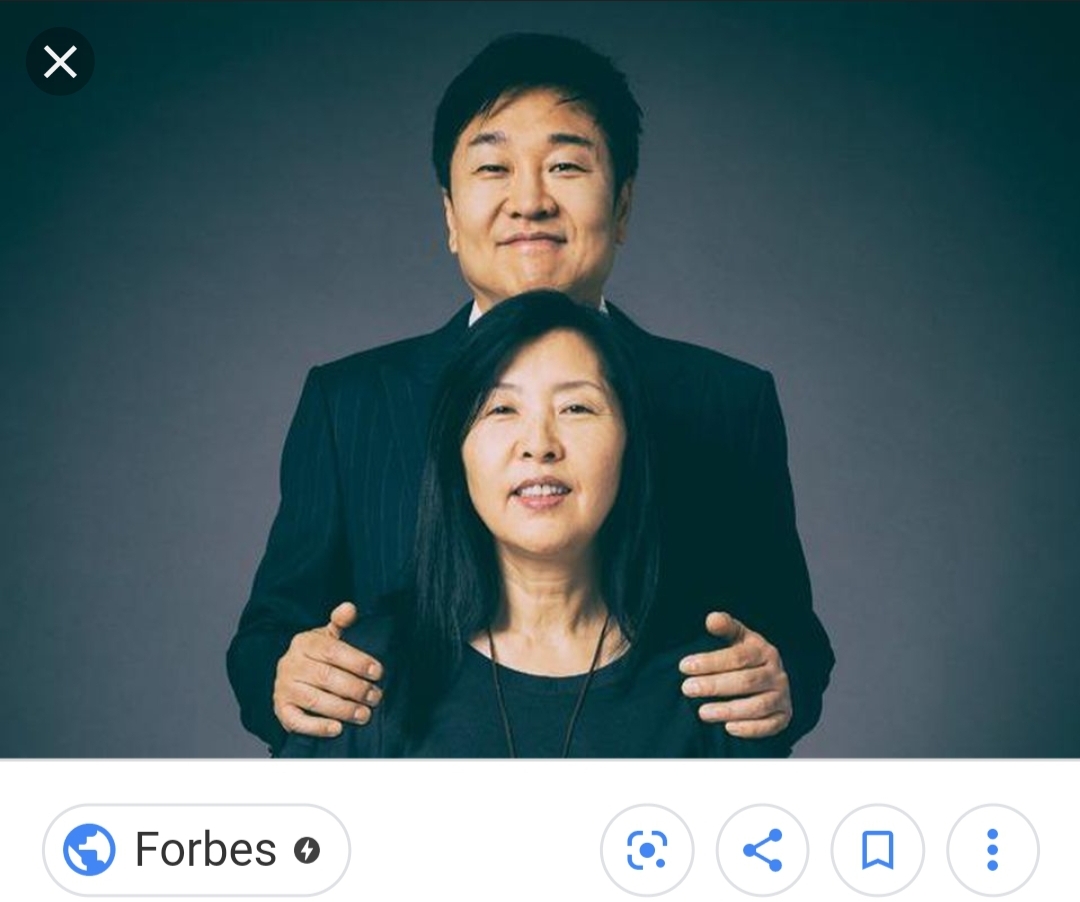

(My fiancé doesn't like having his photo posted anywhere online, so you get to enjoy various photos from my trip around the world with his face covered, haha!) Here is a photo of my family-in-law that I traveled around the world with standing in the courtyard of Gyeongbokgung Palace in Seoul. Our tour guide suggested we post with our hands and fingers twisted in the Korean way they make a heart. Clearly us Americans were not very well versed in this particular pose!

For our tour of Seoul, we found ourselves on a big tour bus with probably twenty other people--and our group by itself was ten, so it was a pretty big group! Our tour guide was a very excited woman named Chloe, who was originally from a smaller village in South Korea but she told us she had moved to Seoul a few years before. Her English was pretty good, and so our tour of Seoul was much more insightful than the tour we would have the next day around Jeju, which you can read about by clicking here.

One of our stops in Seoul was visiting the Royal Palace, just in time to see the Changing of the Guard ceremony.
Today, South Korea has no royal family and so Gyeongbokgung Palace is a historical and tourism site, not a still-functioning home for heads of state. I noticed while we were watching the ceremony that the announcer (who repeated the same message in Korean, English, Japanese, and I believe a form of Chinese as well), noted that the "Guards" in the ceremony were actually actors, and not members of the military or actual trained guards. It makes sense that they are actors and not guards because there is no royal family to protect these days, but I thought it was an interesting thing to note all the same.

I was lucky because I was able to snag the last tourism pamphlet in English that they had available that day! Inside I found these absolutely adorable drawings of the different types of guards, along with their functions. Please don't ask me to try to pronounce any of them!
The ceremony itself was really interesting to witness, but I have to admit, the effect was sort-of ruined by the fact that the palace is now smack in the middle of the hustle and bustle of modern Seoul, so there are skyscrapers all around that can be seen outside the palace walls, as well as electronic billboards and other signs of modern life.
Besides the changing of the guard ceremony, visitors can also walk around the other buildings on the site, most of which are modern recreations of what was once on the site (at least according to our guide). There are not many signs in English, or other non-Asian languages, so if you plan on visiting and don't speak or read Korean, I highly recommend having someone there who can interpret for you.
This is information about the palace I found after doing some online research:
Originally built in 1395 to house the Joseon Dynasty, the palace was destroyed in a Japanese invasion in 1592. The palace was left in ruins for 270 years, only being rebuilt in 1867. During the renovation and rebuilding, several new buildings were added around the complex. In 1895, the royal Empress Myeongseong was assassinated on the palace grounds. After the assassination, the royal family ceased to use the palace grounds as a place to live (presumably for safety reasons), but there are four other palaces in Korea the family was able to use throughout history.
Gyeongbokgung Palace is remembered today as being the place where the emperor created the Korean written alphabet and began distributing it to the people.
In 1910, a peace treaty between Korea and Japan was settled--giving Japan quite a bit more power over Korea than the Korean people would like. As a consequence, the royal palace began to be destroyed to make room for the new government buildings.
Beginning in the 1990s, the South Korean government began to once again restore the palace, allowing visitors to tour the grounds and see the guard changing ceremony like I was able to do.

Another place we visited while in Seoul was the Jogyesa Temple. Jogyesa is a Buddhist Temple that has existed in Korea for many decades. According to the pamphlet I snagged while there, the temple was originally built in 1910 and then moved to its current location in 1937--although the temple did not receive its current name until 1954. The temple's previous names were influenced by the Japanese language and culture, and so the Korean people changed the name to Jogyesa as a way of removing as much evidence of the Japanese occupation as possible.

When we visited the temple in June of 2025, the temple was decorated with all different colored paper lanterns. According to our guide, the different colored lanterns had been purchased by Buddhist people living in the area, who had done so as a way of celebrating the Buddha's birthday, at the end of May. Here I am standing next to a statue of the Buddha as a child which was on the temple grounds.
I did some more research online to be able to tell you more, and this is what I discovered.
The originally temple actually dates as far back as the late 14th century, but the temple was destroyed in a fire. The version of the temple that stands today was rebuilt in 1910 and then moved in 1937, as the pamphlet I got while there explained.
Jogyesa Temple is one of the main sites of Korean Buddhism. Today, it is the head temple for the Jogye order of Buddhist monks--Jogye Buddhism is also the largest denomination of Korean Buddhism. On the temple grounds are two trees that are around five hundred years old, and a ten-story Pagoda that was constructed in 2009. There is even a museum and various conference halls on the grounds as well. The Jogyesa Temple is a strangely spiritual example of how something so important can span the centuries of time as well as represent a religion so deeply ingrained in the people's mindset.

Our last stop of the day on our tour of Seoul was a place called Namsangol Hanok Village. According to the pamphlet I grabbed while there, Hanok Village was traditionally a summer vacation area for people living in Korea during the Joseon Dynasty. As the city of Seoul grew up, Hanok was swallowed by the surrounding city. In 1998, however, officials from the Seoul government chose five houses from Hanok to move and rebuild in a new area, creating Namsangol Hanok Village as an area for tourists and native Koreans alike to learn about their history.
Besides being able to tour the houses, we also learned that people can have traditional Korean weddings on the grounds at Hanok. Our guide told us this was an option that people could do, and sure enough when we rounded a corner we saw a couple in traditional attire in the midst of their big day. (I felt bad that we walked in on them but hopefully they knew ahead of time that the park would not be closed to the public during their wedding!).

(Photo Courtesy of Brides.com--no I did not take photos of the couple during their wedding!)

Walking around the village was interesting to get to see the traditional Korean way of life, but I will add that there were no signs explaining what any of the houses were in English, and our tour guide essentially dropped us off and said, "wander around and meet back at the bus in 20 minutes!" so our group had a hard time figuring out what the different houses represented or who had once lived there. Looking through the pamphlet I picked up, it says the houses are as follows:
House 1 belonged to a carpenter, House 2 belonged to a general, House 3 was the Min Family Home, House 4 belonged to the father of an empress, and House 5 belonged to the empress's uncle. While that information is really cool--none of the houses were labeled either that I can recall so I have no way of telling you which was which.
I did some more research online in order to fill in the gaps a bit more. Apparently in 1994, before the village was even re-built, a time capsule was buried on what are now the village grounds. The capsule is supposed to be buried for four hundred years and should be opened in 2394! The reason for this is because it was buried for the 600th anniversary of Seoul being (South) Korea's capital, and will be opened on the 1000th anniversary!
The five houses chosen to stand in the village today all once belonged to high ranking officials or aristocrats, and all were originally built in different neighborhoods. Four of the five houses were rebuilt by completely recycling the original materials, but one of the houses was too old and decayed so newer materials had to be used (although the website doesn't say which house is newer!).
Apparently there is a lot more to do in Namsangol Hanok other than just walk around, but because it was the last stop on our tour and we didn't have much time, we didn't get to experience anything else. According to the website Visit Korea:
Some of the unique programs and activities to participate in include wearing hanbok, folding hanji (traditional Korean paper), writing in Korean, traditional tea ceremony, traditional etiquette school, and herbal medicine experience. There are also taekwondo demonstrations and other various performances held around the village. Visitors can also try traditional games such as yunnori (traditional board game), or understand more about the area through a guided tour.
The original Hanok Village was known as Cheonghak-dong, or "The Place Where the Gods Live" because of how beautiful the surrounding scenery was. In an effort to try to recreate this beauty, there is a garden with traditional plants in it in the new village today.

We also visited a traditional Ginseng museum and store, as well as a museum about traditional Korean culture, but we had so little time at either I didn't get any photos (nor do I remember the name of the museum!). Here are some other photos we took while traveling around Seoul though.
(Above is a photo of our tour bus advertising that it takes people to the DMZ--luckily our tour didn't go there!)


I've never been to Mexico, but my brother has told me some "horror" stories about the way wiring and other infrastructure is done in Ensenada and Tijuana. As an American, I was just as stunned to see some of the things that are normal and part of every day life in other parts of the world--like the piles of different wires all tied together in knots up above your head or the fact that the massive bolts that are supposed to be holding up light poles were just hammered off to the side of the grounding plate in Seoul.

Another thing I noticed while we drove around Seoul was that there are certain companies that either do not exist at all, or are in much smaller quantities in the US, all over South Korea and other parts of the world. In Seoul, we saw a Kinko's (pictured above) and a Kodak Express. In Australia, South Korea, and Japan, 7/11 stores are EVERYWHERE. And they're really nice too!
So, what did I learn in Seoul? Well, I learned that trying to visit a foreign country with a language barrier is really tough, but we still had fun and got to see some interesting stuff. I hope you enjoyed this virtual tour of Seoul made by an American who will quickly admit I do not know nearly enough about Korean history!
Sources:
Royal Palace Information:
https://royal.cha.go.kr/ENG/contents/E101010000.do
https://english.visitkorea.or.kr/svc/contents/contentsView.do?vcontsId=87740
Jogyesa Temple Information:
https://english.visitkorea.or.kr/svc/whereToGo/locIntrdn/rgnContentsView.do?vcontsId=111552
Namsangol Hanok Village Information:
https://english.visitkorea.or.kr/svc/whereToGo/locIntrdn/rgnContentsView.do?vcontsId=112249