18: Balto
Helped Deliver Medicine to Sick Children
Born: 1919, Nome, Territory of Alaska, United States of America (Present-day Nome, Alaska, United States of America)
Died: 14 March 1933, Cleveland, Ohio, United States of America
Balto was a Siberian Husky whose story has been immortalized for helping deliver medicine to children dying of Diphtheria in February 1925.
(Another, lesser-known dog, who actually covered more ground that frozen winter was Togo, who can be read about by clicking their name!).
In 1924 and 1925, Nome was a much smaller and remote town in Alaska than it is today. The population in 1924 just over 1,400 people, while in 2025 that number had climbed to around 3,600. Still a small town sure, but not quite as small or difficult to reach.
That chilly winter back in 1924/25, Nome only had one doctor, and he worked at the local hospital—which was also very small. In November, he began to receive patients suffering from what he assumed was tonsilitis—but the patients started dying, and he quickly realized the problem was much more serious.
By January, the doctor had officially confirmed the mystery illness to be diphtheria. While the hospital did keep the medicine used to treat diphtheria on hand, their supply had already expired. The new shipment did not arrive before Nome’s port shut down for the winter. Even after a quarantine was put into effect, more people were confirmed to have the disease, which could quickly turn fatal if left untreated.
Because of the treacherous winter weather, getting the medicine to Nome’s remote location was easier said than done. Various methods were ruled out, including deliver by airplane (flying had only been possible for just over twenty years at that point!). The territorial governor finally decided to ship the medicine by train as far as they could, but the nearest train depot was still over 600 miles away. The final stretch of the journey would have to be completed by dog sled.
Over 150 dogs and twenty human mushers (or drivers) were chosen for the mission, which was dubbed “The Great Race of Mercy.”
Balto was one of the dogs chosen for the mission. Balto’s musher was a man named Gunnar Kaasen, an assistant to the better-known Leonhard Seppala, who actually owned both Balto and Togo.
Although Balto was dubbed a “Siberian Husky” during his lifetime, in 2023, genetic testing on his remains revealed that Balto was not a purebred husky. He also had links to Tibetan Mastiffs, as well as dogs from Vietnam and Greenland. These various genetic traits allowed Balto, and Togo, to survive the harsh climate even better than purebred huskies.
When dogs were first being chosen to participate in the journey, Seppala did not want Balto as a lead. Seppala viewed Balto as being much better suited to hauling heavier freight thanks to his stocky build. Seppala personally chose Togo, who was twice Balto’s age (twelve instead of Balto’s six) to lead his team. Once Kaasen was allowed to choose his own team, however, he chose Balto. Balto had no previous experience as a racing sled dog, but Kaasen saw something in the dog that Seppala did not.
On 27 January 1925, the diphtheria medicine arrived by freight train in Nenana. The medicine had been specially packaged to protect it from the freezing weather, and good thing to. With windchill factored in, the dogs and their mushers were operating in weather that is believed to have gotten as low as −85 ℉ (−65 °C). Each team would cover approximately thirty miles before handing off to the next team. The only team that ran further, much further, was Seppala’s team (led by Togo) which covered ninety-one miles of the most treacherous stretch of terrain.
Gunnar Kaasen’s team, led by Balto, was supposed to be second to last. When Kaasen arrived at the drop off spot, however, he found the next musher asleep. Knowing there was no time to waste, Kaasen and his team continued on. Balto entered the halls of history when his team successfully delivered the medicine to Nome, saving upwards of hundreds of lives.
The fifty-three mile stretch that Balto and his team covered were particularly hazardous. At one point, Kaasen reported that wind swept the entire sled up and over, burying the medicine in the snow. Kaasen had to dig for the medicine with his bare hands, luckily finding it so the journey could continue.
At another point, Balto suddenly stopped and refused to continue on. When Kaasen investigated, he discovered that one of Balto’s paws had punched through the ice. He had stopped to protect the rest of the team from following suit!
Balto’s team arrived in Nome at approximately 5:30 AM on the morning of 2 February 1925. According to Smithsonian Magazine (article linked below), historians today don’t even know for sure if Balto was the lead dog that pulled the medicine the final stretch into Nome. It could have been Balto, or one of the other dogs on the team. What is known, is that when the team was staged to take a photo later on, Balto was placed in the lead position for the photo, and he has been given the credit ever since.
The race from Nenana to Nome took around 127.5 hours, or five days. Normally the same journey would take a single sled team a month!
In December 1925, Balta was forever memorialized with a statue in Central Park, New York City. For two years following the momentous delivery, Kaasen and his entire team of dogs toured the lower forty-eight states, showcasing the heroes.
Leonhard Seppala was less than enthused with Balto’s sudden fame, because he didn’t think it fair that the other dogs were forgotten. Luckily, another team, this one led by Togo, was also given a national tour.
Balto and six of his teammates were later sold to a promoter, and put on display in a museum in Los Angeles (yes, while they were still alive!). Luckily, a businessman visiting from Cleveland, Ohio, stumbled upon the exhibit and was appalled by the neglect the dogs were facing. He purchased all seven dogs for $2,000 (or $36,000 in 2024!). Kimble put the news out across the country that he needed help to raise the money to save the dogs, and within ten days he had raised $2,300.
On 19 March 1927, the seven dogs arrived by train in Cleveland. After a parade through the town in their honor, Balto and his fellow teammates were transferred to the Brookside Zoo, where they resided for the rest of their lives.
Balto lived to be fourteen years old.
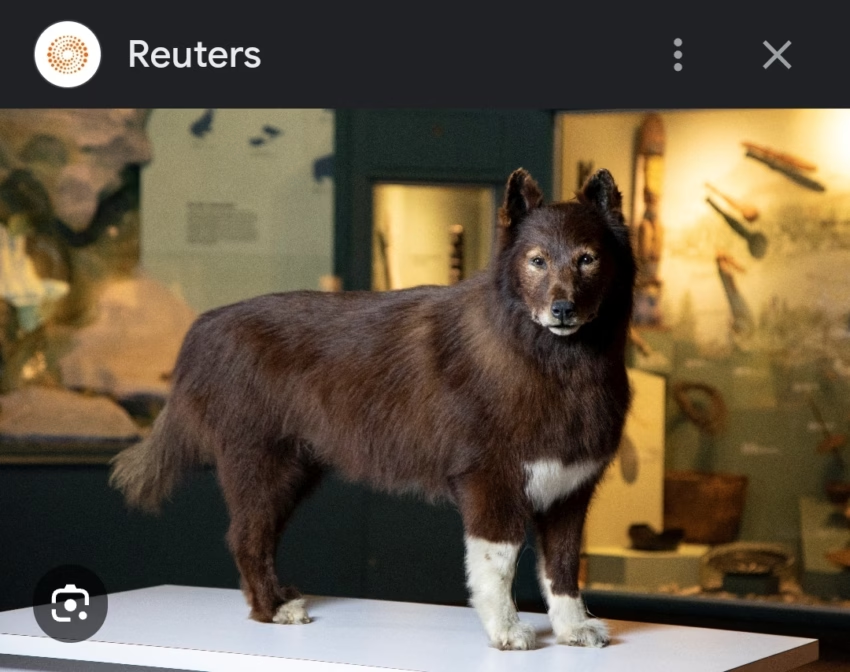
After Balto’s death, his body was preserved and was put on display at the Cleveland Museum of Natural History, where it remains to this day.
In 1995, Balto’s story was cemented in the minds of children around the world after Steven Spielberg’s production company created a (highly fictionalized) version of his story. The movie was an instant hit, and had two direct-to-video sequels. (The smash hit film was actually the second made about Balto, but the first, a silent film released only months after the 1925 sled run, was silent and forgotten about soon after its release).
Today, Balto’s heroism is remembered annually in Alaska by the Iditarod Trail Sled Dog Race. This race follows the path of the original Great Trail of Mercy, but further safety measures are in place. The race must be completed by the same dogs running the entire race, and so they are given much more time to complete the journey. Unfortunately the race can still be hazardous, and according to an article written by PETA, over 150 dogs have either been injured or killed during the races.
I tried to locate a list of names of all the dogs who ran the trek to save the Diphtheria patients, but sadly there doesn't seem to be one anywhere, online at least. I did manage to compile what I could find, and have included that information below. Like Leonhard Seppala, I believe all of the dogs should be remembered, not just Balto.
List of All Mushers and The Information I Found on Their Dogs:
Musher Wild Bill Shannon led a team of nine huskies. Cub, Jack and Jet, all died of lung injuries following their journey. Five other huskies on this team were not named. The team was led by Blackie.
Dan Green was the next musher, no dogs named but he had eight on his team.
Johnny Folger next musher, no dogs named but he had an eight dog team.
Sam Joseph was next and had a team of seven Alaskan Malamutes, none of which were named.
Titus Nikolai was next and there was no information on his dogs other than there were seven on his team.
Dave Corning was next, no info on his dogs though.
Edgar Kalland was next and again, no info on dogs.
Harry Pitka had a team of seven dogs.
Bill McCarty's team was led by Prince, and had seven total dogs on his team.
Edgar Nollner, had seven malamutes led by an eight-year old dog named Dixie.
George Nollner, used same team as Edgar (his brother).
Charlie Evans, had a team of nine dogs, two of whom suffered injury during the run.
Tommy “Patsy” Patson ran next, but there is no information on the dogs.
Jack “Jackscrew” Madros, no info on dogs but he jogged alongside the team for part of the journey to lighten the load.
Victor Anagick had eleven dogs on his team.
Myles Gonangnan had a team of eight malamutes.
Henry Ivanoff was next but there was no info on his dogs.
Leonhard Seppala, had twenty huskies that he ran, dropping some off along the way to be ready to head back on the trek later once the medicine had been handed off to the next musher. Seppala's lead dogs were Togo, Scotty, and Fritz, but I haven't been able to find the names of his other dogs.
Charlie Olson was next. He had two dogs that suffered injury, his lead dog was named Jack, and he had seven total Malamutes on his team.
Gunnar Kaasen was the final musher. His lead dogs were Balto and Fox, while other dogs on the team were named Alaska Slim, Billie, Tillie, Tye, and Old Moctoc. One source says there were actually thirteen dogs on this team, but only seven were eventually purchased and moved to Ohio.
Badges Earned:
Find a Grave Marked
Located In My Personal Library:
American Spirit Magazine Article “Dogged Determination” by Jeff Walter (May/June 2024 Edition)
Sources:
https://www.britannica.com/animal/Balto-dog
https://www.akc.org/expert-advice/lifestyle/balto
https://en.wikipedia.org/wiki/1925_serum_run_to_Nome#Sled_dog_credit
https://www.alaskamushingschool.com/learn/1925-serum-run-to-nome
https://mushing.com/uncategorized/who-were-the-participants-in-the-1925-serum-run
https://www.findagrave.com/memorial/9169/balto_the_wonder_dog